
What Every PV Professional Should Know: How Do IEC 61215 and IEC 61730 Differ?
The short answer
IEC 61215 is about "will it last?"; IEC 61730 is about "is it safe?". The two complement each other, and neither can replace the other.
Anyone working in PV hears IEC 61215 and IEC 61730 almost every day: samples have to be tested to them, tenders ask for them, and material changes trigger retests against them. For newcomers, though, the two numbers are often just "two certificates", and it is not always clear what each covers or how they differ.
This article sets out to make that clear.
01Different positioning and purpose
1. IEC 61215: design qualification and type approval (performance reliability)
The full title of IEC 61215 is Terrestrial photovoltaic (PV) modules – Design qualification and type approval. Through a series of accelerated stress tests, it verifies a module's durability, resistance to degradation and structural reliability.
The core question it answers: can this module design withstand typical outdoor environmental stresses without significant power loss? It is a performance-reliability certification.
2. IEC 61730: safety qualification
The full title of IEC 61730 is Photovoltaic (PV) module safety qualification. It ensures that a module does not create risks of electric shock, fire or mechanical injury during design, installation and use.
The core question it answers: is this module safe over its whole life, or could it endanger people or property? It is a safety certification.
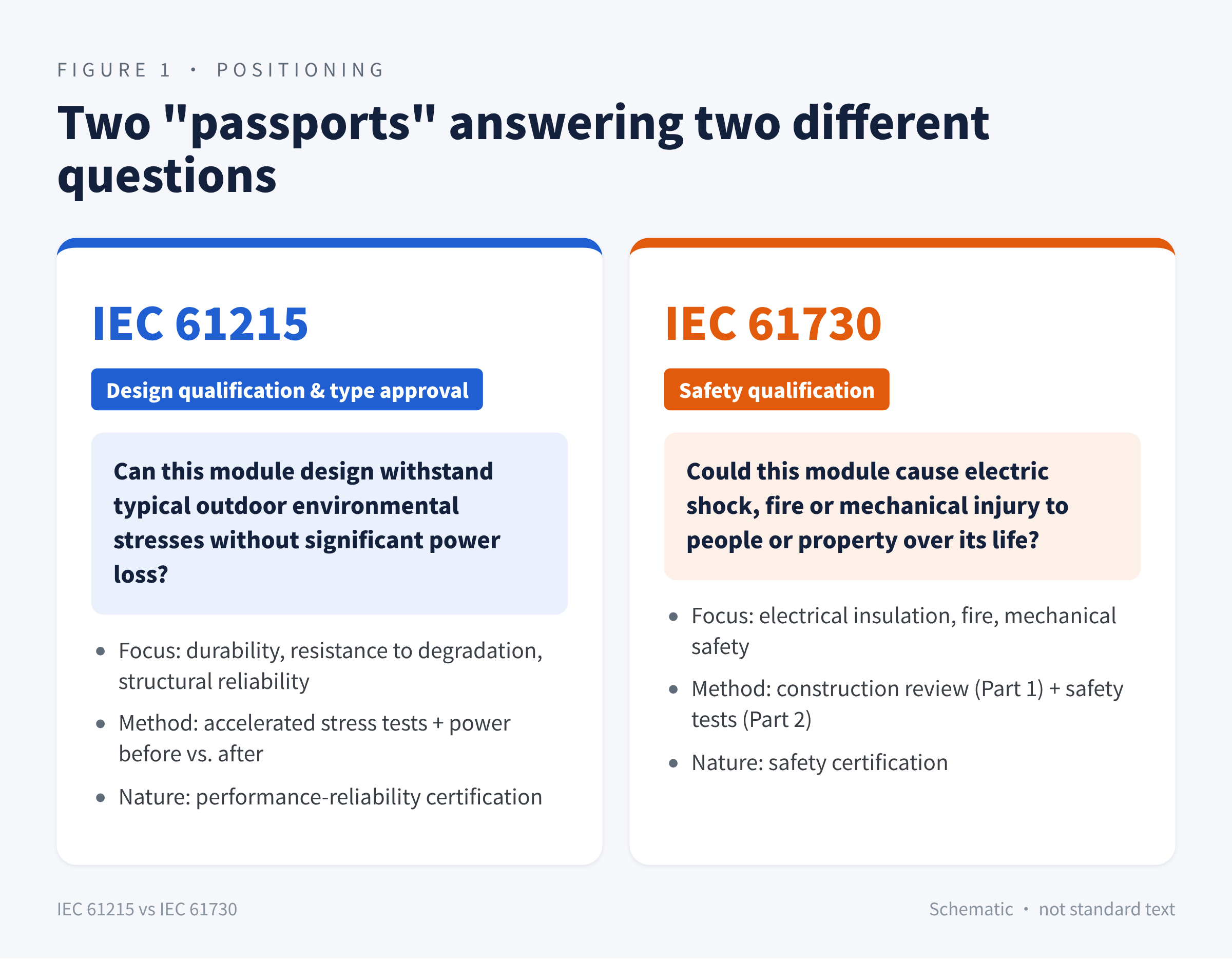
Figure 1 Positioning of the two standards
02Different test content and focus
1. IEC 61215: all about performance and reliability
Purpose: after exposure to various environmental stresses, the module must remain structurally intact, pass insulation tests and keep power loss within the allowed limit. Tests in the standard are numbered MQT (Module Quality Test) and fall roughly into three groups.
(1) Environmental durability tests
| Test | Number | Typical conditions |
|---|---|---|
| Thermal cycling (TC) | MQT 11 | −40 °C ↔ +85 °C, 50 or 200 cycles |
| Humidity freeze (HF) | MQT 12 | 85 °C/85 %RH ↔ −40 °C, 10 cycles |
| Damp heat (DH) | MQT 13 | 85 °C/85 %RH, 1000 h |
| UV preconditioning | MQT 10 | 15 kWh/m² cumulative |
| Potential-induced degradation (PID) | MQT 21 | 85 °C/85 %RH, system voltage applied, 96 h |
| Outdoor exposure | MQT 08 | 60 kWh/m² cumulative |
The PID test (MQT 21) was only formally added in IEC 61215:2021; before that, PID had to be tested separately to IEC TS 62804-1.
(2) Mechanical reliability tests
- Static mechanical load (MQT 16): simulates wind and snow pressure. Test load = design load × safety factor (≥ 1.5), at least 2400 Pa, held for 1 h on the front and back, 3 cycles;
- Dynamic mechanical load (MQT 20): ±1000 Pa, 1000 cycles;
- Hail (MQT 17): ice balls of at least 25 mm diameter fired at 23 m/s at 11 locations;
- Robustness of terminations (MQT 14): checks junction-box adhesion and cable anchorage.
(3) Electrical performance and electrical tests
- Power measurement (MQT 02 / 06): maximum power and STC performance, compared before and after testing to determine degradation;
- Insulation and wet leakage (MQT 03 / 15): dry insulation withstand and wet leakage current;
- Hot-spot endurance (MQT 09): local overheating under shading;
- Bypass diode (MQT 18): diode thermal performance and function.
Power loss of no more than 5 % at the end of each test sequence; no major visual defects as defined in the standard; insulation and wet leakage current tests passed.
Two notes:
- Not exhaustive: the above are representative tests only;
- Salt mist and ammonia have their own standards: salt mist (IEC 61701) and ammonia corrosion (IEC 62716) are not part of IEC 61215 but separate standards, usually added depending on the project environment or customer requirements.
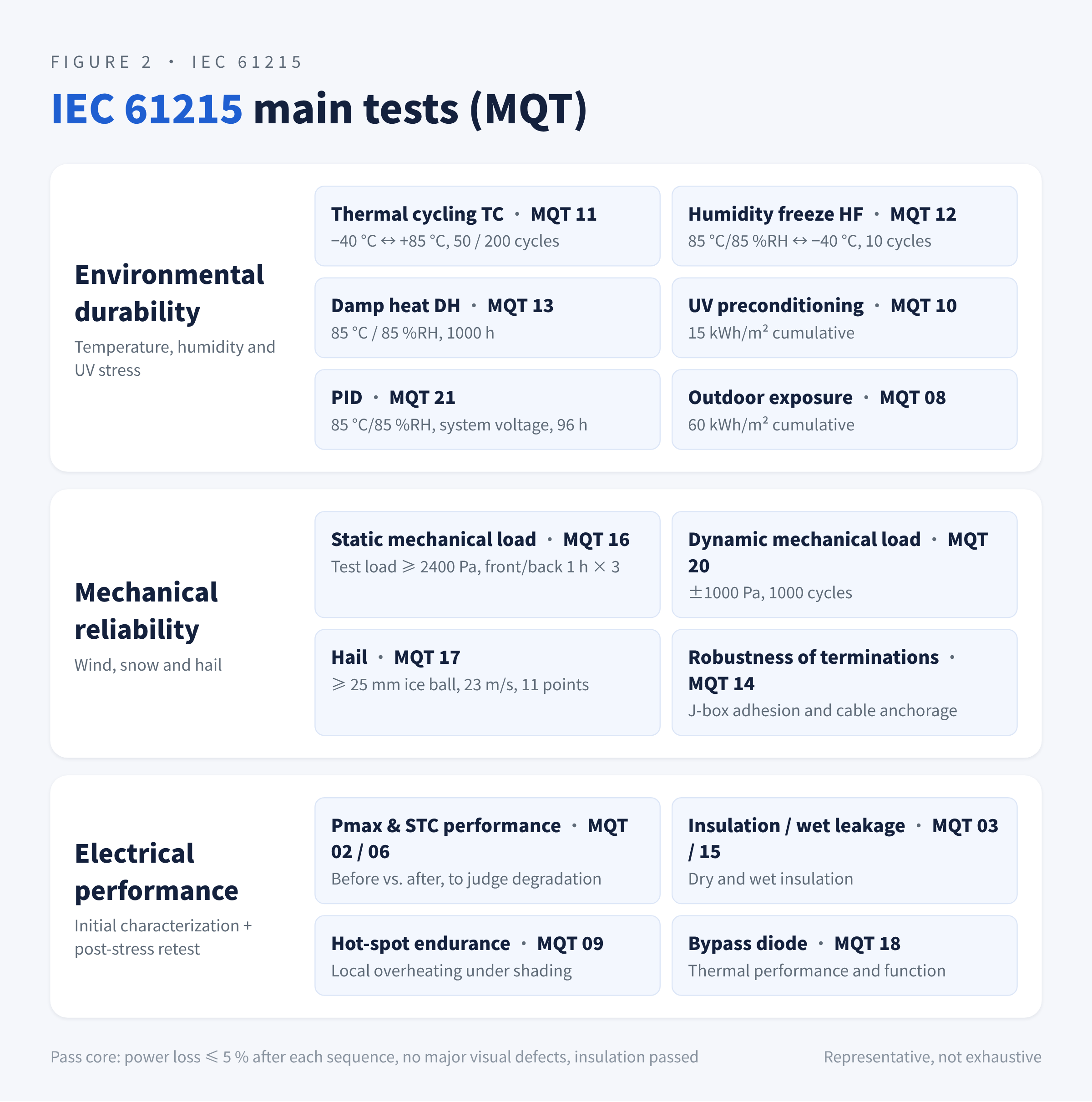
Figure 2 Main IEC 61215 tests
2. IEC 61730: all about safety
Purpose: prevent electric shock, fire and personal injury from module breakage.
IEC 61730 has two parts: Part 1, construction requirements (IEC 61730-1), and Part 2, testing requirements (IEC 61730-2). The first reviews design and material choices; the second verifies them by test.
Part 1: construction requirements require modules to be safe by design and material choice, for example:
- Protection class against electric shock: Class 0 / II / III (replacing the old application classes A / B / C since the 2016 edition);
- Insulation coordination: creepage distances, clearances and insulation thickness;
- Polymeric materials: insulation capability and relative thermal index (RTI / TI) of the backsheet and other polymers;
- Component compliance: junction box, connectors and cables meet their own component standards;
- Structural parts: strength and construction of glass and frame;
- Marking and instructions: nameplate marking and installation manual.
Part 2: testing requirements. Tests are numbered MST (Module Safety Test) and fall into five categories:
- General inspection: visual inspection, durability of markings, sharp edge test, etc.;
- Electric shock hazard tests: accessibility, insulation (withstand), impulse voltage, wet leakage current, continuity of equipotential bonding;
- Fire hazard tests: fire test, ignitability test, temperature test, hot spot, reverse current overload;
- Mechanical stress tests: module breakage, static mechanical load, screw connections, peel and lap shear, material creep;
- Environmental stress tests: thermal cycling, humidity freeze, damp heat, UV, etc., mainly as preconditioning before the safety tests.
A note on fire ratings: the IEC 61730 fire test does not define a single global rating scheme; it follows the building codes of the target market. The Class A / B / C ratings often mentioned for North America, for example, come from the UL fire test system in the United States.
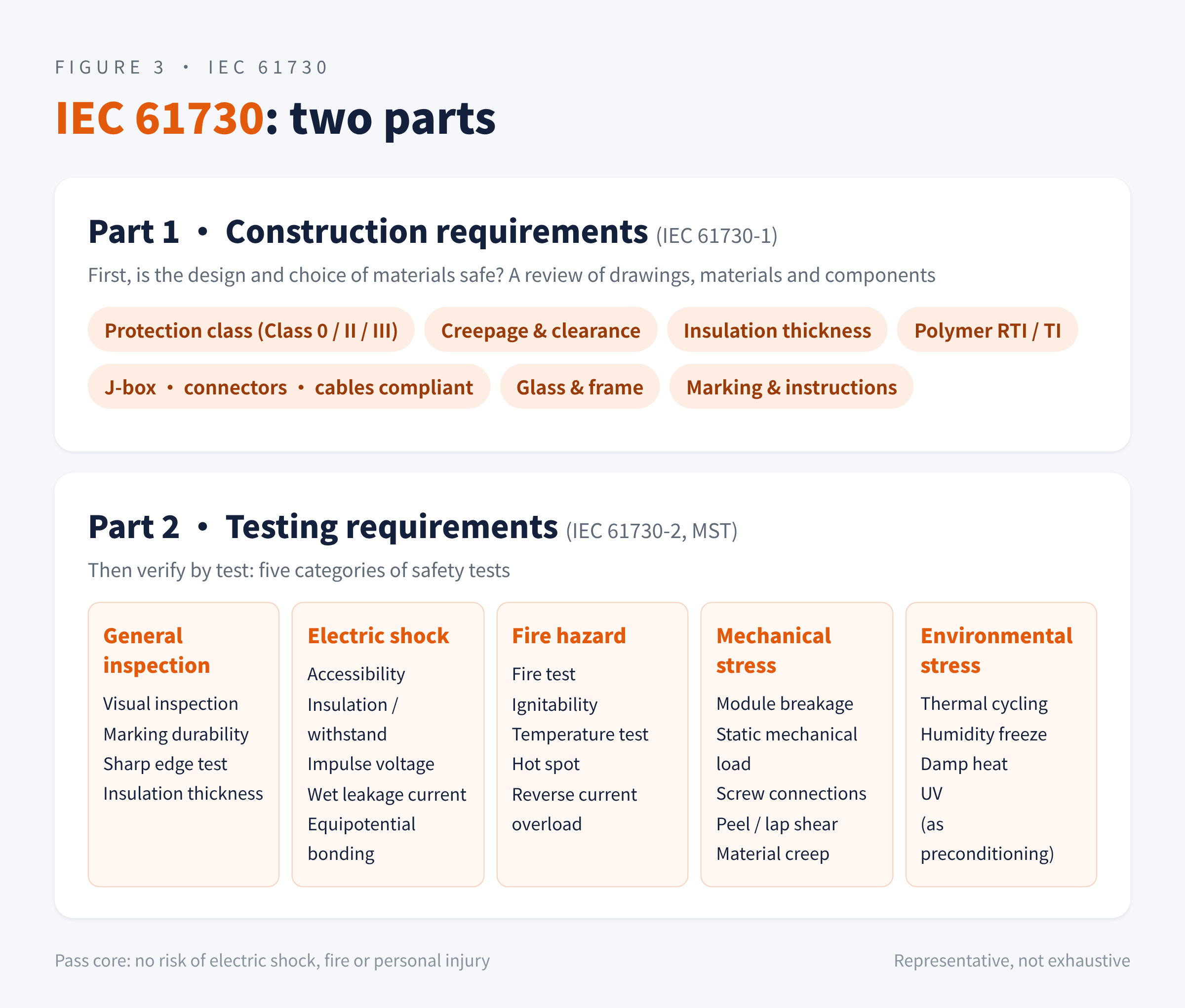
Figure 3 The two parts of IEC 61730
03How IEC 61215 and IEC 61730 relate
| Item | IEC 61215 | IEC 61730 |
|---|---|---|
| Positioning | Performance reliability (design qualification & type approval) | Safety qualification |
| Focus | Environmental endurance, power loss, structural reliability | Electric shock, fire, mechanical injury |
| Test numbering | MQT | MST |
| Core criterion | Power loss after testing ≤ 5 % | No safety hazard |
| Market requirement | Commonly required for tenders, financing and insurance | Commonly required by national safety regulations |
| Can replace the other? | No | No |
| Combination | Paired with IEC 61730 | Paired with IEC 61215 |
Careful readers will notice many tests with the same name in both standards: thermal cycling, humidity freeze, damp heat, hot spot, mechanical load, wet leakage current… Many of the test methods in IEC 61730-2 are taken directly from IEC 61215-2.
The difference is what each one looks at: after the same 200 thermal cycles, 61215 asks how much power was lost, while 61730 asks whether the insulation is still intact and whether any safety hazard has appeared.
For this reason, the two standards are usually tested together on shared samples, giving both certificates in one go. To enter mainstream global markets, a module generally needs both certificates.
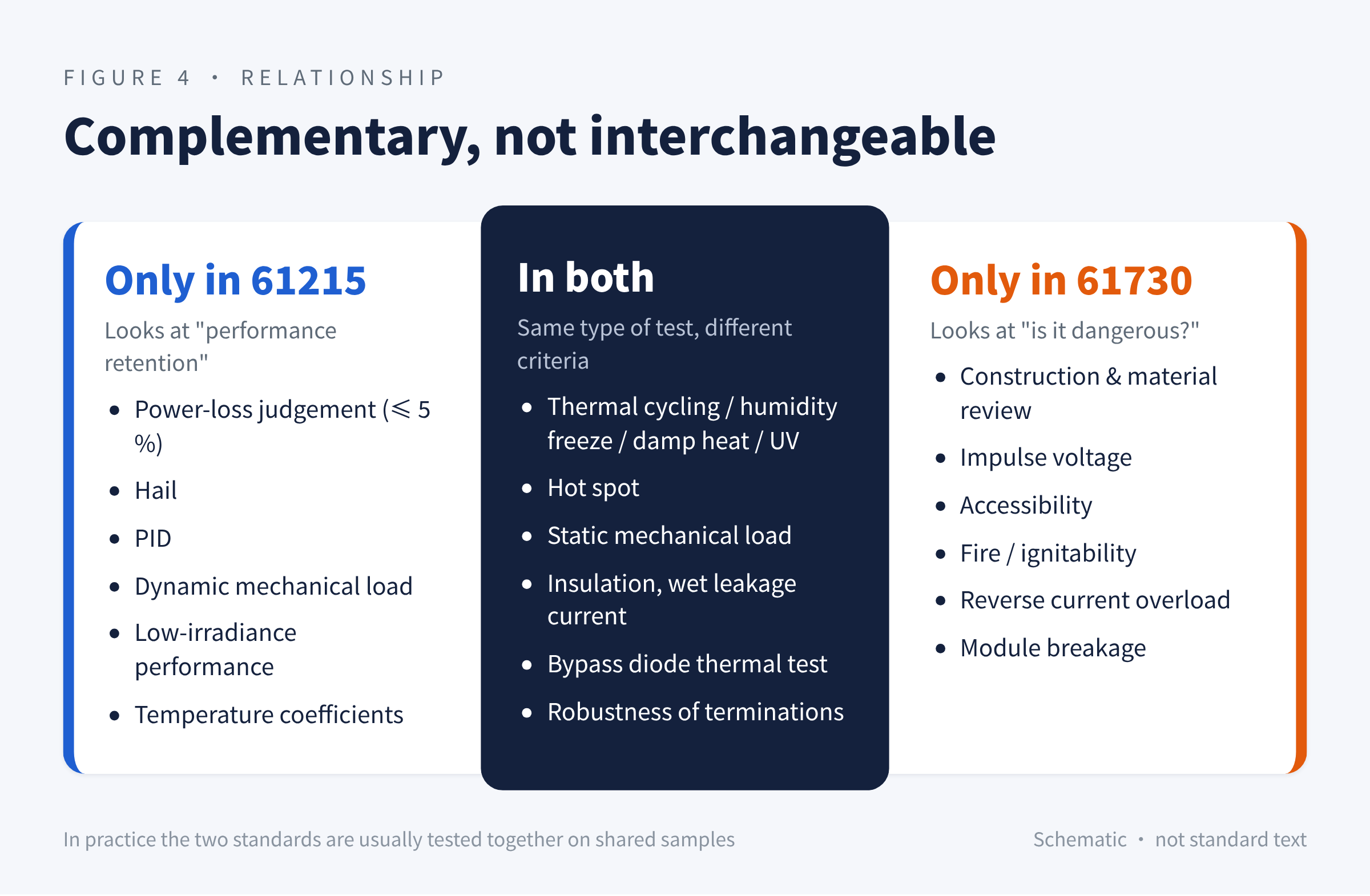
Figure 4 Relationship between the two standards
04Scope
Both standards apply to terrestrial crystalline-silicon and thin-film modules, but not to concentrator PV modules. IEC 61215 is further divided by technology:
- IEC 61215-1: general test requirements;
- IEC 61215-1-1: special requirements for crystalline silicon modules;
- IEC 61215-1-2 / 1-3 / 1-4: special requirements for CdTe, amorphous silicon and CIGS thin-film modules;
- IEC 61215-2: test procedures.
Modules using newer cells such as TOPCon, HJT and BC are still crystalline silicon modules and follow IEC 61215-1-1.
As of October 2026, the commonly used current editions are the IEC 61215:2021 series and the IEC 61730:2023 series. For actual certification, use the edition confirmed by your certification body.
05Three common misconceptions
- Misconception 1: passing IEC 61215 = a 25-year module. IEC 61215 is a design qualification. Its purpose is to screen out early design and material failures in a relatively short time; it is not a lifetime-prediction test. Certification does not guarantee a 25-year life. That is why the industry runs extended tests such as TC600 and DH2000 beyond the standard, or refers to the extended-stress testing in IEC TS 63209-1.
- Misconception 2: once certified, materials can be changed freely. A certificate covers the construction and bill of materials (BOM) submitted for testing. Changing key materials such as the backsheet, encapsulant, cells or junction box requires evaluation and the corresponding retests according to IEC TS 62915:2023.
- Misconception 3: one of the two standards is enough. One looks at performance, the other at safety. Their criteria are entirely different, and neither can replace the other.
06Final thoughts
IEC 61215 = performance-reliability certification: focuses on environmental endurance, uses accelerated stress tests to assess power loss, and does not rate the safety of materials and construction themselves.
IEC 61730 = safety certification: focuses on "is it dangerous?", covers electrical insulation, fire and mechanical safety, and both reviews materials and construction and verifies them by test.
To sum it up in one sentence:
IEC 61215 makes modules built to last; IEC 61730 makes them safe to use.
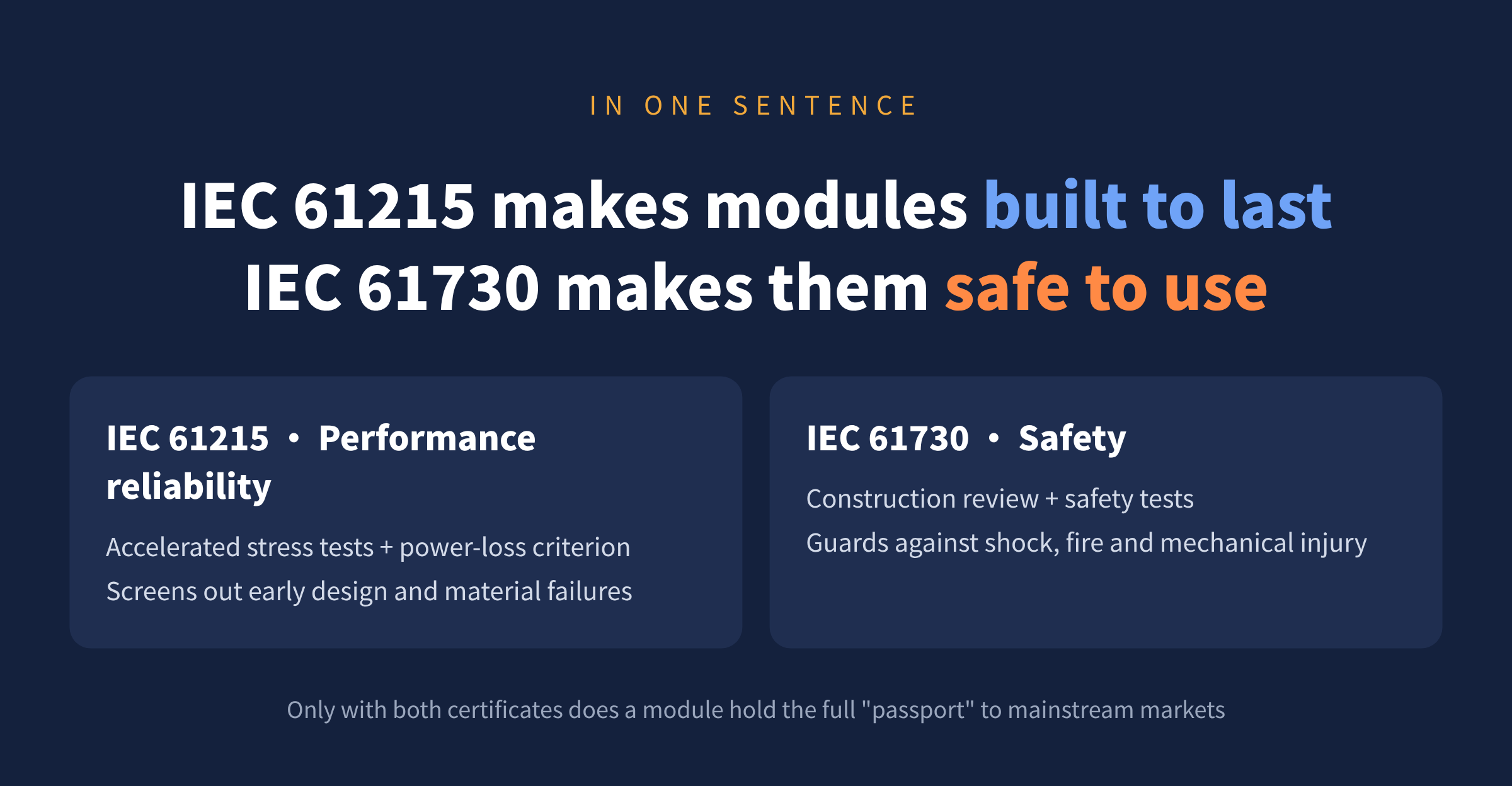
Figure 5 In one sentence
We will keep writing about module standards and certification. Follow along, and feel free to share your thoughts with us.
References
- IEC 61215-1:2021 / IEC 61215-1-1:2021 / IEC 61215-2:2021, Terrestrial photovoltaic (PV) modules – Design qualification and type approval
- IEC 61730-1:2023 / IEC 61730-2:2023, Photovoltaic (PV) module safety qualification
- IEC TS 62915:2023, Photovoltaic (PV) modules – Type approval, design and safety qualification – Retesting
- IEC TS 63209-1:2021, Photovoltaic modules – Extended-stress testing – Part 1: Modules
- IEC 61701 salt mist corrosion testing; IEC 62716 ammonia corrosion testing; IEC TS 62804-1 PID test methods
A PV R&D and technology team with 10+ years of experience | In-depth technical knowledge sharing
Materials · Reliability · Failure Analysis · Standards & Certification · Products · Processes
Exploring AI + PV; collaboration welcome
Disclaimer:
1. Original content reflects the authors' personal views only, is for reference only and does not constitute investment advice.
2. Reposted and cited content is credited to its source, out of respect for original work.
3. Some content was produced with AI assistance (chart generation, data retrieval, concept explanations, etc.); the core framework and key content were written by our technical team and reviewed by people.
4. If anything is inaccurate or infringes your rights, please leave a message or contact us and we will deal with it.