
Frame Materials: Why 6063 Aluminum Alloy?
PV Module Frame Series · 02
INFO
In the previous article we covered the five jobs a frame does in a module. This one answers a deceptively simple question: why are almost all module frames made of 6063 aluminum alloy? How does it differ from 6005 and 6061? What do suffixes like T5, T6 and T66 actually mean? And what cost and quality trade-offs hide behind wall thickness, aluminum prices and recycled aluminum?
01 Placing aluminum alloys in the family tree
Wrought aluminum alloys use four-digit designations, and the first digit names the series, i.e. the main alloying element:
- 1xxx: commercially pure aluminum, with good conductivity but low strength;
- 2xxx: Al-Cu, high strength but poor corrosion resistance, mainly used in aerospace;
- 3xxx: Al-Mn, common in beverage cans and heat sinks;
- 5xxx: Al-Mg, resistant to seawater corrosion, common in ships and sheet, not heat-treatable;
- 6xxx: Al-Mg-Si, the workhorse of architectural profiles and PV frames;
- 7xxx: Al-Zn, the strongest series, common in phone mid-frames and aircraft structures.
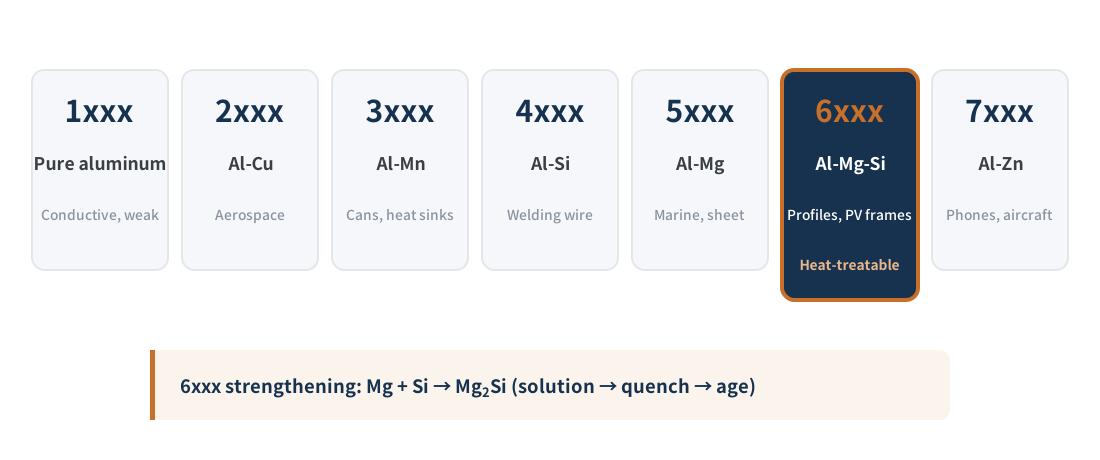
Figure 1 The aluminum alloy family and where the 6xxx series sits
The 6xxx series owes its strength to magnesium and silicon. Together they form Mg₂Si strengthening phases: solution treatment at high temperature, rapid cooling, then low-temperature aging precipitates a large number of fine, dispersed strengthening particles that multiply the strength. This ability to "tune" strength by heat treatment is called heat-treatable strengthening. The 6063, 6005 and 6061 alloys used in PV frames all belong to the 6xxx series.
02 Why 6063 in particular
6063 is not the strongest aluminum alloy, but it has almost no weak spot across the capabilities a frame needs:
- Easy to extrude: low alloy content (Mg 0.45%–0.9%, Si 0.20%–0.6%) means low flow stress at high temperature, so thin-walled, hollow, complex sections can be extruded at high speed. A frame is exactly that kind of section, and extrusion speed directly sets throughput and processing cost;
- Good-looking: its simple composition and uniform structure give a smooth anodized surface with little color variation, making consistent silver and black frames easy to produce;
- Strong enough: through T5, T6 and similar heat treatments, yield strength ranges from 110 MPa to around 200 MPa, which, with a sensible cross-section, meets the mechanical-load requirements of mainstream modules;
- Corrosion-resistant: copper is capped at 0.10%, giving good atmospheric corrosion resistance, which together with the anodized layer supports two to three decades outdoors;
- Mature supply chain: 6063 is the highest-volume alloy for building windows and curtain walls, so casting, extrusion and anodizing capacity and know-how are abundant and prices are transparent.
Key takeaway
6063 wins on overall value: fast to extrude, good-looking when anodized, strong enough, reliably corrosion-resistant and available everywhere.
03 6063, 6005 and 6061 side by side
All three belong to the 6xxx series. They differ mainly in their magnesium, silicon and copper content:
| Alloy | Mg (%) | Si (%) | Cu (%) | Extrudability | Role in frames |
|---|---|---|---|---|---|
| 6063 | 0.45–0.9 | 0.20–0.6 | ≤0.10 | Excellent | Dominant mainstream choice |
| 6005 | 0.40–0.6 | 0.6–0.9 | ≤0.10 | Good | High-load, large-format and thin-wall designs |
| 6061 | 0.8–1.2 | 0.40–0.8 | 0.15–0.40 | Fair | Rarely used |
Composition shows up directly in strength. Under the group standard T/SHLX 005—2024 "Aluminum alloy extruded profiles for solar cell frames", the minimum yield strengths of common alloy-temper combinations are as follows:
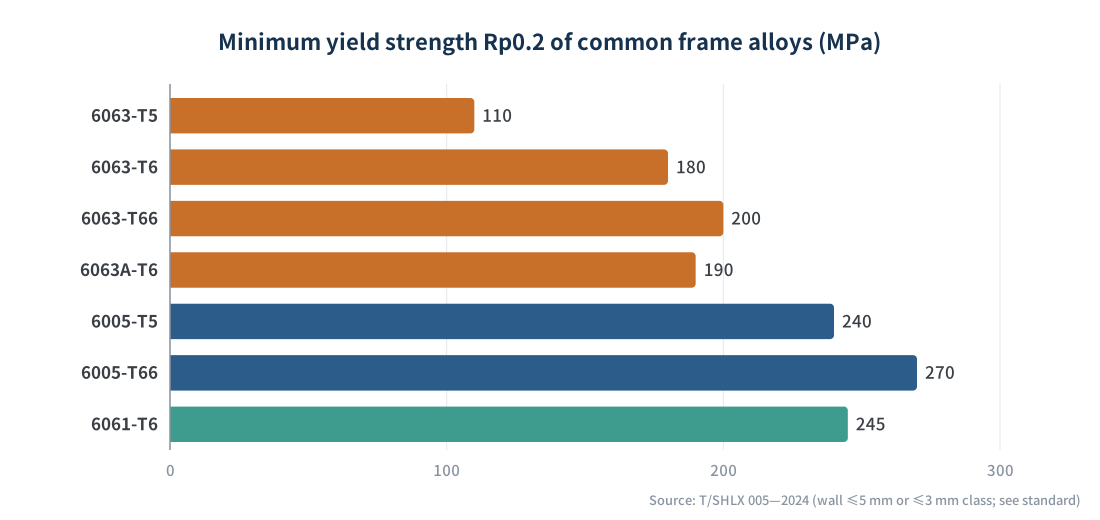
Figure 2 Minimum yield strength of common frame alloys and tempers
6005 contains much more silicon. Beyond forming Mg₂Si, the excess silicon also adds strength, so in the same T5 temper the minimum yield strength rises from 110 MPa for 6063 to 240 MPa. The price is slower extrusion, more die wear, higher quench sensitivity and higher processing cost. It suits large, high-load modules, or designs that trade higher strength for thinner walls.
6061 contains copper and is also strong, but its extrudability, corrosion resistance and anodized appearance all trail 6063, so it is seldom used for frames.
04 T5, T6 and T66: one alloy, different "cooking"
The T5 or T6 after an alloy designation denotes its heat-treatment temper. To understand them, start with the three steps of age hardening:
- Solution treatment: at high temperature, magnesium and silicon dissolve into the aluminum matrix;
- Quenching: rapid cooling "freezes" them in a supersaturated solid solution;
- Aging: holding at about 180–200 °C for several hours precipitates fine, dispersed strengthening phases that block dislocation motion and raise strength.
During extrusion, the billet already leaves the die above 500 °C, which effectively completes solution treatment along the way. The key difference between T5 and T6 is how the profile is cooled after the die:
- T5: air-cooled after the die, then artificially aged. Cooling is relatively mild and strength is moderate;
- T6: press-quenched with strong air, water mist or water after the die, then artificially aged. The faster the cooling, the more solute is retained and the higher the strength after aging;
- T66: a temper widely used for Chinese profiles. On top of T6, magnesium and silicon are held near the upper limits of the composition range and the process is more tightly controlled; think of it as an "enhanced T6".
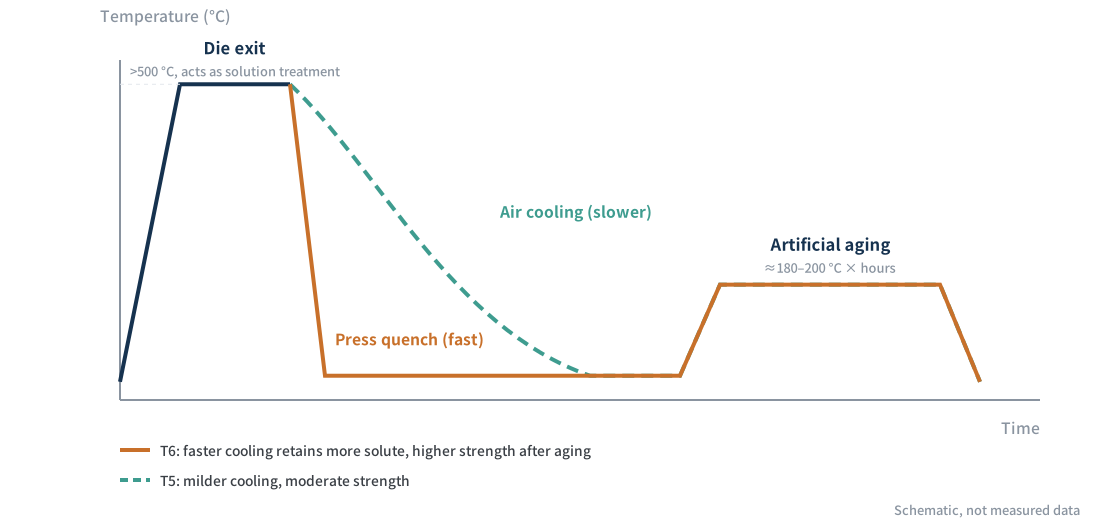
Figure 3 Process paths of T5 and T6 (temperature–time schematic)
For frames, this has three practical consequences:
- Higher strength is not always better: as hardness rises, ductility falls, corners crack more easily during corner-key riveting, and punching burrs and die wear increase. That is why specifications usually set minimums for strength and hardness together with elongation;
- Webster hardness is the most common quick incoming check: T/SHLX 005—2024 requires at least 10 HW for 6063-T5 and 14 HW for 6063-T66, and many module makers set even higher internal limits;
- Under-aging or over-aging both leave strength short of spec: inconsistent hardness at different positions within one batch is a very common incoming-inspection finding.
05 Wall thickness versus aluminum price
Aluminum dominates frame cost. By the Shanghai Metals Market (SMM) estimate, PV frames consume about 6,500 tonnes of aluminum per GW, or about 6.5 g/W. At an A00 ingot price of about RMB 23,500/tonne in mid-October 2026:
- the aluminum ingot alone costs about RMB 0.15/W;
- every RMB 1,000/tonne rise in aluminum adds about RMB 0.0065/W to frame cost;
- cutting overall wall thickness by 10% reduces aluminum use by about 10%, saving about RMB 0.015/W.
With module prices now negotiated in fractions of a cent, that is enough to make everyone chase thinner walls. But thinning walls hits an easily overlooked physical limit: strength is not stiffness.
All aluminum alloys have an elastic modulus of about 69 GPa. Switching from 6063-T5 to 6005-T66 raises how much stress the frame can take before it deforms permanently (yield strength), not how much it bends under load (stiffness). A module's deflection under load depends on the product of elastic modulus and the section's moment of inertia, and thinner walls reduce the moment of inertia.
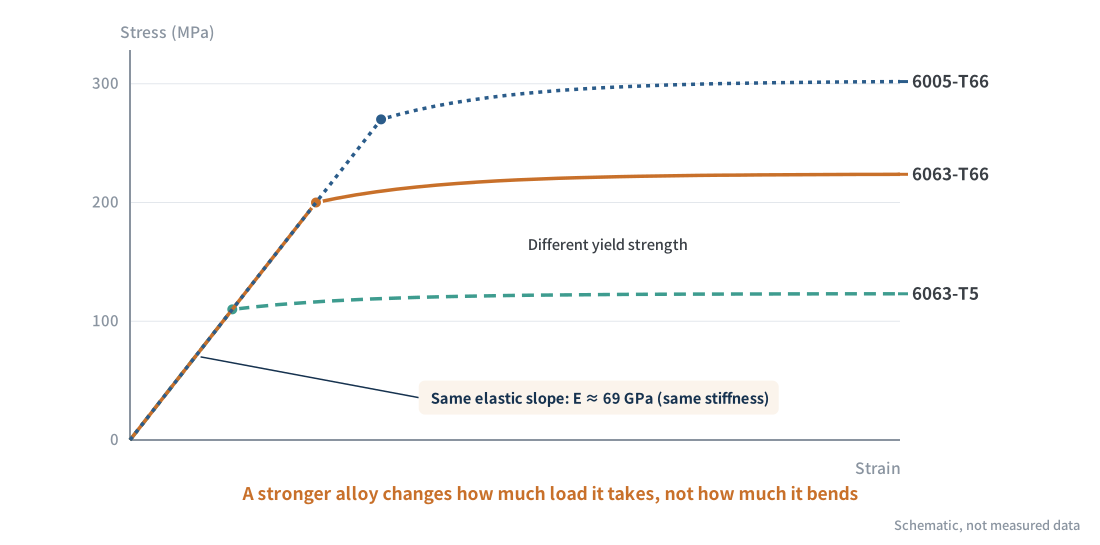
Figure 4 Strength is not stiffness: schematic stress–strain curves of different alloys
The result can look like this: after switching to a stronger alloy and thinning the walls, the frame shows no permanent deformation after the load test, yet the module bends further while loaded, and the risk of cell microcracks and stress at the glass corners actually rises. Thinner walls must therefore come with cross-section optimization, such as a taller Face B, a better cavity or added ribs, which is the subject of Article 04.
As an aside, steel has an elastic modulus of about 200 GPa, nearly three times that of aluminum. That is the physical basis on which steel frames challenge aluminum, which we will cover in Article 09.
Summary
A stronger alloy stops the frame from staying bent, but it cannot stop the module from bending too much. Check stiffness before thinning the walls.
06 Recycled aluminum: a chance to cut carbon, a test of quality
Aluminum is one of the most recyclable metals. According to Xinhua Finance, recycled aluminum uses about 5% of the energy of primary aluminum, and every tonne recycled cuts greenhouse-gas emissions by about 94%. Primary aluminum, by contrast, carries a heavy footprint: the International Aluminium Institute puts the global average at about 16.5 t CO₂ per tonne, and the China Nonferrous Metals Industry Association puts the domestic average at about 14.4 t CO₂ per tonne. As overseas markets tighten carbon-footprint requirements for modules, recycled aluminum frames have become a key lever for cutting carbon.
Recycled aluminum also sets a quality test, however. Scrap sources are mixed, so impurities such as iron, copper and zinc tend to accumulate, and recycling can hardly remove them. In practice they can only be diluted with primary aluminum:
- High iron: forms coarse iron-bearing phases that cause extrusion surface defects, a darker anodized finish, color variation or streaks, lower elongation and more cracking during riveting;
- High copper or zinc: lowers corrosion resistance and erodes long-term outdoor reliability;
- Batch variation: unstable composition makes hardness and appearance swing from batch to batch.
So the question is not whether recycled aluminum can be used but how to control it. Sound practices include:
- Prefer in-plant scrap with well-known composition, such as extrusion butt ends and offcuts;
- Cap the share and the sources of recycled material, with full batch traceability;
- Add composition, hardness and elongation checks at incoming inspection, plus salt-spray tests and anodized-appearance consistency checks where needed.
07 Final thoughts
To wrap up this article:
- Why 6063: fast to extrude, good-looking when anodized, strong enough, reliably corrosion-resistant and backed by a mature supply chain;
- Where 6005 fits: higher strength at higher cost, reserved for large, high-load and thin-wall designs;
- T5, T6 and T66: different "cooking" of the same alloy, decided by cooling speed after the die;
- Wall thickness and aluminum price: thinner walls save money, but stiffness sets the limit;
- Recycled aluminum: cutting carbon is the opportunity, impurity control is the precondition.
Once the material is right, the frame still needs the right "clothes". In the next article we look at surface treatment: how do anodizing, electrophoretic coating and powder coating differ? How should coating-thickness classes be chosen? And what pitfalls come with black frames? Stay tuned.
Calculation notes
- Aluminum use follows the SMM estimate of 6,500 t/GW (about 6.5 g/W). This is an industry statistic; as frames keep getting lighter, the current figure may be lower.
- Aluminum price is the SMM A00 ingot weekly average of RMB 23,576/t for 12–16 October 2026.
- 6,500 t/GW × RMB 23,576/t ≈ RMB 153 million/GW, i.e. about RMB 0.15/W. Only ingot material cost is included, excluding extrusion, surface treatment, processing fees and losses.
- A 10% overall reduction in wall thickness is approximated as a 10% reduction in aluminum use; the actual reduction depends on the section shape.
References
- T/SHLX 005—2024 Aluminum alloy extruded profiles for solar cell frames (Shanghai Aluminum Industry Association group standard, in Chinese)
- GB/T 3190 Chemical composition of wrought aluminium and aluminium alloys
- GB/T 5237.1 Aluminium alloy extruded profiles for architecture – Part 1: Substrate profiles
- Shanglan Media: Impact of new energy on aluminum demand (citing SMM data on PV frame aluminum use), 2024-03 (in Chinese)
- Sina Finance: SMM A00 aluminum ingot spot price weekly report (12–16 October 2026), 2026-10 (in Chinese)
- Xinhua Finance: report on recycled aluminum, 2025-10-11 (in Chinese)
- International Aluminium Institute (IAI) and China Nonferrous Metals Industry Association: primary aluminum carbon emissions (via Reccessary)
PV Materials Lab
A PV R&D and technology team with 10+ years of experience | Hard-core technical knowledge
Materials · Reliability · Failure analysis · Standards & certification · Products · Processes
Exploring AI + PV — collaboration welcome
Disclaimer:
- Original content reflects the authors' personal views, is for reference only and is not investment advice.
- Reposted and cited content is credited to its source.
- Some content is AI-assisted (chart generation, data retrieval, concept explanations); the core framework and key content are written by our technical team and reviewed by humans.
- If anything is inaccurate or infringing, please leave a message or contact us.