
After 28.29%: How Much Room Is Left in the BC Cell Efficiency Race?
Key points
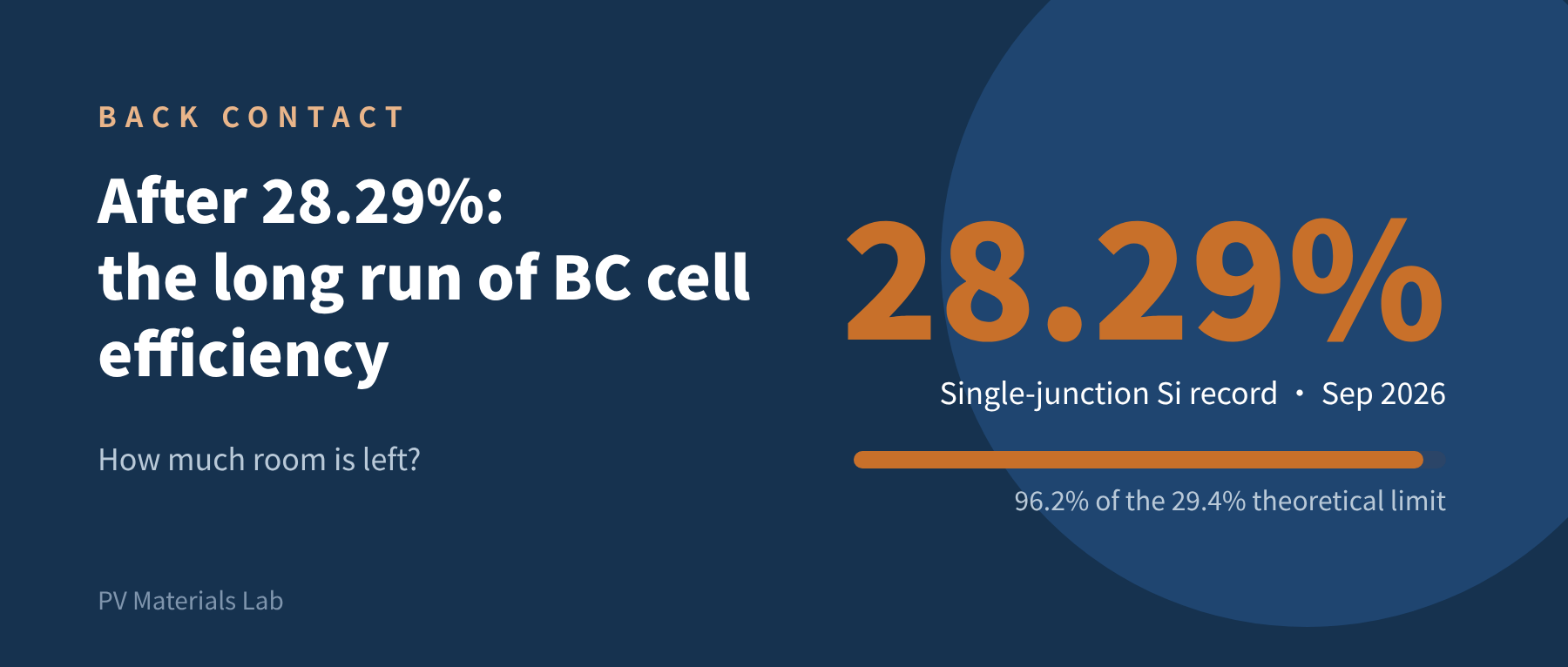
On 24 September 2026, LONGi announced that its HIBC cell had been certified by Germany's Institute for Solar Energy Research Hamelin (ISFH) at 28.29% efficiency. It was the third crystalline silicon world record of the year and the first time a silicon cell has reached 96.2% of the theoretical limit. With only about 1.1 percentage points left below the 29.4% ceiling, the curve is flattening, and the real action now moves to the production line.
Over the past two years, news of efficiency records has become a little tiresome: 27.81%, 28.04%, 28.13%, 28.29%... the decimals keep ticking up. But join these numbers into a line, draw in the 29.4% theoretical ceiling, and something more important becomes visible: the curve is flattening.
This article tries to answer three questions clearly. How has BC efficiency risen over the past few years? Where exactly is the ceiling? And how much more can lab and production efficiencies rise in the coming years?
● 28.29%: lab cell record (September 2026, ISFH-certified)
● 29.4%: theoretical limit for single-junction crystalline silicon (set by Auger recombination)
● ≈1.1 percentage points: the remaining gap (96.2% of the limit reached)
01First, what exactly is BC?
BC stands for back contact. A conventional cell has rows of metal fingers on its front that collect the current, but they also block part of the sunlight. BC's idea is simple: move both the positive and negative electrodes to the rear of the cell, interleaved with each other (hence the early name IBC, interdigitated back contact), leaving no fingers at all on the front.
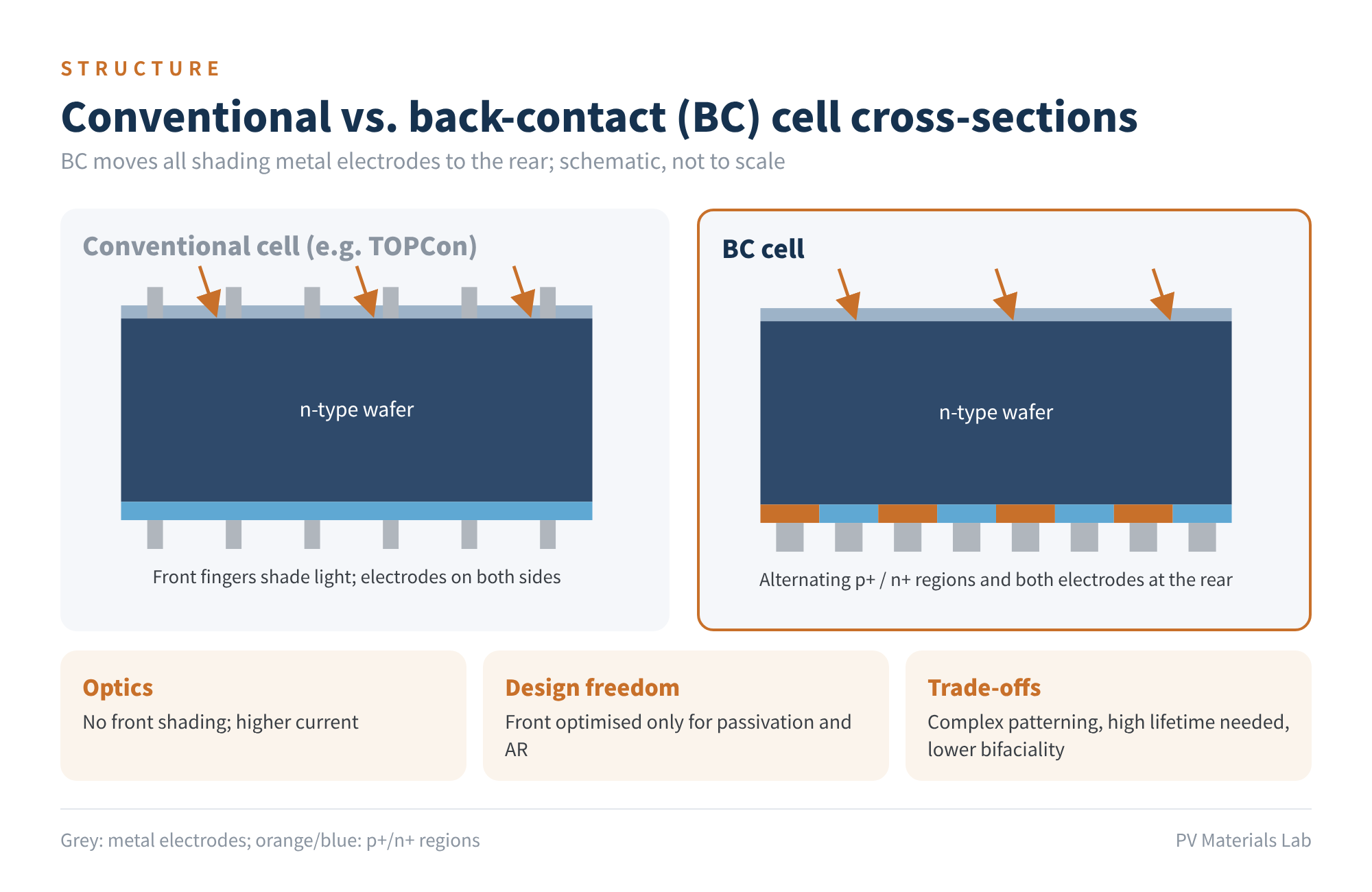
Figure 1 Conventional vs. BC cell cross-sections
The benefits come at two levels. Optically, the front has no shading at all, which directly raises short-circuit current. In terms of design freedom, the front no longer has to conduct current, so it can be optimised purely for passivation and anti-reflection.
The costs are just as clear. Alternating p and n regions must be patterned on the rear at micron scale, which makes processing complex; carriers have to travel sideways to the rear to be collected, which demands higher minority-carrier lifetime in the wafer; and bifaciality is inherently lower than TOPCon's. That is why the BC principle has been known for more than forty years, yet large-scale mass production has only happened in the last three or four.
One more point is easily overlooked: BC is a structure, not a passivation technology. It can be combined with different passivating contact schemes, which is where today's string of names comes from:
| Variant | Passivating contact scheme | Representative |
|---|---|---|
| HPBC | Hybrid passivation; the mass-production mainstay | LONGi HPBC 2.0 |
| ABC | Fully passivated contacts, silver-free metallisation | AIKO |
| TBC | TOPCon tunnel oxide / poly-Si + BC | Several TOPCon makers |
| HBC | Heterojunction amorphous Si + BC | Kaneka, LONGi's early records; JA/Golden Stone |
| HIBC | Low-temperature heterojunction + high-temperature tunnel poly-Si hybrid passivation + BC | LONGi's current record platform |
Table 1 Main technology variants of BC cells
02The efficiency race: a ten-year jog, then a three-year sprint
Line up the best third-party-certified BC cell efficiencies over time and you get an interesting curve.
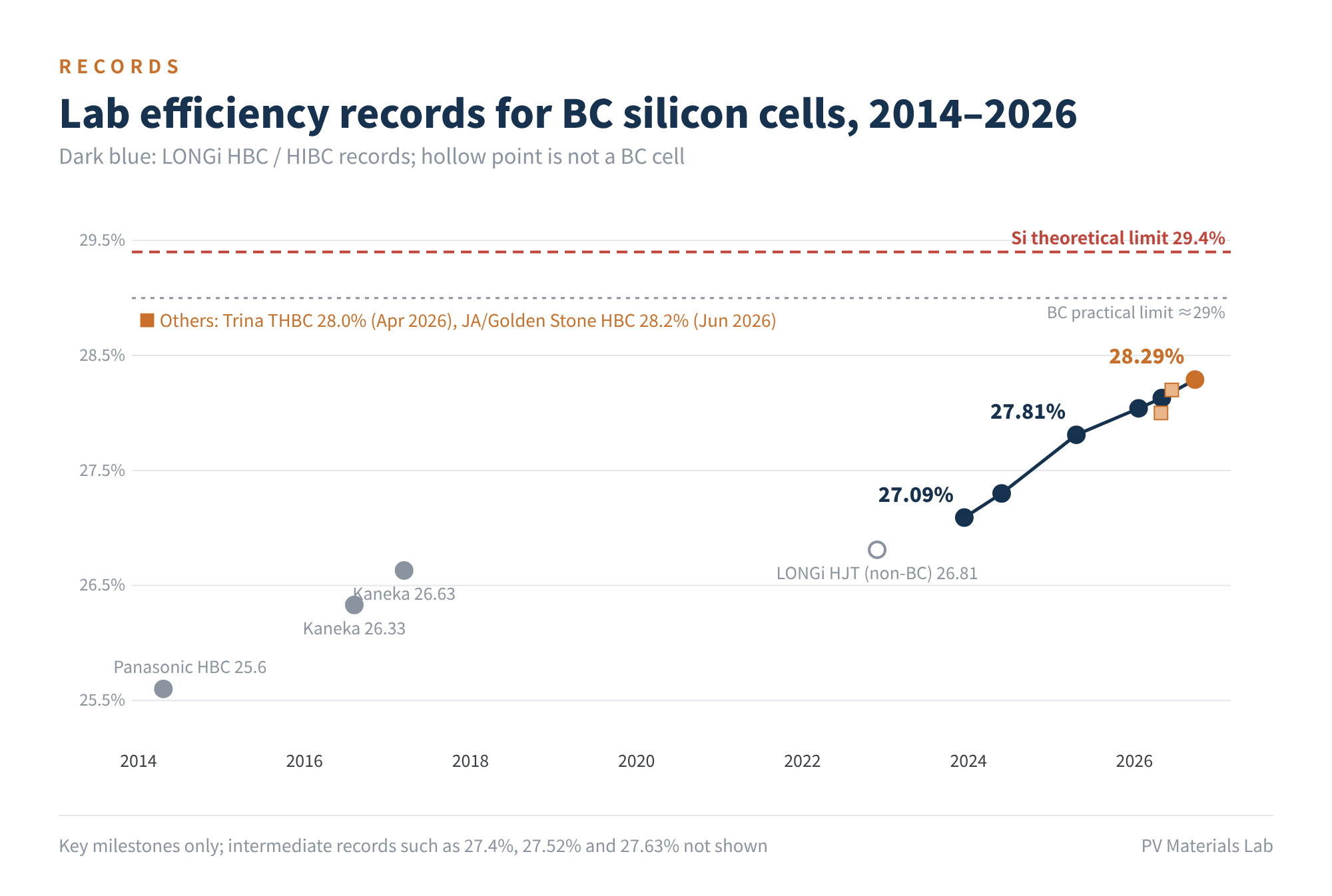
Figure 2 Lab efficiency records for BC silicon cells, 2014–2026
The first phase belonged to Japanese companies. In 2014 Panasonic took an HBC cell to 25.6%. Kaneka then took over, reaching 26.33% in 2016 and 26.63% in 2017. That figure stayed at the top of the table for more than five years.
The turning point came at the end of 2022. LONGi broke Kaneka's record with a 26.81% bifacial heterojunction cell. Note that this cell was not BC. But it showed that passivation had become good enough that further gains would have to come from the structure, and the biggest "reserve" left in the structure was front shading.
That led to three years of consecutive records:
- December 2023, 27.09% (HBC): the first cell above 27%, using full laser patterning instead of costly photolithography;
- May 2024, 27.30% (HBC): followed by 27.4%, 27.52% and 27.63%;
- April 2025, 27.81% (HIBC): published in Nature, with a fill factor of 87.55%;
- January 2026, 28.04%: the first cell above 28%;
- April 2026, 28.13%: at the same time, an HIBC module was certified by a US national laboratory at 26.4%;
- September 2026, 28.29%: the current record, certified by ISFH.
LONGi is not running alone. In April 2026 Trina Solar announced an ISFH-certified 28.0% for its THBC cell, and in June an HBC cell developed by JA Solar and Golden Stone Energy was certified by TÜV Rheinland at 28.2%. With the leading players all above 28%, this is not a lucky "champion wafer" but the maturing of a technology platform.
Breaking down the pace is sobering, though. From 27.09% to 27.81% took 16 months and gained 0.72 percentage points; from 27.81% to 28.29% took 17 months and gained only 0.48 percentage points. Over the same length of time, the gain was a third smaller.
The higher the efficiency, the more each 0.1 percentage point costs. This is not for lack of R&D effort; physics has started to collect its rent.
03Mass production: the other, more important curve
Lab records set the imagination; mass-production efficiency sets the cost of electricity. BC's progress in mass production over the past few years is actually more "real" than the records:
- Cells: LONGi's first-generation HPBC reached a little over 25% in mass production, and HPBC 2.0 raised that to 26.6%. According to LONGi's 2026 interim report and related coverage, its in-house ACM technology is now in mass production and adds another 0.2–0.3 percentage points. Leading lines are now producing cells at around 27%.
- Modules: AIKO's ABC modules have topped TaiyangNews' list of commercially available modules since March 2023, at 23.6% then, rising to 25% in April 2026. LONGi's HIBC-based EcoLife series has also reached 25%. AIKO has said its fourth-generation product can reach up to 26%.
- Scale: LONGi's BC module shipments grew from about 6 GW in 2023, 17 GW in 2024 and 23 GW in 2025 to 19.55 GW in the first half of 2026 alone, up 125% year on year and more than 65% of its module shipments.
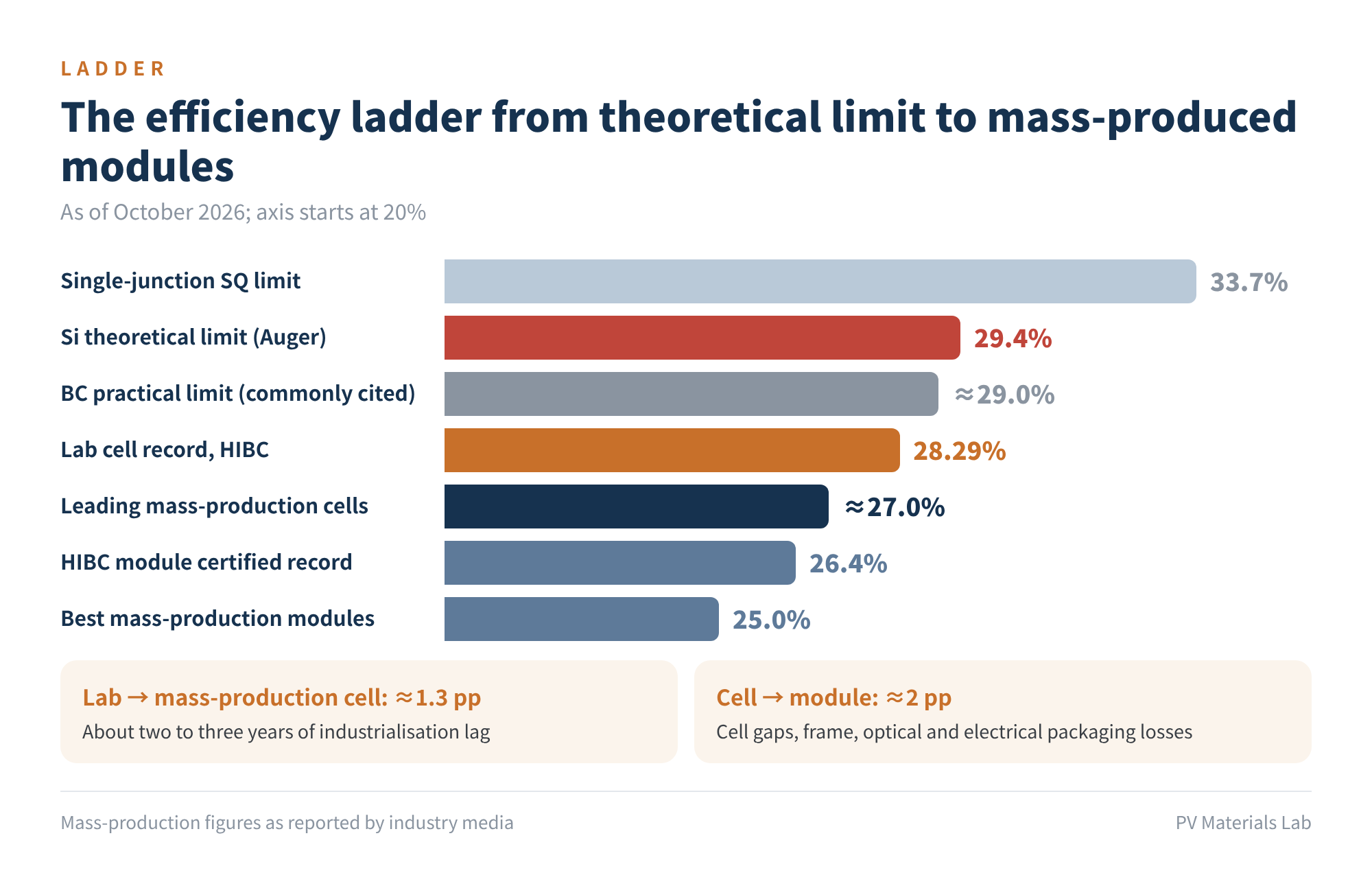
Figure 3 The efficiency ladder from theoretical limit to mass-produced modules (as of October 2026)
Two gaps in Figure 3 are worth remembering. The lab cell record and mass-production cells differ by about 1.3 percentage points, corresponding to an industrialisation lag of roughly two to three years: lab performance at the end of 2023 is today's average on the line. Cells and modules differ by about 2 percentage points, from cell spacing, frames, packaging optical losses and electrical losses; module technologies such as full-screen layouts, zero-busbar (0BB) interconnection and high-transmittance encapsulants claw this back bit by bit.
04Where is the ceiling? Where 29.4% comes from
Any discussion of limits has to start with two numbers.
The first is 33.7%. This is the single-junction limit derived by Shockley and Queisser in 1961: photons with less energy than the bandgap cannot be absorbed, and the excess energy of those above it turns into heat. Even at the ideal bandgap, a single-junction cell can convert at most about a third of sunlight.
The second is 29.4%. Silicon's bandgap (1.12 eV) is not at the ideal position, and more importantly, silicon is an indirect-bandgap material: once carrier density is high, Auger recombination, a loss intrinsic to the material, cannot be avoided. Taking these factors into account, the theoretical limit of a single-junction crystalline silicon cell is about 29.4% (Richter et al. gave 29.43% in 2013; later studies put it between 29.4% and 29.56%).
In other words, 29.4% is not something process technology "cannot yet reach"; it is what silicon "physically does not allow". At 28.29%, only about 1.1 percentage points remain.
How much of that 1.1 points can actually be captured? The theoretical limit assumes an ideal device with no surface recombination, no resistance and perfect light trapping. In real cells, recombination at the rear p/n boundaries and edges, contact and lateral transport resistance, parasitic absorption in films and the wafer's own bulk lifetime all leave losses that cannot be eliminated. The practical limit commonly cited in the industry for BC structures is around 29%.
The room genuinely left to fight for in the lab is only about 0.7–0.8 percentage points.
05The next few years: how much higher?
Based on the historical pace and the physical constraints above, here is our set of estimates (not an institutional forecast; for discussion only):
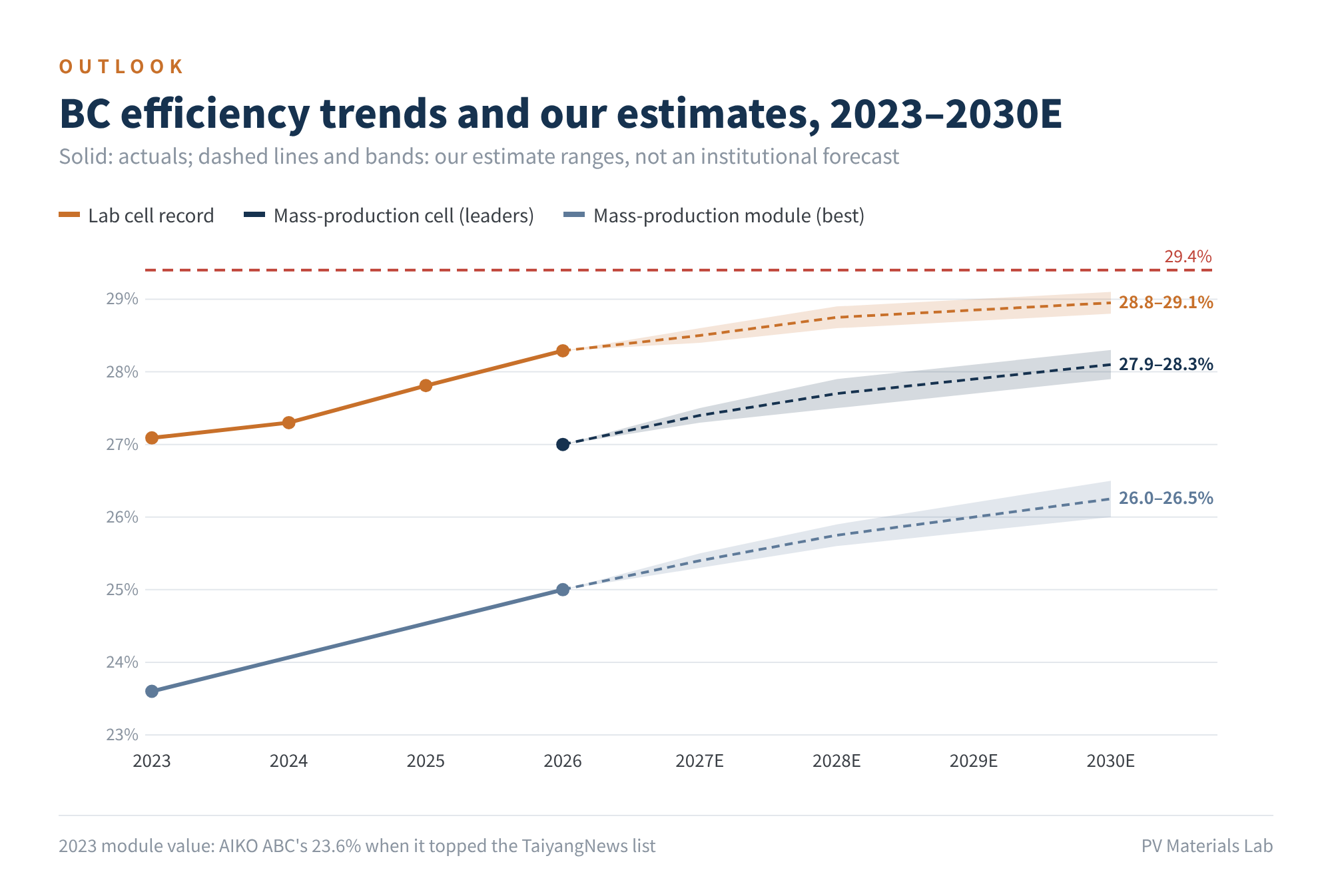
Figure 4 BC efficiency trends and our estimates, 2023–2030E
| Indicator | 2026 actual | 2027E | 2028E | 2030E |
|---|---|---|---|---|
| Lab cell record | 28.29% | 28.4–28.6% | 28.6–28.9% | 28.8–29.1% |
| Mass-production cells (leaders) | ≈27.0% | 27.3–27.5% | 27.5–27.9% | 27.9–28.3% |
| Mass-production modules (best) | ≈25.0% | 25.3–25.5% | 25.6–25.9% | 26.0–26.5% |
Table 2 BC efficiency estimates (2027E–2030E are our estimate ranges)
Three judgements lie behind them:
- Lab records: still rising, but ever more slowly. The pace of roughly 0.4–0.5 percentage points a year over the past three years cannot last. It will most likely slow to about 0.2 points a year over the next two years, then around 0.1 points a year, approaching the ~29% practical limit around 2030. By then each new record may move only the second decimal place.
- Mass-production efficiency: rising faster than the lab, closing the gap. What production lines do today is what labs proved three years ago; the "homework" is already done. Edge passivation, higher-quality wafers, copper metallisation and silver-free processes, and finer laser patterning will all keep adding gains. We expect mass-production cells to gain 0.25–0.3 points a year and pass 28% around 2030, with mass-production modules reaching 26% or more.
- Competition will shift from "efficiency numbers" to "the cost of efficiency". Once every lab is crowded into the one point between 28% and 29%, differentiation will lie more in yield, non-silicon cost, bifaciality and reliability. China's mandatory national energy-efficiency standard for PV modules, issued in July 2026 and taking effect on 1 January 2027, is also turning "high efficiency" from a selling point into an entry requirement.
As for how big a market share BC can win, views differ widely: forecasts on the China Photovoltaic Industry Association's basis put it above 30% by 2030, while the BC Cell Technology Development White Paper published jointly by LONGi and AIKO gives 62%. The disagreement is not about efficiency, but about how fast costs fall and how willing owners of existing TOPCon capacity are to convert it. Conversion is already under way: AIKO has said it is converting 5 GW of PERC capacity in Yiwu and 6 GW of TOPCon capacity in Chuzhou to ABC.
06Beyond the ceiling: handing the baton to tandems
Single-junction silicon approaching its limit does not mean PV efficiency stops there. The way around 29.4% is to stack a wider-bandgap cell on top of the silicon cell and use the solar spectrum in sections.
The theoretical limit of silicon-perovskite tandems is about 43%. In July 2026 LONGi announced a tandem cell certified by Europe's ESTI at 35.5%, a cell close to industrial size (261 cm²) at 34.3%, and tandem modules at 31.4%.
But tandems still have hurdles to clear before mass production: stability, large-area uniformity and proof of a lifetime of 25 years or more. Until they really take over, BC very likely has a full product cycle ahead of it. And whatever happens with tandems, a sufficiently good silicon bottom cell will always be needed.
07Final thoughts
Look back at the curve: from 26.63% to 27.09%, the industry waited six years; from 27.09% to 28.29%, it took less than three. This is the payoff, all at once, of years of work on passivating contacts, laser patterning and high-quality wafers.
Looking ahead, the lab story will get more and more "boring", with numbers moving only after the decimal point. The real story is on the production line.
For single-junction silicon, the efficiency race has entered its final lap, and the final lap is no longer about speed: it is about who can make 28% cells and 26% modules reliably, at TOPCon cost and above 98% yield.
How do you see BC versus TOPCon playing out over the next few years? We would be glad to hear from you.
References
- LONGi: announcement of 28.29% HIBC cell efficiency (24 Sep 2026); coverage by TaiyangNews, pv magazine, Science and Technology Daily and others
- LONGi: announcement of 28.13% cell and 26.4% module efficiency (29 Apr 2026)
- LONGi: record announcements for 27.81% (Apr 2025), 27.30% (May 2024) and 27.09% (Dec 2023)
- LONGi 2026 interim report and related coverage (19.55 GW of BC module sales, ACM technology)
- AIKO: "AIKO Achieves 25% Module Efficiency in Mass Production" (24 Apr 2026); 2026 interim results briefing announcement; TaiyangNews list of commercially available high-efficiency modules (Apr 2026)
- Trina Solar: 28.0% THBC cell efficiency announcement (26 Apr 2026, EnergyTrend); JA Solar and Golden Stone Energy 28.2% HBC cell (Jun 2026, Cleanroom Technology)
- LONGi: announcement of 35.5% silicon-perovskite tandem cell efficiency (14 Jul 2026)
- Richter A. et al., IEEE J. Photovoltaics, 2013; Schäfer S., Brendel R., IEEE J. Photovoltaics, 2018; Niewelt T. et al., Sol. Energy Mater. Sol. Cells, 2022
- LONGi and AIKO: Back Contact (BC) Cell Technology Development White Paper (Apr 2025) (in Chinese)
A PV R&D and technology team with 10+ years of experience | In-depth technical knowledge sharing
Materials · Reliability · Failure Analysis · Standards & Certification · Products · Processes
Exploring AI + PV; collaboration welcome
Disclaimer:
1. Original content reflects the authors' personal views only, is for reference only and does not constitute investment advice.
2. Reposted and cited content is credited to its source, out of respect for original work.
3. Some content was produced with AI assistance (chart generation, data retrieval, concept explanations, etc.); the core framework and key content were written by our technical team and reviewed by people.
4. If anything is inaccurate or infringes your rights, please leave a message or contact us and we will deal with it.