
Composite Frames Offshore: The Real Test Is Not Salt Mist, but a Slowly Opening Slot

01 Why composite frames are being pushed offshore
Offshore PV faces high temperature, high humidity and heavy salt mist, plus strong wind, waves and rain. Two weaknesses of aluminium frames are magnified there: salt and galvanic corrosion, and the need to ground a metal frame, with higher PID risk under negative system bias.
Glass-fibre reinforced polymer (GFRP) frames address both: the resin matrix does not conduct, so the frame can go ungrounded and PID risk drops; there is no metal to corrode, and salt-mist results are typically excellent. Polyurethane composite frames from leading suppliers already ship on GW-scale module volumes, and the China Photovoltaic Industry Association published the group standard T/CPIA 0081-2024 in 2024.
One premise is often overlooked: aluminium is a metal; a composite is a polymer. Under design loads a metal is essentially elastic and springs back. A polymer is viscoelastic: the longer the load, the higher the temperature and the more water it holds, the more it moves — and part of that movement is permanent. Offshore conditions supply all three.
02 Once water gets in, it does three things
Moisture uptake in composites broadly follows Fickian diffusion: fast at first, then slowing to saturation. Temperature matters a great deal — in one glass/polyester study, immersion at 40 °C produced more than six times the uptake seen at 20 °C/50% RH. Once inside, water does three things (Figure 2):
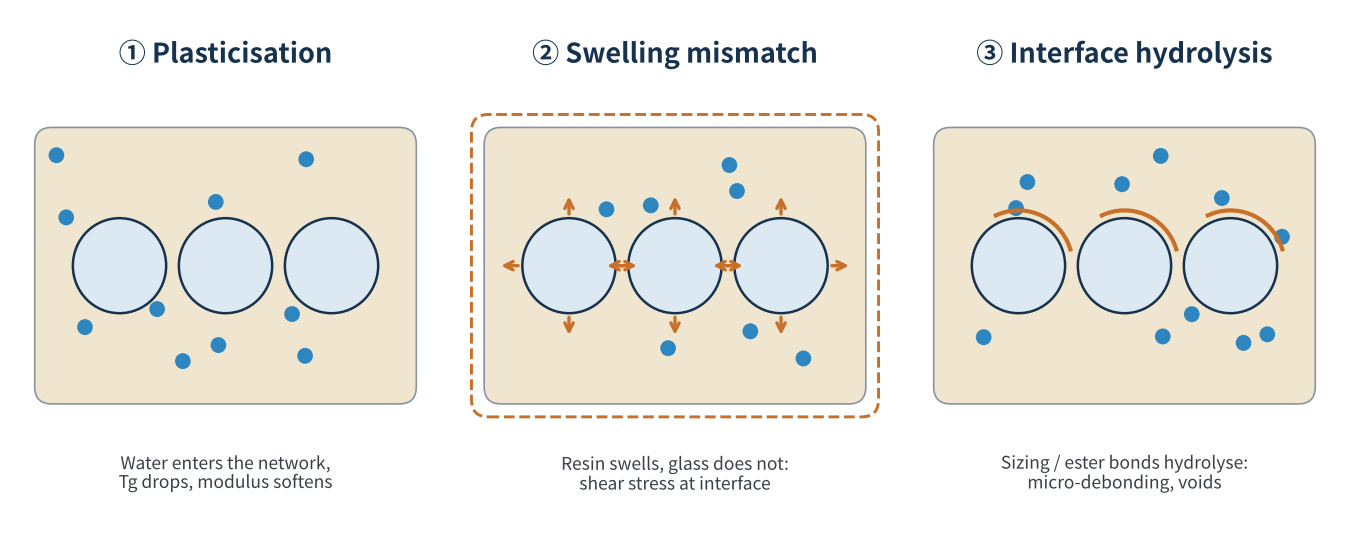
Figure 2 Three effects of absorbed water in a composite (schematic)
- Plasticisation: water enters the polymer network, lowering the glass transition temperature Tg and softening the matrix. Module rear temperatures offshore in summer are not low; as the Tg margin shrinks, creep rate rises markedly.
- Swelling mismatch: the resin swells, the glass barely does, so a sustained shear stress builds at the interface. Wet-dry cycles load and unload it repeatedly — effectively fatiguing the interface.
- Interface hydrolysis: the fibre sizing and ester or urethane bonds in the resin can hydrolyse, weakening the bond and creating micro-debonds and voids that let water in faster.
The role of salt is often misread. Several studies find that seawater saturation uptake is actually lower than in pure water (about 1.5% versus 1.8% in one GFRP test), yet at equal moisture content the mechanical losses are similar; and higher temperature sharply accelerates interface degradation in seawater — one literature review cites roughly 75% loss of interfacial shear strength after about 1,300 h in 60 °C seawater, versus about 69% at 40 °C. A high salt-mist rating and a stable interface under damp heat are two different things.
Moisture damages composite frames mainly at the fibre–resin interface, not the surface — and the largest effect comes early in uptake, exactly the stage short tests tend to miss.
03 Why the slot opens slowly
The frame holds the laminate in a slot, relying on the flange (A-face side) and the adhesive layer to keep clamping the glass edge. Wind, snow and wave-induced platform motion bend the module; the glass edge rotates in the slot and pries the flange outward. Mismatched thermal expansion of laminate and frame also squeezes the slot repeatedly (Figure 1).
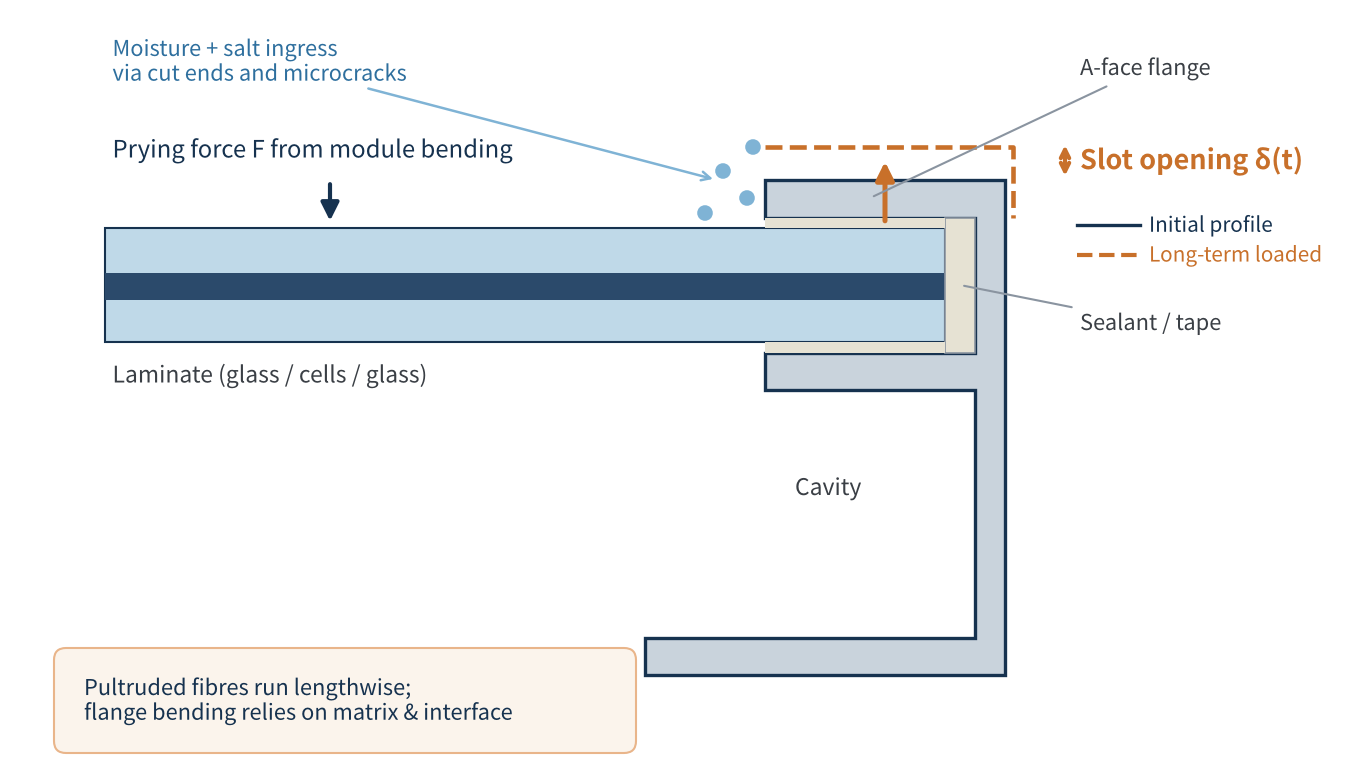
Figure 1 Loads on a composite frame slot and slot opening (schematic)
Fibre orientation is the crux. In pultruded profiles the fibres run mainly lengthwise, giving high longitudinal tensile and flexural strength. But bending the flange outward is resisted mainly by transverse and interlaminar shear properties — the directions governed by matrix and interface, and the most moisture-sensitive.
This sets up positive feedback: interface micro-debonding → lower transverse stiffness → more deflection under the same prying force → the adhesive loosens and clamping force drops → water enters the gap more easily → the interface degrades further. Wet-dry cycling adds mechano-sorptive creep, where humidity fluctuation itself accelerates creep. The result is an irreversible slot opening δ(t) and retention force that decays with time.
Such creep is commonly described with Findley's power law: ε(t) = ε₀ + m·tⁿ, where ε₀ is the instantaneous strain and m and n are fitted parameters depending on material, temperature, humidity and stress level. Civil-engineering studies of pultruded GFRP members extrapolating this model to 50 years suggest effective modulus may fall by about 30%. Those data come from columns and beams and cannot be applied directly to frames, but they show that viscoelastic relaxation over decades is not negligible.
Slot opening is not a sudden fracture but a slow superposition of interface degradation, viscoelastic creep and adhesive relaxation — and it is nearly invisible in factory testing.
04 What current standards test — and what they don't
T/CPIA 0081-2024 is the most comprehensive Chinese standard for composite frames, covering basic mechanics, multiple ageing exposures and full-module mechanical loading. Requirements relevant here:
| Item | Initial | After ageing | Ageing exposures |
|---|---|---|---|
| Corner-key pull-out force | ≥300 N | ≥200 N | UV; UV + damp heat 1000 h; UV + humidity freeze ×10; UV + thermal cycling ×200; salt mist severity 7; ammonia ×20 |
| Interlaminar shear strength | ≥45 MPa | ≥40 MPa | Same |
| Flexural strength | ≥850 MPa | ≥600 MPa | Same |
| Module mechanical load | Static, dynamic, −20 °C static | Static after combined ageing | UV damp heat or UV humidity freeze, then static load |
Source: T/CPIA 0081-2024 Tables 4–6; salt mist per IEC 61701, single cycle no shorter than 30 days
These requirements constrain material quality well, but leave four structural gaps for long-term slot opening:
- Age first, load later: every exposure is done unloaded, and strength is measured once afterwards. In service, damp heat and sustained load act together; their coupling is not tested.
- Corner key, not slot: the pull-out force is measured by pulling a corner key out of two short frame members — a corner-joint property, not the force with which the slot retains the laminate.
- No transverse or wet properties: flexural and tensile coupons are cut lengthwise from the B face; there is no requirement on transverse (90°) properties or their wet retention, though the flange depends on them.
- No time dimension: no equivalence is established between 1,000 h damp heat, 30 days of salt mist and 25 years offshore. The standard gives a few time points, not a curve.
Passing T/CPIA 0081 shows the material is acceptable; it does not show the slot will hold the laminate offshore for 25 years. That needs a separate assessment.
05 How to estimate a 25-year retention curve
We suggest reframing the question from "how much strength is left after ageing" to "how does retention force evolve under load over time", in five steps (Figure 4):
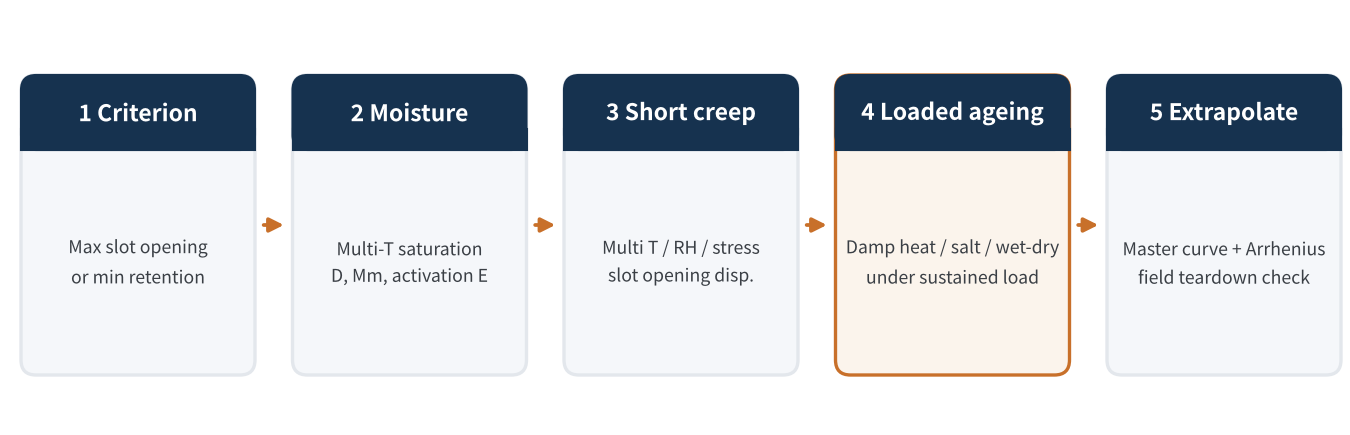
Figure 4 Assessment workflow for long-term slot retention
- Define the criterion: decide what counts as failure — a maximum slot opening (derived from adhesive compression and sealing needs) or a minimum laminate pull-out retention, tied to the module's mechanical design load.
- Characterise moisture uptake: following ASTM D5229, immerse in pure water and artificial seawater at three or more temperatures to obtain diffusivity D, saturation uptake and activation energy, then estimate the frame's equilibrium moisture content from site temperature and humidity.
- Short-term creep: with a dedicated fixture, apply a slot-prying load to full frame sections and measure opening displacement at several temperatures, humidities and stress levels (sustained-load practice per ASTM D2990); build a master curve by time-temperature-moisture superposition and fit Findley or similar models.
- Ageing under load: run damp heat, salt mist and wet-dry cycling while the prying load is maintained; sample at intervals for laminate pull-out force and opening to obtain retention R(t). This is the step current standards most lack.
- Extrapolate and calibrate: map accelerated conditions to the offshore temperature-humidity profile via Arrhenius to produce a 25-year curve with confidence bands, then calibrate with frames periodically removed from field demonstration plants.
Figure 3 is a schematic we drew from literature trends: dry and unloaded, decay is gentle; high humidity and salt knock retention down quickly in the first year or two; add a sustained prying load and the slope stays steeper, possibly dropping below the reference line mid-to-late in service. Standard certification tests cover only the very start of the curve.
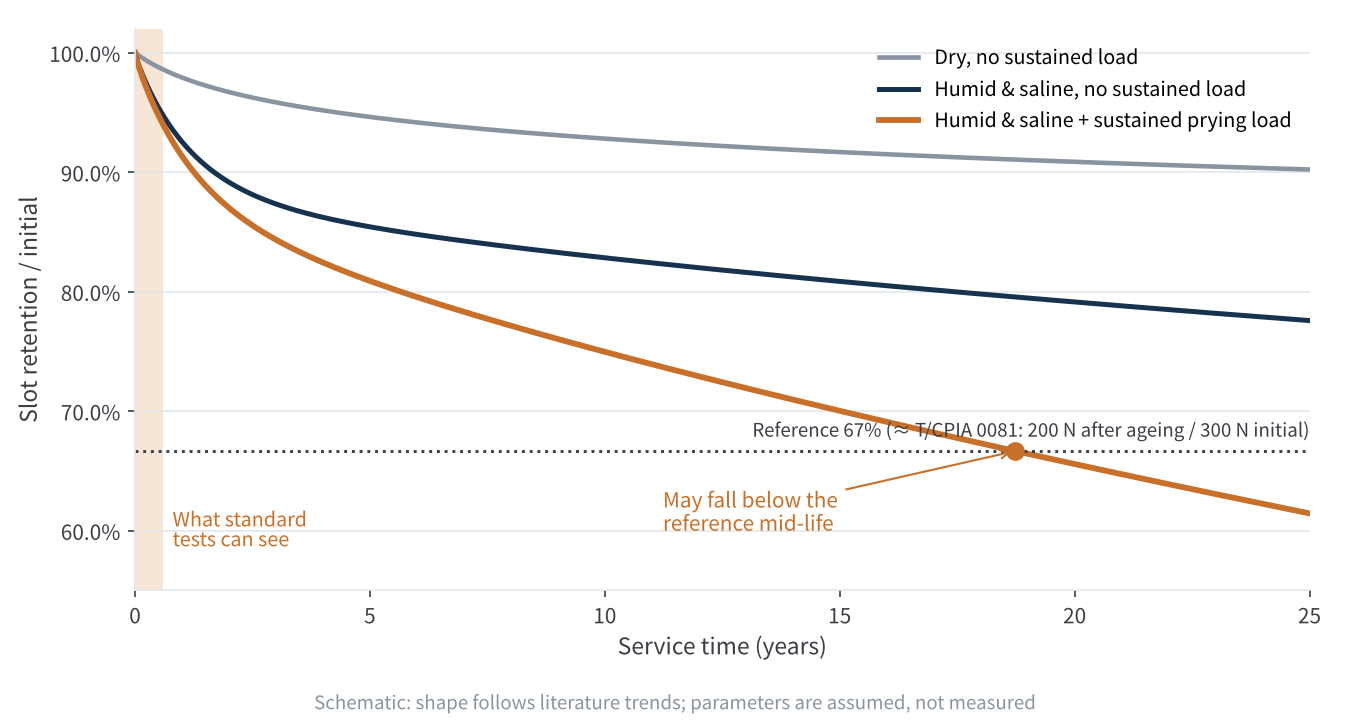
Figure 3 Slot retention versus service time (schematic, not measured data)
06 Advice for module designers and buyers
- Ask for transverse data: request transverse flexural and short-beam shear strength, initial and after saturation, not just longitudinal strength and salt-mist reports.
- Look at resin and interface: GFRP systems differ widely. One comparison found polyurethane-type matrices form a denser interface with glass than vinyl ester, improved further by modification; selection should consider interface and hydrolysis-resistance design.
- Leave margin in the slot: increase grip depth and flange thickness, add undercuts or ribs for mechanical interlock, rather than relying on flange elasticity alone.
- Let the adhesive compensate: choose sealants or tapes with low compression set and good recovery, so their elasticity offsets slow slot opening.
- Require loaded-ageing data: in offshore tenders, specify slot retention after damp heat/salt mist under sustained load, and agree on periodic field teardown sampling.
07 Final thoughts
Composite frames can go offshore; their advantages in insulation, corrosion resistance and carbon footprint are real. The problem is that we still measure them with the ruler made for aluminium: salt-mist severity and post-ageing strength. For a polymer the better question is: under offshore moisture, salt and sustained load, will the slot still hold after 25 years?
There is no standard answer yet. Material suppliers, module makers, test labs and plant owners need to fill in the missing piece — long-term data under load. Next time we will look at another offshore stress point of composite frames: local creep and torque relaxation at clamp locations.
- Figure 3 is schematic, illustrating differences in decay trend between conditions. Its shape follows the literature pattern of rapid early degradation during uptake plus long-term power-law creep; parameters are assumed and do not represent measurements of any product.
- The 67% reference line is the ratio of the post-ageing (200 N) to initial (300 N) corner-key pull-out requirements in T/CPIA 0081-2024, used only for comparison; it is not a lifetime criterion set by the standard.
- Uptake values, interfacial shear strength losses and 50-year modulus reduction come from GFRP studies in civil and marine fields; those material systems differ from frames and are cited only to indicate magnitude and trend.
References
- China Photovoltaic Industry Association. T/CPIA 0081-2024 Glass fibre reinforced composite frame for photovoltaic modules. 2024.
- Trina Solar. Offshore PV Module White Paper. 2026.
- Yang S, et al. Effect of Different Environmental Conditions on Durabilities of Polyester- and Vinylester-Based GFRP Pultruded Profiles. Frontiers in Materials, 2022, 9: 862872.
- Mourad A-H I, et al. Effect of seawater and warm environment on glass/epoxy and glass/polyurethane composites. Applied Composite Materials, 2010, 17(5): 557–573.
- Effect of moisture absorption on the fiber/matrix interface of pultruded GFRP composites in hygrothermal environments. Journal of Materials Science, 2018. doi:10.1007/s10853-018-2944-6.
- Effect of Moisture Absorption on the Tensile and Flexural Properties of Glass Fiber Reinforced Composite Materials. ASME IMECE, Paper 69865.
- Liao K, Schultheisz C R, Hunston D L, Brinson L C. Environmental Fatigue of Pultruded Glass-Fiber-Reinforced Composites. ASTM STP, 1998: 217–234.
- Time-Dependent Deformation of Pultruded Fiber Reinforced Polymer Composite Columns. Journal of Composites for Construction, 2003, 7(4): 356–362.
- Liu Y, Huang Y, Zou Z, Li Y. Effect of Different Resin Matrices on Mechanical Properties of Glass Fiber Reinforced Composite Frame. Plastics Science and Technology, 2025, 53(10): 66–70 (in Chinese).
- ASTM D5229/D5229M (moisture absorption of polymer matrix composites); ASTM D2990 (tensile, compressive and flexural creep of plastics).
- IEC 61215-2:2021; IEC 61701 Salt mist corrosion testing of PV modules.
A PV R&D and technology team with 10+ years of experience | In-depth technical knowledge sharing
Materials · Reliability · Failure Analysis · Standards & Certification · Products · Processes
Exploring AI + PV — collaboration welcome
Disclaimer:
1. Original content reflects the author's personal views, is for reference only and does not constitute investment advice.
2. Reproduced and cited content is attributed to its source, respecting original work.
3. Some content is AI-assisted (chart generation, data retrieval, concept explanations, etc.); the core framework and key content are written by our technical team and manually reviewed.
4. For any inaccuracy or infringement, please leave a comment or contact us.