
35% in the Lab, but Does the Math Work Outdoors? Unpacking Current Mismatch in Perovskite/Silicon Tandems
In July 2026 LONGi announced an ESTI-certified 35.5% efficiency for a two-terminal perovskite/silicon tandem cell; in June, Trina reported a 3.1 m² tandem module rated at 907 W, 29.2% full-area efficiency. The records keep coming, but module engineers and plant developers all ask the same thing: how much of that STC efficiency survives mornings, evenings and rainy days? This article focuses on one issue only: current mismatch in two-terminal tandems.
01 Two pumps on one pipe: why the currents must match
A two-terminal (2T) tandem builds a wide-bandgap perovskite top cell (about 1.68 eV) directly on a silicon bottom cell (1.12 eV), connected in series through a recombination layer. The top cell harvests short wavelengths (below roughly 738 nm); the bottom cell takes the longer wavelengths that pass through.
The price of the series connection: the device current can only equal the smaller of the two sub-cell currents. Think of two pumps on one pipe - the slower pump sets the flow, and the faster pump's extra effort is simply wasted as heat or recombination.
A four-terminal (4T) tandem wires the two cells separately, each with its own maximum power point tracking, so it is immune to mismatch - but it needs an extra transparent electrode and wiring, adding optical, resistive and cost penalties. That is why 2T remains the mainstream choice for large-format production today.
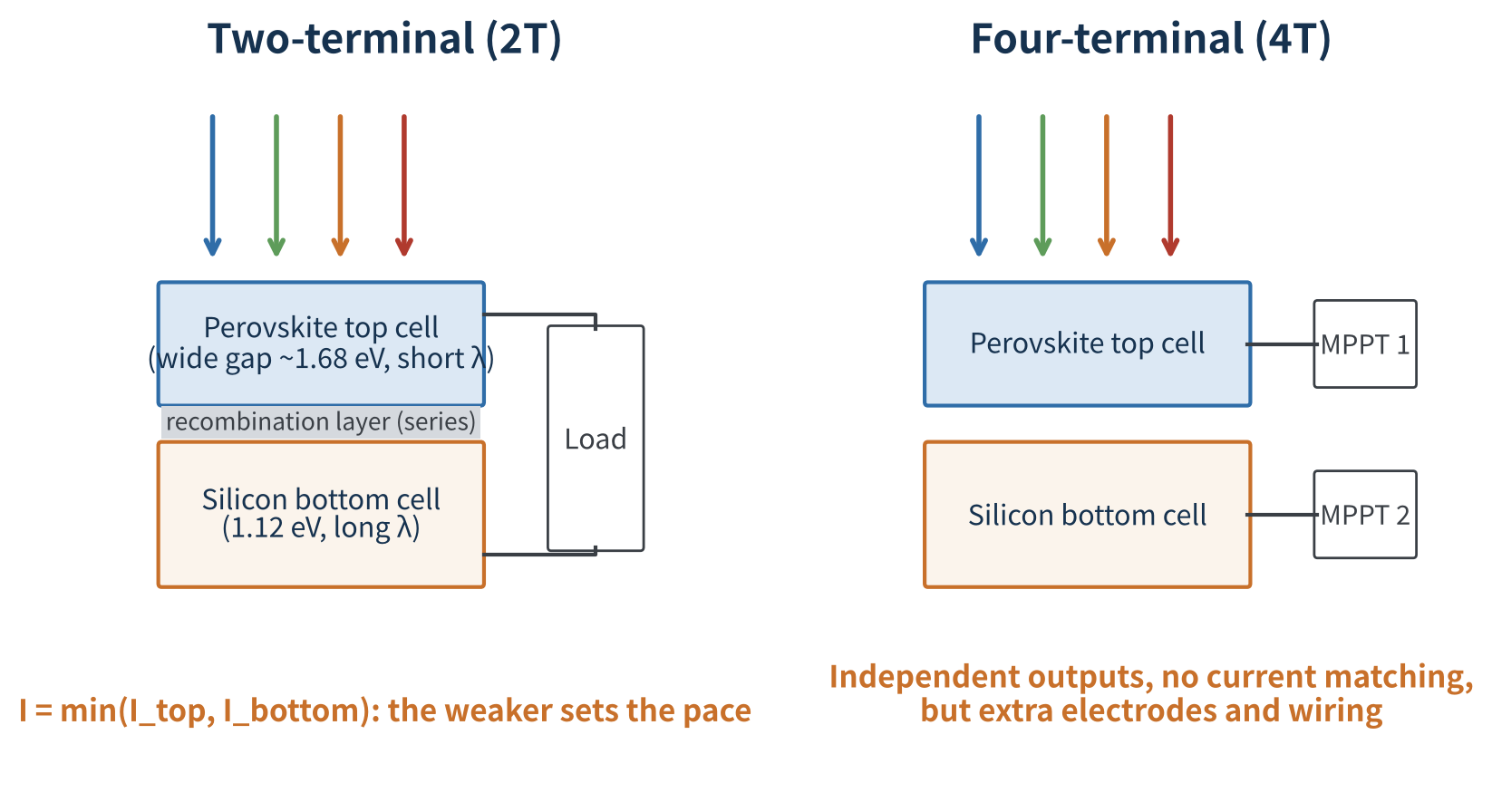
Figure 1 Electrical architecture of 2T vs 4T tandems
02 Sunlight is not AM1.5G: which way does the spectrum drift?
Lab efficiencies are measured under the AM1.5G reference spectrum, corresponding to a clear sky with the sun about 42° above the horizon. A tandem's bandgaps and layer thicknesses are tuned to be exactly current-matched under this one spectrum.
Outdoors the spectrum keeps changing. Three typical cases:
- Low sun in the morning and evening: light travels a longer path through the atmosphere (larger AM), more blue light is scattered away and the spectrum red-shifts - the top cell runs short first.
- Clear-sky noon: AM approaches 1, slightly more blue than the reference spectrum, so the top cell has a small surplus.
- Overcast, cloudy or shaded: direct light is blocked and diffuse light dominates; the spectrum blue-shifts and the bottom cell goes hungry.
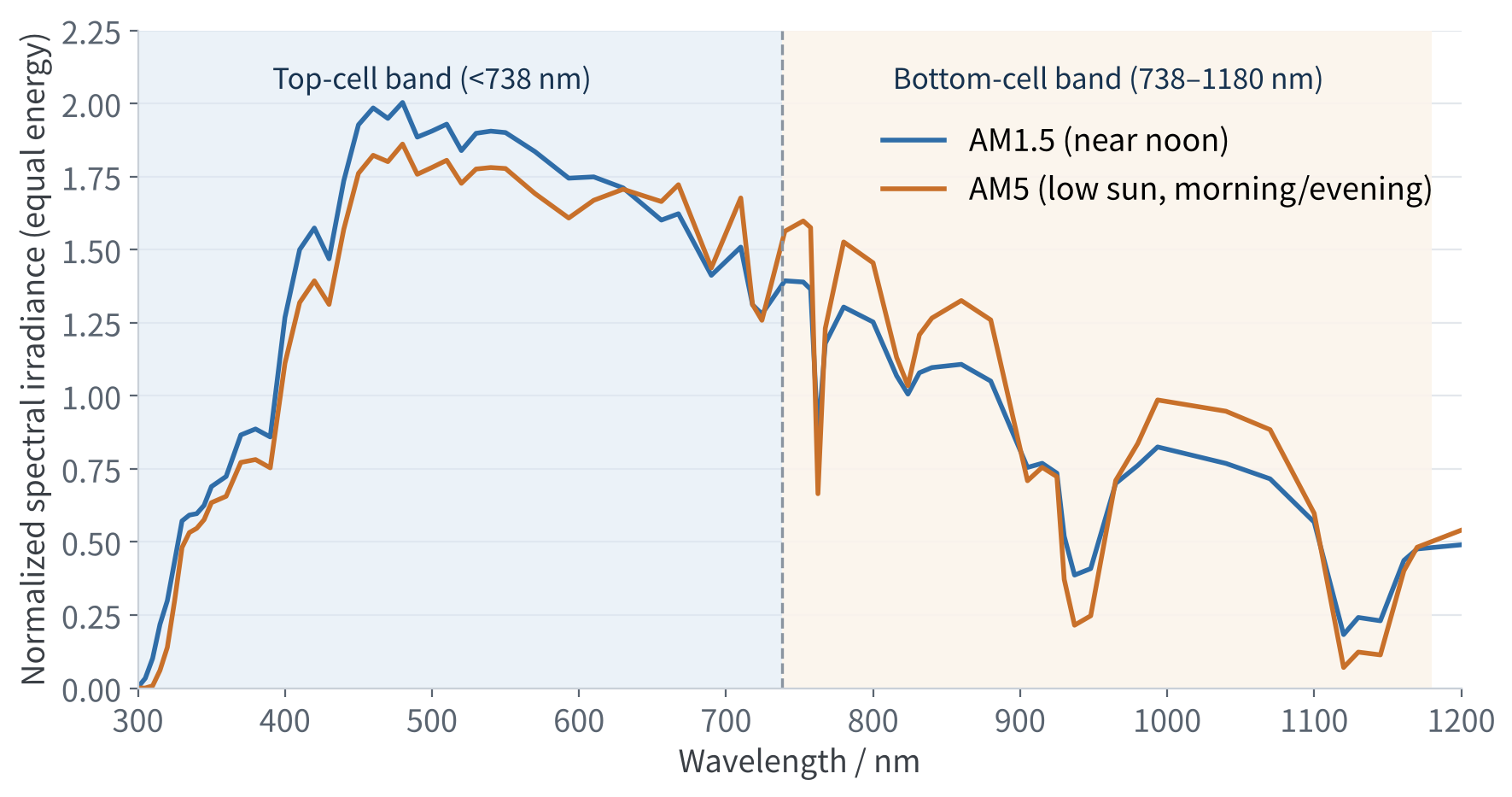
Figure 2 AM1.5 vs AM5 spectra (normalized to equal total energy); dashed line marks the 1.68 eV top-cell absorption edge
03 Who limits whom: the daily hand-over of the bottleneck
We made a simplified estimate with the public SPECTRL2 clear-sky spectral model: take a 2T tandem that is exactly matched under AM1.5G with a 1.68 eV top cell, and see how the top/bottom photocurrent ratio changes with sun height (method in the notes at the end).
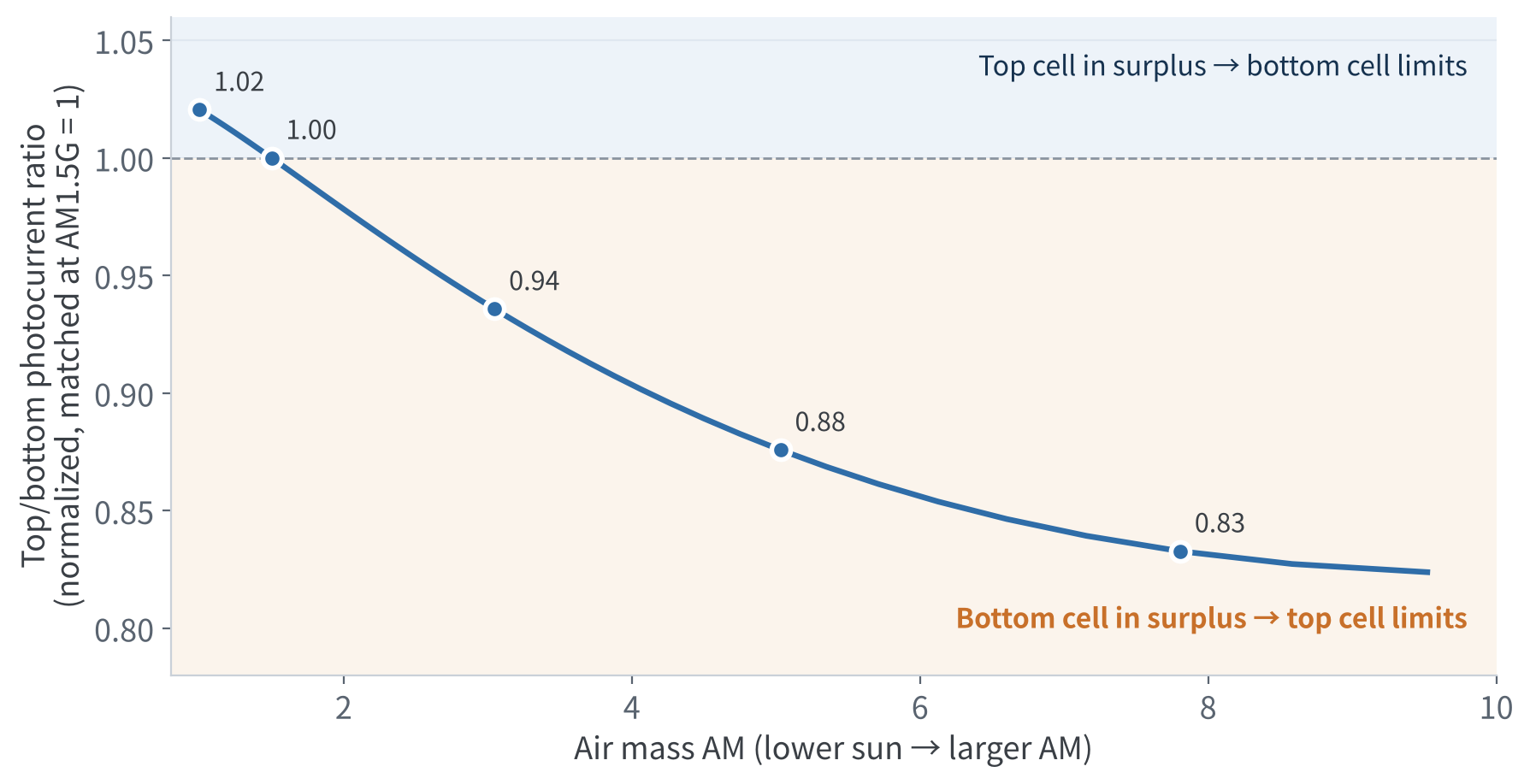
Figure 3 Top/bottom photocurrent ratio vs air mass (estimate, matched at AM1.5G = 1)
| Condition | Typical AM | Top/bottom ratio | Limiting cell | Wasted current |
|---|---|---|---|---|
| Summer noon | 1.0 | 1.02 | Bottom | ~2% of top |
| Standard test | 1.5 | 1.00 | Matched | 0 |
| Sun ~20° high (e.g. winter 9 am) | 3 | 0.94 | Top | ~6% of bottom |
| Low sun, morning/evening | 5 | 0.88 | Top | ~12% of bottom |
| Near sunrise/sunset | 8 | 0.83 | Top | ~17% of bottom |
| Pure diffuse light (shade/heavy overcast) | — | ~2.9 | Bottom | large top surplus |
The conclusion is clear: in clear-sky mornings and evenings the top cell is the bottleneck; under diffuse-dominated cloudy light the bottom cell is. Measurements agree: in 2026 a team including Southwest Petroleum University and Tongwei measured about 4.98% mismatch under a blue-rich spectrum and 4.32% under a red-rich spectrum on a tunable LED simulator, with the device short-circuit current always following the lower-current sub-cell.
One point is easy to miss: although the mismatch ratio is large in the mornings, evenings and on cloudy days, the irradiance is low, so these hours carry little weight in annual yield. Mismatch does not "eat" as much energy as the percentages suggest.
Summary
The hours with the worst mismatch are the hours with the least energy. Spectral mismatch is a real loss, but it is a chronic condition, not an acute one.
04 Three more hands on the dial: temperature, rear-side light, degradation
Beyond the spectrum, three factors quietly shift the matching point:
- Temperature: KAUST's outdoor tests in Saudi Arabia found that as temperature rises, silicon's bandgap narrows (more bottom-cell current) while the perovskite bandgap widens (less top-cell current) - opposite directions. In hot climates, a device tuned at STC is pushed toward top-cell limitation. They recommend an STC top-cell bandgap below 1.68 eV where module temperatures exceed 55 °C; Fraunhofer ISE's outdoor work points the same way, lowering the optimum from a theoretical 1.73 eV to about 1.685 eV.
- Rear-side light (bifacial): ground-reflected light enters almost only the bottom cell. The higher the albedo, the more surplus current in the bottom cell, so the optimal top-cell bandgap moves narrower - simulations give about 1.66 eV at 30% albedo and about 1.64 eV at 50%.
- Degradation: this is our own view. If the perovskite top cell degrades faster than silicon outdoors, its current falls over time and the device drifts further toward top-cell limitation. It is wise to give the top cell a little current margin when choosing the matching point.
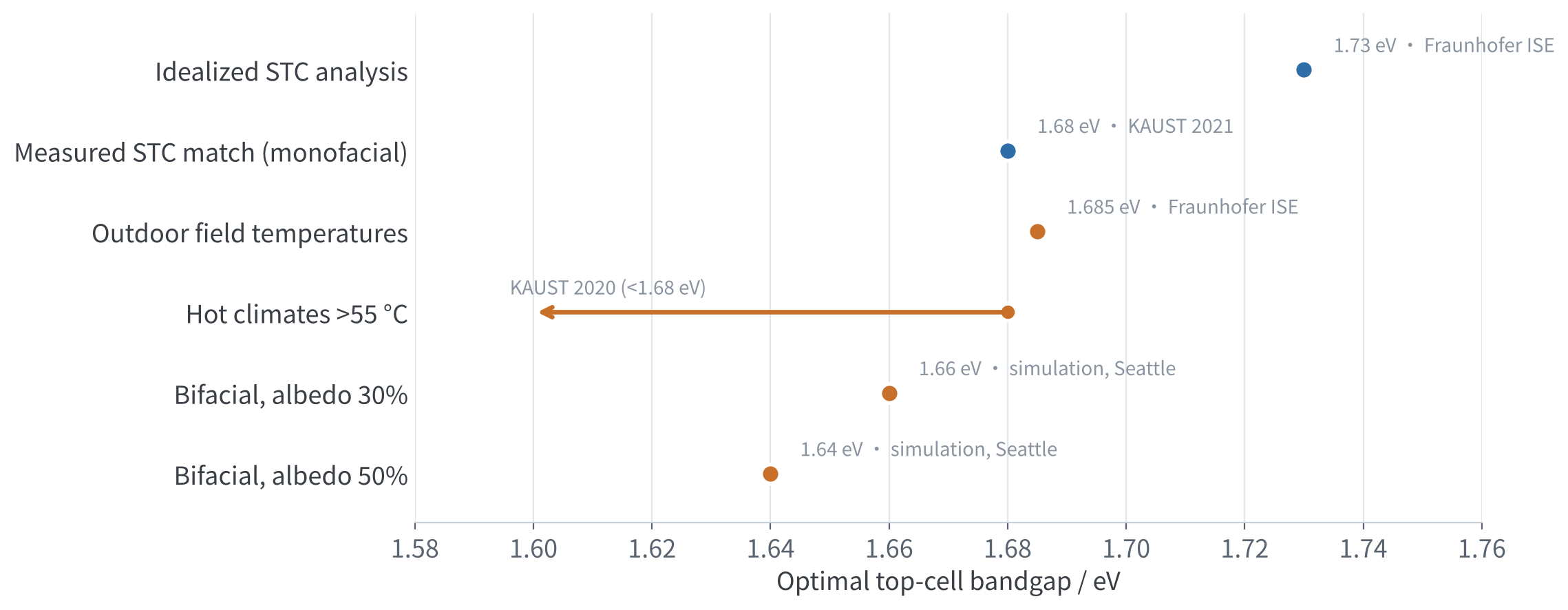
Figure 4 Optimal top-cell bandgap under different operating conditions
05 How the math really works: lose per watt, win per square metre
Back to the title question: why does the math seem not to work? We think there are two separate bills.
The first is the spectral mismatch bill. NREL simulations show that for a device current-matched at STC, annual spectral deviation reduces energy-harvesting efficiency by only about 2% (relative); but if the top-cell bandgap deviates from the matching point by more than 0.1 eV, the loss grows beyond 5%. A 2026 study in eScience Energy using full-year spectra from Haikou, Albuquerque, Yancheng and Daqing found that, compared with TOPCon, tandems produce 0.77%-3.25% less energy per watt - but thanks to higher module power, 8.74%-11.16% more energy per square metre, lowering LCOE by up to about 1.59% in favourable regions and supporting a module price premium of up to about 7%.
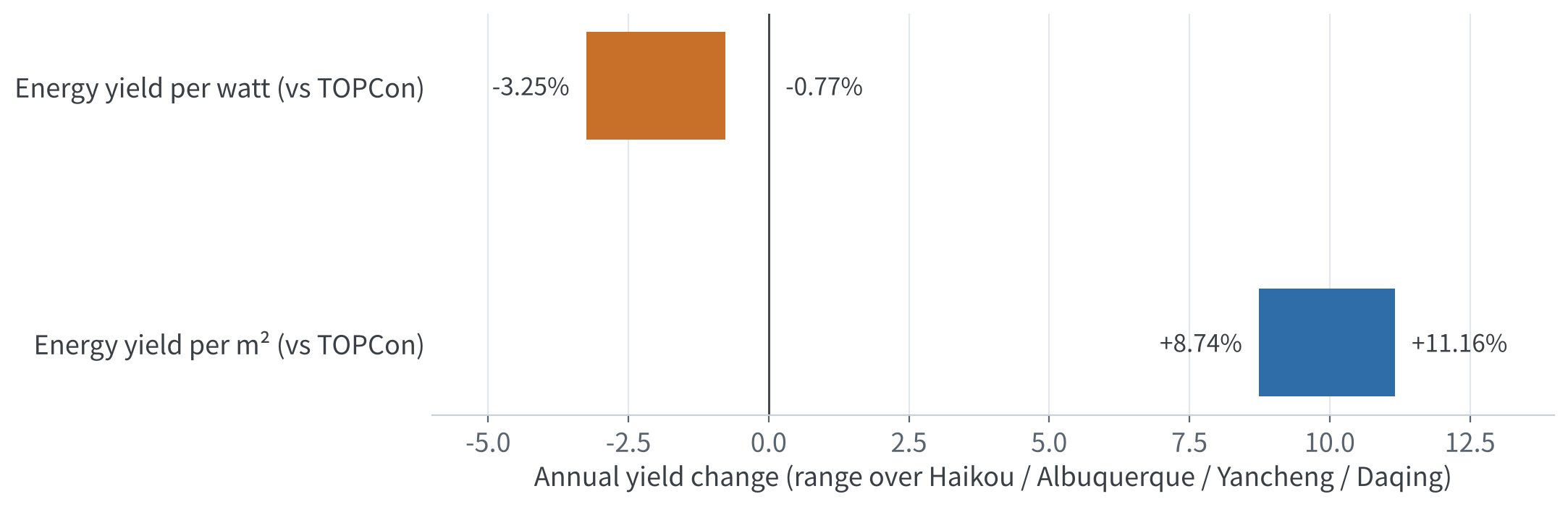
Figure 5 Annual yield of tandems vs TOPCon: per watt and per area (range over four sites)
The second is the cell-to-module gap bill, which is far larger than mismatch:
| Device | Efficiency | Area / notes |
|---|---|---|
| LONGi tandem cell (ESTI, Jul 2026) | 35.5% | area not disclosed |
| LONGi tandem cells | 34.3% / 32.2% | 261 cm² / 274 cm² |
| Trina tandem module (TÜV SÜD, Jun 2026) | 29.2% (907 W) | 3.1 m², full area |
| Oxford PV tandem module record (2024) | 26.9% | 60-cell format, ~1.6 m² |
| Oxford PV first commercial modules (2024) | 24.5% | 72-cell format |
The drop from 35% to 29% comes mainly from scaling up the area, interconnection and encapsulation losses - a different matter from spectral mismatch. Mixing the two bills leads to the wrong impression that "tandems don't work outdoors".
Bottom line
Spectral mismatch costs tandems about 1%-3% of energy per watt, yet they still deliver roughly 10% more per unit area. What really decides outdoor returns is whether the matching point is redesigned for the local spectrum, temperature and albedo.
06 Engineering responses
- Tune the matching point to the climate: in hot or high-albedo sites, choose a narrower top-cell bandgap; at high latitudes with lots of diffuse light, assess bottom-cell limitation on cloudy days.
- Make use of bifaciality: rear-side light naturally boosts the bottom cell, leaving room for narrower-gap, more stable perovskite compositions - two birds with one stone.
- Test sub-cell by sub-cell: I-V measurement of multi-junction devices requires spectral adjustment per IEC 60904-1-1; when procuring, ask suppliers for the spectral response of each sub-cell, not just an STC nameplate.
- Evaluate projects with the local spectrum: the eScience Energy study proposes a quick mismatch indicator based on the UV share of irradiance - handy where full spectral data are unavailable.
- Options beyond 2T: three- and four-terminal designs are not bound by current matching and suit applications that value stable yield, at the cost of extra electrodes, wiring and expense.
07 Final thoughts
Current mismatch in tandems is not a fatal flaw - it is more of a "factory settings" issue: the lab tunes the matching point for AM1.5G, 25 °C and front-side light only, while a real plant runs on a different set of parameters. Efficiency records tell us how far tandems can go; energy-yield models tell us where they are worth installing.
In the next article we plan to cover another hurdle for tandem modules - reliability testing of the perovskite top cell under damp heat, light soaking and reverse bias. Tell us in the comments what you care about most.
Calculation notes
Figure 3 and the "who limits whom" table are our team's estimates, using the SPECTRL2 clear-sky spectral model in pvlib (horizontal plane, precipitable water 1.42 cm, aerosol optical depth 0.1 at 500 nm, ozone 0.31 atm-cm). The top cell absorbs 300-738 nm and the bottom cell 738-1180 nm, both with an external quantum efficiency of 0.9, and the current ratio is normalized to 1 at AM1.5. Temperature, reflection, parasitic absorption and luminescent coupling are not included; the results show trends only and do not represent any specific product. The "pure diffuse light" row uses the clear-sky diffuse component; real heavy-overcast spectra are less blue-shifted.
References
- pv magazine. Longi sets new world record with 35.5%-efficient perovskite-silicon tandem cell, 2026-07-15.
- China Energy News. LONGi again sets world record for crystalline silicon-perovskite tandem cell efficiency, 2026-07-20 (in Chinese).
- Stockstar. Trina Solar tandem module reaches 907 W peak power, 2026-06-01 (in Chinese).
- PV Tech. Oxford PV unveils record 26.9% perovskite tandem module, 2024; Oxford PV ships first commercial perovskite tandem modules, 2024.
- Challenges of two-terminal perovskite/silicon tandem solar cells operating under globally varying spectral conditions. eScience Energy, 2026. DOI: 10.1016/j.esen.2026.100065.
- Witteck R. et al. Spectral effects on the energy harvesting efficiency of 2- and 4-terminal tandem photovoltaics. arXiv:2310.06914, 2023.
- Aydin E. et al. Interplay between temperature and bandgap energies on the outdoor performance of perovskite/silicon tandem solar cells. Nature Energy, 2020. DOI: 10.1038/s41560-020-00687-4.
- De Bastiani M. et al. Efficient bifacial monolithic perovskite/silicon tandem solar cells via bandgap engineering. Nature Energy 6, 167–175, 2021.
- pv magazine USA. How temperature affects tandem solar cell performance (Fraunhofer ISE).
- Perovskite/silicon tandem solar cells: Effect of luminescent coupling and bifaciality. arXiv:2008.13696.
- IEC 60904-1-1. Photovoltaic devices – Part 1-1: Measurement of current-voltage characteristics of multi-junction photovoltaic devices.
- pvlib python, SPECTRL2 spectral model (Bird & Riordan, 1986).
PV Materials Lab
PV Materials Lab
A PV R&D and technology team with 10+ years of experience | In-depth technical knowledge sharing
Materials · Reliability · Failure Analysis · Standards & Certification · Products · Processes
Exploring AI + PV — collaboration welcome
Disclaimer:
- Original content represents the author's personal views only, is for reference only, and does not constitute investment advice.
- Reproduced and cited content is attributed to its source, with respect for original work.
- Some content is AI-assisted (chart generation, data retrieval, concept explanations, etc.); the core framework and key content are written by our technical team and reviewed by humans.
- If anything is inaccurate or infringing, please leave a comment or contact us.