
Every Material Passed, Yet the Module Died in Damp Heat: What Lies Between IEC 62788 and IEC 61215?
Encapsulant, backsheet, flux and silicone each arrive with a passing test report, yet after damp heat the module shows corroded fingers and heavy power loss. This article explains how the IEC 62788 material standards and the IEC 61215 module standards divide the work, where the gap lies, and, using public data from UNSW, NREL and Kiwa PVEL, why compatibility is a property of the BOM rather than of any single material. It closes with practical validation advice for module and material makers.
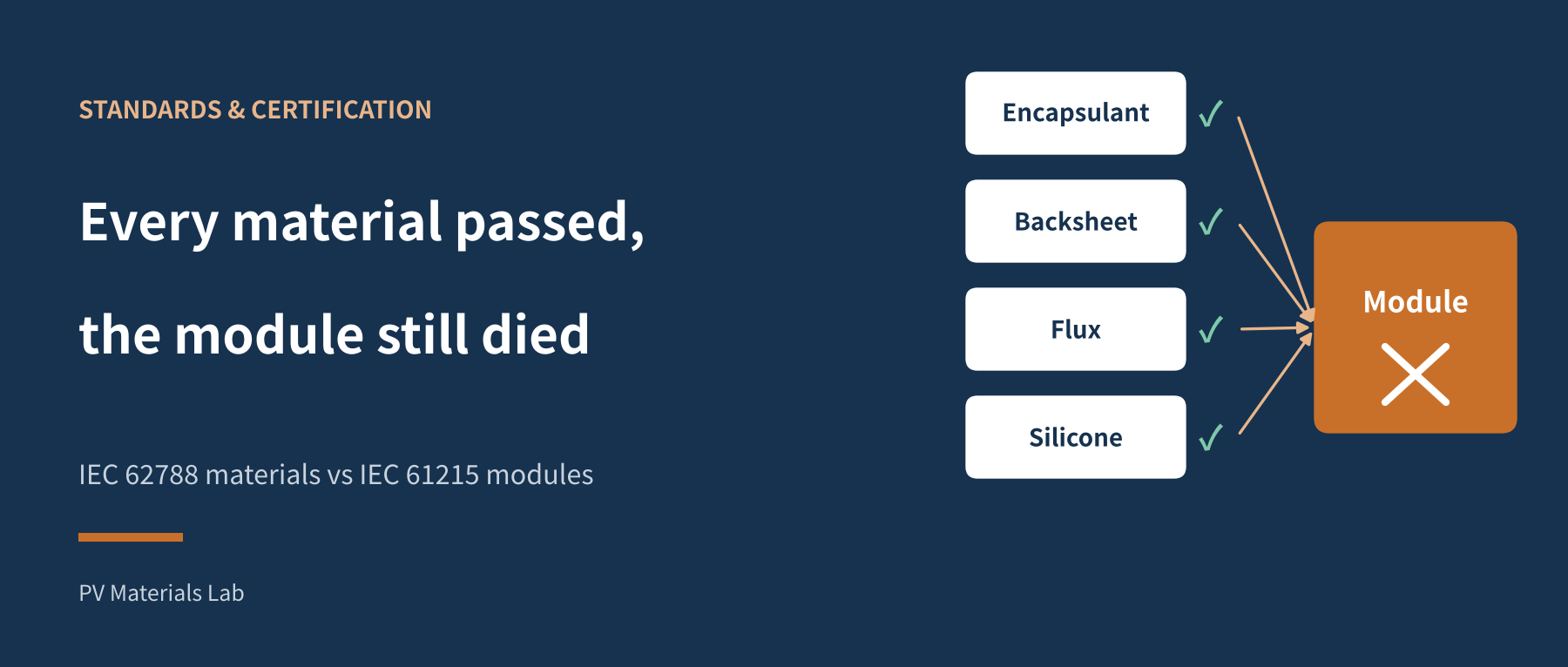
Anyone who has qualified new module materials has probably seen this: the encapsulant, backsheet, ribbon, flux and silicone all arrive with passing reports and excellent datasheet values. Then the module goes into the damp-heat chamber, the EL image shows darkened fingers, and power has dropped sharply. Trace it back and no single supplier is "out of spec". So where is the problem? In our view it sits in a gap in the standards: material standards cover the material, module standards cover the module, and the combination in between is covered by almost no one.
01 Two standard families, two different questions
First, the division of labour.
IEC 62788 is the series "Measurement procedures for materials used in photovoltaic modules", split by material: 1-x for encapsulants (volume resistivity, transmittance, degree of cure, shrinkage and so on), 2-x for frontsheets and backsheets, 5-1 for edge seals, 6-x for general tests such as moisture permeation, and 8-1 for electrically conductive adhesives. Its role is to define test methods and datasheet reporting requirements, usable for material selection, incoming inspection, process control and as support for module-level qualification.
IEC 61215 is design qualification and type approval of the module. It applies a defined set of stresses (thermal cycling, damp heat, humidity freeze, UV, mechanical load and others) to one specific module design, judged mainly on power loss, insulation and visual inspection.
One asks "how good is this material by itself"; the other asks "does this module pass under the defined conditions". Notably, the scope of IEC TS 62788-2 states that backsheet test methods should represent how the material is used in the module, eventually including combination with matched components such as encapsulants or adhesives. The standard writers know combinations matter, but in the current clauses combination effects are still mostly left to module-level testing.
| Aspect | IEC 62788 series (material level) | IEC 61215 series (module level) |
|---|---|---|
| Question answered | How does this material perform by itself | Does this module design pass qualification |
| Test object | Single material or simple laminate coupon | Complete module (one specific BOM) |
| System state | Mostly open; by-products can escape | Semi-closed laminate |
| Typical output | Datasheet, incoming/process control data | Pass/fail plus power loss |
| Multi-material chemistry | Largely not addressed | Only indirectly, within fixed stresses and durations |
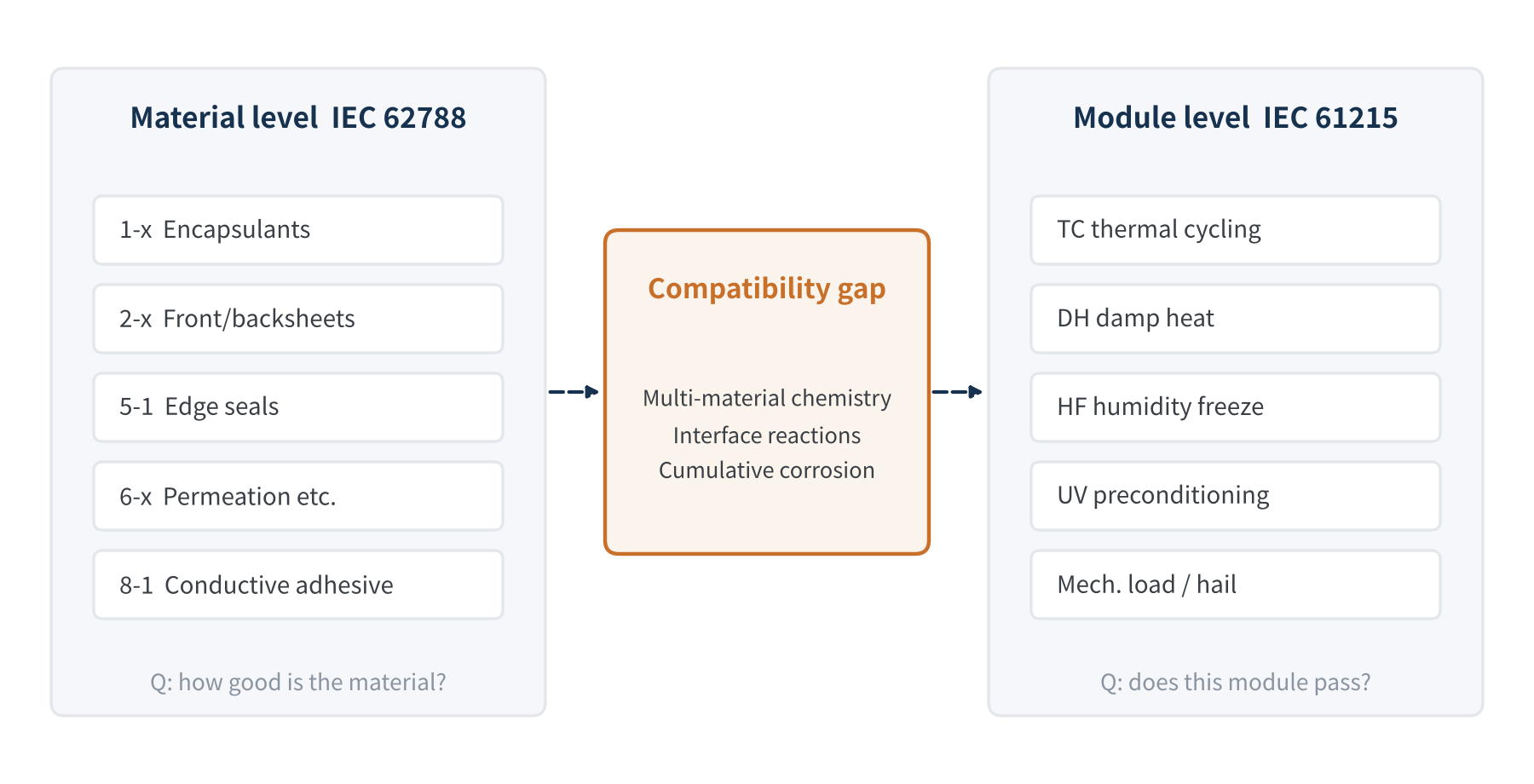
Figure 1 Division of labour between IEC 62788 and IEC 61215, and the compatibility gap in between
02 After lamination, the module is a chemical reactor
After lamination, glass, encapsulant, cells, ribbons and backsheet become one body, with frame and silicone at the edges. Inside, this is a semi-closed micro-environment exposed to heat, humidity and light for decades. Small molecules released by each material cannot easily escape, so they meet and react.
- Encapsulant: EVA deacetylates under damp heat and UV to form acetic acid, which catalyses further degradation. POE itself does not generate acid, but additives such as antioxidants, UV absorbers and co-agents can break down into organic acids under damp heat. Magnesium-containing additives in white EVA can migrate, hydrate and create a locally alkaline environment.
- Backsheet: PET-based backsheets hydrolyse under long-term damp heat; chain scission yields oligomers and carboxylic end groups that may migrate inward. Backsheet breathability also decides whether internal by-products can vent out.
- Flux residues: Organic acids (such as azelaic or malic acid) and halogen activators from no-clean fluxes remain near solder joints and become an electrolyte once moisture arrives.
- Silicones and potting: Alcohol-, oxime- and acetoxy-cure silicones release methanol, oximes and acetic acid respectively while curing, and keep releasing them if under-cured.
- Metals and cells: Paste glass frit, Ag/Al contacts and Cu/Sn ribbons are the targets; TOPCon and HJT cells are more sensitive than earlier technologies.
Taken alone, each release is small and within its own standard's limits. Inside a module, however, they share the same moisture, the same temperature and the same metal surfaces. Acetic acid dissolves a little glass frit, flux residue corrodes a little more of the contact interface, acids from additive breakdown finish the job. That is the chemistry behind "every part passed, the combination failed".
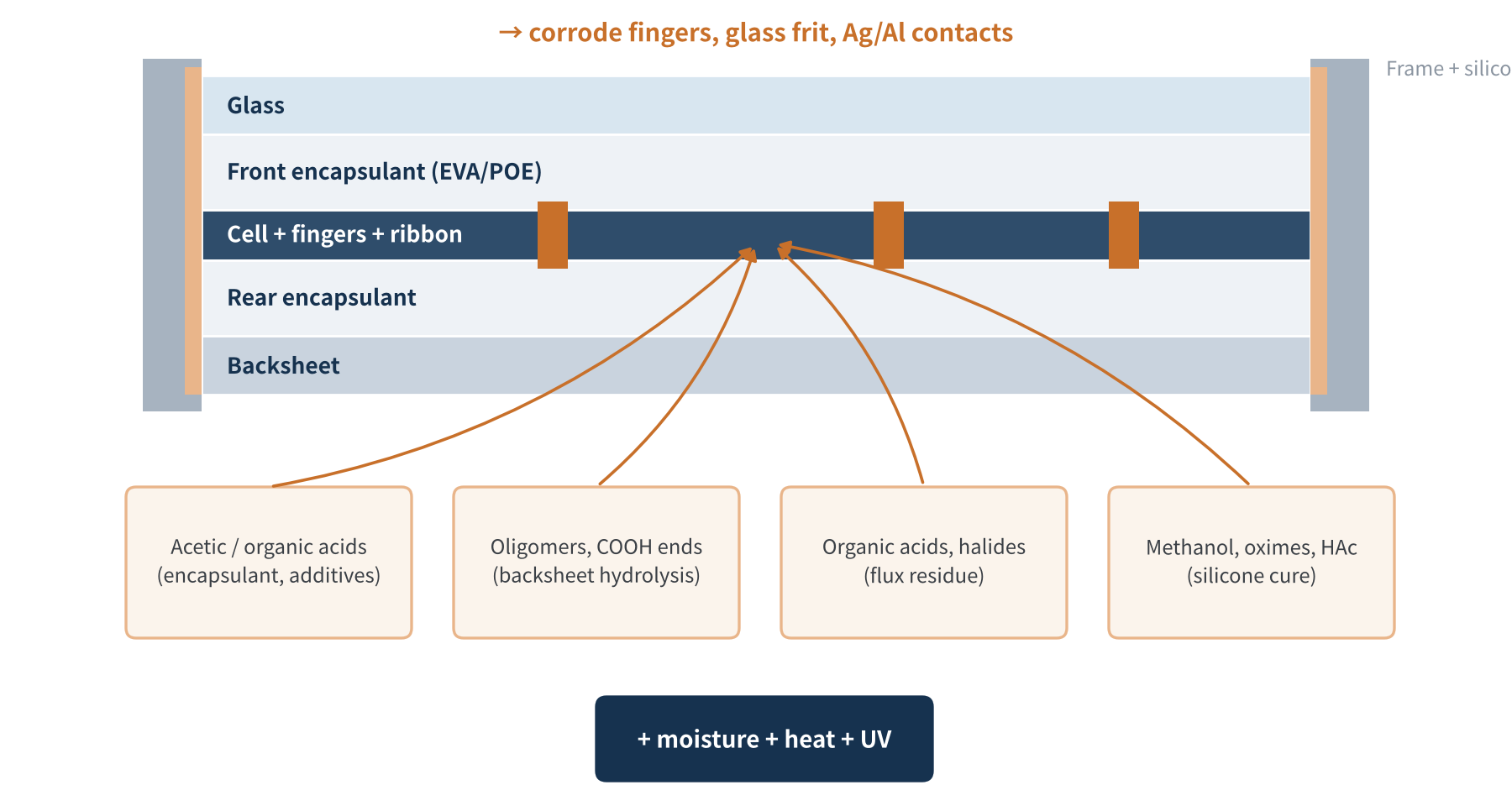
Figure 2 The module as a chemical reactor: by-products of each material meet in a semi-closed micro-environment
Key point: Compatibility is not a property of one material; it is a property of a BOM.
03 Evidence: change one material, get a completely different result
Over the past two years, a UNSW team has run a series of controlled experiments on TOPCon modules that illustrate this well.
- Swap the encapsulant: Identical TOPCon cells were built into mini-modules differing only in encapsulant. After DH1000, the EVA module lost about 11% of its power, while one POE (POE-C) lost more than half, about 55%. Analysis showed thermo-oxidation of the POE matrix producing carboxylic acids, hydrolysis of the UV absorber into benzoic-type acids, plus azelaic acid retained from the flux: an acidic cocktail. Two other POEs in the same study produced no measurable acid and stayed stable.
- Swap the paste: In work by UNSW with Jolywood, EVA/backsheet TOPCon modules made with two low-Al silver pastes lost about 28-30% and 4-5% after DH1500. The difference came from glass-frit chemistry: a Ba/Zn-modified frit resisted acetic acid far better.
- Swap the rear encapsulant: Modules with POE on both sides lost about 8% after damp heat, while those with white EVA on the rear (especially combined with EPE) lost about 16%, driven by alkaline corrosion from Mg-containing additives.
- Swap the flux: Cell-level damp-heat tests showed that a halogen-containing no-clean flux corroded TOPCon front Ag/Al contacts considerably more.
The crucial point: taken individually, these materials would very likely pass their own incoming inspections. POE-C had normal transmittance and gel content; cells made with the two pastes had almost identical starting efficiency of about 25.2%. The problems only appeared once the materials were combined and exposed to damp heat.
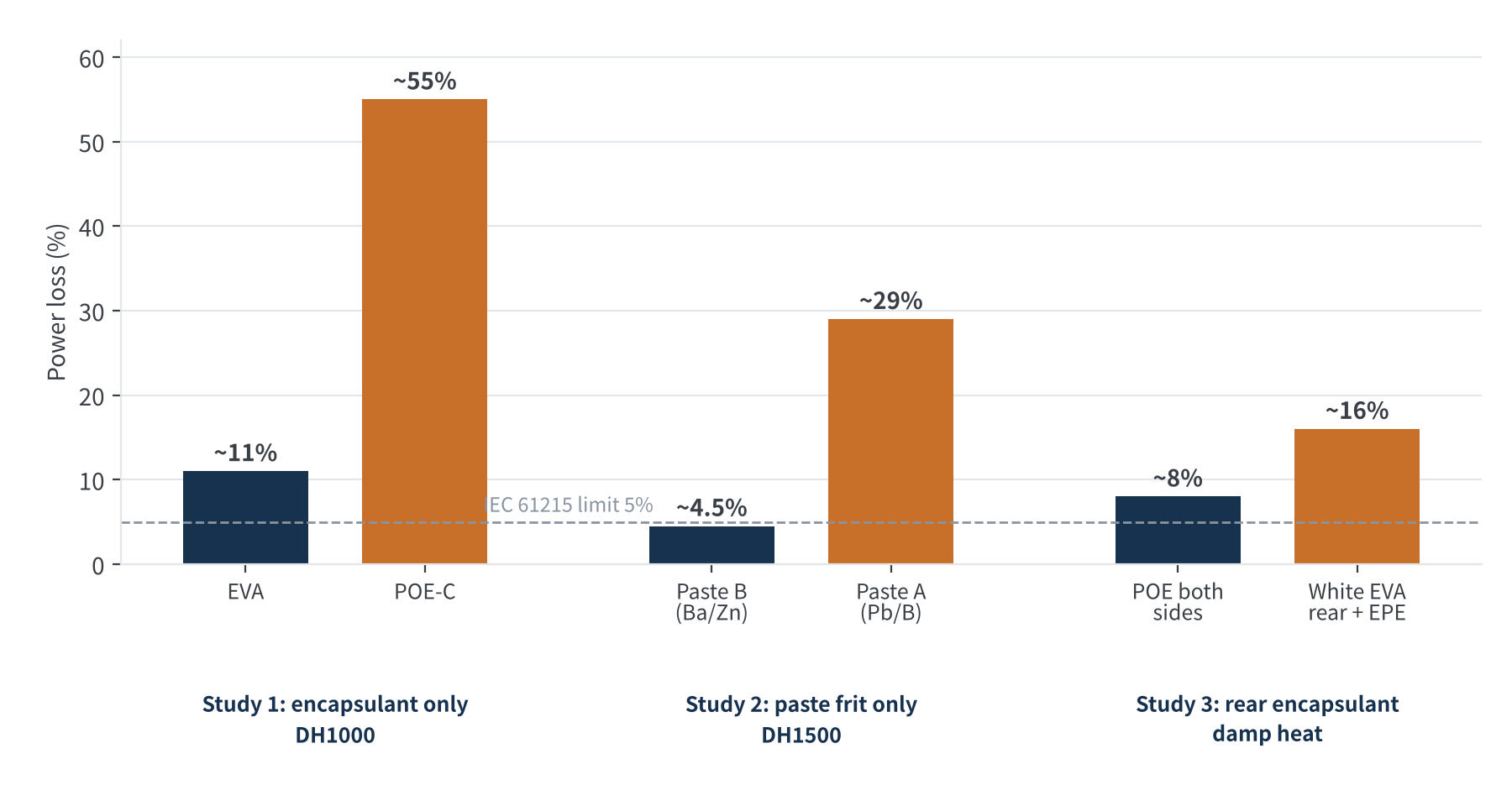
Figure 3 Power loss after damp heat for similar cells with different material combinations (data from several published studies)
Independent testing points the same way. In Kiwa PVEL's 2025 Reliability Scorecard, 59% of BOMs had at least one test failure, a record high; its damp-heat test runs 2000 hours, twice the IEC/UL certification requirement. That PVEL rates by BOM rather than by model name says it all: same model, different material, different product.
04 Why didn't IEC 61215 catch it?
If module testing is the safety net, why do failures slip through? We see three reasons.
- Too short: Corrosion failures are cumulative and often accelerate after DH1000. Passing DH1000 says little about DH2000.
- Stresses applied one at a time: IEC 61215 sequences are mostly single-factor or simple series. NREL showed that a polyamide (PA) backsheet that cracked through in the field was not reproduced by conventional IEC accelerated tests; combined-accelerated stress testing (C-AST), applying UV, temperature, humidity and mechanical load together, did reproduce it.
- Limited sample representativeness: Qualification samples come from one batch with one BOM, while in mass production encapsulant recipes, flux types and silicone lots can change at any time. One certificate cannot cover all of that.
In other words, IEC 61215 is a health check showing one BOM was healthy when sampled, not a lifetime insurance policy.
05 Where the standards are filling the gaps
The standards are not standing still.
- IEC TS 62915:2023: The retesting guideline lists which module tests must be repeated after material or component changes. This edition for the first time references the IEC 62788-1 and 62788-2 series to assess changes to critical sub-components, and provides a matrix covering the possible changes. The logic is clear: when a material changes, go back and re-verify the combination at module level.
- Combined and sequential stress testing: C-AST, MAST and similar methods apply several stresses simultaneously or in sequence, closer to the field, and have reproduced several field failures missed by conventional tests.
- Fast cell-level screening: Acetic-acid immersion and damp heat on unencapsulated cells with flux exposure can reveal compatibility risks between paste, flux and encapsulant by-products before any module is built. EPFL research also notes that an accelerated test for acetic-acid corrosion is still missing from industry standards.
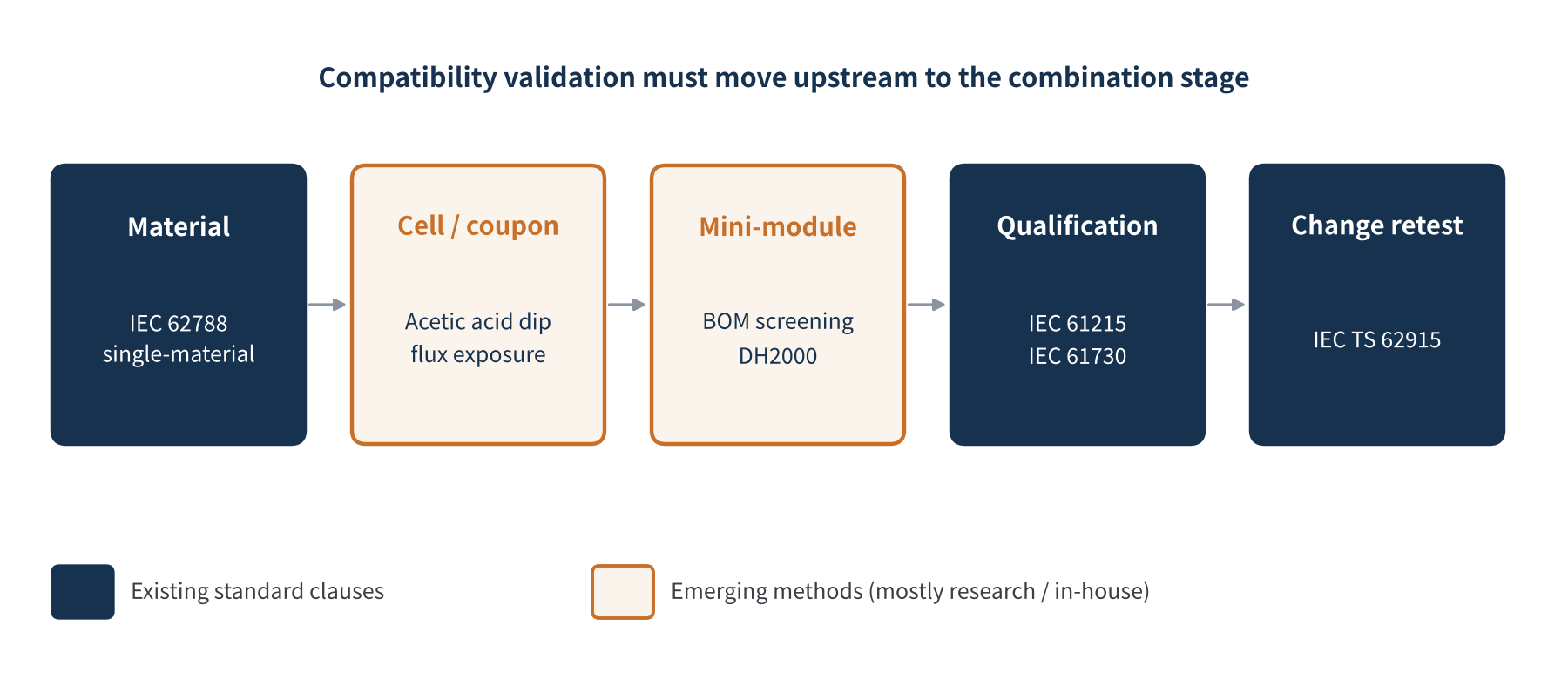
Figure 4 From material level to module level: the current chain of standards and the methods being added
Still, most of these remain technical specifications, research methods or third-party programmes rather than mandatory qualification clauses. For now, compatibility validation is largely up to companies themselves.
06 Final thoughts
A few practical suggestions for module and material makers:
- Lock the BOM: A certificate covers a specific BOM, not "equivalent materials". Any change of model or recipe in encapsulant, flux, silicone or backsheet should be assessed for retesting along the lines of IEC TS 62915.
- Build a compatibility matrix: Record validation results for encapsulant x paste x flux x backsheet x silicone combinations. When introducing a new material, check the matrix first, then test only the gaps.
- Screen earlier: Acetic-acid immersion, flux exposure and DH2000 on cells or mini-modules cost far less than rework at full-module certification.
- Control recipe changes: Require suppliers to give advance notice of changes to recipe, additives or process. "Same part number, different recipe" is the most hidden risk of all.
In one sentence: Material standards ensure every material is good; module standards ensure this module was good at that moment. Whether good materials make a good module together is a question every BOM has to answer for itself.
Next time we will walk through the IEC TS 62915 retest matrix: which material changes require which tests, and which can be waived. You are welcome to share your own "every part passed, the combination failed" cases in the comments.
Data notes: The data in Figure 3 come from different studies with different sample structures, cell batches and test durations (DH1000, DH1500, etc.). They only illustrate that material combinations strongly affect the outcome and should not be compared as absolute values; figures are approximate values reported in the literature. The 5% line is the IEC 61215 per-test power-loss criterion, shown for reference only.
References
- IEC 62788-1-1:2024, Measurement procedures for materials used in photovoltaic modules – Part 1-1: Encapsulants – Polymeric materials used for encapsulation.
- IEC TS 62788-2:2017, Measurement procedures for materials used in photovoltaic modules – Part 2: Polymeric materials – Frontsheets and backsheets.
- IEC TS 62915:2023, Photovoltaic (PV) modules – Type approval, design and safety qualification – Retesting.
- Owen-Bellini M. et al., Advancing reliability assessments of photovoltaic modules and materials using combined-accelerated stress testing, Progress in Photovoltaics 29(1), 2021.
- Miller D.C., Hacke P., Schelhas L.T. et al., Towards validation of combined-accelerated stress testing through failure analysis of polyamide-based photovoltaic backsheets, Scientific Reports 11, 2021.
- UNSW, The dark side of certain POE encapsulant: Chemical pathways to metallisation corrosion in TOPCon modules, Solar Energy Materials and Solar Cells (via pv magazine, 2026-01-16).
- UNSW & Jolywood, Enabling EVA for TOPCon: How glass frit composition governs resistance to acetic acid–induced corrosion, Progress in Photovoltaics (via pv magazine, 2026-05-18).
- UNSW, A novel damp heat-induced failure mechanism in PV modules (with case study in TOPCon), Solar Energy Materials and Solar Cells (via pv magazine, 2026-02-02).
- UNSW, Assessing the impact of solder flux-induced corrosion on TOPCon solar cells, Solar Energy Materials and Solar Cells (via pv magazine India, 2025-08-18).
- Gnocchi L., The role of encapsulants in the long-term performance of advanced crystalline silicon glass-glass PV modules, EPFL thesis, 2022.
- Kiwa PVEL, 2025 PV Module Reliability Scorecard (Executive Summary and related coverage).
PV Materials Lab (光伏新材料研究所)
光伏新材料研究所
十余年光伏研发与技术团队|硬核专业知识分享
材料 · 可靠性 · 失效分析 · 标准认证 · 产品 · 工艺
AI+光伏探索交流,欢迎合作
声明:
- 原创内容仅代表作者个人观点,仅供参考,不构成投资建议。
- 转载及引用内容均注明出处,尊重原创。
- 部分内容含AI辅助(图表生成、数据检索、概念说明等),核心框架与重点内容由本技术团队撰写,并经人工审核。
- 如有不实或侵权,请留言或联系我们处理