
US Tandem Modules Are "Coming Soon", China's GW Lines Are Ramping: The Real Gate Is the Bank
Bottom line first
Certification is only the entry ticket. Whether tandem modules reach the market depends on whether reliability data are good enough for banks to lend. The US has not exaggerated its technical progress this time, but there are still two hurdles, reliability and bankability, between it and "actually selling", and Chinese companies haven't cleared them either.
In early October, New York Times energy reporter Ivan Penn published a report with a blunt headline: a new crop of solar panels is the US's best hope of catching China. It says several companies, including Tandem PV, First Solar and Hanwha Qcells, are preparing to sell tandem modules commercially "soon".
The story was syndicated widely in the US and summarised by many outlets in China. We checked every number in the original and set it against progress in China on BC, TOPCon and perovskite tandems. Our conclusion: the US has not exaggerated its technical progress, but two hurdles, reliability and bankability, still stand between it and "actually selling", and Chinese companies haven't cleared them either.
01What the report says
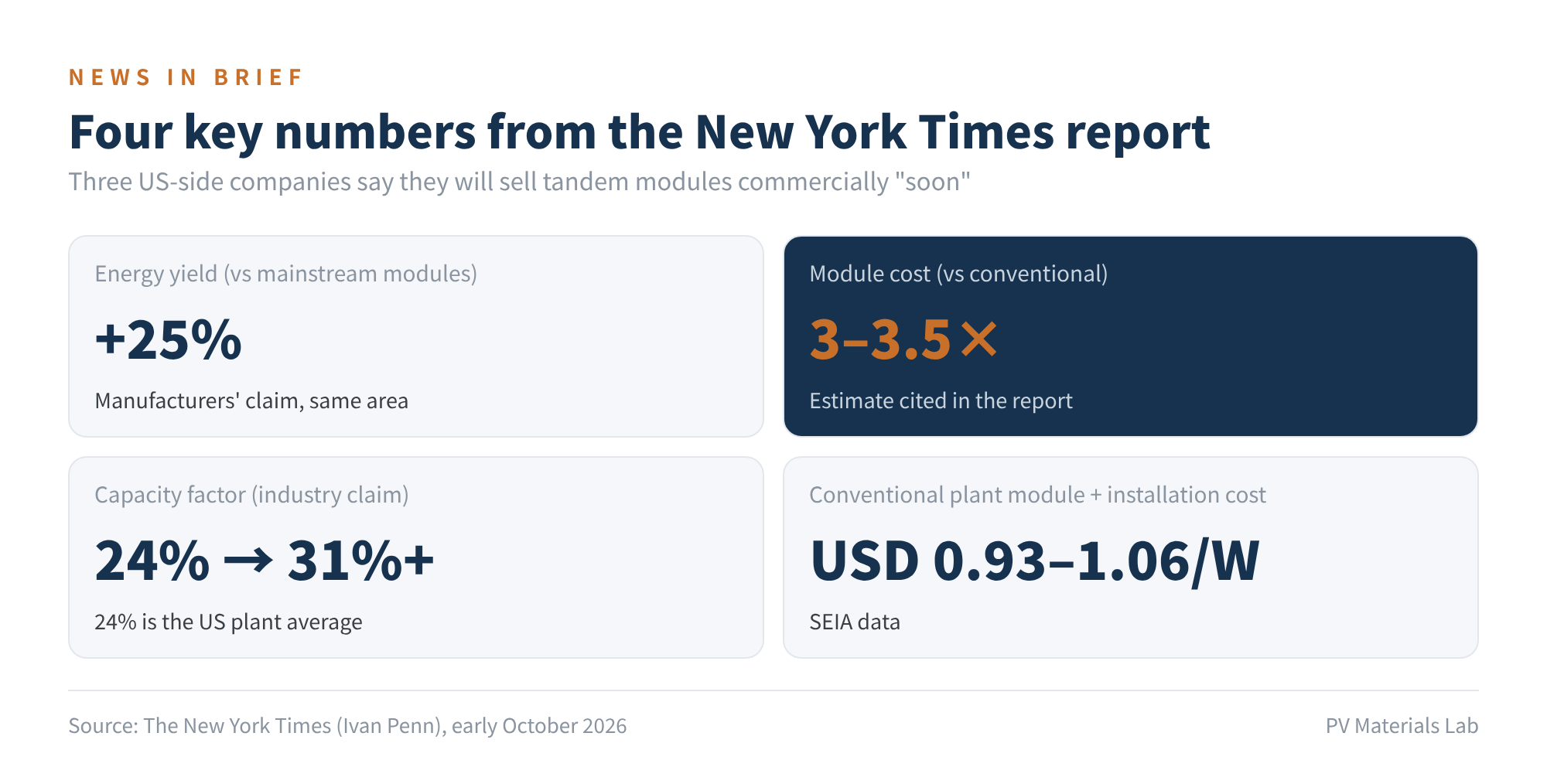
Figure 1 Four key numbers in the report
There are four core points: tandem modules produce about 25% more electricity than mainstream modules; they cost about 3–3.5 times as much as conventional modules; insiders say the capacity factor could rise from the US plant average of 24% to over 31%; and whether banks will accept them, and whether modules can run reliably for 20–30 years, remain open questions.
Two points of interpretation are worth flagging.
The report says several companies are preparing to sell after testing and certification, but the only one explicitly certified is Qcells: in July 2026, TÜV Rheinland certified its two-terminal perovskite-silicon tandem technology to IEC 61215 and UL 61215. Tandem PV has published internal tests and about a year of outdoor trials; First Solar has not disclosed certification for a tandem product.
Capacity factor = actual energy ÷ (rated power × 8,760 hours). When module efficiency rises, the rated power of the same panel rises in step; numerator and denominator rise together, so the capacity factor itself barely changes. 31 ÷ 24 ≈ 1.29, the same order as "about 25% more energy", so it looks more like a restatement of "more energy per unit area". To raise energy per watt, tandems need better temperature coefficients or low-light response; two-terminal tandems also suffer current mismatch under changing spectra, so actual energy yield may not scale with STC efficiency.
02The three US players: how far each has got
- Qcells is the most methodical. It uses its own Q.antum silicon as the bottom cell with perovskite on top in a two-terminal structure; its M10 full-area cell efficiency is 28.6% (certified by Fraunhofer ISE CalLab). The tested modules came from its R&D pilot line in Germany and completed UV preconditioning at 15 kWh/m², 200 thermal cycles, 10 humidity-freeze cycles and 1,000 hours of damp heat. Outdoor sites are in the US, Australia, Cyprus and South Korea, and hail impact testing is under way. No mass-production date has been announced; according to the Korea Herald in June, Hanwha Qcells has set 2029 as its target for commercialising the tandem technology.
- Tandem PV is a start-up. Its demonstration factory in Fremont, California has about 40 MW of annual capacity; it began trial production in January and formally announced production in April, turning out only a dozen or twenty modules a day, each about a quarter the size of a large utility module. The company says internal tests show 29.7% module efficiency and accelerated ageing suggests annual degradation below 1%; it will ship to customers for validation in 2026, with volume production only in 2028.
- First Solar's card is thin film. CEO Mark Widmar says the company has invested more than USD 2 billion in thin-film R&D; in February it licensed Oxford PV's perovskite patents; it plans to build a GW-scale perovskite pilot line in 2027. Management is clear that large-scale deployment depends on proving long-term durability and bankability with plenty of field data.
Taken together, the US strategy is to "switch lanes": unable to match China's scale and cost in mainstream silicon, it is betting on the next generation. Mike Carr, head of the Solar Energy Manufacturers for America Coalition, says in the report that Chinese companies are also working on tandems but their technology is no better than America's and may even lag. Checked against the data, that claim is hard to sustain.
03China: TOPCon defends, BC attacks, tandem in reserve
Start with the mainstream. The 17th edition of the ITRPV roadmap shows global module shipments of about 706 GW in 2025, an n-type wafer share of about 82%, and TOPCon still the leading technology. On TaiyangNews' list of commercial module efficiencies, the best TOPCon is JA Solar's 24.1%, with some new datasheets claiming 24.8%.
BC is the line that changed most this year. LONGi sold 19.55 GW of BC modules in the first half, up 125% year on year and over 65% of its module shipments; AIKO shipped 9.39 GW of ABC in the first half, up about 50%, and together with LONGi leads the TaiyangNews list with 25% commercial module efficiency, with its next-generation product claimed at 26%. But the premium is thin: according to InfoLink, BC carries a premium of only about CNY 0.1/W over TOPCon in China's utility projects. Exawatt estimates BC needs an absolute efficiency advantage of 1–1.5 percentage points to justify full replacement.
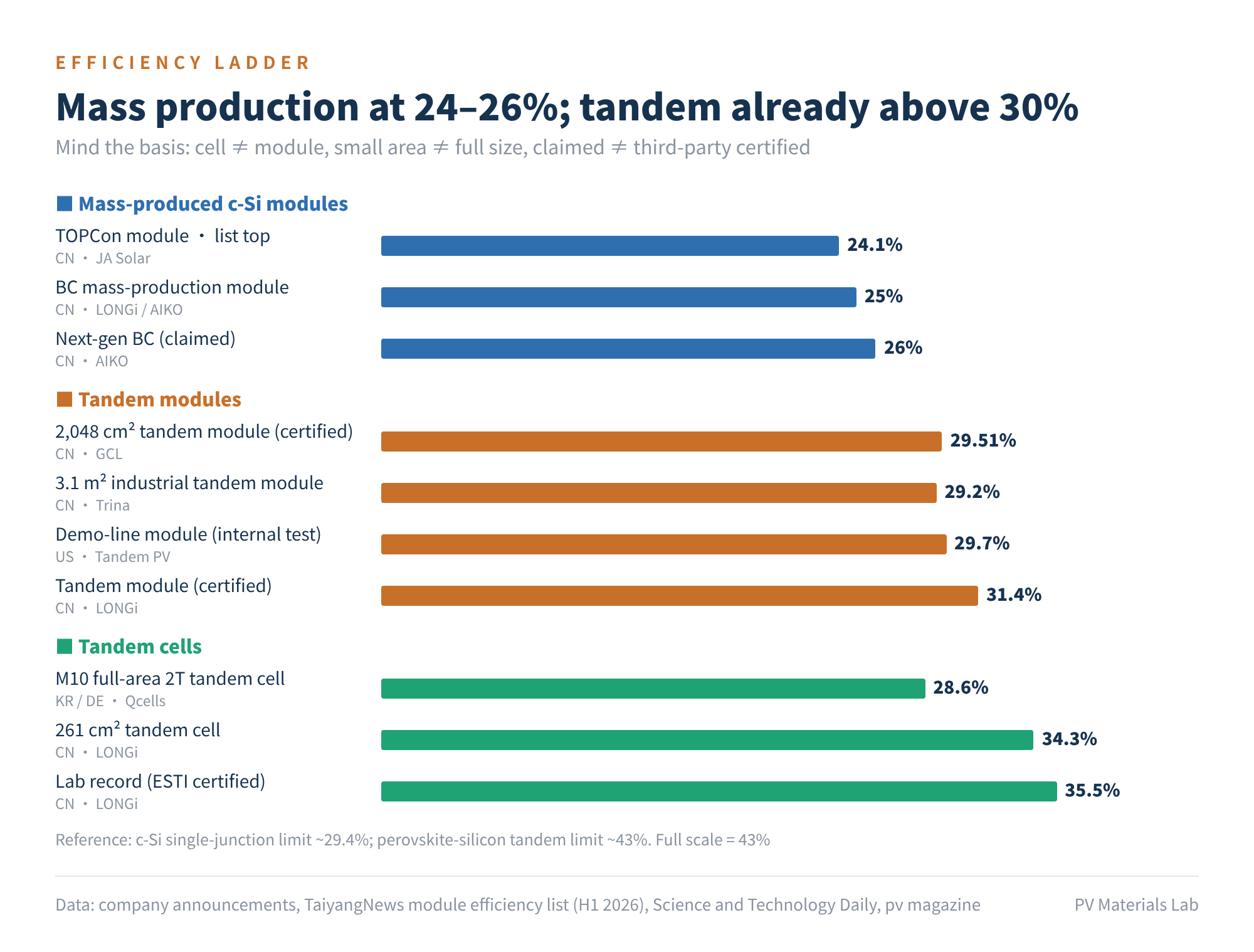
Figure 2 Efficiency ladder from mass-produced silicon to tandem records (note the differences between cells and modules, area and certification basis)
Now tandems. On efficiency, LONGi's perovskite-silicon tandem cell reached 35.5% certified by ESTI, a 261 cm² cell 34.3%, and a tandem module 31.4%; GCL Optoelectronic's 2,048 cm² tandem module reached a steady-state efficiency of 29.51%, certified by China's National Institute of Metrology; Trina's 3.1 m² industrial tandem module reached 29.2% and 907 W (calibrated by TÜV SÜD), passed IEC 61215 and IEC 61730 testing, and in June won its first overseas commercial order from a distributed-energy customer in New Zealand.
On production lines, GCL Optoelectronic's GW-scale line was fully connected on 18 September, UtmoLight's GW-scale line in Wuxi is running and shipping, and Microquanta shipped four-terminal tandem modules as early as the end of 2024. CECEP Solar's 10 MW tandem pilot line is due to be completed by year-end. On certification, GCL says its tandem modules were the first to obtain both IEC 61215 and IEC 61730 certificates, and its single-junction modules passed 3× IEC extended ageing.
Incidentally, Qcells calls itself "the first to obtain both IEC 61215 and UL 61215 certification", while GCL says it was "the first to obtain IEC 61215 and IEC 61730 dual certification". Different bases; both can claim to be "first".
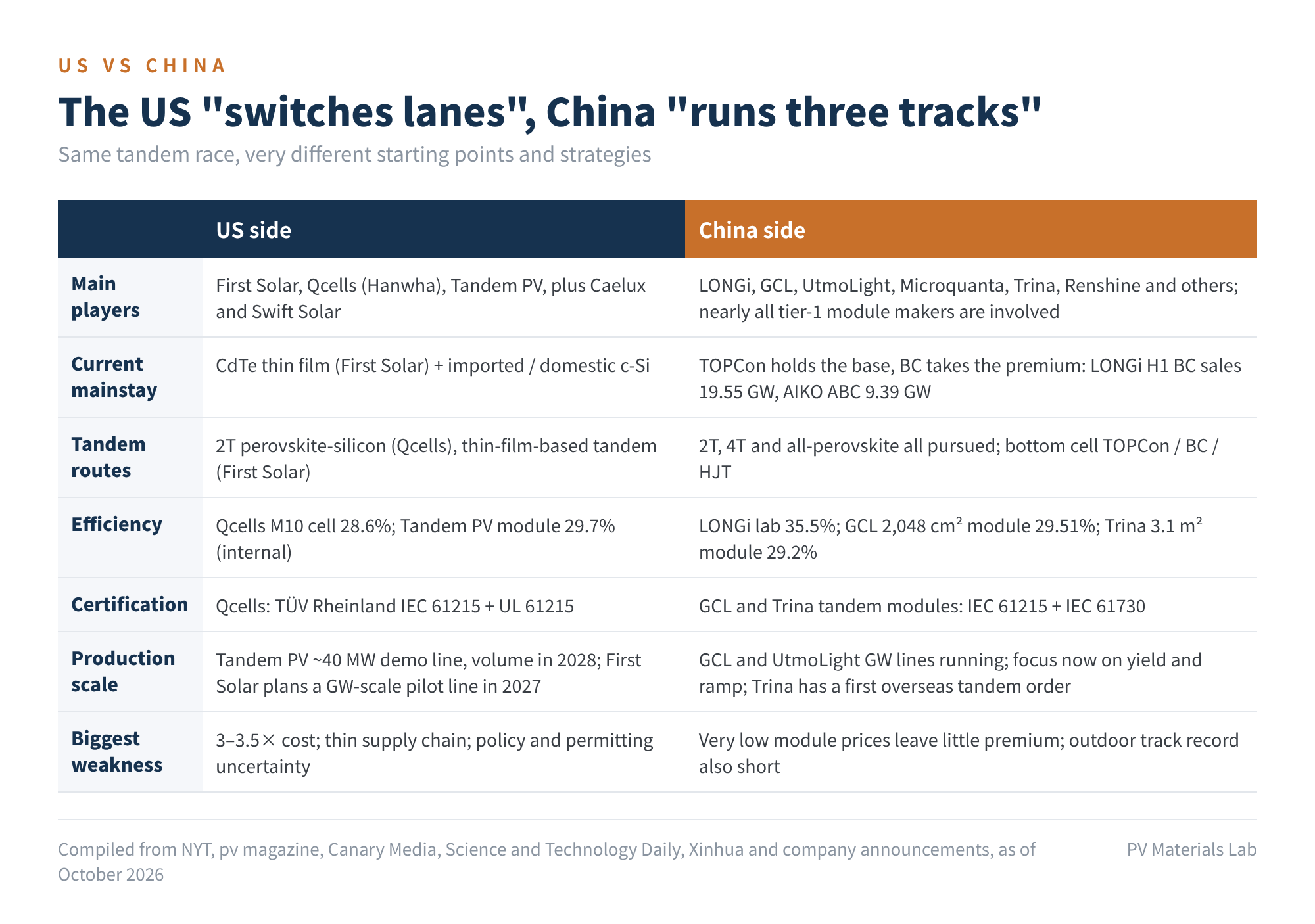
Figure 3 US vs China in the tandem race
China's strategy is three tracks in parallel: TOPCon provides cash flow and scale, BC captures the premium and overseas markets, and tandem is the next-generation reserve. More importantly, a perovskite-silicon tandem adds a layer on top of a silicon bottom cell, so the cheaper and better the bottom cell, the higher the tandem's starting point. Seen this way, the fierce competition in TOPCon and BC is in effect paving the way for tandems.
04Reliability: passing IEC doesn't mean 25 years of service
Anyone who has certified modules knows IEC 61215 is design qualification: it answers "is early-failure risk under control?", not "how long will it last?". For silicon modules, decades of outdoor data have linked the two; perovskites have no such track record, and they have several failure modes silicon doesn't.
- Coupled light and heat. Damp heat, thermal cycling and humidity freeze are all dark tests, whereas ion migration in perovskites and phase segregation in wide-bandgap mixed halides mainly occur under light plus high temperature. The four tests Qcells disclosed are all standard sequences; long-term ageing data under illumination have not been published.
- Day-night metastability. Perovskite devices degrade during the day and partly recover at night, so how to stabilise and measure power is itself an open question, and it directly affects how degradation rates are calculated.
- Reverse bias. Perovskites have low reverse breakdown voltages, so sub-cells are easily damaged irreversibly under partial shading; hot-spot tests and bypass protection design both need rethinking.
- Moisture and UV. Encapsulation requirements are clearly higher than for silicon; glass-glass with edge sealing is practically mandatory, and the moisture barrier of encapsulants and edge seals becomes one of the factors that determine lifetime.
- Lead. Lead leaching after hail or mechanical breakage is a more sensitive compliance issue than power loss.
As far as we know, the technology-specific requirements in IEC 61215 currently cover silicon and several mature thin films; perovskite-specific test requirements are still under discussion and development. In other words, today's certificates were earned on someone else's exam paper.
Public data from China tell the same story: several research results published in the first half report continuous operation of 800 to just over 1,000 hours, and manufacturers mostly disclose figures on the order of "80.5% retained after 1,000 hours of illumination". Professor Martin Green of UNSW still has a point: the stability problem may be solved in five or ten years, or it may never be solved.
05Bankability: what banks actually look at
Fabian Fertig, head of tandem R&D at Qcells, puts it plainly in the report: the power sector is conservative about new technology, and companies must convince banks it will perform as expected.
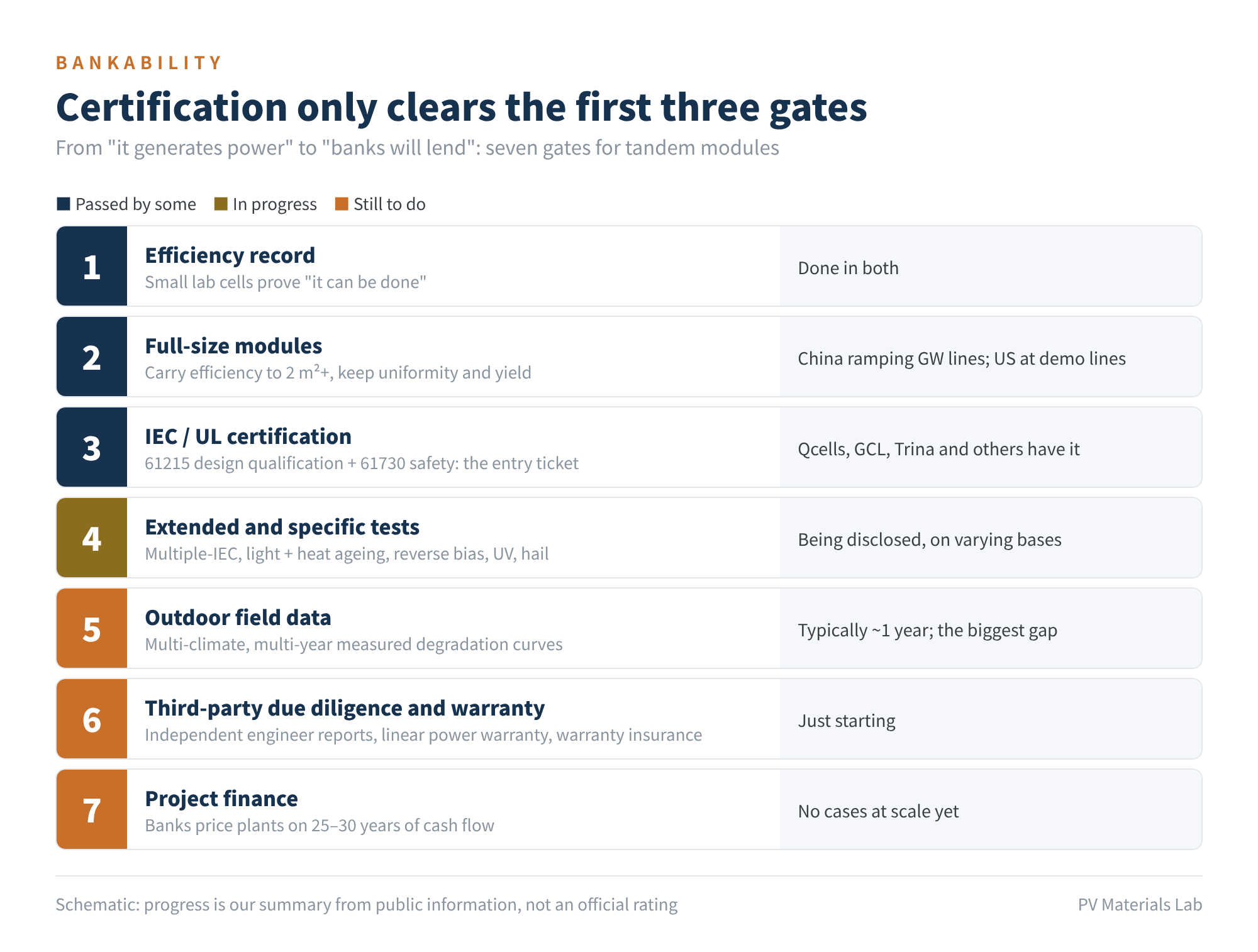
Figure 4 Seven gates from efficiency record to project finance
Plant finance is about 25–30 years of cash flow, and banks care about three things: how uncertain the energy yield forecast is, whether the degradation assumption holds, and whether the warranty can be honoured if things go wrong. For module makers, that means multi-year field data from several climate zones, extended-test results from third-party labs, due diligence reports from independent engineers, and insurance or parent-company credit behind the warranty.
Take Tandem PV's "annual degradation below 1%". Even if that holds, at 1% a year linear, about 75% remains after 25 years; mainstream n-type module warranties are usually 1% in the first year and about 0.4% a year after, leaving about 87% at the end of 30 years. Part of the initial 25% extra energy is eaten away year by year by faster degradation, which has to be discounted in the financial model.
Wayne Li of the Electric Power Research Institute (EPRI) notes that some utilities have bought early tandem modules but require extensive third-party testing, and manufacturers are reluctant to share details and data. Chetan Krishna of RMI also says long-term durability is still unknown. Without data transparency, due diligence can't be done, and that is a harder constraint than cost.
Here the US has an easily overlooked advantage: First Solar's CdTe was also accepted by banks step by step, on the strength of over a decade of field data and warranty credit, so it knows the road. Chinese companies' advantage is production lines and shipment volume: the more they install, the faster the data arrive. Several leading Chinese perovskite companies already have MW-scale projects on the grid, and the field degradation curves of the next two or three years matter more than any efficiency record.
06Cost: efficiency can't carry a 3× premium
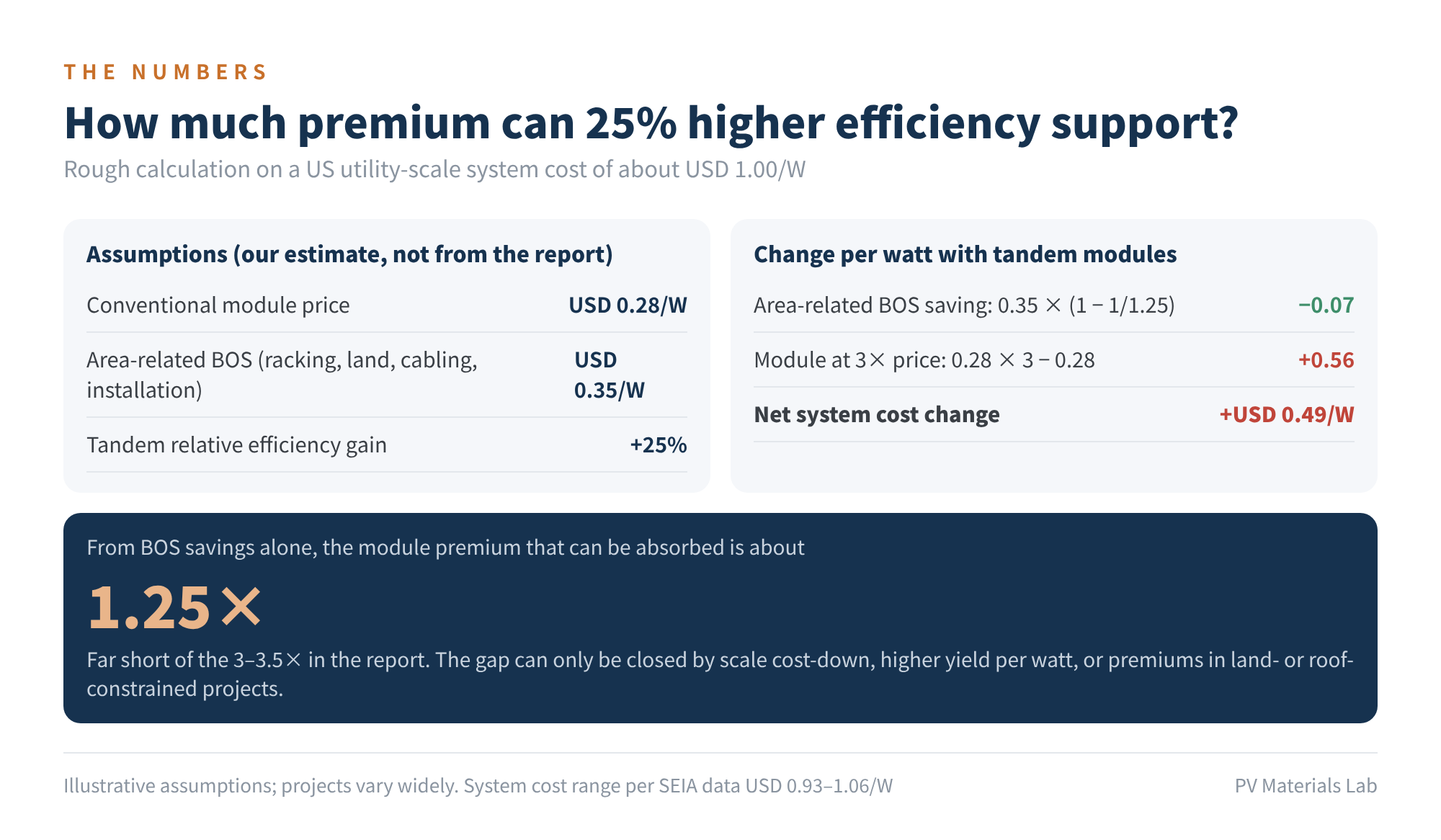
Figure 5 How much module premium the efficiency gain can cover (our estimate)
We did a rough calculation on a US utility-scale system cost of about USD 1/W: assuming conventional modules at USD 0.28/W and area-related BOS of about USD 0.35/W, a 25% relative efficiency gain saves about USD 0.07/W of BOS. In other words, from BOS savings alone, tandem modules can bear a premium of only about 1.25 times conventional modules, far from 3–3.5 times.
AES CEO Andrés Gluski says in the report that price decides everything, and China's capacity could supply the world twice over. That is pressure on US manufacturers, but equally on Chinese perovskite companies: silicon module prices in China are already extremely low, first-half installations were 72.07 GW, down 66% year on year, and selling a new technology at a premium is even harder.
China's cost-down path is at least clear. An UtmoLight executive says perovskite modules currently cost about CNY 1.5/W, a single GW line at full output can reach about CNY 0.8/W, and industry capacity of 10–20 GW could bring about CNY 0.5/W. GCL Optoelectronic says that, owing to small capacity and an immature supply chain, its modules are still about CNY 1/W more expensive than silicon.
07Final thoughts: our judgements
- 2026–2027 are years of certification and demonstration, not mass production. ITRPV expects silicon-based tandem cells to enter the market in considerable volumes around 2028 and reach about 17% market share by 2036.
- The deciding factor is not efficiency records but field data and warranty credit. Whoever first builds up three to five years of measured degradation curves across climate zones, and is willing to publish them, will be first to secure project finance.
- The first US applications will be narrow. Only projects with constrained land or roof space, domestic manufacturing incentives and high power prices can absorb a premium of several times.
- China's trump card is the bottom cell and the supply chain. BC and TOPCon are both today's cash flow and the foundation of tandem; whoever has the cheapest bottom cell will have the cheapest tandem.
- When reading tandem news, ask three questions first: How large is the area? Who measured it? How long was it aged under light?
The finish line of this race is the bank's loan approval form; efficiency figures are just the entry form.
What do you think of the bankability hurdle for tandem modules? We would be glad to hear from you.
References
- The New York Times (Ivan Penn), October 2026; syndicated by NWA Democrat-Gazette on 11 October
- Baton Rouge Business Report summary of the NYT report
- DNYUZ: full syndication of the NYT report, 2026-10-05
- pv magazine: Qcells secures TÜV Rheinland certification for perovskite-silicon tandem solar tech, 2026-07-16
- pv magazine USA / TaiyangNews: Tandem PV opens 40 MW factory in California, April 2026
- Canary Media: Tandem PV's Fremont factory
- Perovskite-Info: First Solar perovskite roadmap (Q1 2026)
- Solar Power World: First Solar gets access to Oxford PV perovskite patents, February 2026
- Science and Technology Daily: LONGi tandem cell at 35.5%, 2026-07-16; China Energy News, 2026-07-20
- Perovskite-Info / SMM: GCL 2,048 cm² tandem module at 29.51%, 2025
- pv magazine USA: Trina Solar announces 907 W tandem solar module with 29.2% efficiency, 2026-06-01; PV Tech: Trina tandem order in New Zealand, 2026-06-22
- Science and Technology Daily: GCL Optoelectronic GW-scale line fully connected, 2026-09-19
- Xinhua: LONGi 2026 interim results; TaiyangNews: AIKO H1 2026 results
- Sina Finance / PV Insights: perovskite mass production review, 2026-09-09; CECEP Solar 10 MW tandem pilot line
- TaiyangNews: commercial module efficiency list (H1 2026); Exawatt technology analysis
- pv magazine USA / TaiyangNews: ITRPV 17th edition, June 2026
- pv magazine USA: China installs 72.07 GW in H1 2026, 2026-07-29
A PV R&D and technology team with 10+ years of experience | In-depth technical knowledge sharing
Materials · Reliability · Failure Analysis · Standards & Certification · Products · Processes
Exploring AI + PV; collaboration welcome
Disclaimer:
1. Original content reflects the authors' personal views only, is for reference only and does not constitute investment advice.
2. Reposted and cited content is credited to its source, out of respect for original work.
3. Some content was produced with AI assistance (chart generation, data retrieval, concept explanations, etc.); the core framework and key content were written by our technical team and reviewed by people.
4. If anything is inaccurate or infringes your rights, please leave a message or contact us and we will deal with it.