
5–10× Faster Inspection, 0.1% Missed Defects: How to Read the Six Numbers as AI Enters LONGi's Storage Line
Introduction
LONGi Jingkong has opened its smart manufacturing base in Suzhou, disclosing an "MES + BI + AI" platform and six efficiency and quality numbers. We are positive on the move: well-chosen scenarios, clearly quantified targets, and AI inspection experience from LONGi's Wuhu base behind it. This article unpacks what the numbers mean, the key bases for reading them, and the challenges and highlights of AI inspection on an energy storage line.
On 11 October, Securities Daily reported that the smart manufacturing base of LONGi Jingkong, a LONGi Green Energy subsidiary, in Suzhou High-tech Zone had officially opened, and gave six efficiency and quality numbers in one go. The most eye-catching: "inspection efficiency up 5 to 10 times, missed-defect rate kept within 0.1%".
As a technical team with more than a decade on production lines and in labs, we are broadly positive about this news: it is rare in the industry for a PV leader to publish quantified AI targets for a new base right at start-up. Below we take the numbers apart to see where each comes from, how to read it, and what to watch next.
01What the news actually says
First, the facts. According to the report, the base covers about 66 mu (roughly 4.4 hectares) and handles manufacturing, testing, quality inspection and delivery of commercial, industrial and utility-scale energy storage products worldwide. The utility-scale integration line is to reach 31 GWh a year of integration capacity by the end of October, expanding to 50 GWh a year in the first half of 2027; the C&I storage line is to reach an output of more than 10,000 units a year by the end of October.
LONGi Jingkong was formerly Jingkong Energy, which holds 345 R&D patents. In November 2025, LONGi obtained about 62% of its voting rights, and control, through a combination of share transfer, capital injection and voting-rights entrustment, entering the energy storage business. Less than a year from gaining control to opening the base is a fast pace.
On digitalisation, the base will complete a full MES upgrade in November, building a lightweight "MES + BI + AI = MOM" manufacturing operations management platform connected to ERP, WMS and RCS. On AI, it focuses on three scenarios: smart process execution, smart quality inspection and smart equipment maintenance.
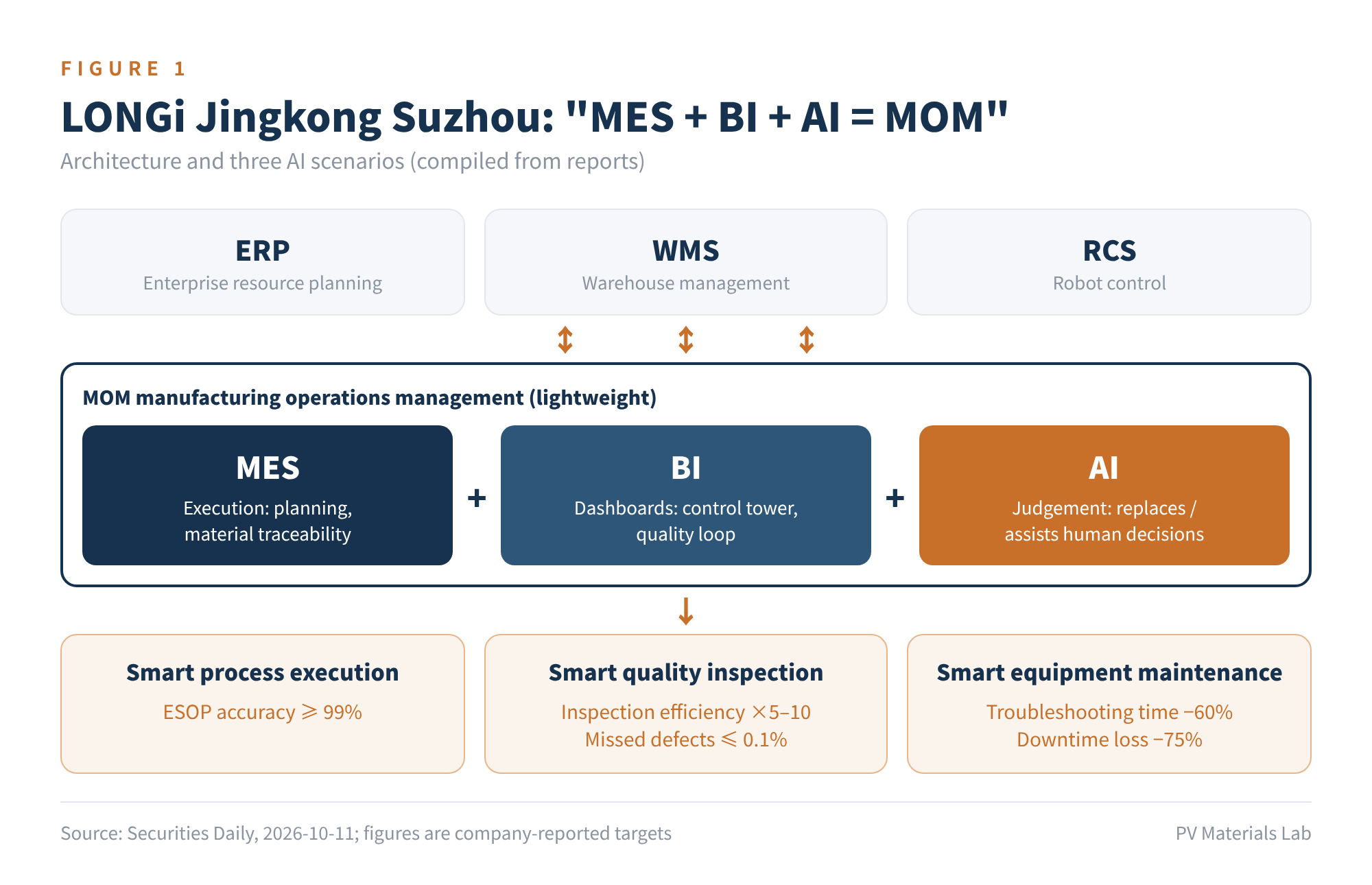
Figure 1 LONGi Jingkong Suzhou's "MES + BI + AI = MOM" architecture and three AI scenarios (compiled from reports)
Before reading the news, keep two premises in mind:
- This is an energy storage line, not a module line. The objects inspected are cells, modules, packs and system cabinets, quite different from the module EL and visual inspection we know.
- Most of these numbers are targets. MES will only be fully deployed in November, and the original uses wording such as "can reach", "will drive" and "kept within", so they should be read as design targets or pilot values. Publishing quantified targets at start-up is itself a sign of confidence.
02First, separate "AI" from "digitalisation"
The MOM formula itself shows the division of labour: MES handles execution (issuing plans, material traceability), BI handles visibility (control tower, quality dashboards), and AI handles judgement (replacing or assisting human decisions). Sorting the six numbers in the report by where they come from gives this:
| Company-reported number | Attributed to | Baseline disclosed? | Our reading |
|---|---|---|---|
| Quality issue closure time cut by over 50% | Control tower + digital quality loop | No | Digitalisation gain, high certainty |
| ESOP execution accuracy ≥ 99% | AI · smart process execution | No | Error-proofing; achievable in the industry |
| Inspection efficiency up 5–10× | AI · smart quality inspection | No | Most likely vs manual; precedents exist |
| Missed-defect rate ≤ 0.1% | AI · smart quality inspection | Denominator not stated | Ambitious target; basis to be disclosed |
| Troubleshooting time cut by over 60% | AI · smart equipment maintenance | No | AI + knowledge base; relatively achievable |
| Downtime loss cut by 75% | AI · smart equipment maintenance | No | Several measures combined; ambitious |
Table 1 Where the six numbers come from, and how we read them
The first number is explicitly attributed to the "manufacturing operations control tower" and "digital quality loop management": in essence it comes from connecting processes and making information transparent, through MES + BI. We make this distinction deliberately because the two kinds of gain differ: digitalisation gains come from removing waiting and information gaps, and are replicable and highly certain; AI gains come from replacing human judgement and have a higher ceiling. LONGi Jingkong is coordinating both on one MOM platform, laying the digital foundation first and then adding AI, which is a sound approach.
The six numbers cover execution, inspection and maintenance end to end, and five of them sit under AI. The targets are clear and trackable; the actual results will be worth watching.
03Inspection: how to read "5–10×" and "0.1%"
What does an energy storage line inspect? Roughly: incoming cell appearance, laser welds on terminals and busbars, module/pack assembly, harness connections, bolt torque, air-tightness, insulation and withstand voltage, and end-of-line (EOL) testing. Visual judgements such as welds, appearance, connector seating and labels are AI inspection's main battleground; electrical tests were already judged automatically by equipment.
Start with "5–10×". For PV people this order of magnitude is familiar: AI image judgement of module EL and appearance has long delivered several-fold efficiency gains over manual judgement, so the target has industry precedent. The span from 5× to 10× reflects differences between stations: highly standardised stations such as welds and appearance more easily reach the upper end.
Now "0.1%". This is a fairly ambitious target. When reading such numbers, what matters most for a missed-defect rate is the denominator. If the denominator is defective units, 0.1% means 99.9% detection; if it is all units, then under an assumed 2% defect rate, detection is about 95%. The same "0.1%" can mean a 50-fold difference in escaped defects. This basis problem is common across the industry, not unique to this news.
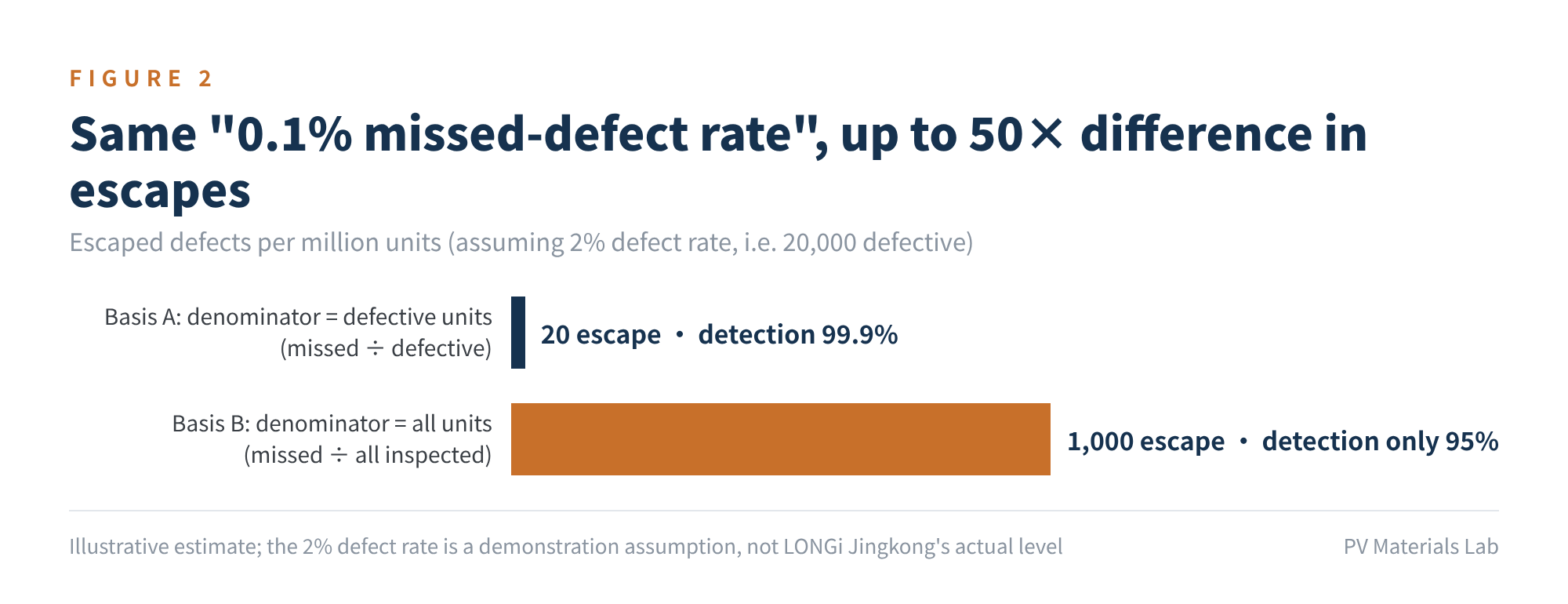
Figure 2 Escaped defects under two bases for a "0.1% missed-defect rate" (estimate; assumptions at the end)
The companion metric is the over-reject rate. Missed defects and over-rejects are a seesaw: tighten the threshold and misses fall, but more good parts are wrongly flagged and manual re-checking grows. The real value of AI inspection lies in finding a better balance between the two than humans can.
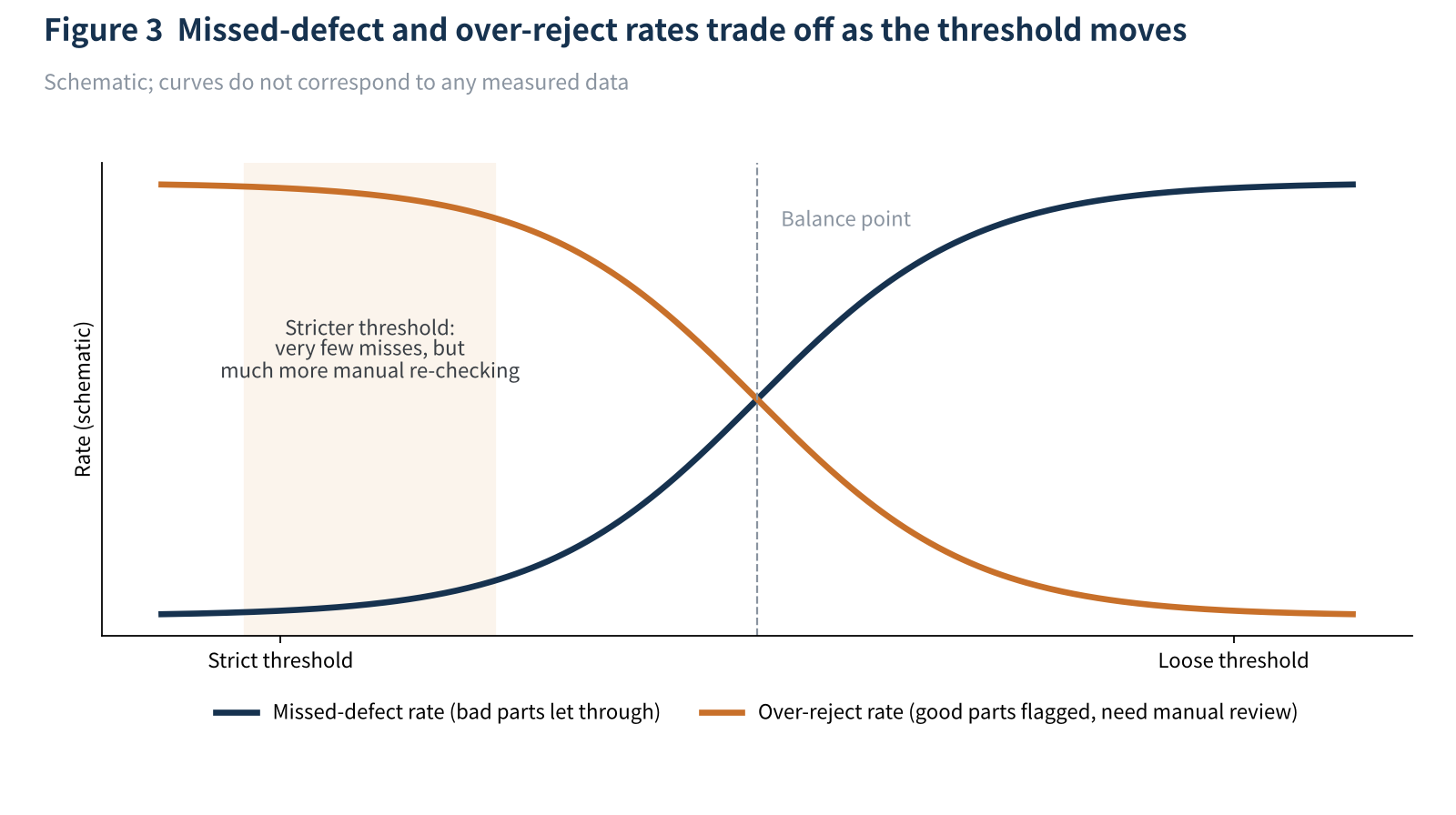
Figure 3 Missed-defect and over-reject rates trade off as the threshold moves (schematic)
There is also the question of the ground truth: cold or false welds in storage products may not be visible at end of line, often only showing up later through internal resistance and temperature rise. We summarise the key bases for reading such numbers in four points, and hope LONGi Jingkong will disclose them once the base has been running for a while:
- Baseline: compared with manual visual inspection, or with an older vision system?
- Denominator: is the missed-defect rate based on defective units or on all units?
- The other half: what is the over-reject rate over the same period, and how much has manual re-checking fallen?
- Ground truth and samples: what defines a "true defect", how large is the sample, which defect categories does it cover, and is there third-party sampling?
04Maintenance: the premises behind 60% and 75%
"Troubleshooting time cut by over 60%" is easy to understand and relatively easy to deliver: linked equipment data, fault trees and knowledge bases (quite possibly with an LLM Q&A assistant) help engineers locate problems faster, and there are many successful cases in the industry.
"Downtime loss cut by 75%" is an ambitious target. Downtime loss comprises troubleshooting, waiting for spare parts and restarting production; spare-parts management, standardised inspection rounds and AI all contribute. Note that predictive maintenance relies on accumulated failure samples, so a new base must initially rely on equipment makers' models and experience transferred from similar lines. Seen another way, though, the new base has its equipment data system in place from day one; samples will accumulate and models will improve with use, a higher starting point than retrofitting an old line.
05Placing it within LONGi's own track record
In September, Science and Technology Daily and Xinhua reported that LONGi's Wuhu module base had achieved Level 4 certification under the Capability Maturity Model for Intelligent Manufacturing (CMMM), the first module factory in the PV industry to do so; only around a hundred companies nationwide have reached Level 4. The base deploys seven AI engines covering skills management, scheduling, quality inspection, equipment maintenance, process optimisation, energy management and warehousing; its full-chain AI inspection platform raised defect detection efficiency by 80% and cut the line's quality incident rate by 40%, while production efficiency rose 21% and energy consumption fell 7%.
This is a key reason we are positive on the Suzhou base: LONGi already has AI deployment on the module side that has been assessed under the national standards framework, so Suzhou isn't starting from scratch. Note, though, that Wuhu reports "80% efficiency gain" while Suzhou reports "5–10×"; the bases clearly differ, and efficiency percentages without a common basis shouldn't be compared directly.
Technically, transferring module experience to storage has its own difficulties. Module AI inspection is built on vast numbers of EL images with relatively standard defect forms; storage lines have small batches and many models, weld and assembly defects take many forms, and defect samples are scarce, so the small-sample problem is more acute. This is the key challenge for the Suzhou base, and where we most look forward to results.
06Final thoughts
Our assessment: the direction is right, the foundation is solid and the targets are clear; it deserves a positive view. Process execution, quality inspection and equipment maintenance are the three most mature manufacturing AI scenarios with the clearest economics, and "lightweight MOM" is more pragmatic than talk of "lights-out factories"; with the experience from Wuhu, LONGi Jingkong has the basis to deliver these targets. The published numbers are still mostly company-reported targets, and bases such as baselines, sample sizes and over-reject rates remain to be disclosed.
We suggest checking back on three things this time next year: whether there is a third-party capability assessment, whether customer-side quality data have improved, and whether the annual report contains traceable operating metrics. In our "AI + PV" series, we will keep tracking AI practice in PV companies' manufacturing.
Well-chosen scenarios, a solid foundation and clearly quantified targets: we are positive on AI manufacturing at LONGi Jingkong's Suzhou base, and look forward to actual results and disclosure of the bases.
How are missed-defect and over-reject rates defined for AI inspection on your line? We would be glad to hear from you.
References
- Securities Daily: "LONGi Jingkong smart manufacturing base officially opens, accelerating solar-storage integration and global delivery", 2026-10-11 (republished by 10jqka and Sina Finance)
- Science and Technology Daily: "LONGi's Wuhu base becomes the PV industry's first module factory at Level 4 of intelligent manufacturing capability maturity", 2026-09-01; Xinhua coverage, 2026-09-03
- Yicai: coverage of LONGi Green Energy obtaining control of Jingkong Energy, November 2025
- GB/T 39116-2020, Maturity model of intelligent manufacturing capability; GB/T 39117-2020, Assessment method of intelligent manufacturing capability maturity
A PV R&D and technology team with 10+ years of experience | In-depth technical knowledge sharing
Materials · Reliability · Failure Analysis · Standards & Certification · Products · Processes
Exploring AI + PV; collaboration welcome
Disclaimer:
1. Original content reflects the authors' personal views only, is for reference only and does not constitute investment advice.
2. Reposted and cited content is credited to its source, out of respect for original work.
3. Some content was produced with AI assistance (chart generation, data retrieval, concept explanations, etc.); the core framework and key content were written by our technical team and reviewed by people.
4. If anything is inaccurate or infringes your rights, please leave a message or contact us and we will deal with it.