
How Much of the Power Lost in UV Testing Is Real? Trina Splits TOPCon UVID into Reversible and Irreversible
In brief
A Trina Solar team writing in SOLMAT divides ultraviolet-induced degradation in TOPCon cells into reversible r-UVID and irreversible ir-UVID, aligned with the recovery procedure in the proposed IEC TS 63624-1: a higher UV dose followed by a standardised light soak. What recovers is temporary loss; only what remains is the "real" degradation that belongs in warranties and yield models. We unpack the logic of the classification, the status of the standard and the trade-offs in the passivation stack.
On 14 October, pv magazine reported on a paper by a Trina Solar research team in Solar Energy Materials and Solar Cells. It splits ultraviolet-induced degradation (UVID) in TOPCon cells into a reversible part (r-UVID) and an irreversible part (ir-UVID), and aligns the split with the recovery procedure in IEC TS 63624-1, which is still being finalised. It may look like nothing more than two new labels, but it addresses one of the most frustrating questions in TOPCon reliability over the past two years: of the few percent of power lost after a UV test, how much is real?
01What the paper says
First, the news itself. Based on the pv magazine report and the paper's title, the work makes four main points:
- Two definitions: r-UVID is metastable loss that can be recovered by light soaking or thermal annealing; ir-UVID is the persistent loss that remains after the recovery procedure.
- Alignment with the standard: the classification follows the recovery procedure in the proposed IEC TS 63624-1, so that standards bodies, reliability labs, warranty assessors and project financiers can speak the same language.
- Test approach: instead of the usual low-dose UV preconditioning, it recommends a higher UV dose followed by a standardised light soak to separate temporary from persistent loss.
- Mitigation: the key lies in front-surface passivation: AlOx thickness and deposition method, SiON capping layers, PEALD processing, SiNx refractive index and hydrogen management.
The corresponding author is Zhiwei Li. The paper is essentially a review of mechanisms and methodology. Its value lies not in any single new data point but in giving the industry a common yardstick.
02Why TOPCon UVID is hard to measure: metastability
UV photons at 280–400 nm carry about 3.1–4.4 eV. Almost all of them are absorbed near the front surface, in the p⁺ emitter and the AlOx/SiNx passivation stack. That energy is enough to disturb Si–H bonds and fixed charge at the interface, which raises surface recombination. The most direct symptom is a drop in open-circuit voltage (Voc).
The difficulty is that TOPCon UVID is strongly metastable. According to the paper, cells keep losing power after UV exposure ends if they are stored in the dark, mainly as a further drop in Voc that follows double-exponential kinetics. Most of this extra loss can be recovered by light soaking or thermal annealing, through mechanisms linked to hydrogen redistribution and changes in the charge state of traps at the passivated interface.
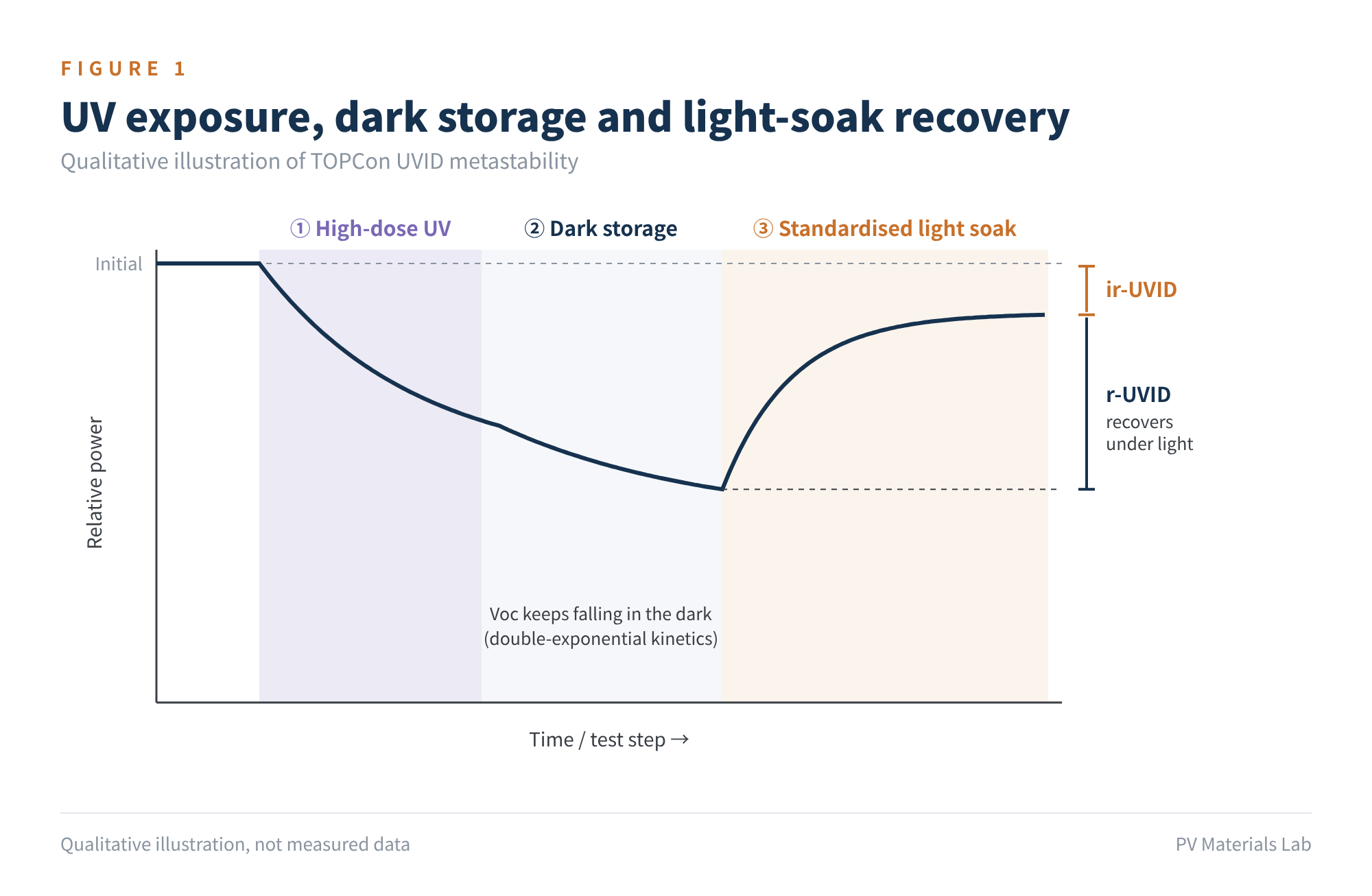
Figure 1 UV exposure, dark storage and light-soak recovery (qualitative illustration, not measured data)
This creates a very practical problem: the same batch of samples can give noticeably different results depending on whether it is measured one day or two weeks after UV exposure. Yet long dark storage is exactly the condition that does not exist outdoors, where modules are re-illuminated by the sun every day. The Trina team says field tests have confirmed that this metastable loss does not affect real outdoor yield, because daily sunlight keeps reversing it.
That conclusion is not isolated. A study by Fraunhofer ISE and CSP, published in EPJ Photovoltaics in March, compared three TOPCon module types and one PERC type at five outdoor sites over up to 28 months. It found that a short light-soak stabilisation after UV exposure is essential for lab assessment, because it cancels the dark-storage effect; without stabilisation, one module type showed a loss of about 6.5%. With stabilisation, indoor results correlated well with outdoor degradation and only slightly overestimated it for TOPCon. Work by Jinko and UNSW in Energy & Environmental Science has also confirmed, at materials level, that TOPCon UVID can be recovered by light soaking.
Dark storage inflates the loss and light gives it back. A UV test without a recovery step is likely to overstate the real risk.
03r-UVID vs ir-UVID: one light soak draws the line
Once metastability is understood, the r/ir split is straightforward. A single standardised light soak is the dividing line: whatever recovers is r-UVID, and whatever remains after recovery is ir-UVID.
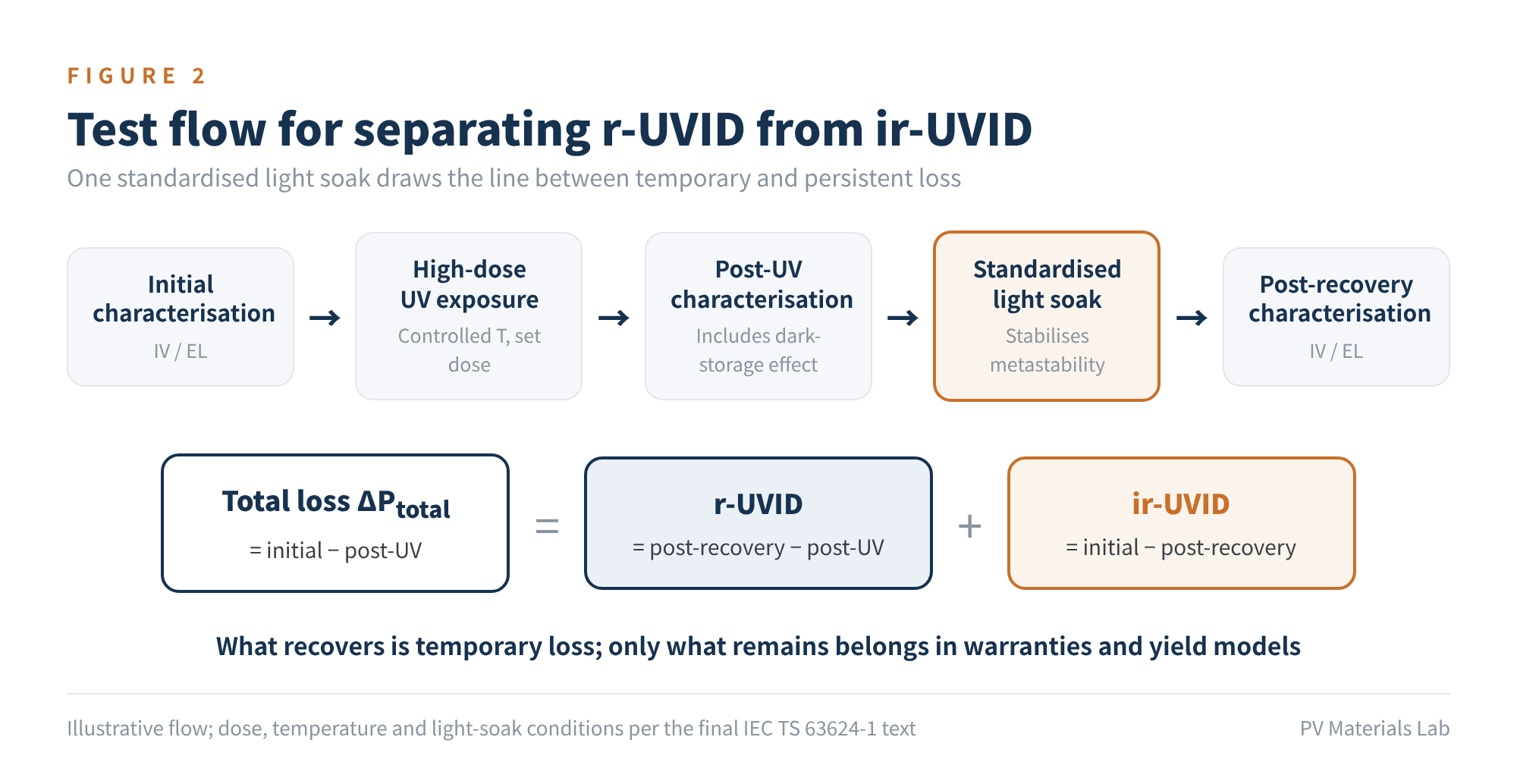
Figure 2 Test flow for separating r-UVID from ir-UVID (illustrative)
Why the higher dose? The UV preconditioning test in IEC 61215 (MQT 10) has a cumulative dose of only 15 kWh/m². It was designed to screen for early failures in encapsulation materials. For cell-level UVID in TOPCon it is neither harsh enough nor does it specify a recovery step, so it may miss degradation mechanisms specific to TOPCon. A higher dose gives persistent damage a chance to show up; stripping away the metastable part with a light soak then leaves a figure that can be meaningfully compared.
| Aspect | r-UVID (reversible) | ir-UVID (irreversible) |
|---|---|---|
| How it is determined | Portion recovered by standardised light soak/annealing | Portion remaining after the recovery procedure |
| Typical signature | Voc keeps falling during dark storage; double-exponential kinetics | Power and Voc loss that persists after recovery |
| Mechanism clues | Hydrogen redistribution, changes in interface trap charge state | Persistent changes in the passivation stack that do not self-heal; still under study |
| Outdoor impact | Recovered daily by sunlight; no yield impact seen in the field | Counts directly toward long-term degradation and yield |
| Who cares most | Test labs, certification bodies | Warranties, financing, plant assessment |
Table 1 r-UVID vs ir-UVID (compiled from reports on the paper)
Only what remains after recovery is the "real" degradation that belongs in warranty terms and yield models.
04Aligning with IEC TS 63624-1: where the standard stands
Much of the significance of this classification comes from the fact that it is tied to an international standard that is close to publication. We looked up its current status:
- Title and committee: IEC TS 63624-1, Photovoltaic (PV) modules – Test method for ultraviolet-induced degradation – Part 1: Crystalline silicon, a Technical Specification under IEC TC 82.
- Proposers: according to TaiyangNews (February 2025), the project was initiated by Canadian Solar together with the China Electronics Standardization Institute and others.
- Scope: light source, test conditions, irradiation dose, sample requirements, and the metastability stabilisation and recovery procedure.
- Dose: a 2025 paper citing an early draft gave 120 kWh/m² and equated it to roughly 5–8 years of outdoor UV exposure. Kiwa PVEL, however, estimates the same 120 kWh/m² at roughly 1–2 years of field exposure. Converting dose into "outdoor years" depends on site and spectral assumptions, and the estimates do not agree; the final dose will be whatever the published text specifies.
- Status: national standards bodies' project pages show that the project entered stage 50.00 (final text submitted for approval) in June and moved to stage 50.20 on 2 October 2026 (proof sent to the secretariat or final ballot initiated), with the next stage scheduled for late November. As of writing, it has not yet been published.
Test labs have already moved ahead. Kiwa PVEL's UVID test applies 120 kWh/m² to the front side (metal-halide lamps; 75 kWh/m² with UV fluorescent lamps) at 60 °C with modules short-circuited. If average degradation reaches 2% or more, it adds a full-spectrum light soak of at least 1 kWh/m² and re-measures within four hours, with an optional extension to UVID360. Fraunhofer CSP also offers UV testing according to IEC TS 63624-1. "UV first, then recovery" is becoming the de facto industry practice; what the Trina paper adds is formal names for the two parts of the loss and a clear account of the mechanisms.
The standard governs how to test; the r/ir classification governs how to read the result. Together they let test reports feed directly into warranties and financing.
05Mitigation: trade-offs in the passivation stack
The paper stresses that UVID severity depends strongly on AlOx thickness and deposition method, hydrogen content and bonding configuration, and the choice of capping layer, and that it varies widely between manufacturers because of differences in wafer quality, passivation deposition processes and emitter doping profiles. Almost every mitigation measure comes with both a benefit and a cost:
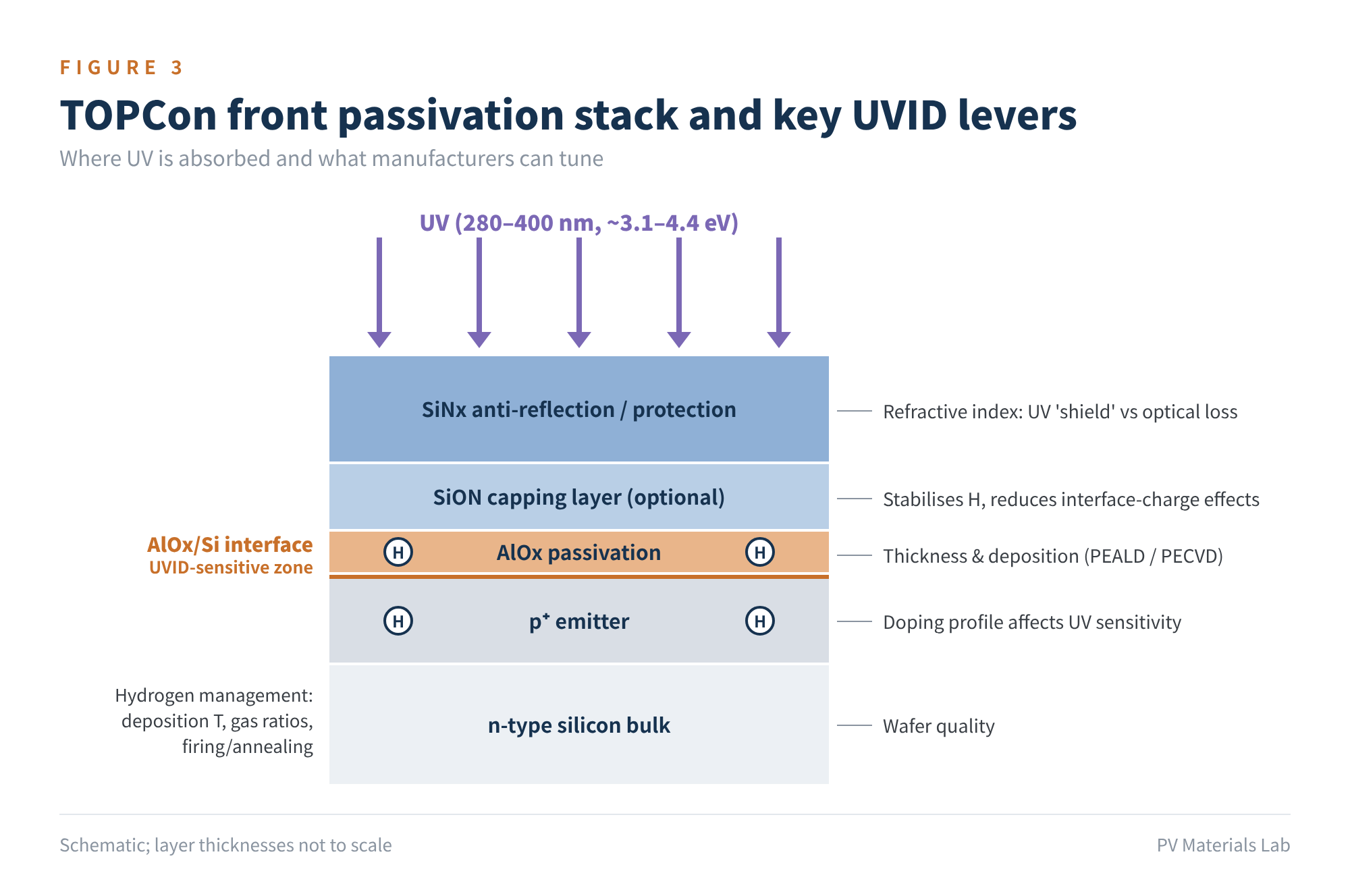
Figure 3 TOPCon front passivation stack and key UVID levers (schematic)
| Measure | Benefit | Cost / risk |
|---|---|---|
| Thicker / optimised AlOx | Most direct gain in UV resistance | Too thick: blistering, more interface defects, higher tunnelling resistance |
| SiON capping layer | Stabilises hydrogen, reduces interface-charge effects, improves chemical passivation | Process window and line compatibility need validation |
| PEALD instead of conventional PECVD | Usually better UV resistance | Results depend on the specific process; tool and throughput cost |
| Tuning SiNx refractive index | Absorbs more UV, protecting the interface below | Too much absorption loses short-wavelength optical gain |
| Hydrogen management | Retains beneficial hydrogen passivation | Must be coordinated with deposition temperature, gas ratios, firing and annealing profiles |
Table 2 Benefits and costs of the main UVID mitigation measures (compiled from reports on the paper)
The SiNx item deserves a closer look. The Trina team's approach is to raise the refractive index so that SiNx absorbs more UV and acts as a shield. Jinko and UNSW, by contrast, found that thick AlOx combined with SiNx with a low Si:N ratio improves UV resistance, and pointed to increased UV reflection from that layer. The two routes do not contradict each other, but they show that SiNx optimisation has to be considered as part of the optical and passivation design of the whole stack; a single refractive index figure cannot simply be copied across.
06Our view: what it gets right and what is still missing
Overall, we view this work positively. It brings at least three practical benefits:
- For warranties and financing: it separates the number that is measured from the number that should be compensated. What owners and banks really need to price is ir-UVID, and the r/ir classification gives third-party reports a metric they can cite directly.
- For cell makers: large differences between manufacturers mean that UVID is mainly a matter of process capability rather than an inherent flaw of the TOPCon route. With a common criterion, manufacturers that do it well can let the data speak.
- For materials and module makers: higher passivation tolerance at cell level and UV-cut or UV down-shifting (UVDS) encapsulants at module level are complementary. Once r and ir are separated, it becomes easier to assess how much "real" degradation an encapsulant actually prevents.
At the same time, ir-UVID is not a negligible number. NREL research published in February found that, after a UV dose equivalent to about one year outdoors, some TOPCon cells still had 2.3–3.2% of non-recoverable loss after recovery, beyond what typical warranties allow. Meanwhile the extra loss caused by dark storage recovered within seconds to minutes under UV LED illumination. This supports the value of the r/ir classification from another direction: the reversible part comes back easily, and what really needs watching is what remains.
Several questions remain open. First, "reversible" does not mean "harmless". A UNSW study this year suggested that some UVID is electrically reversible but structurally irreversible; whether r-UVID gradually turns into ir-UVID over repeated cycles of UV exposure and recovery deserves close checking as the standard is implemented. Second, the authors themselves list open questions: the combined effect of heat and UV, equivalence criteria between light sources such as fluorescent and metal-halide lamps, the effect of UVB relative to UVA, differences in how Isc and passivation-related parameters degrade, and the immaturity of mitigation measures that target ir-UVID.
The r/ir classification turns UVID from an argument into a calculation. Next, watch for long-term ir-UVID data and targeted fixes.
07Final thoughts
Over the past two years TOPCon UVID has gone from being ignored to being overstated. A test report without a recovery step can saddle a reliable product with an unnecessary risk label; conversely, a vague claim that the loss "recovers" can hide genuine persistent damage. Together with IEC TS 63624-1, the Trina paper moves the issue a big step toward being measurable, interpretable and priceable.
For engineers on the front line, the most direct lesson is this: the next time you read a UV test report, first ask "Was a recovery step done? How much loss remains after recovery?" We will keep following the publication of IEC TS 63624-1 and further long-term ir-UVID data.
How does your UV test procedure handle recovery? We would be glad to hear from you.
References
- pv magazine. Trina Solar researchers propose new classification of ultraviolet-induced degradation in TOPCon solar cells. 2026-10-14.
- Zhiwei Li (corresponding author) et al. Ultraviolet-induced degradation in TOPCon solar cells: Reversible (r-UVID) and irreversible (ir-UVID) degradation, mechanisms and mitigation strategies. Solar Energy Materials and Solar Cells, 2026.
- IEC TS 63624-1 ED1 project information (Photovoltaic (PV) modules – Test method for ultraviolet-induced degradation – Part 1: Crystalline Silicon), project pages of the Institute for Standardization of Serbia (ISS) and the Bulgarian Institute for Standardization (BDS), accessed 2026-10-26.
- TaiyangNews. China Solar PV News Snippets (Canadian Solar leads IEC standard proposal for UV-induced degradation testing). 2025-02-07.
- Fraunhofer ISE / CSP. UV-induced degradation: comparative analysis of PV module testing and stabilization procedures against outdoor behavior. EPJ Photovoltaics, 2026, 17: 15. doi:10.1051/epjpv/2026007
- Zhang P. et al. (Jinko Solar / UNSW). A non-destructive UV Raman characterisation platform to enable insight into the mechanism of reversible UVID in TOPCon solar cells. Energy & Environmental Science, 2026, 19(4): 1148–1158. doi:10.1039/d5ee05078b
- pv magazine. Thicker aluminum oxide layers can reduce ultraviolet-induced degradation in TOPCon solar cells (UNSW, Solar Energy Materials and Solar Cells). 2026-01-07.
- pv magazine. NREL researchers quantify UV-induced degradation levels in TOPCon solar cells. 2026-02-03.
- Kiwa PVEL. PQP UV-Induced Degradation (UVID) test procedure.
- Report on the relevance of perovskite module outdoor ageing performance and indoor UV degradation trend. Nanoscale Advances, 2025. doi:10.1039/D5NA00622H (cites draft dose information from IEC TS 63624-1)
A PV R&D and technology team with 10+ years of experience | In-depth technical knowledge sharing
Materials · Reliability · Failure Analysis · Standards & Certification · Products · Processes
Exploring AI + PV; collaboration welcome
Disclaimer:
1. Original content reflects the authors' personal views only, is for reference only and does not constitute investment advice.
2. Reposted and cited content is credited to its source, out of respect for original work.
3. Some content was produced with AI assistance (chart generation, data retrieval, concept explanations, etc.); the core framework and key content were written by our technical team and reviewed by people.
4. If anything is inaccurate or infringes your rights, please leave a message or contact us and we will deal with it.