
An Efficiency Ranking Unchanged for Four Months: BC Tops Out at 25%, TOPCon Close Behind, HJT Holds 740 W
In brief
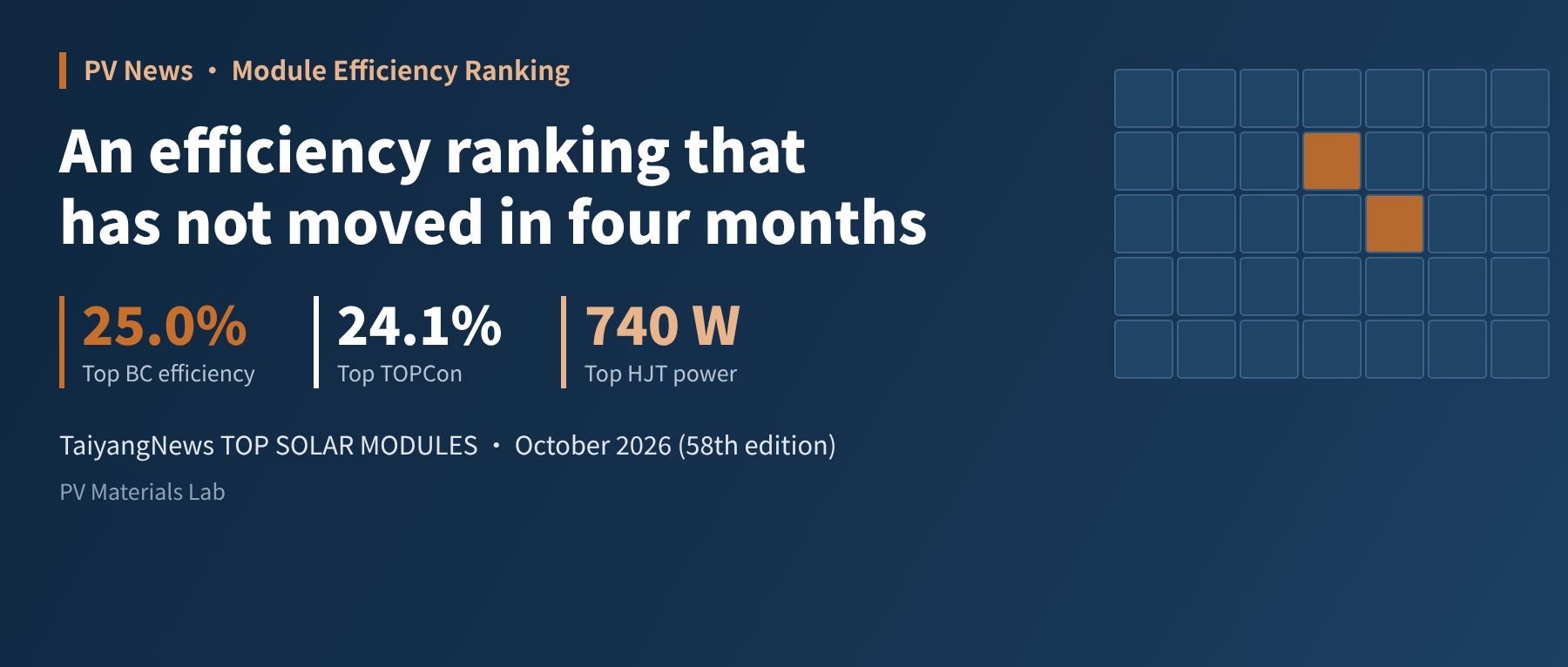
The October edition (58th) of the TaiyangNews commercial module efficiency ranking is unchanged for the fourth month running: BC modules from Aiko and LONGi share first place at 25%, JA Solar's TOPCon module is third at 24.1%, and Risen Energy's HJT module remains the most powerful at 740 W. We look at where the three technologies stand, why power and efficiency need to be read separately, and what lies behind the "no change": the listing rules and new products outside the ranking.
On 14 October, TaiyangNews published the 58th edition of its TOP SOLAR MODULES listing of the world's most efficient commercial modules. As in July, August and September, nothing changed: 38 products from 31 companies, with no additions, no removals and no efficiency upgrades. A ranking that has not moved for four editions in a row is, if anything, worth a closer look.
01The ranking: what the top 12 look like
First, the rules. TaiyangNews has updated the list monthly since early 2022. It only includes commercial modules with an efficiency of at least 21.5%, and the ranking is based solely on the nameplate efficiency in the datasheet; ties are broken by power, then alphabetically. Some criteria are strict: modules must use cells made by the company itself; a complete datasheet must be available on the company's website; and if an efficiency looks "suspiciously high" or sets a record, additional proof of commercial availability is required. Only the best product per company and per technology is listed.
| Rank | Company | Technology | Nameplate efficiency | Power | Module size (mm) |
|---|---|---|---|---|---|
| 1 | Aiko | BC (ABC) | 25.0% | 675 W | 2382×1134 |
| 1 | LONGi | BC (HIBC) | 25.0% | 510 W | 1800×1134 |
| 3 | JA Solar | TOPCon | 24.1% | 650 W | 2382×1134 |
| 4 | JinkoSolar | TOPCon | 23.9% | 645 W | — |
| 4 | Trina Solar | TOPCon | 23.9% | 645 W | — |
| 6 | Risen Energy | HJT | 23.8% | 740 W | 2384×1303 |
| 7 | Tongwei | TOPCon | 23.7% | 735 W | 2384×1303 |
| 7 | DMEGC | TOPCon | 23.7% | 640 W | 2382×1134 |
| 9 | GCL SI | TOPCon | 23.5% | 730 W | 2384×1303 |
| 9 | Huasun | HJT | 23.5% | 730 W | 2384×1303 |
| 9 | Astronergy | TOPCon | 23.5% | 635 W | 2382×1134 |
| 12 | Jolywood | TOPCon | 23.2% | 600 W | 2278×1134 |
Table 1 Top 12 in the TaiyangNews October 2026 listing (datasheet sizes for the JinkoSolar and Trina Solar modules were not given in the source, shown as "—")
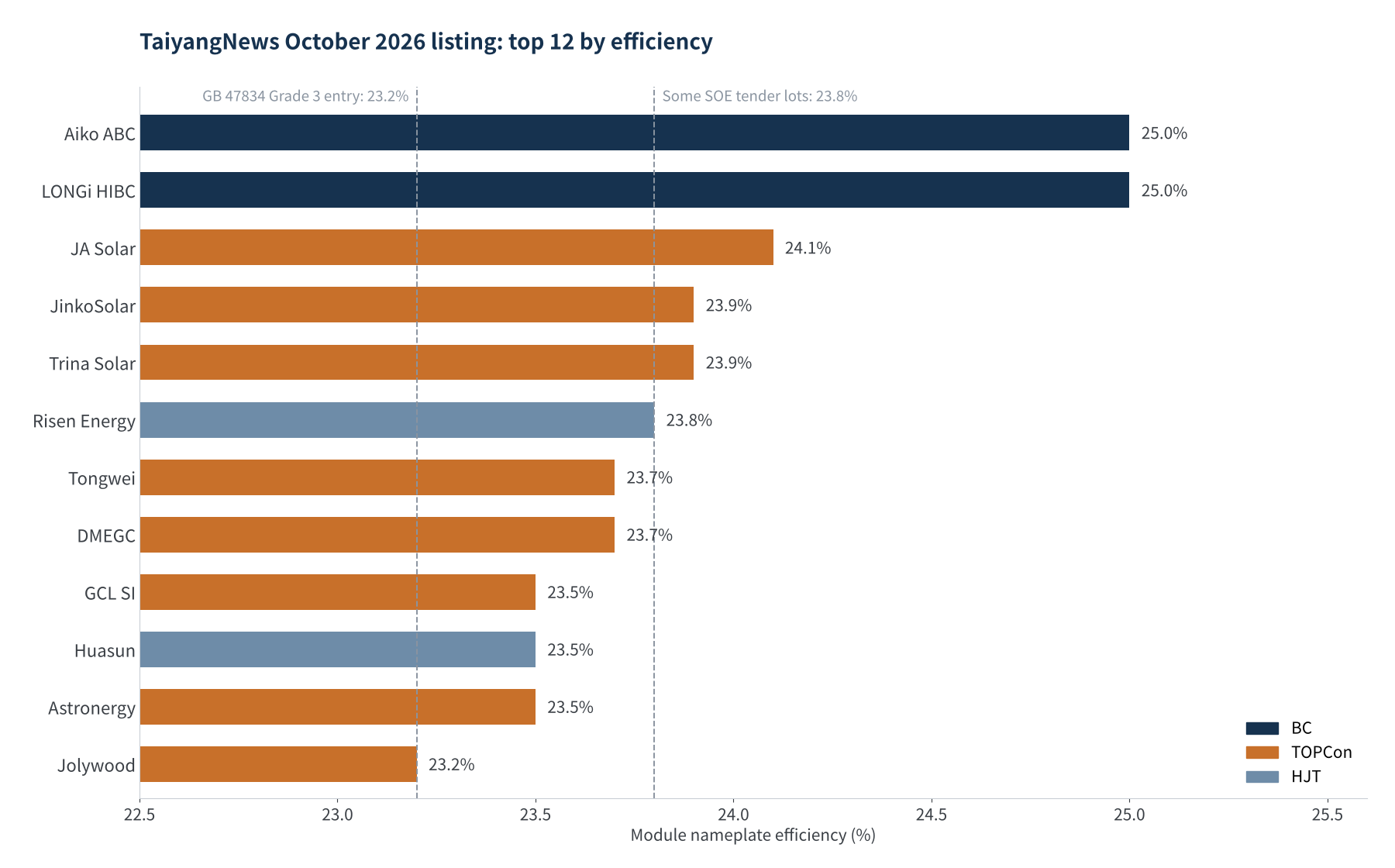
Figure 1 Efficiency ladder of the top 12 in the October listing (dashed lines are Chinese thresholds, for visual reference only)
Count the top 12 places: 2 BC, 8 TOPCon and 2 HJT. PERC has dropped out of the top tier entirely. TaiyangNews puts it bluntly in its chart note: PERC module efficiency tops out at about 21.7%, and going higher requires high-efficiency cell structures.
02Three technologies, each holding its own high ground
- BC: holding the efficiency ceiling. Aiko's Comet 3N72 (ABC, 675 W) and LONGi's EcoLife LR7-54HJD-510M (HIBC, 510 W) both rose to 25% in April, the first time a 25% commercial module appeared on the list. Before that, Aiko had held first place alone since it joined the list in March 2023. LONGi's HIBC uses TOPCon-style passivating contacts on one side and heterojunction on the other; a cell of the same type holds the single-junction crystalline silicon cell efficiency record of 28.13%, certified by Germany's ISFH.
- TOPCon: filling the middle ground. Five of the top eight places are TOPCon (JA Solar, JinkoSolar, Trina Solar, Tongwei, DMEGC). JA Solar's DeepBlue 5.0, at 24.1%, is the first commercial TOPCon module above 24%, using 198 third-cut cells of 182 × 70 mm. According to TaiyangNews's H1 report, TOPCon's share of listed products has risen from 33% to 53%.
- HJT: holding the top power spot. Risen Energy's Hyper-ion Pro ranks sixth at 740 W and 23.8%, the most powerful product on the list, with a bifaciality of 90 ± 5%, clearly above the 80 ± 5% typical of TOPCon. Huasun follows closely at 730 W.
BC wins on efficiency, TOPCon on numbers, HJT on power. BC's 0.9-percentage-point lead over TOPCon has not changed in four months, and BC makes up only about 5% of listed products: it is a lead held by a few players.
03Why 740 W ranks only sixth: read power and efficiency separately
Many first-time readers are puzzled: Risen's 740 W module has 65 W more than Aiko's 675 W, so why does it rank lower? The answer is area.
Module efficiency = maximum power ÷ (module area × 1,000 W/m²). Using the datasheet dimensions:
| Module | Size (mm) | Area (m²) | Power | Power per m² | Efficiency |
|---|---|---|---|---|---|
| Aiko Comet 3N72 | 2382×1134 | 2.701 | 675 W | ≈250 W | 25.0% |
| LONGi EcoLife 510 | 1800×1134 | 2.041 | 510 W | ≈250 W | 25.0% |
| JA Solar DeepBlue 5.0 | 2382×1134 | 2.701 | 650 W | ≈241 W | 24.1% |
| Risen Hyper-ion Pro | 2384×1303 | 3.106 | 740 W | ≈238 W | 23.8% |
Table 2 Area and efficiency of four representative modules
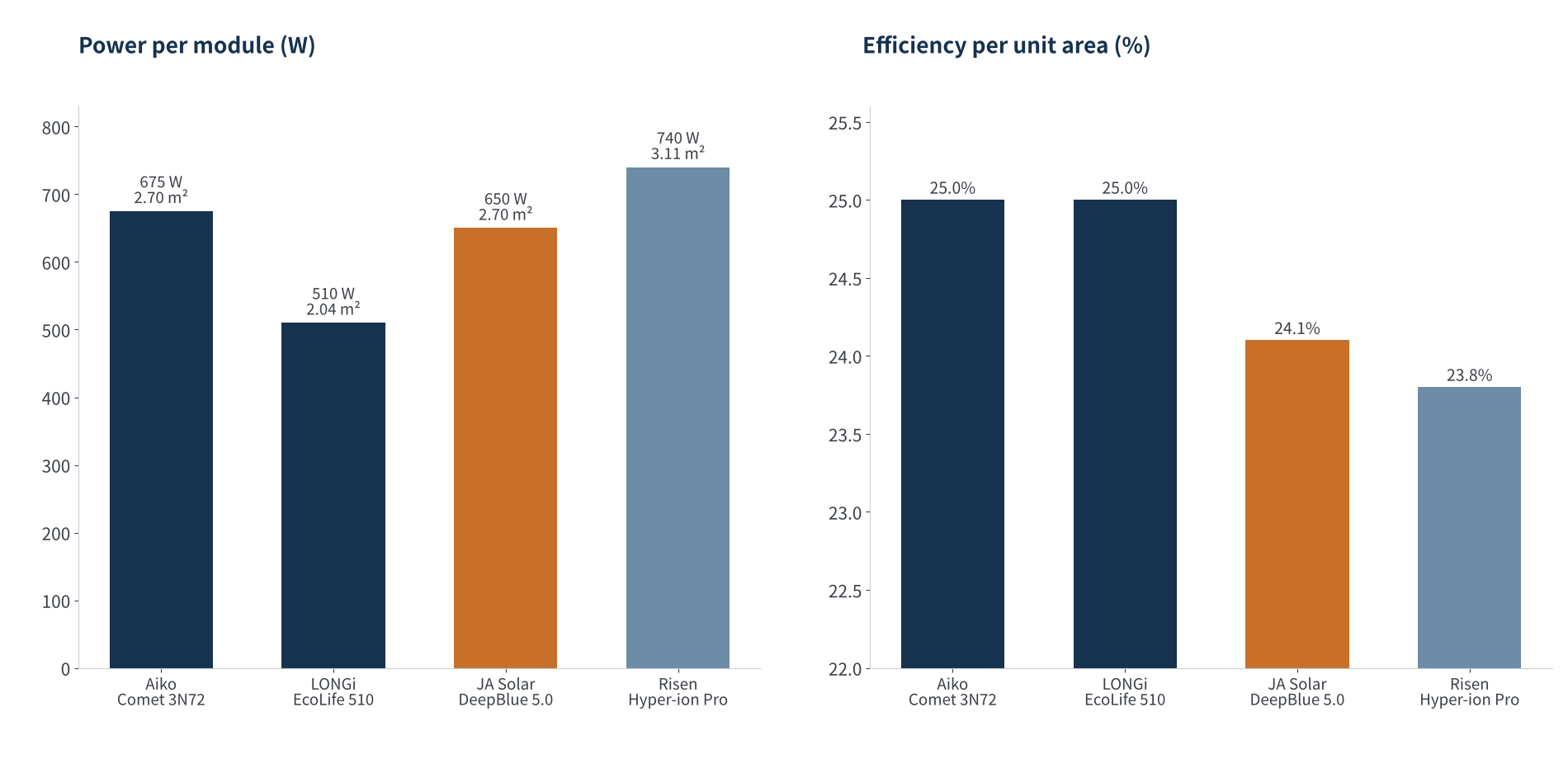
Figure 2 Four representative modules: power per module vs efficiency per unit area
Risen's module has an area of about 3.106 m², roughly 15% larger than Aiko's 2.701 m², but only about 9.6% more power, so its output per square metre is naturally lower. LONGi's module is only 510 W, but it is a small residential format of 1,800 × 1,134 mm that also delivers about 250 W per square metre, which is why it shares first place with Aiko.
For module selection: distributed projects with limited roof area should prioritise efficiency. Ground-mounted plants care more about the structure, installation and cabling costs spread over each module, and about rear-side yield, so high-power, high-bifaciality formats remain competitive. The ranking compares front-side nameplate efficiency only and ignores bifaciality, which is exactly where HJT and TOPCon draw their strength in utility-scale applications.
Efficiency answers "how much power per square metre"; power answers "how much power per module". The two numbers solve different problems.
04Four months without change does not mean technology has stalled
A monthly ranking that stays unchanged for four editions might suggest the industry has hit a plateau. TaiyangNews itself stresses that this only means the products meeting its criteria have remained stable, not that technology development has slowed; whether a product is listed depends on its commercial status and supporting evidence.
Look beyond the list and there are quite a few products waiting in the wings:
- LONGi BC: according to China Energy News in June, LONGi's BC modules have reached peak mass-production power of 690 W and mass-production efficiency above 25.5%; a module based on HIBC cells has been certified by NREL at 26.4%.
- Aiko's fourth-generation ABC: at SNEC in June, Aiko launched its G4 Infinite Ultra module, with 690 W and 25.6% efficiency in mass production in the standard 2,382 × 1,134 mm format and up to 26% peak efficiency. Mass production and delivery were planned from Q3, and it took 3.75 GW of orders in the first two days of the show. In September the company told investors it would gradually bring the product into mass production lines and start deliveries.
- Canadian Solar TOPCon 3.0: launched in June with up to 670 W and 24.8%, with global volume shipments planned from August; yet Canadian Solar's product on the list is still at 22.6%.
None of these figures has appeared in the October listing yet. The reasons may be that datasheets are not yet online, proof of commercial availability has not been submitted, or listing rules such as cell sourcing apply; we will wait for TaiyangNews to clarify. In the October listing, TaiyangNews again said it is reviewing its qualification criteria for commercial modules to better reflect technological progress. In other words, the list reflects efficiency you can buy and prove, and it naturally lags product launches by a step.
Chinese thresholds offer a useful comparison. On 27 June, the State Administration for Market Regulation and the Standardization Administration issued the mandatory national standard GB 47834-2026, Minimum allowable values of energy efficiency and energy efficiency grades for crystalline silicon PV modules and inverters, effective 1 January 2027. Grade 3 (the minimum entry level) requires at least 23.2% efficiency for TOPCon and HJT modules and at least 23.5% for BC modules. In state-owned enterprise (SOE) procurement, module tenders from Huadian, Huaneng and China Three Gorges in the second half of 2025 all included high-efficiency lots requiring at least 23.8%; Huadian's roughly 5 GW framework tender in September this year requires at least 23.2% and states that orders delivered in 2027 must meet Grade 3 of the new standard. A simple comparison with the list shows that only 6 products reach 23.8% or more, and only 12 reach 23.2% or more. Of course, the test and assessment basis of the national standard differs from datasheet nameplate values, so this is only a rough reference.
05Our observations
- Will the 0.9-point gap narrow? TOPCon's catch-up path is clear: edge passivation, rear poly-fingers, finer fingers, more cell cuts and 0BB interconnection, each squeezing out a few tenths of a percent. BC's next step already points to 26%. Both are moving forward, so the gap may not narrow noticeably in the short term.
- Beyond efficiency, look at the warranty curve. The ranking looks only at initial efficiency, but plant economics run over 30 years. Per datasheet warranties: Aiko and LONGi BC modules allow 1% in year 1 and 0.35% a year thereafter, retaining 88.85% after 30 years; mainstream TOPCon allows 0.4% a year, retaining 87.4%; Risen and Huasun HJT modules retain 90.3% after 30 years (see Figure 3).
- The higher the efficiency, the more "expensive" packaging losses become. Optical and electrical losses at module level are magnified with high-efficiency cells: high-transmittance glass, down-converting encapsulants, low-shading 0BB ribbons and narrower cell gaps have all become key battlegrounds. This is why we keep a close eye on materials.
- Know the limits of the list. It only includes modules with in-house cells and only looks at STC nameplate values; it says nothing about temperature coefficients, low-light performance, reliability or actual yield. It is a good technology barometer, but not sufficient on its own as a basis for module selection.
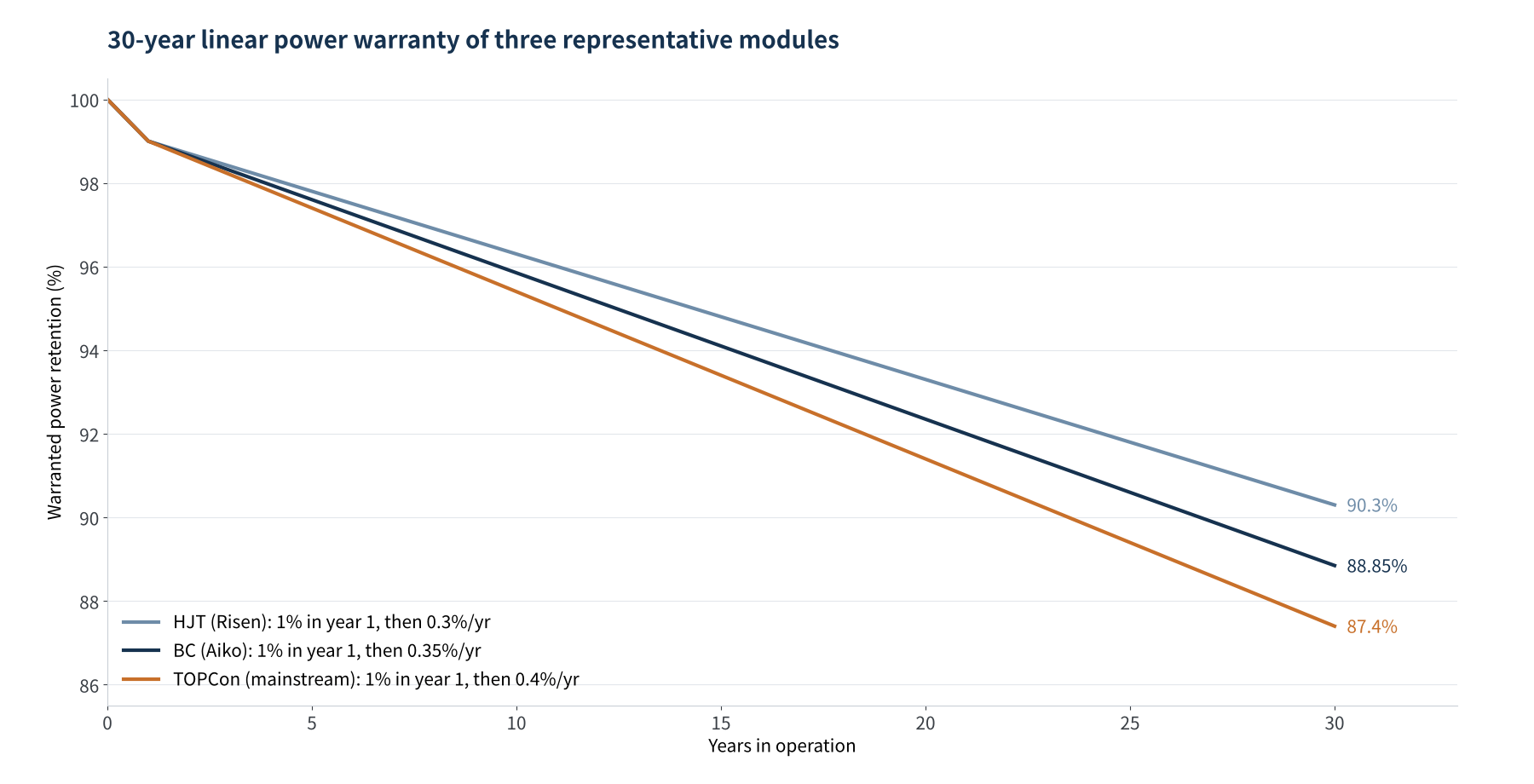
Figure 3 30-year linear power warranty of three representative modules (drawn from datasheet warranty terms)
06Final thoughts
The fact that this edition did not change is itself a signal: BC at 25%, TOPCon at 24.1% and HJT at 23.8% form the three benchmarks of commercial module efficiency in 2026. The real changes may be queuing up between product launches, certification bodies and production lines. When the list does move again, it is likely to be a concentrated jump.
On your projects, does module selection now weigh efficiency or power more heavily? We would be glad to hear from you, and we will keep tracking the monthly listing.
References
- TaiyangNews. TOP SOLAR MODULES Listing – October 2026, 2026-10-14.
- TaiyangNews. Back-Contact Modules Break the 25% Barrier as Solar's Efficiency Race Accelerates (TOP SOLAR MODULES H1 2026 report press release), 2026-06-25.
- TaiyangNews. TOP SOLAR MODULES Listing – April 2026 / July 2026 / August 2026.
- pv magazine. Longi announces world record efficiency of 28.13% for silicon solar cell, 2026-04-29.
- China Energy News (People's Daily). Report on LONGi BC modules reaching 690 W mass-production power and over 25.5% mass-production efficiency, 2026-06-15.
- China Daily (Chinese edition): Aiko Infinite Ultra modules debut at SNEC, 2026-06-04; pv magazine. Aiko showcases 690 W back contact solar module with 25.6% efficiency, 2026-06-10; Aiko investor relations activity record, 2026-09.
- pv magazine USA. Canadian Solar launches TOPCon 3.0 high-power-density module with 24.8% efficiency, 2026-06-22.
- GB 47834-2026, Minimum allowable values of energy efficiency and energy efficiency grades for crystalline silicon PV modules and inverters; ifeng.com report on the new module efficiency standard taking effect in 2027, 2026-09.
- Jiemian. SOEs raise efficiency thresholds, putting BC modules in the spotlight for large bases.
A PV R&D and technology team with 10+ years of experience | In-depth technical knowledge sharing
Materials · Reliability · Failure Analysis · Standards & Certification · Products · Processes
Exploring AI + PV; collaboration welcome
Disclaimer:
1. Original content reflects the authors' personal views only, is for reference only and does not constitute investment advice.
2. Reposted and cited content is credited to its source, out of respect for original work.
3. Some content was produced with AI assistance (chart generation, data retrieval, concept explanations, etc.); the core framework and key content were written by our technical team and reviewed by people.
4. If anything is inaccurate or infringes your rights, please leave a message or contact us and we will deal with it.