
Eight Makers Cut Prices and High-Efficiency Modules Slip Too: How Far Are Module Prices from the "Hangzhou Floor"?
In brief
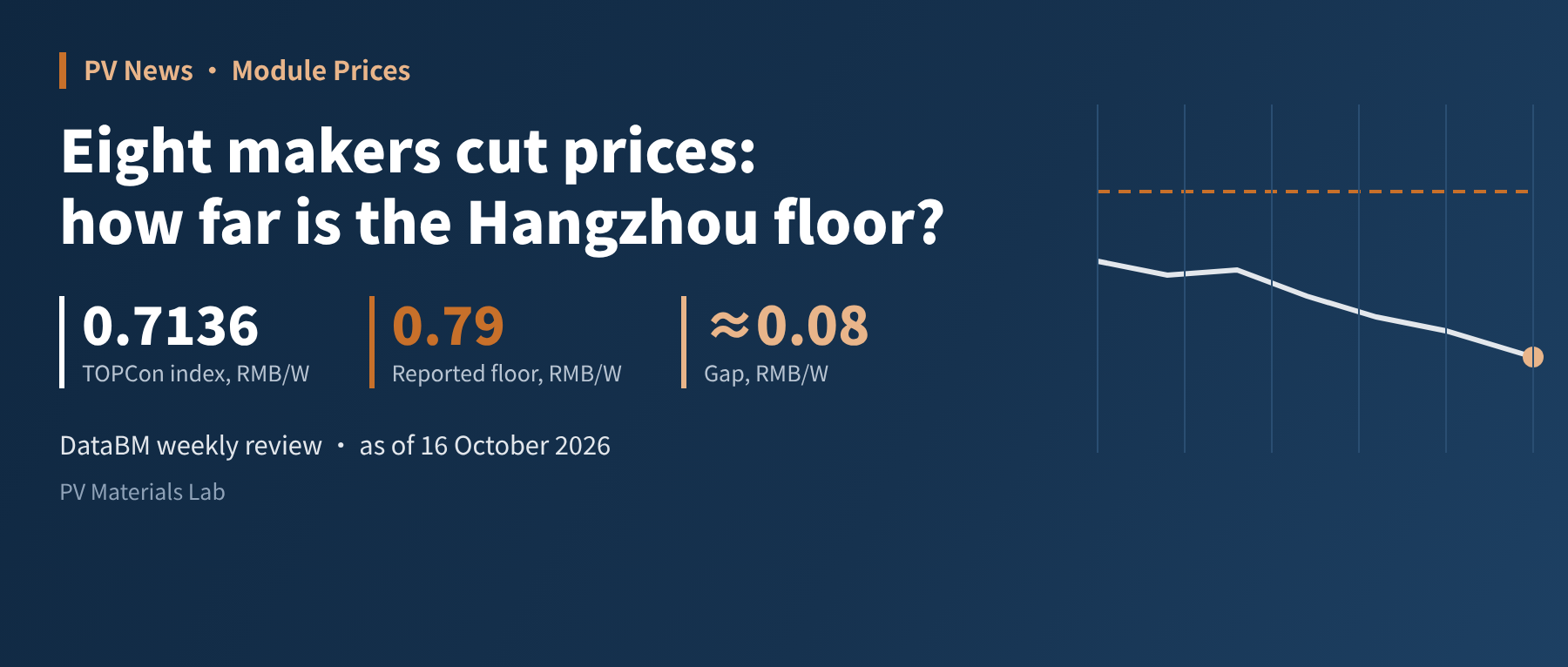
After the National Day holiday, eight module makers cut their quotes by RMB 0.01–0.03/W, and even high-efficiency modules, until now the most stable segment, slipped. The TOPCon 210mm price index fell to RMB 0.7136/W, still about RMB 0.08/W below the RMB 0.79/W floor reported from a meeting in Hangzhou. We unpack this week's data and look at high-power inventory, mandatory delivered pricing and whether this "floor" can really hold prices up.
In the first week back from the long holiday, the module market did not get the tail end of the usual autumn peak season; it got a round of across-the-board price cuts. According to DataBM's weekly review of 16 October, eight module makers lowered their quotes this week by RMB 0.01–0.03/W. More notably, high-efficiency modules, which had held their prices best, did not hold this time. In this article we explain the news in ten minutes: what happened, why, and how it relates to the "Hangzhou floor" that dominated headlines a few days ago.
01This week's prices at a glance
Start with the hard data. As of 16 October, the price indices for all four mainstream technologies fell week on week, by RMB 0.0025–0.0049/W. The numbers look small on their own, but they came as eight makers cut prices at the same time, so the direction says more than the size of the move.
| Technology | Price index (RMB/W) | Week on week | This week's quote range (RMB/W) |
|---|---|---|---|
| TOPCon 210mm | 0.7136 | −0.0025 | 0.65–0.77 |
| TOPCon 210R | 0.7276 | −0.0031 | — |
| HJT 210mm | 0.7000 | −0.0049 | 0.67–0.76 |
| BC 210R | 0.8159 | −0.0039 | 0.74–0.88 |
Table 1 Module prices by technology this week (source: DataBM)
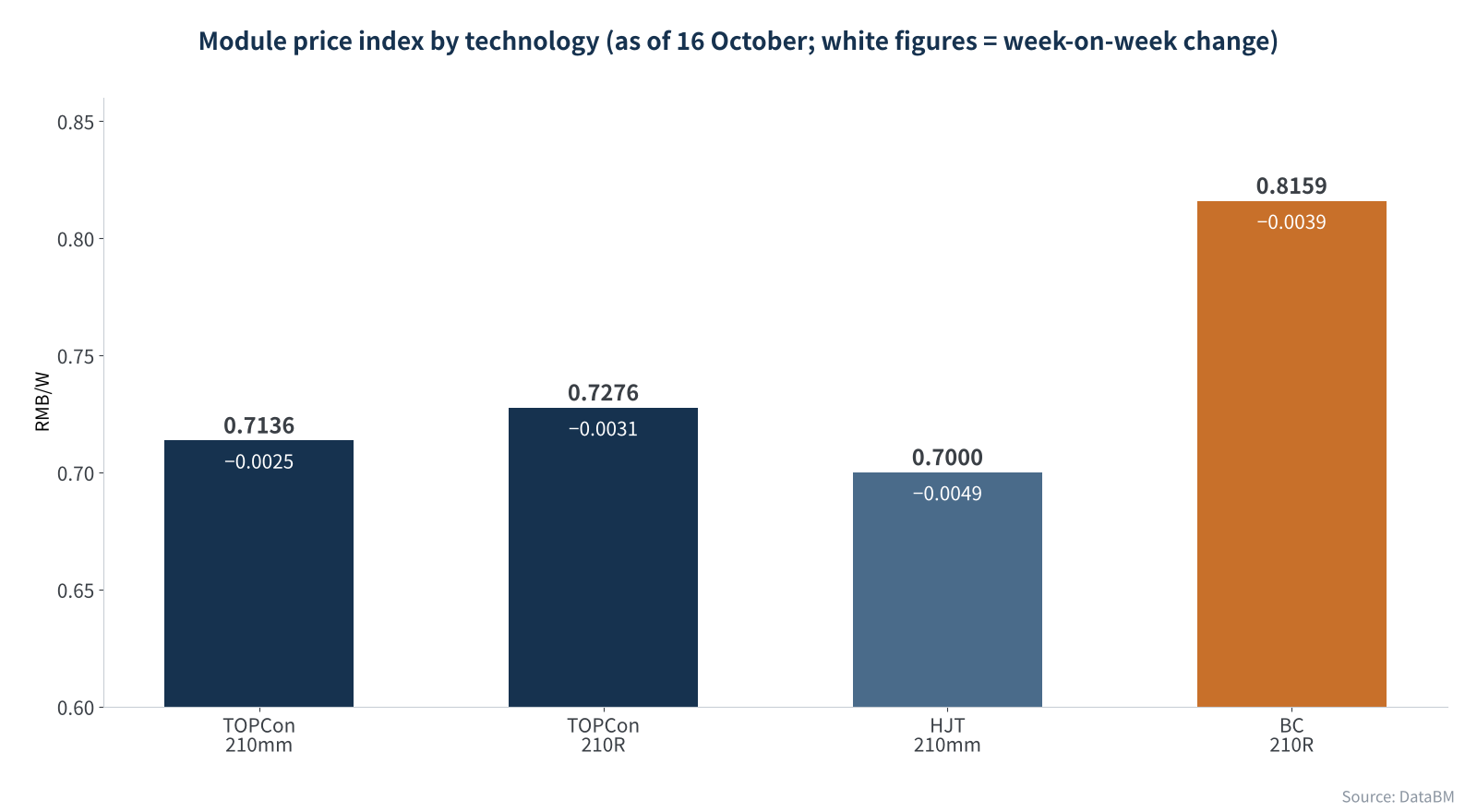
Figure 1 Module price index by technology and week-on-week change
A few details stand out:
- Clear tiers within TOPCon: high-power 645–655 W products are still quoted at RMB 0.75–0.77/W but actually trade at about RMB 0.74–0.75/W; mainstream products from second- and third-tier makers trade at only RMB 0.66–0.69/W.
- Leading BC makers moved too: the BC range is RMB 0.74–0.88/W, and two leading companies cut prices across their whole range by RMB 0.01–0.02/W.
- HJT fell the most: the HJT index dropped RMB 0.0049/W week on week, the largest decline of the four technologies.
- Overseas markets weakened as well: average European channel prices fell 1.1–3.6% from the previous week, with TOPCon quoted at about USD 0.10–0.13/W and BC at about USD 0.11–0.14/W.
02Why did the most stable high-efficiency segment slip?
For most of the past year, a common view in the industry was that standard-power modules had hit rock bottom, but high-efficiency, high-power products could still hold a premium. This week's data show that this "moat" is starting to leak. We see two main reasons.
First, a structural mismatch. Manufacturers have invested heavily in efficiency this year, and output is increasingly concentrated in 650–655 W formats. The mandatory national standard GB 47834-2026, issued on 27 June and effective 1 January 2027, grades modules by efficiency: Grade 1 for TOPCon requires front-side efficiency of at least 24.0% and bifaciality of at least 75%. For the mainstream 2,382 × 1,134 mm format, 24.0% corresponds to about 650 W, and an OPIS report at the end of July described the TOPCon Grade 1 threshold directly as "650 W" (645 W for HJT, 655 W for BC), pushing manufacturers further towards higher power. But buyers still prefer the 625–630 W class: it offers good value and fits better with the existing designs, mounting structures and inverter configurations of many projects. The result is growing inventory in the high-power segment, and makers can only cut prices to move it.
Second, demand itself is insufficient. DataBM attributes this round of cuts to weaker-than-expected distributed shipments. Distributed solar has been an important buyer of high-efficiency modules at a premium, so when it softens, high-efficiency quotes naturally cannot hold.
As technologists, we would add one point: a "high-efficiency premium" should in essence be a payment for verifiable gains in levelised cost of electricity, meaning higher yield, lower degradation and better reliability. If the premium rests only on nameplate power, and downstream buyers find that the gain does not cover the price difference, then it is the first thing to be squeezed out once supply increases.
The high-efficiency segment is slipping not because the technology has failed, but because of three factors at once: a concentrated release of high-power capacity, buyers still preferring mainstream formats, and weaker-than-expected distributed demand.
03How far from the "Hangzhou floor"?
From 13 October, several Chinese media outlets reported that on 11 October eight polysilicon producers (Tongwei, GCL, Daqo, Xinte, Asia Silicon, East Hope, Lihao and Gens), together accounting for more than 90% of China's effective polysilicon capacity, held a closed-door meeting in Hangzhou to discuss capacity coordination and mutual supervision. Polysilicon was not to be sold below an average tax-inclusive cost of RMB 43,000 per tonne, and price floors were set for modules: BC no lower than RMB 0.86/W and TOPCon no lower than RMB 0.79/W, applying also to exports, commercial procurement and tenders. Securities Times followed up on the meeting on 14 October.
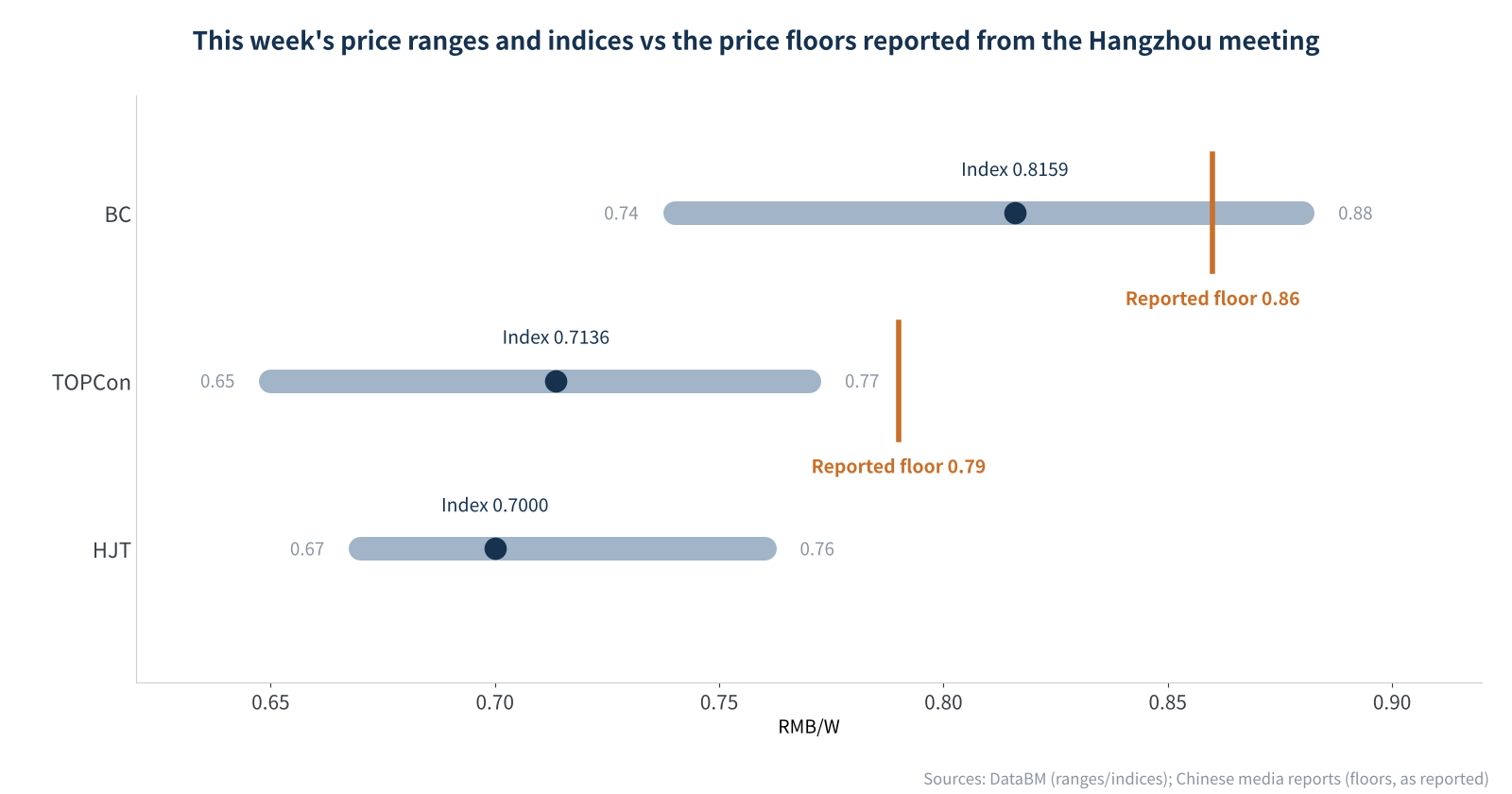
Figure 2 This week's price ranges and indices vs the price floors reported from the Hangzhou meeting
Put this week's data next to the floors and the gap is obvious:
- TOPCon: the index of RMB 0.7136/W is about RMB 0.076/W, or 9.7%, below the RMB 0.79/W floor; even the top of this week's TOPCon range, RMB 0.77/W, does not reach the floor.
- BC: the index of RMB 0.8159/W is about RMB 0.044/W, or 5.1%, below the RMB 0.86/W floor; only some quotes at the top of the range are above it.
In other words, the proposed price and the traded price are not "a little apart": almost the entire range sits below the floor. And this week prices were still falling, moving in the opposite direction.
We think the reasons the floor will be hard to enforce in the short term are clear. First, the meeting was led by upstream polysilicon producers, and the main module makers were not there, so its binding force on downstream module prices is questionable. Second, the figures in circulation are all media accounts; we have not found a public text of the proposal, and one participant told the media that the meeting did take place but that prices were not discussed. Third, the module segment has far more players than the polysilicon segment, and any one of them breaking the floor to ship volume could set off a chain reaction.
The floor can serve as an "anchor" for future policy and tender rules, but until supply and demand improve, it is more of a target than a price.
04Two easily overlooked signals
Beyond prices themselves, two details this week deserve more thought than the numbers.
Signal one: no more self-collection, delivery included by default. Some leading makers have dropped the self-collection option and now quote delivered prices only. On the surface this is just a change in delivery terms, but it matters for small distributed orders: small, multi-site orders already carry high logistics costs, and with delivery bundled in, buyers lose the option of arranging their own transport to cut costs. For makers, it protects part of their actual revenue while the nominal unit price stays flat or falls slightly. When reading quotes, always check whether they are ex-works or delivered; comparing figures on different bases can easily lead to the wrong conclusion.
Signal two: tenders "look large", awards are "actually small". Utility-scale tenders this week totalled about 6.2 GW, which looks substantial, but about 6 GW came from a single Longyuan Power project; awards in the same period were only about 0.71 GW.
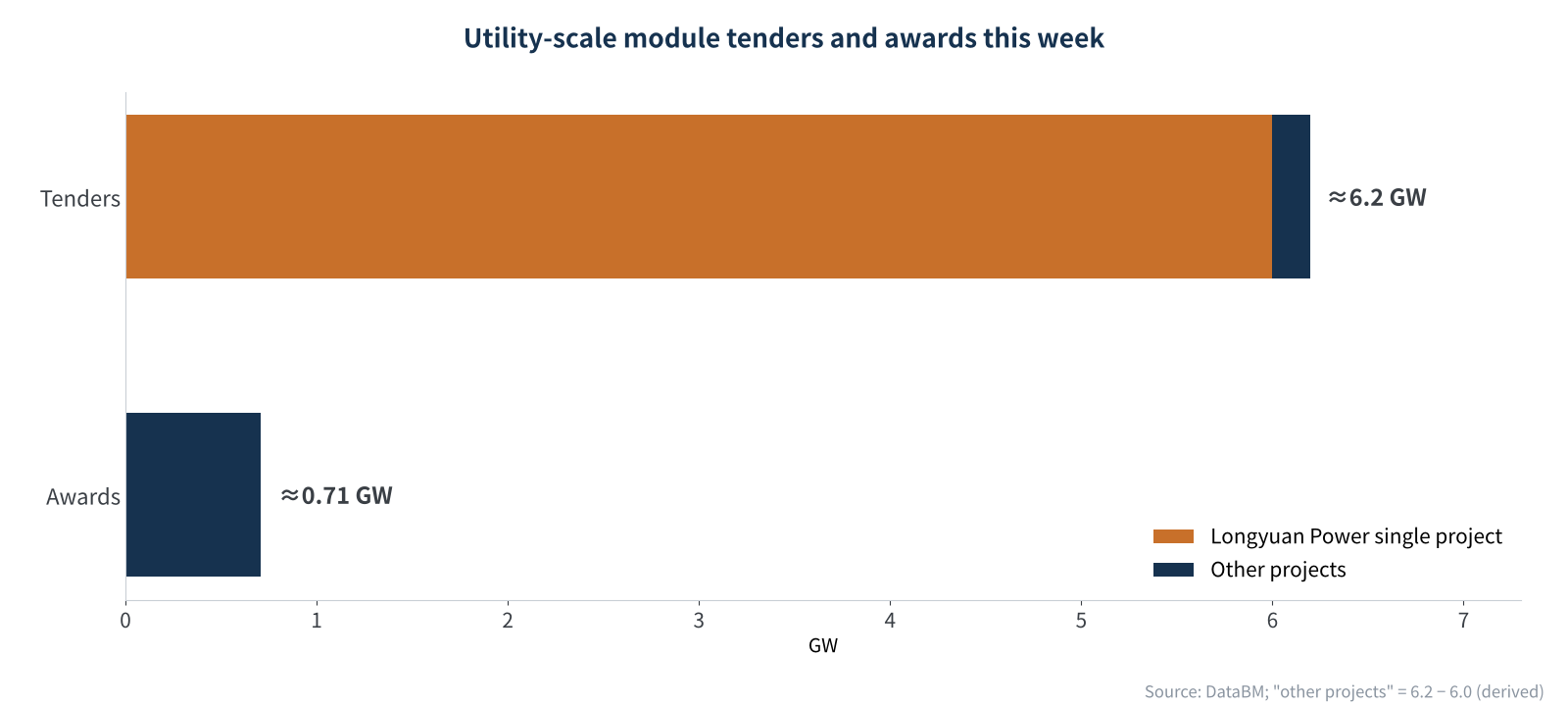
Figure 3 Utility-scale module tenders and awards this week
Excluding the Longyuan tender, other utility-scale tenders this week amounted to only about 0.2 GW. The small volume of awards actually turning into orders shows that utility-scale demand offers limited support for prices. Longyuan's tender, published on 14 October, is a 6 GW framework procurement in seven lots: 1 GW offshore high-efficiency, 3.5 GW onshore high-efficiency and 1.5 GW onshore medium-efficiency, so high-efficiency lots make up 75%. Notably, it no longer specifies technology or power, and divides lots by conversion efficiency only, in line with the efficiency-based grading of the new national standard. The prices at which these 6 GW are finally awarded will be an important window over the coming weeks for seeing whether the "floor" has any binding force.
05Final thoughts
To sum up this week's news: prices are falling, now reaching the high-efficiency segment; a floor has been drawn, but it is far from where deals are done.
Data from a week later offer a useful cross-check: InfoLink's quotes of 21 October show an average TOPCon module price of RMB 0.719/W (range RMB 0.65–0.78/W), HJT at RMB 0.750/W and BC at RMB 0.792/W, under the headline "prices stabilise for now amid limited fluctuations across the supply chain". The two organisations use different methods, so their figures should not be compared directly, but both put average TOPCon prices around RMB 0.71–0.72/W, still well below the RMB 0.79/W floor.
Our outlook for the coming period is cautious. Q4 is traditionally a time of both year-end installation rushes and inventory clearance. Until distributed demand clearly recovers, module prices are likely to remain under pressure, and the gap between high-efficiency and standard modules may keep narrowing.
A few suggestions for different readers:
- Buyers and project developers: check the basis of quotes (delivered or not) and the power class; the price gap between 625–630 W and 650 W+ is shifting, so select modules on LCOE rather than nameplate power.
- Module makers: plan ahead for clearing high-power inventory; premiums need to be backed by field yield and reliability data, not just a power label.
- Industry watchers: keep an eye on three things: the award prices for Longyuan's 6 GW, whether the text of the proposal is made public, and whether the floor finds its way into price-cap clauses in tender documents.
Has your company received price adjustment notices this week? Has the basis of quotes changed? We would be glad to hear from you.
References
- DataBM, weekly module price review, 2026-10-16
- Securities Times, "A new round of polysilicon capacity limits is in the works; supply-side contraction may intensify", 2026-10-14; Wallstreetcn, National Business Daily and China Financial Information Network reports on the Hangzhou closed-door meeting, 2026-10-13
- pv magazine USA, "Chinese TOPCon module prices fall as high-efficiency supply adds pressure" (OPIS), 2026-07-31
- GB 47834-2026, Minimum allowable values of energy efficiency and energy efficiency grades for crystalline silicon PV modules and inverters; Beijing News report on TOPCon Grade 1 requirements
- Reports on Longyuan Power's first 2026 framework procurement tender for PV modules (Sohu), 2026-10-14
- InfoLink Consulting, PV spot price, 2026-10-21
A PV R&D and technology team with 10+ years of experience | In-depth technical knowledge sharing
Materials · Reliability · Failure Analysis · Standards & Certification · Products · Processes
Exploring AI + PV; collaboration welcome
Disclaimer:
1. Original content reflects the authors' personal views only, is for reference only and does not constitute investment advice.
2. Reposted and cited content is credited to its source, out of respect for original work.
3. Some content was produced with AI assistance (chart generation, data retrieval, concept explanations, etc.); the core framework and key content were written by our technical team and reviewed by people.
4. If anything is inaccurate or infringes your rights, please leave a message or contact us and we will deal with it.