
Nameplate 0.70, Field 0.60: How Much Is the Bifacial Rear-Side Gain Overstated?

In brief
Using two years of SCADA data from a 50 MWp single-axis tracker plant, researchers at the Universitat Politècnica de València and Grupotec found that modules rated at 0.70 bifaciality delivered an effective bifaciality of only about 0.60 in the field, 13–15% lower, with the gap widening at higher irradiance. We unpack four easily confused "bifacial factors", why field performance shrinks, the role of mounting geometry, and what it means for yield models and module selection.
Bifacial modules have long been standard in ground-mounted plants, and "extra yield from the rear side" appears in almost every feasibility study. A field study due to appear in Renewable Energy is a useful reminder, though. Two years of operating data from a 50 MWp single-axis tracker plant show that the modules' nameplate bifaciality is 0.70, but the effective bifaciality in the field is only around 0.60, a gap of 13–15%. And the gap is largest in exactly the sunniest, most productive hours.
01What the news says
The study was carried out by the Universitat Politècnica de València (UPV) and the Spanish engineering firm Grupotec, under the title "The bifacial gain gap: Nominal and regulatory vs. effective performance across five utility-scale PV sites". pv magazine reported on it on 14 October 2026 [1]; the Spanish edition said the paper is due to be published in December [2][3], and several other industry outlets have since picked up the story.
The reference site is a 50 MWp single-axis tracker plant with bifacial modules in Spain. The researchers used two years (2024–2025) of SCADA data at 15-minute resolution, including weather data and string-level electrical data. Rear-side irradiance was measured with albedometers and module temperature with PT100 sensors attached to the module backs. Night-time data, outliers and sensor faults were removed, but the fluctuations caused by cloudy weather were kept. The results were then validated at two more plants in Spain and two in the UK. All five plants use the same module technology: bifacial monocrystalline silicon half-cell modules. The two UK sites see mainly diffuse light, with average irradiance 35–45% lower than in Spain [8].
| Metric | Value | Note |
|---|---|---|
| Nameplate bifaciality | 0.70 | Module datasheet value |
| Effective bifaciality (time-weighted) | 0.610 | About 13% below nameplate |
| Effective bifaciality (irradiance-weighted) | 0.599 | About 14% below nameplate |
| At irradiance >600 W/m² | <0.60 | Hours of highest output |
| At irradiance >1000 W/m² | About 0.55–0.57 | About 19–21% below nameplate |
| Five-site irradiance-weighted effective bifaciality | 0.464–0.722 | 66–103% of nameplate |
Table 1 Key results for the reference plant and the five-site validation (sources: [1][2][8])
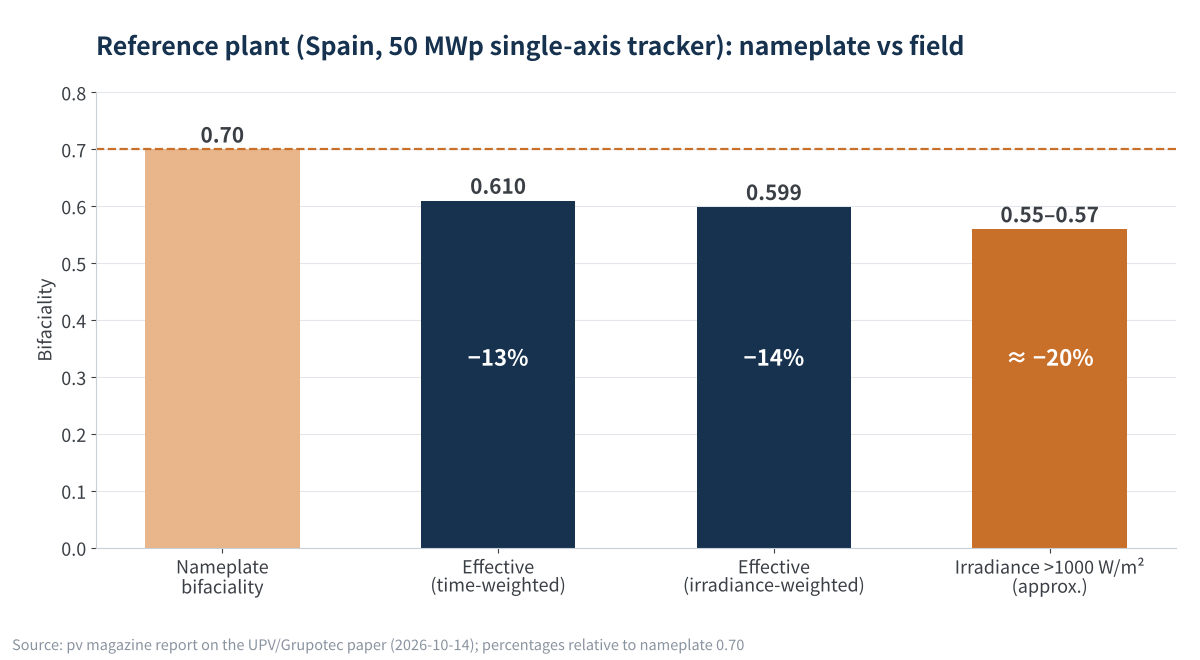
Figure 1 Nameplate vs effective bifaciality at the reference plant
Nameplate bifaciality is what the module can do in the lab; effective bifaciality is what the plant actually collects. At this plant the two differ by more than a tenth, and the gap is concentrated in the hours of highest output.
02First, separate four "bifacial factors"
Discussions of bifacial gain often mix figures defined in different ways, which is exactly what the authors want to correct. We put them side by side:
| Concept | How it is derived | What it answers |
|---|---|---|
| Nameplate bifaciality φ | Ratio of rear to front electrical performance under standard test conditions | How capable the module's rear side is |
| Effective bifaciality | Back-calculated from field irradiance and string power data | How much of that capability the plant actually uses |
| Bifacial power gain (BPG) | Field metric defined in the paper, relative to temperature- and irradiance-corrected front-side nominal power; reference plant time-weighted mean 49.5%, median about 51%, P90 80.4%; five-site medians 22.9–53.5% | How strong the rear-side contribution is under operating conditions |
| Spain's 1.15 factor | RD 997/2025: installed capacity of bifacial modules counted as front-side power × 1.15 | How much capacity is counted for permitting |
Table 2 Four "bifacial factors" that are easily confused
Two points deserve emphasis. First, the authors stress that BPG should not be read as the energy gain over an equivalent monofacial plant; it only describes how strong the rear-side contribution is. The reports do not give the full formula for BPG, so we do not convert its values further, and it should not be compared directly with 1.15.
Second, Article 5.2 of Spain's Royal Decree 997/2025, issued in November 2025, states that for permitting purposes the installed capacity of bifacial modules is calculated as 1.15 times their front-side rated power [4][5]. Regional approvals have already been adjusted accordingly: for example, the peak power of 90,000 modules of 690 Wp was restated from 62.10 MWp to 71.4 MWp [6]. The authors stress that the 1.15 factor is an administrative capacity conversion rule and does not guarantee a 15% increase in operating performance. The wide spread across the five sites shows that a single fixed factor cannot reflect real performance at different sites and with different mounting structures, so project-level performance assumptions still need to be based on local conditions [1][8].
Nameplate tells you capability, effective bifaciality tells you what you actually collect; 1.15 governs how much capacity you declare, not how much more energy you generate.
03Why the field figure shrinks
The report includes some revealing electrical data. Around noon, rear-side irradiance at the reference plant was about 20–25% of average front-side irradiance. As the rear-side contribution increased, string current rose from about 3.9 A to 8.2 A, an increase of up to 110%; voltage fell from about 1,275 V to 1,165 V, a drop of 8–9%; and module temperature rose by up to 3.5 °C, which the authors estimate cost about 0.013 in BPG [1].
The seasonal pattern is even more telling. In the second quarter, BPG reached its highest quarterly value of 57.9%, yet effective bifaciality fell to 0.590. In the first quarter, BPG was only 35.2%, but effective bifaciality rose to 0.641. In other words, the more light the rear side collects, the less efficiently that extra light is converted. Combining the study's findings with our engineering experience, the causes fall into four groups:
- Temperature coupling: rear-side irradiance adds to front-side irradiance, so the module runs hotter. Crystalline silicon modules typically have a power temperature coefficient of around −0.3%/°C, and summer noon, with high irradiance, is exactly when temperatures are highest and the rear side receives the most light.
- Non-uniform rear illumination: rear-side irradiance varies considerably along the module height and between the edges and the middle of the array. Current mismatch between series-connected cells eats into the gain, and a single albedometer reading may not represent the average light on a whole module.
- Structural shading: the tracker torque tube, purlins, junction boxes and frames all cast shadows on the rear side, especially around noon.
- Electrical losses: current rises with rear-side irradiance, and I²R losses in ribbons, busbars and cables grow with the square of current. We suspect that in plants with high DC/AC ratios, inverter clipping may also cut off part of the rear-side power.
The study also found a pattern common to all five plants: effective bifaciality first rises and then falls with irradiance, peaking at about 400–500 W/m² and declining thereafter [1]. At low irradiance, diffuse light makes up a larger share and the rear side receives relatively more light; at high irradiance, the loss mechanisms above add up and amplify each other.
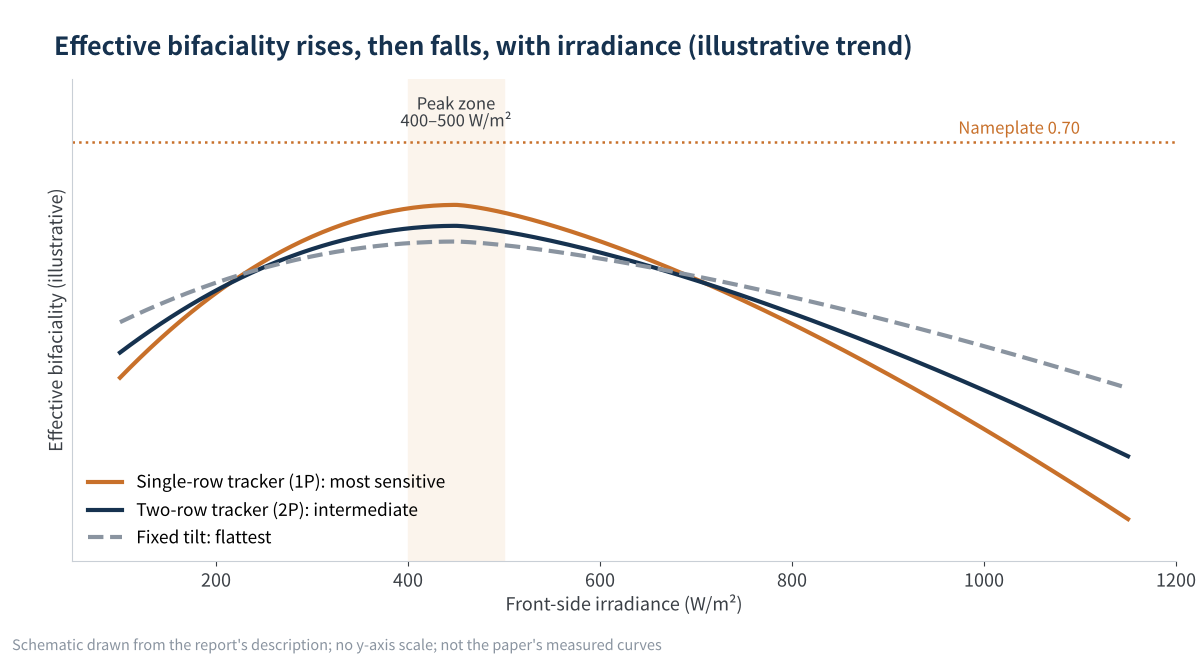
Figure 2 Trend of effective bifaciality with irradiance (illustrative, drawn from the report's description)
Effective bifaciality is not a constant but a function of irradiance and temperature. Applying a fixed 0.70 all year overstates the rear-side contribution in precisely the hours of highest yield.
04Mounting geometry sets the ceiling
Although all five plants use the same module technology, their effective bifaciality ranges from 0.464 to 0.722, with the highest more than 50% above the lowest. The three Spanish plants use single-axis trackers and the two UK plants use fixed-tilt structures. The shape of the curve also changes with the structure: single-row trackers (1P) are the most sensitive to irradiance, two-row trackers (2P) less so, and fixed-tilt structures the least [1].
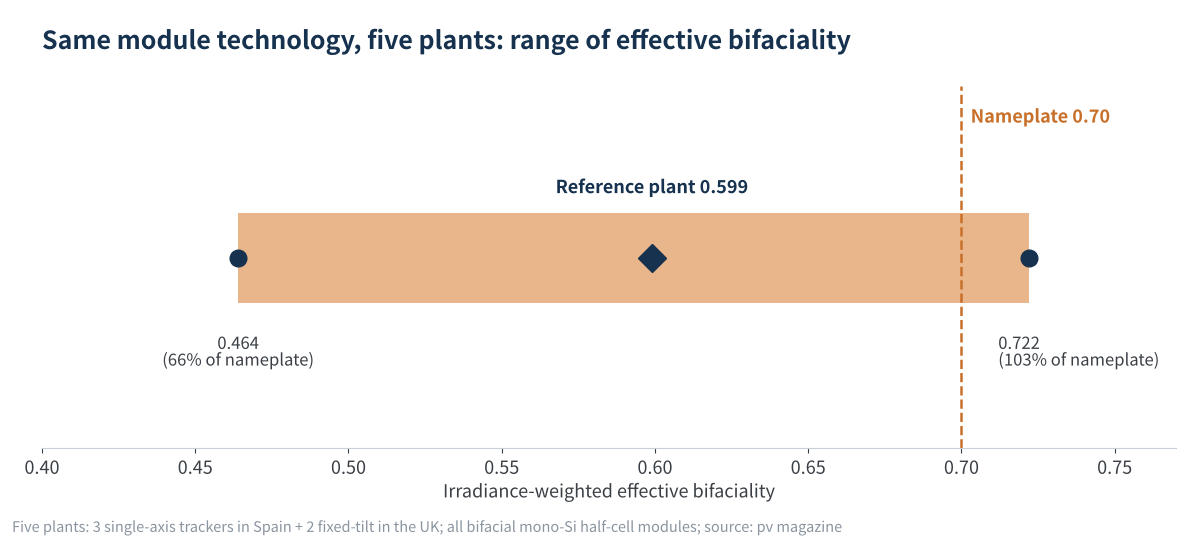
Figure 3 Range of irradiance-weighted effective bifaciality across five plants
The authors attribute the differences mainly to the rear-side view factor, that is, how much illuminated ground and sky the back of the module can "see", plus ground albedo, row spacing, shading, soiling and electrical losses. From an engineering standpoint, the main adjustable variables are:
- Height above ground: the higher the module, the brighter and more uniform the ground it sees, but structure cost and wind loads rise too.
- Row spacing and GCR: wider spacing lets more light reach the ground and raises rear-side gain, but reduces installed capacity per unit of land.
- 1P vs 2P: 2P modules sit higher, but shading from the central torque tube is more concentrated; 1P is simpler with a more open rear side. The trade-off has to be judged on measured data.
- Ground treatment: vegetation, bare soil, gravel and light-coloured covers have very different albedos, which also change with season, rainfall and dust.
In other words, for the same module, nameplate bifaciality shows its potential, but how much of it is realised depends largely on system design.
05What it means for module makers and plant owners
- Yield models: the authors recommend building the dependence of effective bifaciality on irradiance and temperature into yield models instead of applying the nameplate value all year. Our suggestion: in sensitivity analysis, run at least one case with bifaciality reduced by 10–15%.
- Order of magnitude: with an illustrative assumption, if the original model gives an annual bifacial energy gain of 8% at 0.70, recalculating at 0.60 gives about 6.9%, roughly 1.1 percentage points less (see the calculation notes at the end). That will not sink a project, but it can no longer be ignored for projects with high DC/AC ratios bidding at low tariffs.
- Capacity accounting: in Spain, multiplying bifacial capacity by 1.15 for permitting affects licensed capacity and DC/AC ratio calculations, but it does not mean the plant can actually deliver 15% more power. The two calculations must be kept separate.
- Module selection: the nameplate advantage of high-bifaciality products such as TOPCon and HJT still holds, but comparisons should focus on measured gains on the same structure and site, not just datasheet figures.
- Design and reliability: rear glass transmittance, long-term transmittance loss of rear encapsulation materials, and the layout of rear-side shading elements such as junction boxes and frames are all magnified in the field. Rear-side performance degradation over time also deserves a place in field monitoring.
06Final thoughts
The value of this study lies not just in a "discounted" number but in reminding the industry that nameplate parameters, regulatory factors and field performance are three different yardsticks. With bifacial modules now almost the default for ground-mounted plants, rear-side gain has changed from a nice extra into one of the core assumptions in yield models, and it deserves to be measured and verified more carefully.
Some caveats apply. First, only news reports and the paper's abstract page are publicly available so far; the full definition of BPG and each site's structural parameters and albedo conditions must be confirmed in the full paper, whose DOI we have not yet been able to find. Second, the five sites use the same module technology (bifacial mono-Si half-cell), but the brands and whether they are the same model have not been disclosed. Third, south-central Spain has strong irradiance and high temperatures, so the conclusions should be extended to other climates with care. We will follow up once the paper is formally published.
The rear-side bonus of bifacial modules is real, but don't count on the full nameplate value: the field delivers roughly 80–90% of it, and less at high irradiance.
How far does the measured bifacial gain at your plants fall from the design value? We would be glad to hear from you.
References
- pv magazine. Study reveals up to 15% gap between expected and actual bifacial gains in utility-scale PV. 2026-10-14.
- pv magazine España. La ganancia bifacial real de las grandes plantas fotovoltaicas queda hasta un 15% por debajo de la nominal, según un estudio. 2026-10-14.
- The bifacial gain gap: Nominal and regulatory vs. effective performance across five utility-scale PV sites. Renewable Energy (in press), ScienceDirect PII: S0960148126013583.
- Real Decreto 997/2025, de 5 de noviembre, por el que se aprueban medidas urgentes para el refuerzo del sistema eléctrico. BOE.
- MITECO (Spanish Ministry for the Ecological Transition). Preguntas frecuentes: RD 997/2025 potencia instalada (bifacial modules counted as front-side power × 1.15).
- Diario Oficial de Extremadura, no. 73, 2026-04-17.
- Sun X., Khan M. R., Deline C., Alam M. A. Optimization and performance of bifacial solar modules: A global perspective. Applied Energy, 2018, 212: 1601–1610.
- Green Building Africa. Study finds real world bifacial solar performance falls short of nominal ratings. 2026-10-16.
A PV R&D and technology team with 10+ years of experience | In-depth technical knowledge sharing
Materials · Reliability · Failure Analysis · Standards & Certification · Products · Processes
Exploring AI + PV; collaboration welcome
Disclaimer:
1. Original content reflects the authors' personal views only, is for reference only and does not constitute investment advice.
2. Reposted and cited content is credited to its source, out of respect for original work.
3. Some content was produced with AI assistance (chart generation, data retrieval, concept explanations, etc.); the core framework and key content were written by our technical team and reviewed by people.
4. If anything is inaccurate or infringes your rights, please leave a message or contact us and we will deal with it.