
China's New Module Standard Is Not Yet in Force, but 23.2% Is Already in Tenders: The Countdown for Older Lines Has Moved Forward
In brief
China's mandatory module efficiency standard GB 47834-2026 takes effect on 1 January 2027, but buyers have already acted: Huadian's 5 GW framework tender requires module efficiency of at least 23.2%, and a leading maker has withdrawn its older PERC modules from bids for state-owned enterprises (SOEs). We summarise the news, the standard's three grade lines and the corresponding power ratings, and comment as technical practitioners: 23.2% is only a pass mark, and the real challenge may be the degradation requirement.
GB 47834-2026, Minimum allowable values of energy efficiency and energy efficiency grades for crystalline silicon PV modules and inverters, does not take effect until 1 January 2027, now less than 70 days away. But according to a report by the Economic Observer on 17 October, buyers are not waiting: Huadian's 5 GW framework tender sets a minimum module efficiency of 23.2%, and a leading manufacturer has withdrawn its older PERC modules from domestic SOE bids. We break the news down: what exactly the standard requires, why buyers are moving early, what choices manufacturers face, and our views as technical practitioners.
01What the news says
The report interviewed module makers, plant owners, storage integrators and an overseas project manager, and it is packed with information. We summarise it in four points, by role:
- Buyers: on 2 September, Huadian Group's materials company issued its second framework tender for PV modules, with an estimated volume of 5 GW. Module efficiency must be at least 23.2%, with no restriction on cell or module size. The framework runs for one year from the date the agreement takes effect, or until purchases reach 110% of the estimated volume, whichever comes first. Note that 5 GW is an estimate, not confirmed orders.
- Manufacturers: one leading maker has withdrawn its older PERC modules from domestic SOE bids; its pricing manager put it bluntly: "If you can't reach the efficiency line, a lower price doesn't even come into it." Another n-type maker said that modules from its new-generation TOPCon lines reliably average above 24% in mass production, but some first-generation lines commissioned in 2023–2024 still hover around 23.2% in volume production.
- Owners: a plant operator said that large framework procurements with deliveries running into 2027 will explicitly require Grade 3 compliance as a minimum, and that module efficiency and long-term degradation now carry more weight in bid evaluation.
- Overseas: an overseas project manager said lead times for some spot enquiries are two to four weeks longer than in Q2, but none of the dozens of European and Latin American tender specifications he has seen makes 23.2% a mandatory clause.
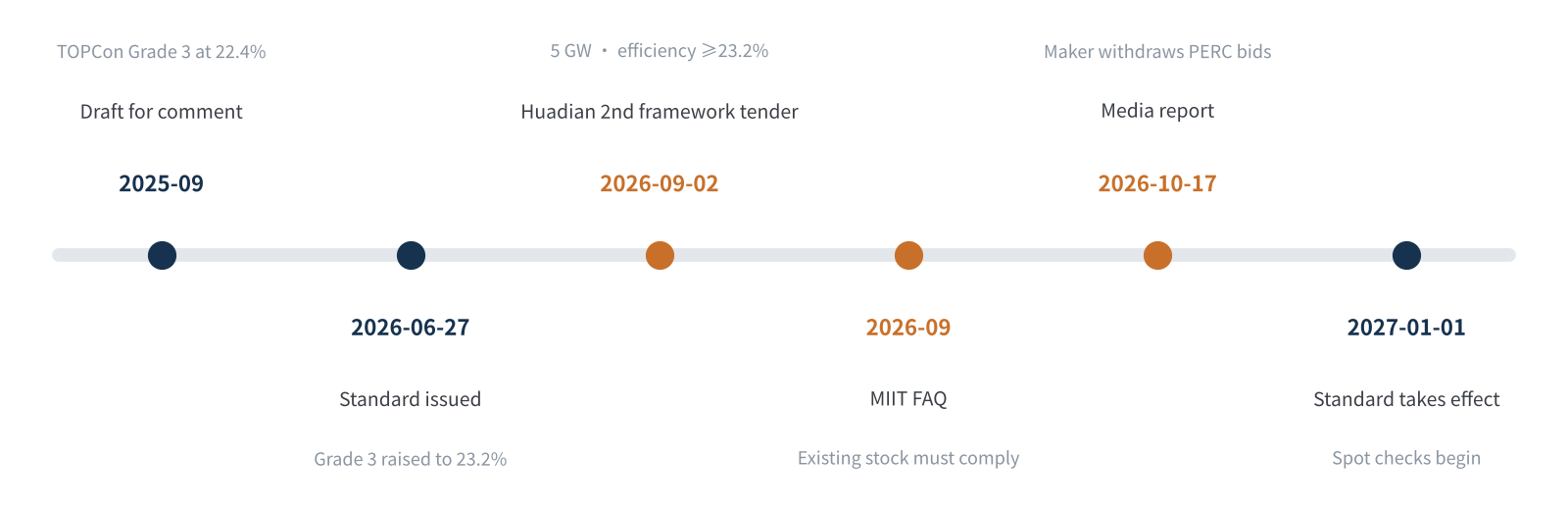
Figure 1 From draft to implementation: key dates for GB 47834
The standard is not yet in force, but tender documents have already turned it into a threshold.
02Where exactly is the "pass mark"?
GB 47834-2026 was issued on 27 June 2026 by the State Administration for Market Regulation and the Standardization Administration of China. As a mandatory national standard, under Article 25 of China's Standardization Law, non-compliant products may not be produced, sold or imported. Module efficiency is divided into three grades, with separate lines for each cell technology:
| Technology | Grade 1 | Grade 2 | Grade 3 (entry) | Minimum bifaciality |
|---|---|---|---|---|
| TOPCon | 24.0% | 23.7% | 23.2% | ≥75% |
| HJT | 23.8% | 23.5% | 23.2% | ≥85% |
| BC | 24.2% | 23.9% | 23.5% | ≥70% |
Table 1 Module efficiency grades in GB 47834-2026 (compiled from public reports, company releases and the MIIT FAQ; the full standard text prevails)
Besides efficiency and bifaciality, there is an easily overlooked requirement: the module's coupled environmental stress degradation must not exceed 8.6%. This is the first time degradation has been written into a mandatory energy efficiency standard.
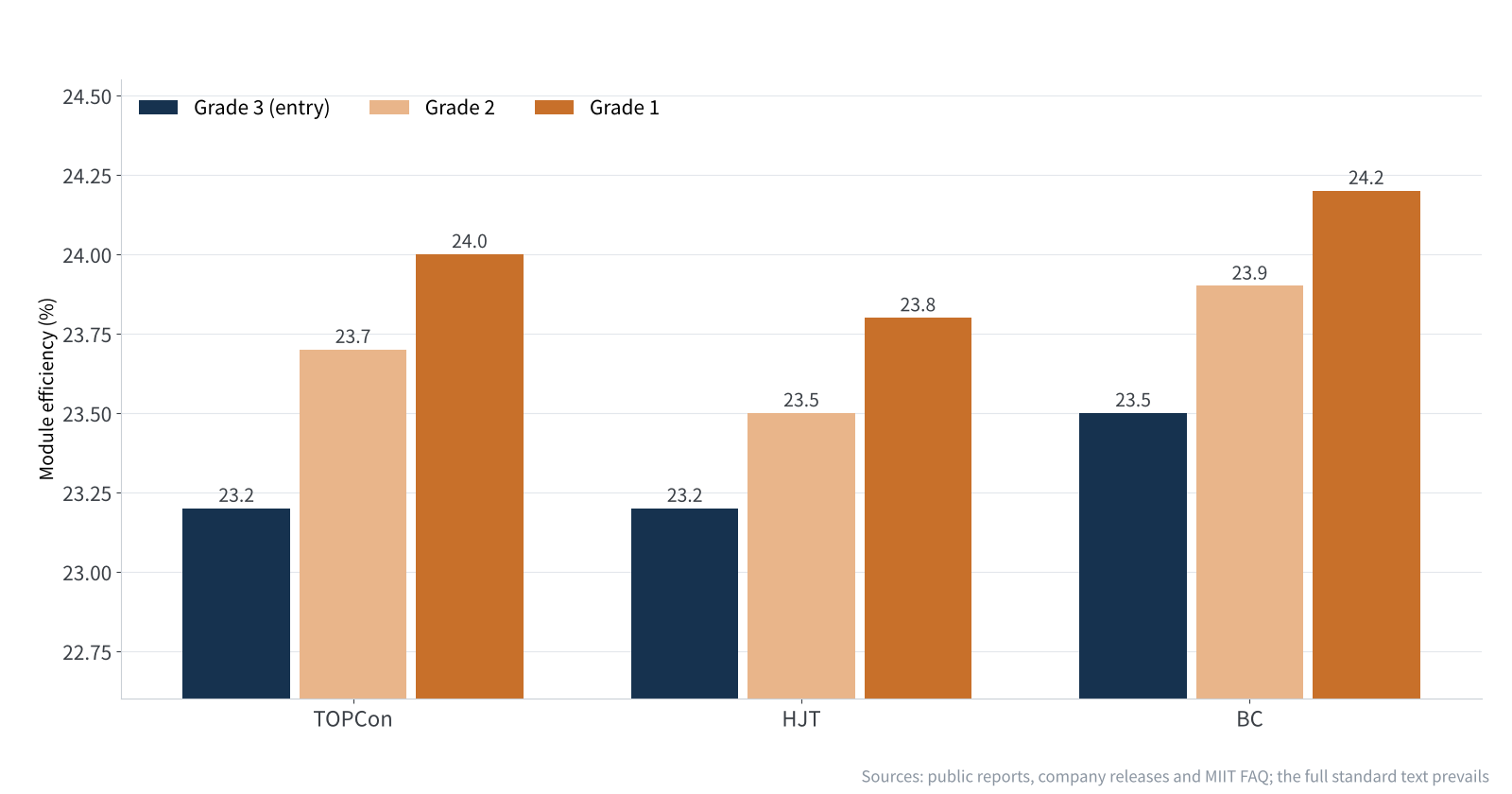
Figure 2 Efficiency grade lines for the three technologies
Converting efficiency to power makes it more tangible. For the mainstream 2,382 × 1,134 mm format (about 2.70 m²): 23.2% corresponds to about 627 W, 23.5% to about 635 W and 24.0% to about 648 W. With 5 W power bins, TOPCon and HJT modules need at least a 630 W nameplate, and BC modules at least 635 W. Existing products around 620 W in this format will essentially fail the threshold.
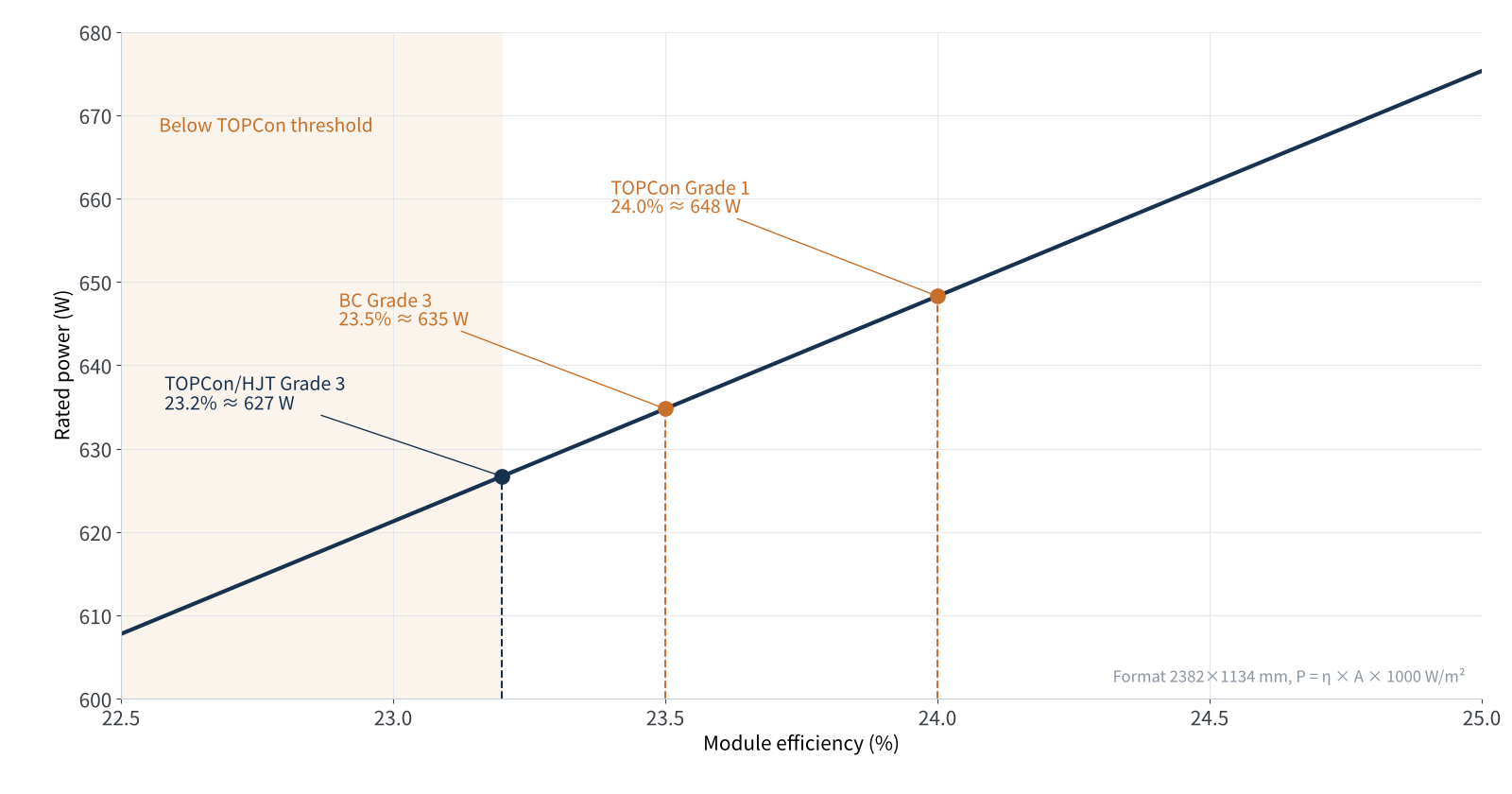
Figure 3 2,382 × 1,134 mm format: converting efficiency to power
Scope and existing inventory were clarified officially in September. The Ministry of Industry and Information Technology (MIIT) published its first FAQ (17 questions), which makes several points clear. PV products deployed in China must comply, whether in utility-scale or distributed projects. Export products may follow the technical requirements agreed in their contracts, but products later resold in China must comply. After the standards take effect, non-compliant existing inventory must also meet the new requirements when sold, regardless of production date; products shown by testing or certification to comply may be reworked and sold. Companies with long-term contracts below the new thresholds should review their orders and renegotiate with customers. In addition, the module safety and labelling standards take effect on 1 June 2027, market regulators' spot checks begin on 1 January 2027, and the QR code on module nameplates must remain accessible throughout the product's service life.
One clarification while we are at it. Some in the industry say the final version "went easy on BC". But according to OFweek's comparison with the draft for comment (September 2025), BC's Grade 3 line rose from 23.3% to 23.5% while its Grade 1 line fell from 24.8% to 24.2%; TOPCon's Grade 3 line jumped from 22.4% to 23.2%. So it is more accurate to say: the entry bar for BC went up, while its top-grade bar was relaxed.
03Why buyers can't wait until next year
On the surface this looks like "proactive compliance", but behind it is very practical contract logic:
- Deliveries span the year end: framework agreements run for a year, signed this year and delivered next year. Products must comply on the day they arrive; if the threshold is not set at tender, it will bite during delivery. The MIIT FAQ's inclusion of existing inventory makes this even more certain.
- Moving risk forward: owners do not want to bear the risk of non-compliant deliveries that cannot pass grid-connection acceptance, and writing the threshold into tender documents is the cheapest way to avoid it.
- Package effects: in combined solar-plus-storage projects, a non-compliant module choice can jeopardise the eligibility of the whole bid, so integrators have to tighten up too.
- The bar was already rising: 23.2% is only the floor. According to a winning bidder's press release, high-efficiency lots making up 75% of Huadian's procurement earlier this year already required module efficiency above 23.8%; Longyuan Power's 6 GW framework tender, published on 14 October, no longer specifies technology or power and divides lots by conversion efficiency alone.
In other words, SOE tenders have always been the industry's weathervane. The standard sets the legal floor; tender documents set the real threshold, and the latter often arrives earlier and sits higher.
04Three paths for manufacturers
Judging from the report, manufacturers' choices are diverging:
- Upgrade: lines with good buildings and hardware keep the plant, laminators and conveyors, and raise volume efficiency above the threshold with margin by optimising passivation and metallisation. The maker interviewed expects to recover the investment in three to four years, provided follow-up orders support high capacity utilisation; upgrades are rotated quarter by quarter to avoid shutting down the whole plant.
- Exit the domestic market: early lines with limited upgrade potential will not receive major new investment; once the standard takes effect, they will stop supplying China and ship overseas to local requirements.
- Scale back PERC: older PERC lines are less likely to receive additional investment, and their domestic shipments will gradually shrink.
One detail is worth noting. CLASP's summary of the standard says it applies to ground-mounted n-type crystalline silicon modules, and how p-type PERC is handled in the standard text remains to be confirmed against the full text. But given the MIIT FAQ's position that "PV products deployed in China must comply", PERC modules sold in China cannot get around the efficiency threshold either, and PERC module efficiency generally tops out at about 21.7%. Buyers' tender thresholds have already made the choice for the market. As for the "about 327 GW of capacity to be eliminated" quoted in some media, that figure does not appear in the Economic Observer's original report, and the basis of the estimate has not been published, so we treat it as indicative only.
05Our views
As a team with more than ten years on the front line of module R&D, reliability and certification, we have four takeaways:
- 23.2% is a pass mark, not a competitive mark: as the pricing manager put it plainly, "owners won't pay a noticeable premium for products that just scrape past 23.2%". To stay reliably above the line in mass production, makers must also allow for batch variation, power measurement uncertainty and binning losses, so internal targets usually sit well above the threshold. Products that only just pass earn no premium and are always at risk of non-compliance, which is the most awkward position for early-generation lines.
- The real challenge may be degradation: raising efficiency still has room through passivation and metallisation process optimisation, but coupled environmental stress degradation of ≤8.6% tests the overall reliability of cells, encapsulation materials and processes. Issues widely discussed with early TOPCon, such as UV-induced degradation and metallisation corrosion under damp heat, are exactly where older lines are weakest. We expect that, for some lines, the bottleneck will shift from "is the efficiency high enough" to "is the degradation stable enough".
- Shipping old capacity overseas is not the end of the story: overseas tenders do not currently require 23.2%, but large overseas plants are already moving towards high-efficiency products. Lower-efficiency products shipped abroad will mostly serve small and mid-sized developers and price-sensitive markets, with limited margins, and could trigger new low-price competition overseas.
- Don't over-read short-term supply: owners also noted that there is still old-spec inventory on the market, and the exit of long-idle lines has limited impact on current supply. Longer lead times mainly reflect fluctuating output on individual lines during upgrades, with second- and third-tier makers' schedules squeezed more. The logic of "capacity exits mean price rises" may not hold in the short term.
The real effective date of the mandatory standard is not 1 January 2027 but the day buyers write it into their tenders; and just scraping past the line only gets you a ticket to the game.
06Final thoughts
The value of this news is that it connects a standard's text with production lines, orders and lead times. Our suggestions for people in different roles:
- Procurement and projects: check efficiency test reports against manufacturers' line-upgrade progress, and spell out compliance clauses clearly for orders delivered across the year end; check existing inventory against the new requirements too.
- Process and quality: leave ample margin in internal efficiency targets, and bring combined stress tests such as damp heat and UV into validation plans early.
- R&D and materials: watch how the bifaciality and degradation requirements steer cell structures and encapsulant selection; this will be the main battleground for cost reduction and efficiency gains in the next phase.
We will take a closer look at the details of the full standard text, including inverter requirements and test and calculation methods. Is your company already feeling this line? We would be glad to hear from you.
References
- Economic Observer, Wang Yajie: "New PV rules not yet in force, some modules already out of the race for big orders", 2026-10-17 (reposted by ifeng Finance and East Money)
- OFweek Solar / PV notes: "Does the new GB 47834-2026 standard go easy on BC cells?", 2026-10-14
- CCTV News (reposted by China Financial Information Network): "PV energy consumption and efficiency standards issued", 2026-07-02
- CLASP: China Introduces the World's First National Mandatory MEPS for Photovoltaic Modules
- JinkoSolar press release: "New PV national standard issued; Tiger Neo 3 module receives CPVT Grade 1 energy efficiency certification", 2026-07-03
- Caixun: "Aiko wins Huadian 6 GW high-efficiency module procurement", 2026-03-17
- PV Tech: Official Q&A clarifies rules of China's mandatory PV standards, 2026-09-15; OPIS: China Clarifies Mandatory PV Standards Ahead of 2027 Implementation, 2026-09-13
- ifeng.com report on the new module efficiency standard taking effect in 2027; Sohu report on Longyuan Power's 6 GW module procurement, 2026-10-14
A PV R&D and technology team with 10+ years of experience | In-depth technical knowledge sharing
Materials · Reliability · Failure Analysis · Standards & Certification · Products · Processes
Exploring AI + PV; collaboration welcome
Disclaimer:
1. Original content reflects the authors' personal views only, is for reference only and does not constitute investment advice.
2. Reposted and cited content is credited to its source, out of respect for original work.
3. Some content was produced with AI assistance (chart generation, data retrieval, concept explanations, etc.); the core framework and key content were written by our technical team and reviewed by people.
4. If anything is inaccurate or infringes your rights, please leave a message or contact us and we will deal with it.