
The PV Ribbon Industry Today and Tomorrow: Growing Volumes, Thinning Margins, Diverging Technologies
In brief
In this final article of our PV ribbon series we turn from technology to industry. Ribbon consumption grew to about 6.8 times its level in six years, and China's market reached about RMB 29.8 billion in 2024; yet leading makers posted gross margins of only about 5.5%–5.7% and net margins below 1% in 2025. Drawing on listed companies' annual reports, we analyse why volumes are up but profits thin, how the competitive landscape is shifting, map technology directions such as finer wire, BC-specific, low-temperature and cost-saving ribbon, and look back over the whole series.
Over the previous eight articles we took this thin copper wire apart from eight angles: roles, structure, materials, manufacturing, testing, soldering, failures and reliability. For the final article we pull back from the lab and the production line to the whole industry: how big is the ribbon market, who makes ribbon, is it profitable, and where is it heading? Our view in one sentence: in the ribbon industry, volumes are growing, margins are thinning and technologies are diverging.
01Market size: a "small material" that has grown fast
Ribbon is a small share of module cost, but with rapid growth in PV installations it has become a sizeable market segment. According to ChinaIRN (Zhiyan Consulting):
- Market size: China's PV ribbon market was about RMB 29.8 billion in 2024, up about 39.3% year on year.
- Consumption: ribbon consumption grew from about 47,700 tonnes in 2018 to about 322,700 tonnes in 2024.
- Cost position: ribbon accounts for about 12% of non-silicon module cost, a significant item among module materials.
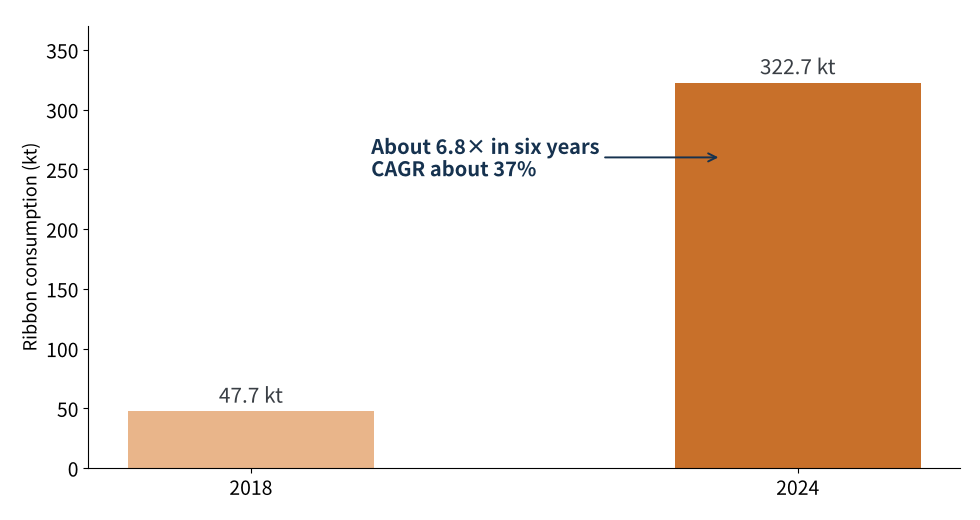
Figure 1 China PV ribbon consumption, 2018 vs. 2024
Over six years consumption grew to about 6.8 times its earlier level, a compound annual growth rate of about 37%. Dividing RMB 29.8 billion by 322,700 tonnes gives a rough average ribbon price of about RMB 92,000 per tonne in 2024. Set against copper prices at the time, this number already sends a signal: copper makes up most of the ribbon price, leaving little room for the processing margin.
Note that statistical bases differ considerably between research firms: a 2026 report by Qianzhan Industry Research Institute estimates China's PV ribbon market at more than RMB 24 billion in 2025. Market size figures are best read for magnitude and trend, not compared directly across firms.
02Who makes it: a fragmented field with a shifting top tier
China's ribbon industry is dominated by private companies and is highly market-driven. Major players include:
| Company | Listing | Ribbon business profile |
|---|---|---|
| Yubang New Materials (YourBuddy) | ChiNext (301266) | Long-standing leader; helped draft national and industry ribbon standards; early to launch BC composite ribbon |
| Tongxiang Technology | Beijing Stock Exchange (920167) | Fast-growing interconnect ribbon volume; early mass production of MBB ribbon |
| Wetown Electric | STAR Market (688226) | PV new materials business mainly ribbon, covering SMBB, low-temperature and busbar ribbon |
| Tailisong, Taiyang Technology and others | — | Important regional or niche suppliers |
Table 1 Major PV ribbon makers in China
On concentration, data from Guanyan Report show that in 2021 the top five held about 43% of the market combined: Yubang about 16.5%, Tongxiang about 10.2%, and Taiyang Technology, Tailisong and Wetown about 6.5%, 5.1% and 4.8% respectively. With the top five holding less than half, the industry remains quite fragmented.
The top tier has also been shifting in the past two years. H1 2025 data compiled by ChinaIRN show Tongxiang's interconnect ribbon revenue at about RMB 1.307 billion, up about 26% year on year, and Yubang's at about RMB 1.224 billion, down about 10.6%. Wetown's 2025 annual report disclosed PV new materials revenue of about RMB 1.713 billion, up about 14%. The ranking among leading companies is no longer as stable as it used to be.
There are changes on the capital side as well: in September 2026, Yubang's former controlling shareholder signed an agreement to transfer about 29.99% of the shares to Suzhou Deling for about RMB 861 million, changing the company's controlling shareholder.
03Is it profitable? A "processing fee" business
After size, profit. We compare the 2025 financials of the two main listed ribbon makers:
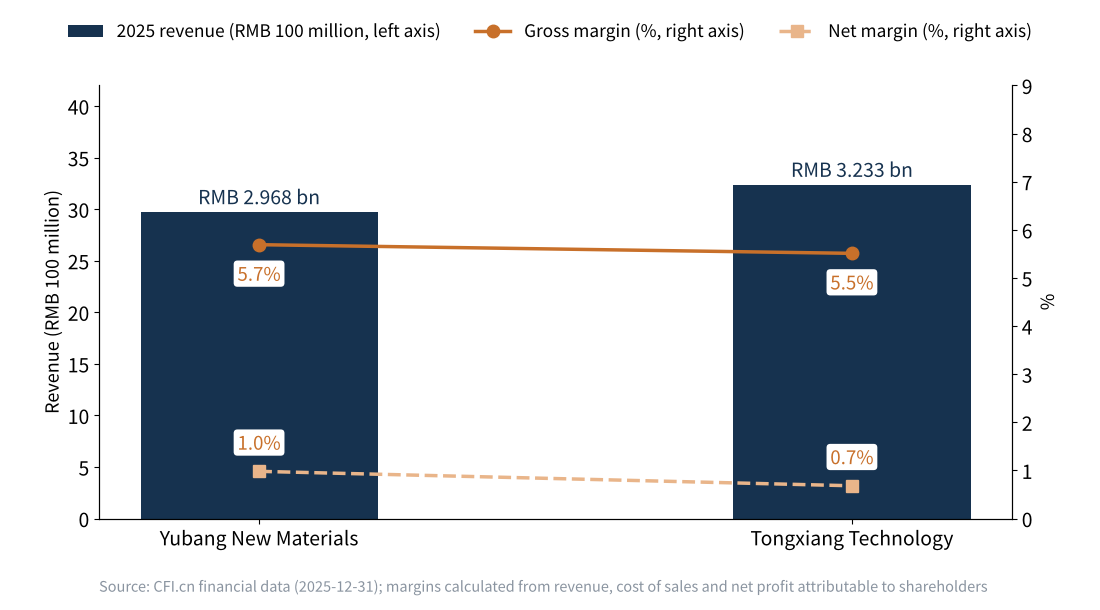
Figure 2 Yubang New Materials and Tongxiang Technology: 2025 revenue and margins
Both companies had 2025 revenue of around RMB 3 billion, but gross margins of only about 5.5%–5.7% and net margins below 1%. Three billion yuan of revenue produced net profit of only twenty to thirty million yuan. Yubang's 2024 earnings forecast had already flagged a year-on-year fall of about 72%–74% in net profit attributable to shareholders, partly due to a marked fall in processing fees for conventional ribbon.
Why is ribbon so hard to profit from? The key is its price structure:
- Copper "pass-through": ribbon is usually priced as "copper price + processing fee", with copper price movements essentially passed on to customers. The higher the copper price, the larger the revenue, but that revenue generates no profit and in fact dilutes gross margin. With LME copper hitting a record USD 14,617 per tonne in September 2026, this effect is all the more pronounced.
- Squeezed processing fees: in recent years the PV value chain has seen "rising volumes, falling prices", and cost pressure on modules passes upstream layer by layer; processing fees are the part of a materials supplier's price squeezed most directly.
- Heavy working capital: copper purchases require a lot of cash, while module makers pay on long terms, so ribbon makers face considerable working capital pressure and receivables risk.
So a ribbon maker's real competitiveness lies not in "how many tonnes of copper it sells" but in whether it can hold its processing fee, and that depends on a technology premium.
The latest data show some signs of recovery: Yubang's H1 2026 revenue was about RMB 1.676 billion, up about 10% year on year; net profit attributable to shareholders was about RMB 68.04 million, up about 89%; gross margin recovered to about 10.1%, and overseas revenue rose about 61%. Half a year of data is not enough to say the industry has bottomed out, but the direction is worth watching.
Copper makes up most of ribbon revenue, while profit comes from the processing fee. Fees for conventional products keep being squeezed, putting the industry in a phase of "rising volumes, thin profits"; whether it recovers depends on whether technology premiums and overseas markets can support processing fees.
04Where the technology is going: one main line, several branches
Looking back over the series, ribbon technology development can be summed up as "one main line and several branches":
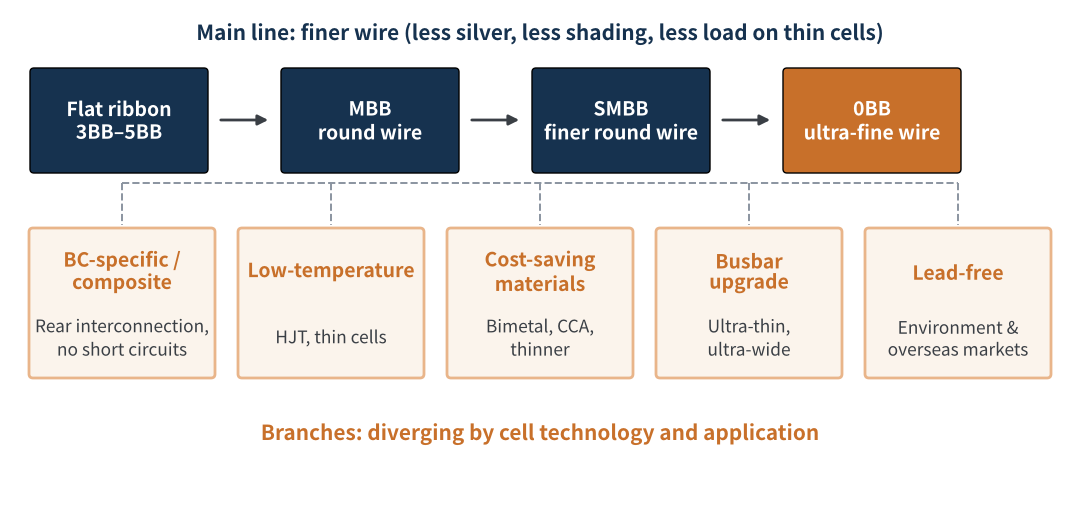
Figure 3 PV ribbon technology development: one main line and several branches
The main line is finer wire. From flat ribbon to MBB, SMBB and then ultra-fine 0BB round wire, ribbon keeps getting thinner and more numerous. Wetown notes in its annual report that SMBB ribbon fits closely with TOPCon cells' need for cost reduction and efficiency gains and is rapidly gaining market share; 0BB pushes ribbon diameter below 0.2 mm, with 0.18 mm and 0.20 mm low-temperature ribbons already in mass production, raising requirements for diameter consistency and coating control. According to TaiyangNews' 2026 technology trends report, nearly every leading module supplier introduced a 0BB module in 2025, mainly to reduce silver consumption.
The branches diverge by cell technology and application. Several directions are worth watching:
| Direction | Driver | Representative developments |
|---|---|---|
| BC-specific / composite ribbon | Rising BC module share; rear-side interconnection must prevent short circuits | Yubang launched composite ribbon for BC modules in 2024, exceeding 3% of shipments in Q4 |
| Low-temperature ribbon | HJT is temperature-sensitive; cells keep getting thinner | Wetown's low-temperature ribbon is qualified for HJT and supplied in volume; 0.18/0.20 mm ultra-low-temperature ribbon in mass production |
| Cost-saving materials | Copper prices running high | Bimetallic layered substrate ribbon, copper-clad aluminium and others in R&D and qualification |
| Busbar ribbon upgrades | Layout optimisation, less bulging after lamination | Ultra-thin, ultra-wide busbar ribbon in pilot production |
| Lead-free | Environmental requirements and overseas market access | Process and reliability groundwork for lead-free coatings |
Table 2 Ribbon technology branches and representative developments
Notably, most of these branches are high value-added products with high technical barriers. They are usually more profitable than conventional ribbon; Yubang notes that its BC composite ribbon is relatively profitable. This is the way for companies to escape the "rising volumes, thin profits" trap. Yubang's 2025 annual report puts it well: the company's performance driver has shifted from "scale growth" to "technology premium".
05A changing competitive logic: from scale to technology
Putting market, profit and technology together, competition in the ribbon industry is changing in three ways:
- From scale to technology: conventional ribbon is highly commoditised, and room to grab share by expanding capacity is shrinking; only companies that can quickly introduce new products and keep up with cell technology iterations earn higher processing fees.
- From single products to solutions: with new technologies such as 0BB and BC, ribbon has to be qualified together with encapsulant, flux, stringer equipment and cell metallisation. Suppliers that can co-develop with module makers and offer complete interconnection solutions have the advantage.
- From domestic to overseas: expanding overseas module capacity brings new demand. Yubang's annual report says its overseas markets cover Southeast Asia, Europe, Africa and South America and have become an important growth engine.
At the same time, industry concentration is likely to rise further. Smaller companies weaker in technology, funding and cost management will gradually exit under the twin pressures of falling processing fees and high copper prices.
The ribbon industry has moved from "whoever has the biggest capacity wins" to "whoever keeps up with cell technology and holds its processing fee wins".
06Series review: nine facets of a ribbon
With this, all nine articles of the PV ribbon series are complete. Here is a table reviewing the whole series:
| Article | Topic | Key point in one sentence |
|---|---|---|
| 01 | Functions and roles | Ribbon handles conduction, connection and shading all at once |
| 02 | Structure and classification | From flat ribbon to round wire, ribbon goes wherever cell technology goes |
| 03 | Materials | Copper handles conduction and temper; the coating handles soldering and reliability |
| 04 | Manufacturing | The challenge is not any single step but consistency over thousands of kilometres |
| 05 | Test methods | Standards only set the floor; key indicators must be written into agreements |
| 06 | Soldering | Ribbon always yields on cooling; joints must be strong without damaging cells |
| 07 | Common failures | Most failures are the long-term combined result of manufacturing defects, material properties and field stress |
| 08 | Module reliability | Ribbon reliability depends on matching cells, metallisation and encapsulant |
| 09 | Industry | Volumes are growing, margins are thinning, technologies are diverging |
Table 3 Review of the nine-part PV ribbon series
07Final thoughts
Ribbon is a great window to look through: small enough to be routinely dismissed as an "auxiliary material", yet critical enough that every change in cell technology leaves its mark on it. Understanding ribbon is, in a way, understanding one of the hidden threads in the evolution of PV module technology.
Thank you to everyone who has read this far. This concludes the ribbon series; we will continue with series on PV materials, module reliability, failure analysis and more. If there is a ribbon topic you would like to discuss further, or a new series you would like us to write, we would be glad to hear from you.
References
- ChinaIRN (Zhiyan Consulting): Analysis of China's PV ribbon industry chain, status, competitive landscape and trends, 2025, https://www.chyxx.com/industry/1239694.html
- Guanyan Report: Analysis of China's PV ribbon industry (2021 market shares), https://www.chinabaogao.com/baogao/202211/618352.html
- CFI.cn: Yubang New Materials (301266) financial data, https://quote.cfi.cn/cwfxzb/156239/301266.html
- CFI.cn: Tongxiang Technology (920167) financial data, https://quote.cfi.cn/cwfxzb/136644/920167.html
- Yubang New Materials 2025 annual report summary, Shanghai Securities News, https://paper.cnstock.com/html/2026-04/17/content_2200787.htm
- Gelonghui: report on Yubang New Materials' 2024 earnings forecast, https://m.gelonghui.com/news/4930605
- Wetown Electric 2025 annual report, CNINFO, https://static.cninfo.com.cn/finalpage/2026-04-29/1225249968.PDF
- Qianzhan Industry Research Institute: PV ribbon industry chain and market analysis (2025 market size), https://www.qianzhan.com/analyst/detail/220/260515-2553e944.html
- 10jqka Finance: Yubang New Materials operating results and change of control, 2026-09-18, https://stock.10jqka.com.cn/20260918/c680059106.shtml
- Gelonghui: Controlling shareholder of Yubang New Materials (301266.SZ) to change to Suzhou Deling, 2026-09, https://m.gelonghui.com/news/5306821
- Gelonghui: LME copper hits record high, 2026-09-08, https://m.gelonghui.com/live/2656118
- TaiyangNews: Gapless, Full-Screen, And 0BB Redefine Module Assembly, 2026-07-03, https://taiyangnews.info/technology/gapless-full-screen-and-0bb-redefine-module-assembly
A PV R&D and technology team with 10+ years of experience | In-depth technical knowledge sharing
Materials · Reliability · Failure Analysis · Standards & Certification · Products · Processes
Exploring AI + PV; collaboration welcome
Disclaimer:
1. Original content reflects the authors' personal views only, is for reference only and does not constitute investment advice.
2. Reposted and cited content is credited to its source, out of respect for original work.
3. Some content was produced with AI assistance (chart generation, data retrieval, concept explanations, etc.); the core framework and key content were written by our technical team and reviewed by people.
4. If anything is inaccurate or infringes your rights, please leave a message or contact us and we will deal with it.