
Ribbon Materials: The Fine Points of Copper Substrate and Coating
In brief
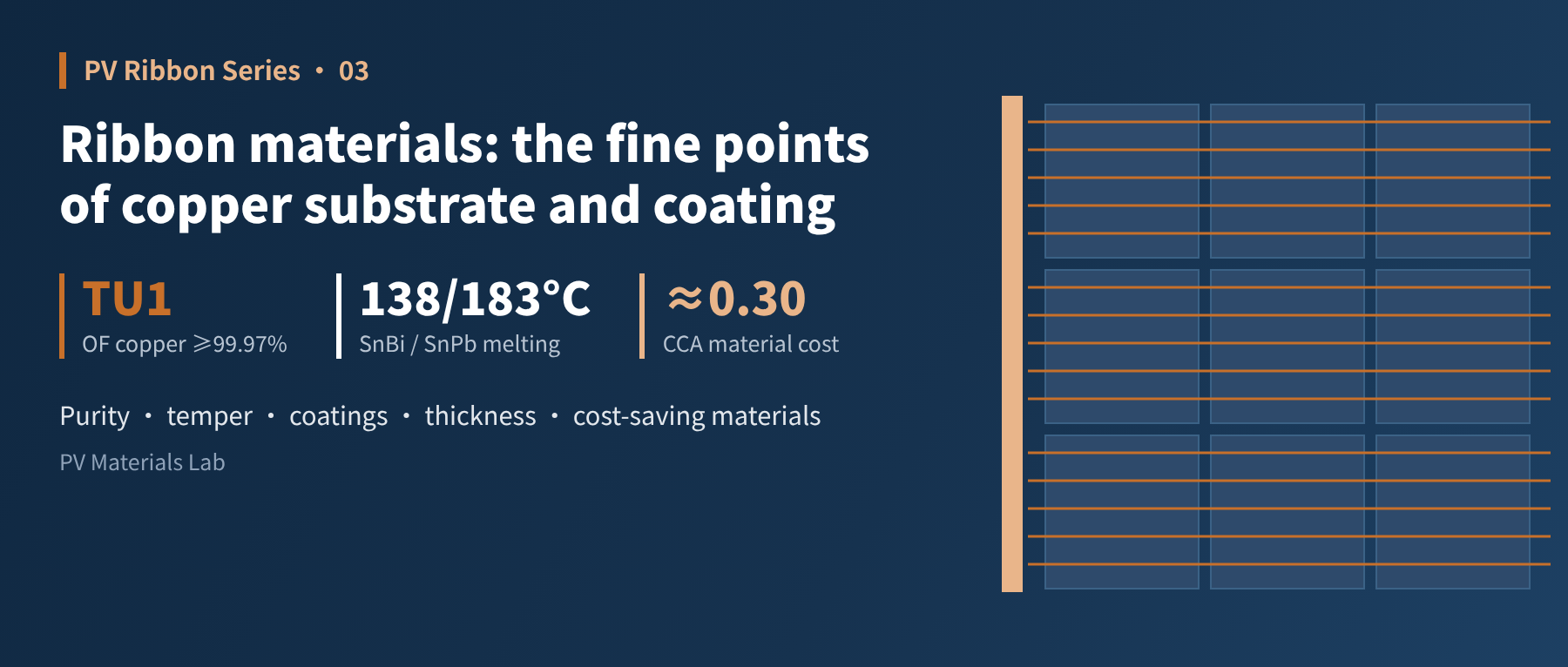
Ribbon consists of a copper substrate and a tin alloy coating. The copper determines how much current it can carry and whether it damages the cell; the coating determines whether it solders and how reliable the joint is. Starting from "why copper", we look at the purity and temper of oxygen-free copper, the trade-offs between tin-lead, tin-bismuth and lead-free coating systems, how coating thickness affects conduction, and use estimates to weigh the pros and cons of cost-saving materials such as copper-clad aluminium.
In the previous article we covered ribbon's "form": from flat strip to round wire, from conventional to shaped. Yet two 0.26 mm round wires from different makers can differ widely in peel force, micro-crack rate and long-term reliability. The difference often lies not in the shape but in the material. In this article we "cut open" the ribbon and look at the fine points of the copper substrate and the coating.
01Why copper?
Ribbon must conduct, be solderable, be soft and be cheap. Put a few common metals side by side and the answer is clear:
| Material | Resistivity (μΩ·cm) | Density (g/cm³) | Coefficient of linear expansion (10⁻⁶/K) | Main problem |
|---|---|---|---|---|
| Silver Ag | About 1.59 | 10.5 | About 19 | Too expensive |
| Copper Cu | About 1.72 | 8.96 | About 17 | Heavy; volatile copper price |
| Aluminium Al | About 2.82 | 2.70 | About 23 | Hard to solder; greater expansion |
| Silicon Si (reference) | — | 2.33 | About 2.6 | — |
Table 1 Key properties of candidate ribbon metals
Silver conducts best, but it costs a hundred times as much as copper or more, so it is out of the question for ribbon. Aluminium is cheap and light, but its resistivity is about 60% higher than copper's, its surface oxide makes it almost impossible to join with conventional tin soldering, and its thermal expansion is even greater than copper's.
Copper is the best balance of conductivity, solderability, strength and cost. Its only "flaw" is the large thermal expansion mismatch with silicon: copper's coefficient of linear expansion is more than six times silicon's. This mismatch means that the most critical property of the copper substrate is not conductivity but "temper".
02Copper substrate: purity, resistivity and "temper"
Ribbon generally uses oxygen-free copper. Common Chinese grades include TU1 and TU2 (copper content at least 99.97% and 99.95% respectively), as well as oxygen-bearing T2 copper. Oxygen-free copper has two advantages:
- Better conductivity: lower impurity and oxygen content brings resistivity closer to the theoretical value for pure copper.
- More stable annealing: oxygen-free copper is less prone to problems such as "hydrogen embrittlement" during annealing, with more uniform grain growth and more consistent softening.
With purity settled, next comes temper. Copper work-hardens during drawing and rolling: grains are elongated and dislocations pile up, raising strength and lowering elongation. If such "hard copper" were soldered directly, the pull from copper shrinking as it cools would act straight on the cell, causing warpage and micro-cracks.
So ribbon production always includes an annealing step: the copper is heated above its recrystallisation temperature so that grains regrow and work hardening is removed. After annealing, yield strength drops sharply and elongation rises markedly, reducing soldering stress accordingly.
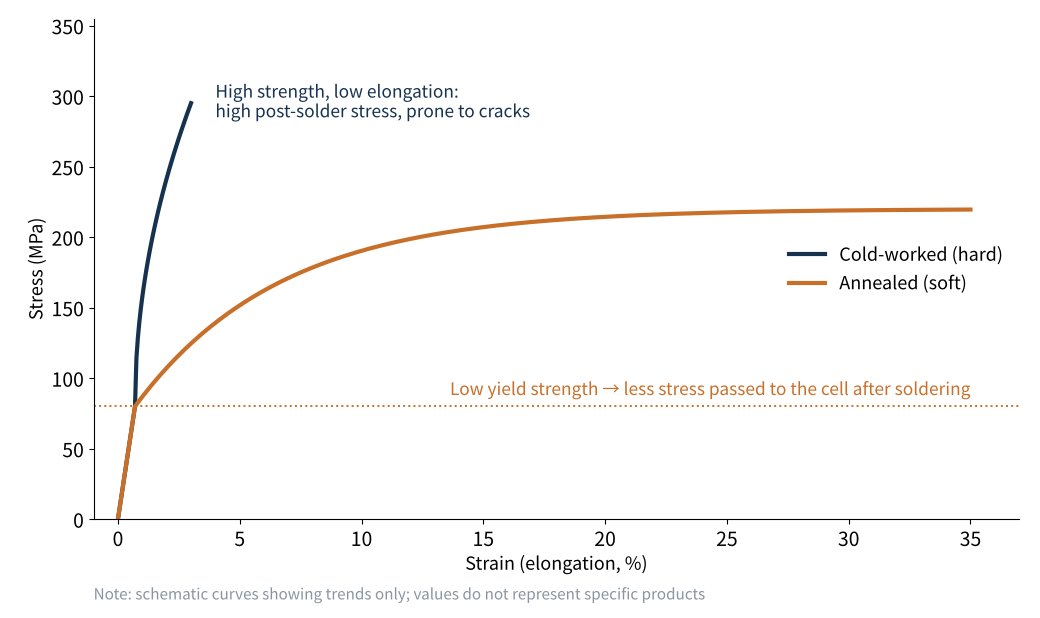
Figure 1 Stress-strain curves of cold-worked and annealed copper (schematic)
So is softer always better? No. Too low a yield strength brings new problems:
- Stretching in production: stringers apply tension when pulling ribbon, and overly soft ribbon is easily drawn thinner and longer, leading to unstable diameter and misaligned soldering.
- Poorer straightness: fine round wire bends and deforms more easily during unwinding, winding and threading, affecting positioning accuracy.
- Deformation in lamination: under lamination pressure and temperature, overly soft ribbon is more easily flattened or displaced.
So ribbon yield strength is a "window", not "the lower the better". The thinner the cell and the finer the ribbon, the narrower this window. For ribbon makers, precise control of annealing temperature, speed and atmosphere, and consistency between batches, are core process capabilities.
Besides purity and temper, the surface quality of the copper substrate matters just as much. Scratches, burrs and oxide spots left by drawing or rolling make the coating adhere poorly and unevenly, eventually showing up as local cold joints. For fine round wire, surface defects are larger relative to the cross-section, so their impact is more pronounced.
The key to the copper substrate is not just purity but "temper". Annealing lowers yield strength to protect the cell, but too soft hurts production, so it must be precisely controlled within a window.
03Coating: a multiple-choice question in solder alloys
The coating is the ribbon's "solder". During stringing it melts, wets the cell's silver electrodes and forms a solder joint on cooling. Choosing a coating alloy is essentially a trade-off between melting point, wettability, reliability and environmental compliance. Common coating systems in the industry include:
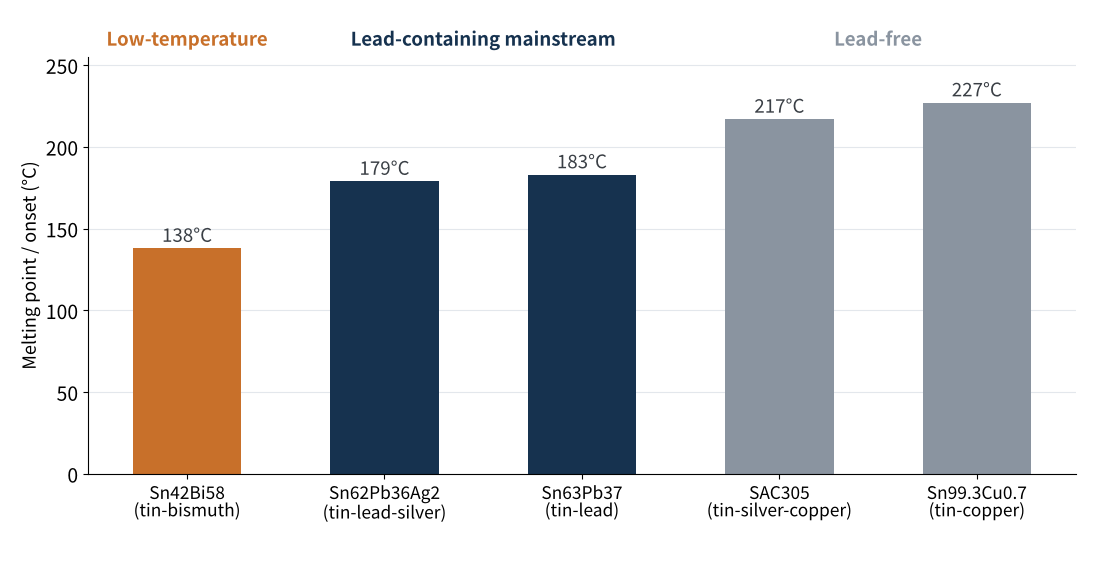
Figure 2 Melting points of common ribbon coating alloys
- Tin-lead (Sn63Pb37, etc.): the classic system. Eutectic melting point about 183 °C, good wettability, wide soldering window, low cost and strong resistance to tin whiskers; currently the mainstream choice for ribbon on conventional cells.
- Tin-lead-silver (e.g. Sn62Pb36Ag2): adds a little silver to tin-lead, lowering the melting point slightly and, more importantly, suppressing dissolution of the silver in the electrodes into the solder during soldering ("silver scavenging"), improving joint strength.
- Tin-bismuth (e.g. Sn42Bi58): a low-temperature system with a eutectic melting point of about 138 °C, used for heat-sensitive cells such as HJT and for thin wafers sensitive to thermal stress. Its drawbacks are the brittleness of bismuth and higher resistivity, so the fatigue resistance of the joints needs careful verification.
- Lead-free (tin-silver-copper, tin-copper, etc.): meets environmental requirements, but melting points are generally above 217 °C, meaning higher soldering temperatures, greater thermal stress and a narrower soldering window.
Why is tin-lead still mainstream? Beyond performance and cost, there is a regulatory reason: the EU RoHS Directive (2011/65/EU) explicitly excludes from its scope "photovoltaic panels intended to be used in a system that is designed, assembled and installed by professionals for permanent use at a defined location", and in Europe PV modules are managed for recycling mainly under the WEEE Directive. However, this exclusion does not cover every case, and some customers and markets explicitly require lead-free products, so building process capability for lead-free ribbon remains necessary.
Coating choice must also be considered together with cell technology and soldering process. Low-temperature ribbon with low-temperature soldering, for instance, can reduce micro-cracks in thin cells, but the behaviour of low-temperature joints under thermal cycling must be confirmed by reliability tests such as TC, not judged on initial peel force alone.
A "slow variable" also hides inside the solder joint: intermetallic compounds (IMC). During soldering, tin in the coating reacts with the copper substrate and the silver in the electrodes, forming copper-tin, silver-tin and other compound layers at the interfaces. A thin, continuous IMC layer is a sign of a strong joint, but it slowly thickens at high temperature and over long service; IMC is hard and brittle, and when too thick, joints are more likely to crack along the interface under thermal cycling. That is why coating systems with the same initial peel force can perform very differently after ageing.
The coating also works hand in hand with flux. Flux removes oxides from the ribbon and electrode surfaces at the moment of soldering, helping the solder wet and spread. When the coating composition changes, the activity and formulation of the flux often need adjusting too, and the two must be validated together.
Tin-lead is the best all-round balance of performance, cost and process window; tin-bismuth solves "heat sensitivity" at the cost of brittleness and resistance; lead-free is the environmental direction, at the cost of higher soldering temperatures.
04Coating thickness: a bit more or a bit less are both problems
A thicker coating is not automatically safer. An easily overlooked fact: coating alloys have roughly 10–20 times the resistivity of copper.
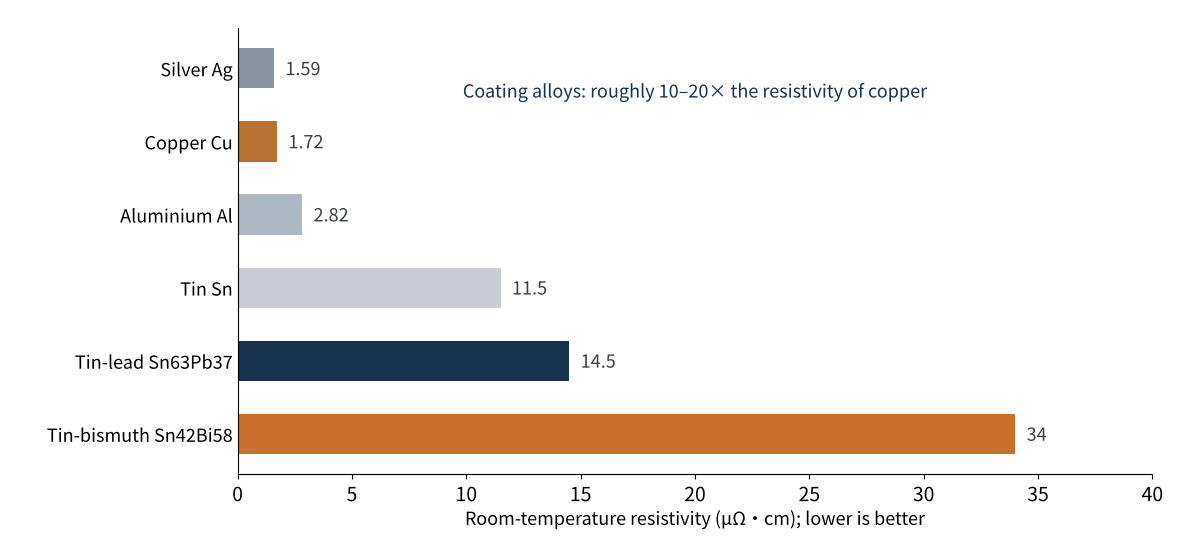
Figure 3 Room-temperature resistivity of ribbon-related metals and alloys (common reference values)
This means the coating contributes almost nothing to conduction while taking up cross-section. Take a 0.26 mm round wire as an example: with a 15 μm coating on each side, the copper core is only about 0.23 mm in diameter and makes up only about 78% of the cross-section; the remaining 22% or so is essentially "dead weight".
The finer the ribbon, the worse this becomes. With the same 15 μm coating on a 0.18 mm round wire, the copper core's share falls to about 70%. That is why ultra-fine ribbon such as 0BB is so sensitive to coating thickness control: every few micrometres of coating saved is like "getting conductive cross-section for free".
But the coating cannot be thinned indefinitely:
- Too thin: insufficient solder, under-filled joints, risk of cold joints and low peel force; once the coating oxidises in storage, solderability drops more noticeably.
- Too thick: excess solder overflows during soldering into solder balls or bridges, wasting cross-section and material, and possibly affecting appearance and insulation.
- Uneven: an off-centre coating on round wire, or different thicknesses on the two faces of flat ribbon, leaves joints full on one side and cold on the other, with widely scattered peel force.
So coatings cannot be judged on average thickness alone; uniformity and consistency matter too. In addition, the coating surface gradually oxidises with storage time, so storage conditions and shelf-life management of ribbon must not be overlooked in module makers' incoming material control.
05Cost-saving materials: copper-clad aluminium, thinning and low silver
Ribbon pricing is essentially "copper price plus processing fee". As a rough estimate for a 182 mm, 144-half-cell module with 16 round wires of 0.26 mm: interconnect plus busbar ribbon uses about 0.27 kg of copper; at a copper price of about RMB 110,000 per tonne (average Shanghai spot price for #1 electrolytic copper of about RMB 110,400 per tonne on 1 September), the copper alone costs about RMB 30 per module, or about RMB 0.05/W. Every RMB 10,000/t rise in copper adds about RMB 2.7 per module. And on 8 September, LME copper hit a record USD 14,617 per tonne, up about 17% year to date, so the pressure on this calculation is growing.
That is why the industry keeps exploring cost-saving materials for ribbon. There are three main directions:
First, copper-clad aluminium (CCA). An aluminium core clad in copper combines aluminium's lightness and low cost with copper's solderability. Assuming 15% copper by volume, at the same resistance as pure copper ribbon:
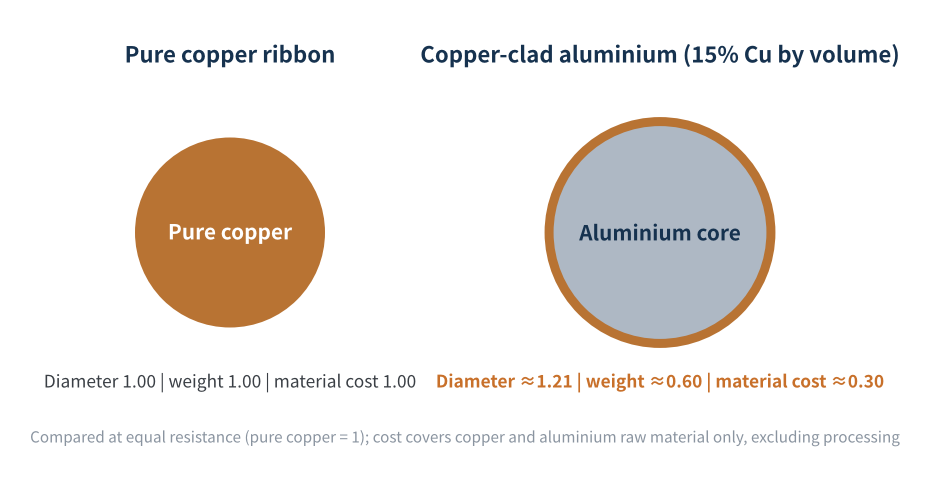
Figure 4 Copper-clad aluminium vs pure copper ribbon at equal resistance (estimate)
Raw material cost can fall to about 30% of pure copper and weight to about 60%, but diameter must increase by about 21%. For interconnect ribbon, a larger diameter means more shading, eating into power. There are also some unavoidable issues:
- Interface bonding: the bond strength and long-term stability between copper and aluminium need verifying; interface cracking under thermal cycling increases resistance.
- Galvanic corrosion: once the ribbon is cut, the aluminium core is exposed at the cut end, creating a risk of galvanic corrosion between copper and aluminium in damp heat.
- Mechanical properties: aluminium is weaker and less fatigue-resistant than copper, and the problem grows as wires get finer.
Logically, busbar ribbon, which is insensitive to cross-section and causes no shading, is the easier entry point for alternative materials such as CCA; interconnect ribbon requires a careful balance of power, reliability and cost.
Second, thinning and finer wires. Where electrical performance allows, reducing cross-section directly reduces copper use. This follows the same direction as the busbar evolution covered in the previous article, but resistive loss limits how far it can go.
Third, low-silver or silver-free coatings. The silver in tin-lead-silver coatings is a small share but still a cost item when silver prices are high: London spot silver rose about 147% over 2025. Where soldering reliability allows, replacing tin-lead-silver with tin-lead is another way to cut cost.
| Cost-saving route | Savings potential | Main costs / risks |
|---|---|---|
| Copper-clad aluminium | Large; raw material cost can fall by about 70% | Larger diameter, more shading; interface bonding and corrosion risks |
| Thinning / finer wire | Medium; depends on cell design | Higher resistive loss; constrained by cell electrode design |
| Low-silver / silver-free coating | Small to medium; varies with silver price | Joint strength and reliability must be revalidated |
Table 2 Comparison of ribbon cost-saving routes
Cutting ribbon material cost requires a system-level calculation: material savings must not be eaten up by power loss and reliability risk.
06Final thoughts
The fine points of ribbon materials can be summed up in one sentence: copper handles conduction and temper; the coating handles soldering and reliability. Understand these two, and when you read the purity, yield strength, coating composition and thickness on a supplier's datasheet, you will know what problem each parameter is there to "prevent".
With the materials chosen, how do you turn them into a reel of good ribbon? In the next article we will look at the ribbon production process: drawing, rolling, annealing, tinning and winding, and the key control points at each step. What pitfalls have you met in ribbon material selection? We would be glad to hear from you.
References
- 10jqka Finance: Changjiang non-ferrous metals spot prices on 1 September (#1 copper), 2026-09-01
- 10jqka Finance: Chalco aluminium ingot spot prices on 29 September, 2026-09-29
- Gelonghui: LME copper prices hit successive record highs, 2026-09-08
- TMTPost (Gantanhao Technology): Overview of PV silver-reduction technology routes (2025 silver prices), 2026-01-05
- Directive 2011/65/EU (RoHS), Article 2(4)(i); PV CYCLE: Photovoltaic waste legislation details (PV modules under RoHS and WEEE)
- GB/T 5231, Designation and chemical composition of wrought copper and copper alloys (composition requirements for grades such as TU1 and TU2).
- Physical properties of metals and solder alloys are general reference values.
A PV R&D and technology team with 10+ years of experience | In-depth technical knowledge sharing
Materials · Reliability · Failure Analysis · Standards & Certification · Products · Processes
Exploring AI + PV; collaboration welcome
Disclaimer:
1. Original content reflects the authors' personal views only, is for reference only and does not constitute investment advice.
2. Reposted and cited content is credited to its source, out of respect for original work.
3. Some content was produced with AI assistance (chart generation, data retrieval, concept explanations, etc.); the core framework and key content were written by our technical team and reviewed by people.
4. If anything is inaccurate or infringes your rights, please leave a message or contact us and we will deal with it.