
How a Spool of Ribbon Is Made: The PV Ribbon Production Process
In brief
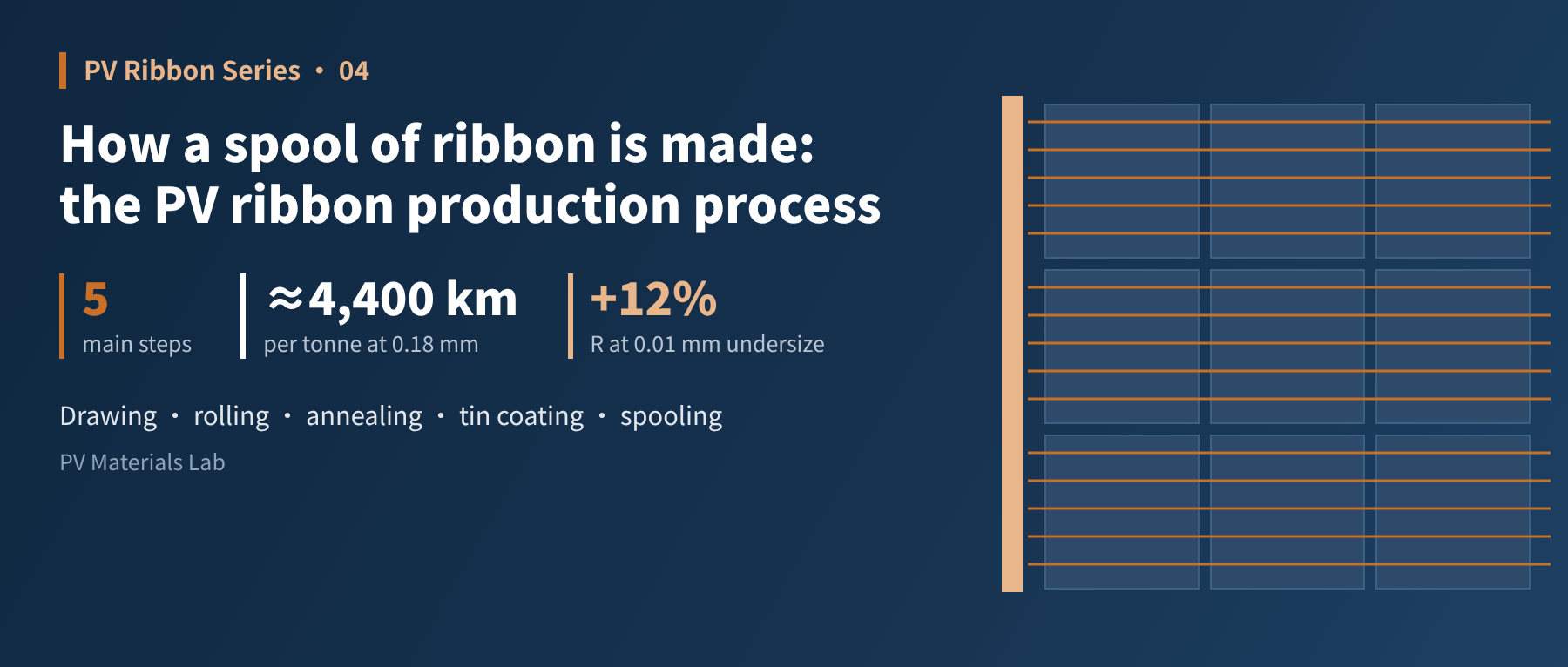
Turning a copper rod a few millimetres thick into a spool of round-wire ribbon around 0.2 mm in diameter with an even coating takes several steps: drawing, rolling, annealing, tin coating, and spooling and inspection. This article walks through what each step does and where its key control points lie, and uses estimates to show that the thinner the ribbon, the more the same dimensional deviation affects resistance, and the harder the process becomes.
In the first three articles we covered ribbon's roles, forms and materials. Once the material is chosen, it still has to be "made". A good spool of ribbon must have accurate dimensions, consistent temper, an even coating and a clean surface, and all of this must hold over thousands of kilometres of length. In this article we walk down the production line and see how a copper rod becomes a spool of ribbon.
01The whole process: five main steps
Process details differ between manufacturers and products, but the main flow is broadly the same:
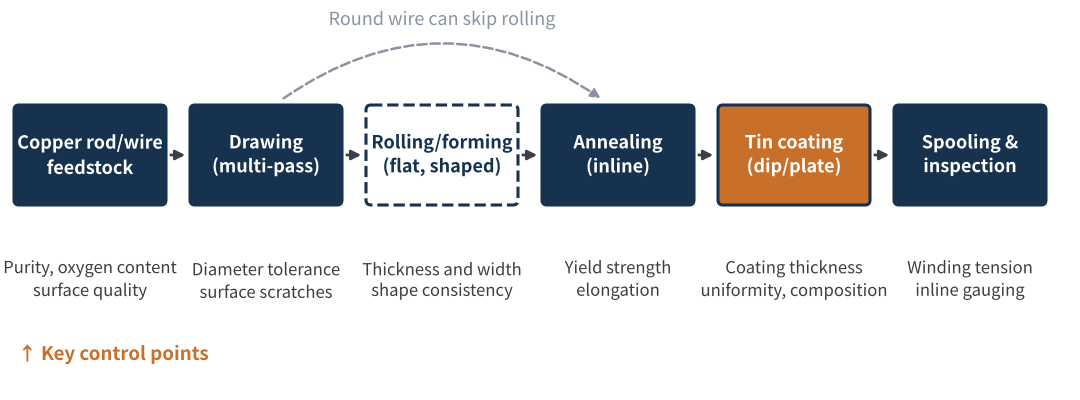
Figure 1 Main production steps and key control points for PV ribbon
- Drawing: a thicker copper rod or wire is pulled through a series of dies and gradually thinned to near the target size.
- Rolling/forming: flat and shaped ribbons need rolls to press the round wire into the target cross-section; round-wire ribbon can skip this step.
- Annealing: removes the work hardening caused by drawing and rolling, making the copper "soft".
- Tin coating: a tin alloy coating is applied to the copper surface, mainly by hot-dip coating, with electroplating as an alternative.
- Spooling and inspection: the ribbon is wound onto spools at a set tension and traverse pattern, checked by inline and offline inspection, then packed and shipped.
On real production lines, annealing and tin coating are often done in series on the same continuous line: the copper wire enters at the pay-off end, passes through annealing, coating and cooling, and is wound up at the other end. This raises efficiency and prevents the annealed "soft copper" from oxidising or deforming during handling between steps.
To get a feel for ribbon "length": a 0.26 mm round wire runs about 2,100 m per kilogram; at 0.18 mm it is about 4,400 m per kilogram. A tonne of 0.18 mm 0BB ribbon stretches to more than four thousand kilometres. Keeping dimensions and properties consistent over such lengths is the core challenge of ribbon manufacturing.
02Drawing and rolling: getting the dimensions right
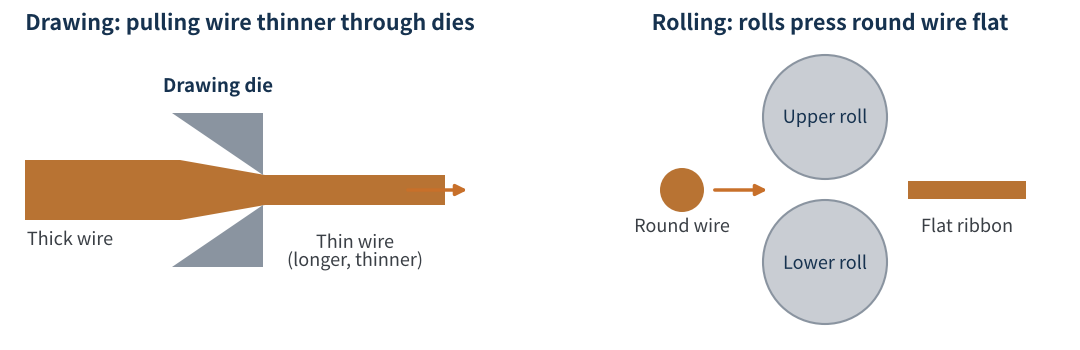
Figure 2 Principles of wire drawing and rolling (schematic)
The principle of drawing is simple: the copper wire is pulled through a die with a slightly smaller opening, becoming thinner and longer under tension. Each die can only reduce part of the cross-section, or the wire will break, so getting from a rod a few millimetres thick down to a few tenths of a millimetre takes several stages (coarse, intermediate and fine drawing) and dozens of dies.
Drawing has three key control points:
- Die precision and wear: the last few dies directly determine the finished diameter. Dies wear with use and their openings grow, so they must be checked and replaced regularly. Fine wire usually uses diamond-type dies for better wear resistance.
- Lubrication and cooling: friction during drawing generates heat, so drawing fluid must lubricate and cool continuously; poor lubrication causes surface scratches and wire breaks.
- Surface quality: scratches, burrs, copper pick-up and other surface defects are "inherited" all the way to the finished product, affecting coating adhesion and soldering.
Rolling feeds the round wire between an upper and a lower roll and presses it into a flat cross-section. The width and thickness of flat ribbon depend on both the roll gap and the incoming wire diameter, while triangular, flattened-round and other shaped ribbons need rolls or forming dies with specific grooves. Rolling must control thickness and width, edge shape and cross-section consistency, and roll precision and wear are again key.
Drawing and rolling set the ribbon's "skeleton" dimensions. Precision and wear management of dies and rolls are the foundation of dimensional stability.
03Annealing: making the copper "soft"
As the previous article explained, copper work-hardens after drawing and rolling and must be annealed back to a soft state; otherwise, after soldering it passes stress to the cell and causes micro-cracks.
Ribbon production mostly uses inline continuous annealing: the copper wire passes through the annealing zone at a set speed, is heated above its recrystallisation temperature within a very short time, and is then quickly cooled. Common heating methods include tube furnaces and resistance heating (passing current directly through the wire so it heats from its own resistance).
Annealing has a few key points:
- Matching temperature and speed: the faster the line, the shorter the time the wire spends in the annealing zone, and the higher the temperature needed. Fluctuation in either temperature or speed causes yield strength to fluctuate.
- Protective atmosphere: copper oxidises very easily at high temperature, so the annealing zone is usually flushed with a protective gas such as nitrogen to prevent surface oxidation that would affect the later coating.
- Consistency: annealing is the core step that sets yield strength and elongation. Consistency of mechanical properties within a spool, between spools and between batches directly affects the stability of stringing at the module plant.
As cells get thinner, module makers are setting stricter yield strength requirements for ribbon, and the stability of the annealing process often matters more than any single test value.
04Tin coating: hot-dip or electroplating?
Tin coating is the step that distinguishes ribbon from ordinary copper wire, and one of the steps with the highest process barrier. There are two main methods:
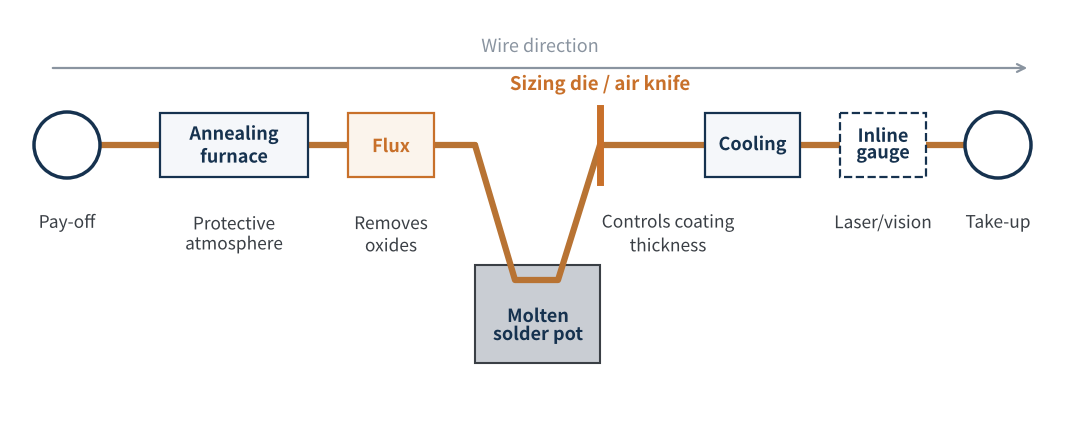
Figure 3 Continuous hot-dip tinning line (annealing and coating in series, schematic)
Hot-dip coating is currently the mainstream method in the ribbon industry. The copper wire first passes through a flux bath to remove surface oxides, then dips into a pot of molten tin alloy. On leaving the pot, a sizing die or air knife wipes off excess solder to control coating thickness, and the wire is then cooled. Its advantages are high throughput, low cost and flexible alloy adjustment: tin-lead, tin-lead-silver, tin-bismuth and other systems can all be used directly.
Electroplating deposits tin or tin alloy onto the copper surface by electrochemical reaction in an electrolyte. The coating is thinner and more uniform, suiting cases with very tight coating thickness requirements; but production is relatively slow, alloy composition is harder to control, and plating solution and wastewater must be treated, so environmental and operating costs are higher.
| Item | Hot-dip | Electroplating |
|---|---|---|
| Principle | Dip in molten tin alloy, size on exit | Electrochemical deposition |
| Coating thickness | Relatively thick; controlled by sizing die/air knife | Can be very thin, with good uniformity |
| Alloy systems | Flexible; many alloys usable directly | Alloy plating is harder to control |
| Throughput and cost | Fast, low cost | Slower, higher cost |
| Environment | Mainly flux and fume treatment | Plating solution and wastewater treatment needed |
Table 1 Hot-dip vs. electroplated tin coating
Whichever method is used, the control priorities in coating are the same:
- Coating thickness: too thin means too little solder and cold joints; too thick wastes cross-section and tends to produce solder balls.
- Uniformity and concentricity: the coating must be even all round a round wire and on both faces of a flat ribbon; otherwise one side of the joint is full and the other is a cold joint.
- Alloy composition: the composition in the solder pot changes as solder is consumed and copper dissolves into it, so it must be analysed and replenished regularly to keep melting point and wetting stable.
- Surface condition: the coating surface must be smooth, without bare spots or solder lumps, and flux residue must be kept within reasonable limits.
Hot-dip is mainstream, winning on throughput and flexibility; electroplating wins on thin, even coatings. The thinner the ribbon, the more demanding the control of coating thickness and concentricity.
05Special ribbons: adding steps to the main flow
The various shaped and functional ribbons mentioned in the previous article are mostly made by adding or modifying a step in the main flow:
- Segmented ribbon: flattened sections are pressed periodically into round wire. Their position and pitch must precisely match cell size and cell spacing, which places high demands on inline synchronisation.
- Light-reflecting ribbon: rolls with micro-patterned surfaces press V-grooves or other reflective structures into flat ribbon, while keeping the coating intact.
- Triangular, flattened-round and other shaped ribbons: formed by rolls or dies with specific grooves; the difficulty lies in consistent cross-section shape and preventing twisting on the spool.
- Black ribbon: a blackening or surface treatment step is added after coating; the colour must be even without affecting soldering or reliability.
- Low-temperature 0BB ribbon: the main changes are in the coating alloy and in annealing. According to information YourBuddy (Yubang New Materials) presented in early 2025, ultra-low-temperature ribbons at 0.18 mm and 0.20 mm are in mass production, with a bismuth-rich SnPbBi coating melting over roughly 93–150 °C; the company also treats elongation and a yield strength of about 106 MPa as process parameters for controlling ribbon offset during soldering. In other words, 0BB has extended ribbon requirements from "dimensions" to a combined window of "alloy plus mechanical properties".
What these steps share is that equipment must be customised, process windows are narrow and yield ramps slowly. This is where ribbon makers mainly pull apart from one another.
06Spooling and inspection: the final gate
Spooling looks like the simplest step but takes real care. Too much winding tension stretches soft ribbon thinner; uneven traverse makes the ribbon tangle or break when the module plant pays it off. For ultra-fine ribbon such as 0BB, the traverse pattern on the spool directly affects whether the stringer can run stably and continuously.
Inspection is split into inline and offline. Inline inspection usually includes laser diameter gauging and surface vision inspection to catch out-of-tolerance dimensions and surface defects in real time; offline inspection samples each batch for dimensions, resistivity, tensile strength, yield strength, elongation, coating thickness and solderability. We will go into these test methods and indicators in the next article.
Why do inspection and control get harder as ribbon gets thinner? Let's do the arithmetic:
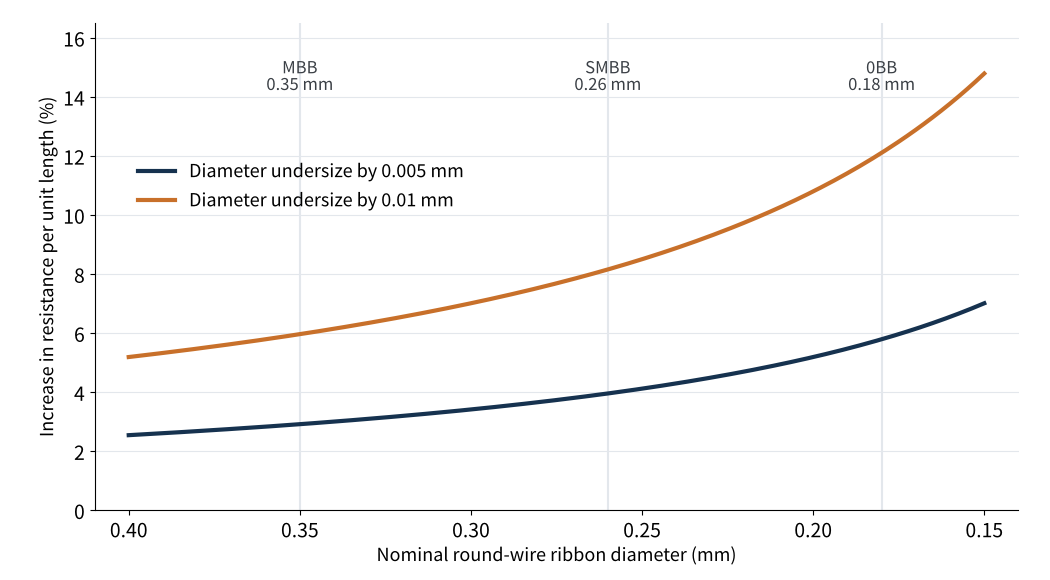
Figure 4 Increase in resistance per unit length when the diameter is undersize (estimate)
For the same 0.01 mm undersize: a 0.35 mm ribbon's resistance rises by about 6%; a 0.26 mm ribbon's by about 8%; and a 0.18 mm ribbon's by more than 12%. In other words, with the same absolute tolerance, the thinner the ribbon, the larger the effect of the same dimensional deviation on performance. This means ultra-fine ribbon must either tighten its tolerances or accept larger performance swings; either way, it tests the precision of drawing, annealing and coating.
| Step | Core control parameters | Typical problems when out of control |
|---|---|---|
| Drawing | Diameter, surface quality | Out-of-spec resistance, surface scratches, wire breaks |
| Rolling/forming | Thickness and width, cross-section shape | Dimensional deviation, edge burrs, twisting |
| Annealing | Temperature, speed, protective atmosphere | Yield strength fluctuation, surface oxidation |
| Tin coating | Coating thickness, uniformity, composition | Cold joints, solder balls, unstable peel force |
| Spooling and inspection | Tension, traverse, inline gauging | Stretching, tangling, missed defects |
Table 2 Core control parameters and risks for each ribbon production step
The difficulty of ribbon manufacturing is not how complex any single step is, but "consistency" over thousands of kilometres; the thinner the ribbon, the harder that consistency is to hold.
07Final thoughts
From copper rod to ribbon, none of the five main steps looks especially "high-tech", but each one "scores" the final product on dimensions, temper, coating and surface. For module makers, knowing how ribbon is made is what lets them understand the causes behind incoming-material variation and hold deeper discussions with suppliers.
Margins in this business are thin, too. Qianzhan Industry Research Institute estimates China's PV ribbon market exceeded RMB 24 billion in 2025. Taking leading maker YourBuddy (Yubang New Materials) as an example: in 2024–2025 the module price war passed down to ancillary materials and squeezed ribbon processing fees, and together with volatile copper and tin prices this pushed the company's gross margin as low as 5.68% in 2025; it recovered to 10.12% in the first half of 2026, with overseas revenue up 61% year on year. In September 2026 the company's controlling shareholder changed. With thin processing fees and expensive raw materials, ribbon makers can only earn their money through yield and consistency, which makes process capability all the more important.
With the process covered, how do you tell whether a spool of ribbon is good? In the next article we look at ribbon test methods and key indicators: dimensions, resistance, mechanical properties, coating thickness, solderability and peel strength, and how to make incoming inspection effective. What variation have you seen in incoming ribbon? We would be glad to hear from you.
References
- Qianzhan Industry Research Institute: PV ribbon industry chain and market analysis (tin-based alloy coating by hot-dip or electroplating; 2025 market size), 2026, https://www.qianzhan.com/analyst/detail/220/260515-2553e944.html
- China Securities Net: Tongxiang Technology PV ribbon production and capacity, https://cs.com.cn/xsb/202110/t20211028_6214391.html
- Kobelco: Manufacturing Process for Copper Strip (copper strip rolling), https://www.kobelco.co.jp/english/products/advanced-materials/about-copper/process/rolling.html
- US Patent 9,991,410: Method and apparatus for manufacturing lead wire for solar cell, https://image-ppubs.uspto.gov/dirsearch-public/print/downloadPdf/9991410
- TaiyangNews: YourBuddy: Ribbons For 0BB Metallization, 2025-01-28, https://taiyangnews.info/technology/yourbuddy-ultra-thin-low-temperature-0bb-metallization
- 10jqka Finance: Yubang New Materials operating results and change of control, 2026-09-18, https://stock.10jqka.com.cn/20260918/c680059106.shtml
- Gelonghui: Controlling shareholder of Yubang New Materials (301266.SZ) to change to Suzhou Deling, 2026-09, https://m.gelonghui.com/news/5306821
A PV R&D and technology team with 10+ years of experience | In-depth technical knowledge sharing
Materials · Reliability · Failure Analysis · Standards & Certification · Products · Processes
Exploring AI + PV; collaboration welcome
Disclaimer:
1. Original content reflects the authors' personal views only, is for reference only and does not constitute investment advice.
2. Reposted and cited content is credited to its source, out of respect for original work.
3. Some content was produced with AI assistance (chart generation, data retrieval, concept explanations, etc.); the core framework and key content were written by our technical team and reviewed by people.
4. If anything is inaccurate or infringes your rights, please leave a message or contact us and we will deal with it.