
Still Mixing Up EVA, POE and EPE? A Complete Guide to the PV Encapsulant Family
In brief
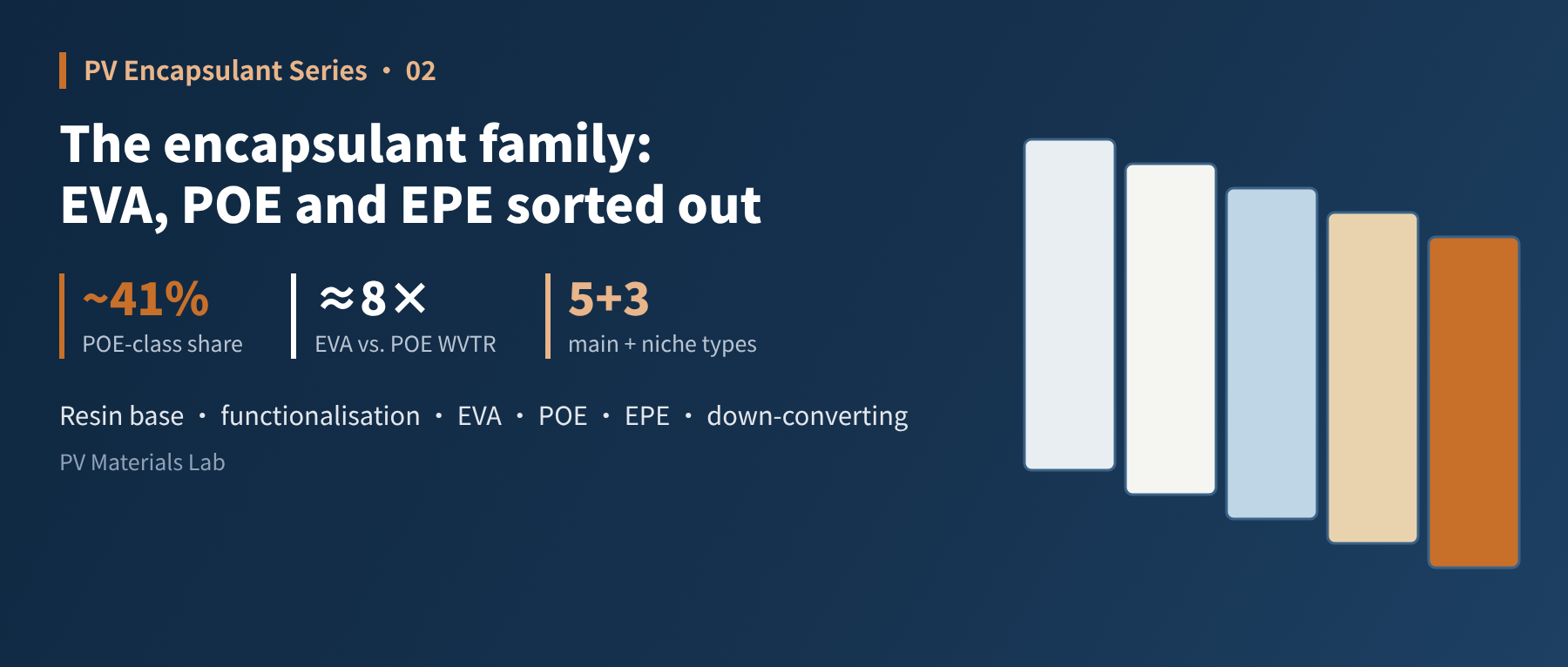
Transparent EVA, white EVA, POE, co-extruded EPE and down-converting films, plus niche routes such as PVB, TPO and silicone: PV encapsulant has long since stopped being a single material. In this second article of our PV encapsulant series, we use two threads, "resin base + functionalisation", to sort out the family: which of the five jobs from the previous article each member does best, where its weaknesses lie, which modules it suits, and why the market has moved in recent years from EVA dominance to several routes side by side.
In the previous article we covered the five jobs encapsulant does in a module: adhesion, light transmission, insulation, barrier and cushioning. But no single encapsulant scores full marks on all five: some bond well but fear damp heat, others block water well but are hard to process. So over the past decade or more, encapsulant has evolved from "EVA everywhere" into a large family.
In this article we get to know each family member: which job it does best, where it falls short, and which modules it belongs in.
01Two threads first: resin base + functionalisation
Encapsulant names look bewildering, but broken down there are only two threads.
The first is the resin base, which sets the encapsulant's "basic character". There are only two mainstream bases today: EVA (ethylene-vinyl acetate copolymer) and POE (polyolefin elastomer, mainly ethylene-octene copolymer). Co-extruded EPE is essentially the two resins stacked together.
The second is functionalisation, building on the resin base: adding titanium dioxide makes a white high-reflectance film, adding a down-converter makes a down-converting film, and adjusting the UV absorber makes a high-transmission or high-cut-off film.
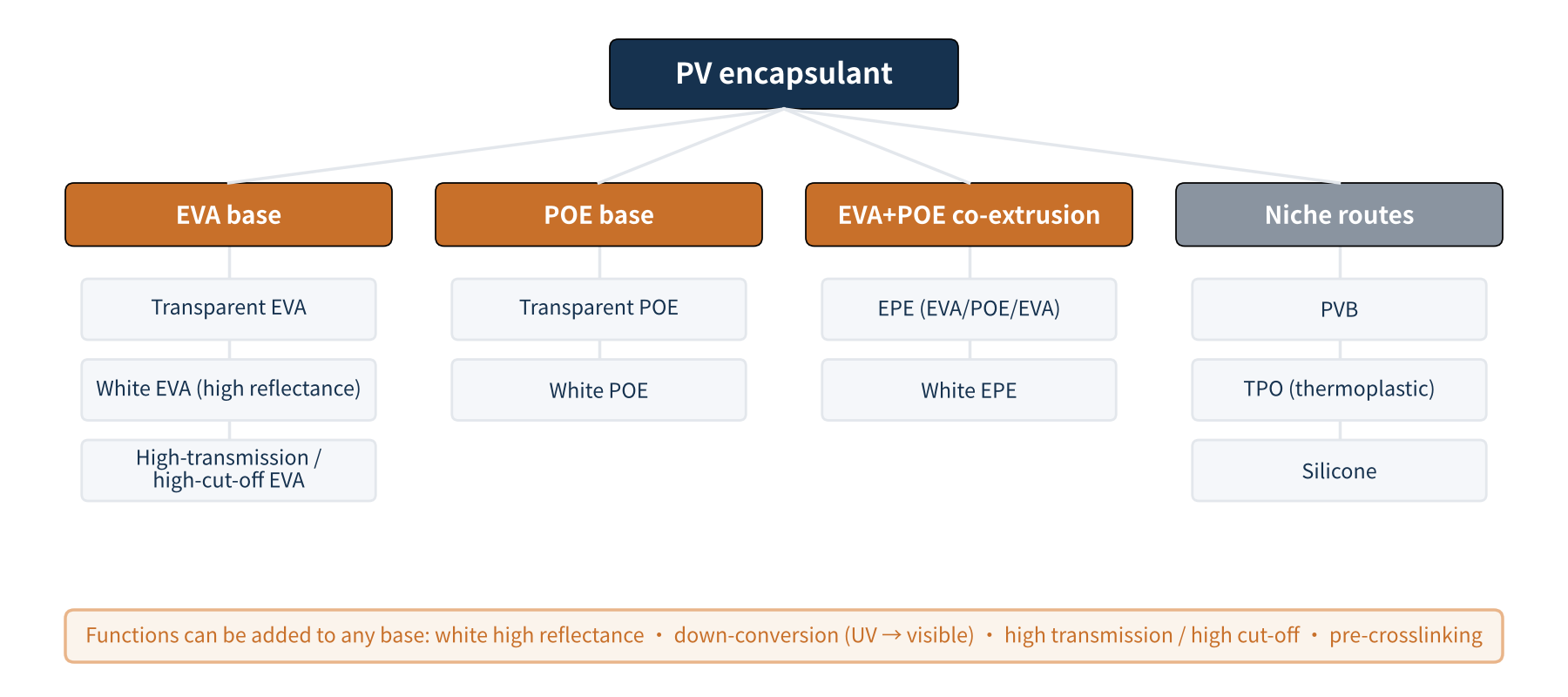
Figure 1 The PV encapsulant family tree (schematic)
With this framework in mind, whenever you meet a new name such as "white EPE" or "down-converting POE", you can immediately break it down into its base and the function added.
02Transparent EVA: the veteran "all-rounder"
EVA is a copolymer of ethylene and vinyl acetate (VA); PV-grade EVA typically contains about 28%–33% VA. The polar groups from VA make it naturally "easy to get along with": it bonds firmly to glass and backsheets, is compatible with crosslinkers, silanes and anti-ageing additives, flows well when molten, has a wide lamination process window, and is the cheapest.
Its weaknesses also come from VA. First, it hydrolyses under damp heat to produce acetic acid, which corrodes fingers and ribbon. Second, its water vapour transmission rate is high, commonly about 25 g/m²·24 h (38 °C, 90% RH), roughly 8 times that of POE. Third, its volume resistivity is relatively low, so PID resistance has to be boosted through formulation.
- Strengths: adhesion, processability, cost.
- Weaknesses: barrier, long-term insulation (PID resistance).
- Typical use: front encapsulant in glass-backsheet modules, and applications with less demanding damp heat and PID requirements.
03White EVA: "recovering" the light that leaks away
White EVA adds white fillers such as titanium dioxide to EVA to make a high-reflectance film. It is used only behind the cells: gaps between cells, and between cells and the frame, would otherwise let some light pass straight through to the backsheet. The white film diffusely reflects this light back, part of which is reflected again by the inner surface of the glass and finally reaches the cells, raising front-side power in monofacial modules.
The most typical process problem with white film is "white overflow": during lamination the white film flows up and creeps onto the edges or even the front of the cells, causing shading and cosmetic defects. The industry generally uses pre-crosslinked white film for this reason: the white layer is lightly crosslinked before shipping to reduce its flow during lamination.
- Strength: raises front-side power of monofacial modules.
- Limitations: opaque, so unusable in bifacial modules; rear encapsulant only. As bifacial modules have become mainstream, white EVA's share has been falling overall.
04POE: the "water-blocking star pupil" born for n-type and glass-glass
POE is a copolymer of ethylene and an α-olefin (mainly octene). Its molecular chain has no ester groups, making it non-polar. This gives it a clear edge on all of EVA's weaknesses:
- No acid: with no hydrolysable ester groups, acetic acid corrosion is avoided at the root.
- Strong water barrier: water vapour transmission rate about 3 g/m²·24 h, far below EVA.
- Good insulation: high volume resistivity and strong PID resistance.
- Low-temperature performance: stays elastic at low temperatures, whereas EVA stiffens noticeably around −20 °C.
But "non-polar" cuts both ways. Additives are poorly compatible with POE and tend to migrate out; adhesion to glass relies more on formulation; lamination takes longer, the process window is narrower, and cell shift and slippage are more likely. On top of that, POE resin has long depended on overseas suppliers such as Dow, ExxonMobil, Mitsui and LG Chem, so it costs markedly more than EVA. This is starting to loosen: China's POE import dependence was still about 95% as of the first three quarters of 2025, but in January 2026 PetroChina's Dushanzi Petrochemical announced large-scale POE production and expects PetroChina's total POE capacity to exceed 300,000 tonnes by the end of 2026.
So POE's positioning is clear: glass-glass modules and n-type TOPCon/HJT modules, exactly the applications with the highest demands for PID resistance, water blocking and corrosion resistance.
05Co-extruded EPE: stacking EVA and POE together
If EVA is easy to process and POE blocks water well, why not take the best of both? EPE is the answer: multilayer co-extrusion produces an "EVA / POE / EVA" three-layer structure. The outer EVA layers handle adhesion to glass and cells and flow during lamination, while the POE core provides the water barrier and PID resistance.
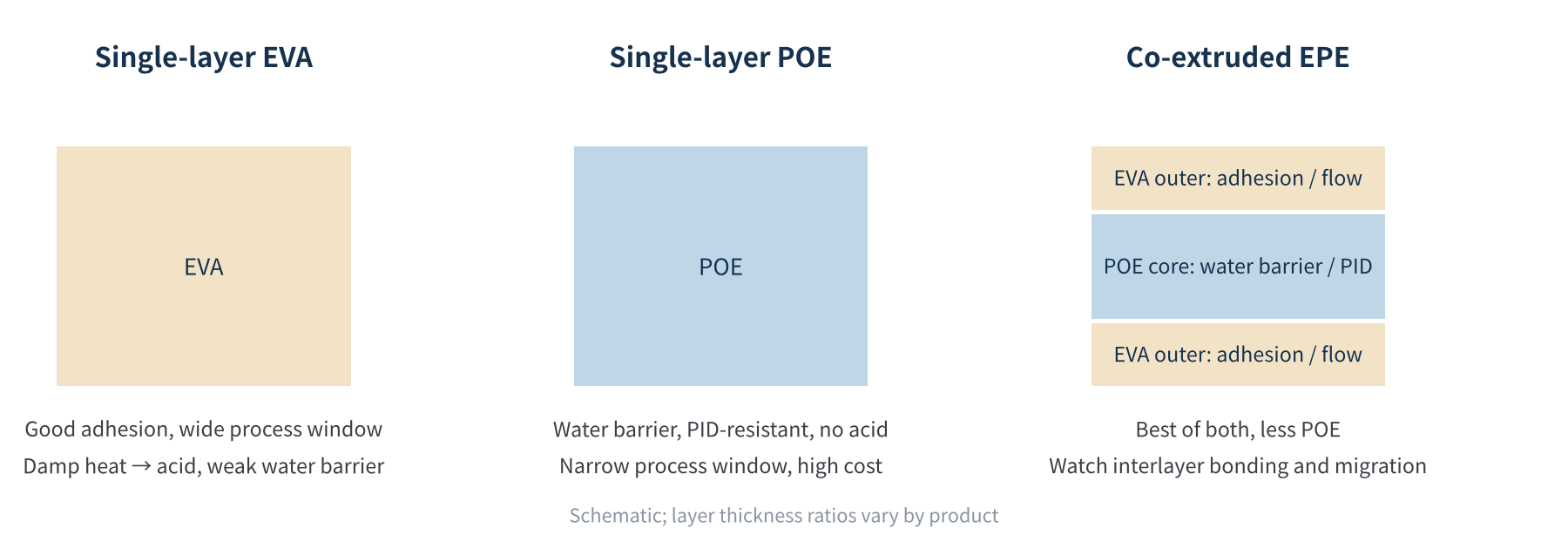
Figure 2 Structures of EVA, POE and co-extruded EPE encapsulants (schematic)
EPE's other big significance is cost reduction: for the same barrier performance, far less POE is needed, offsetting the pressure of expensive, tight POE resin supply. This is why it has ramped up quickly in TOPCon glass-glass modules.
Of course, EPE is not a simple "1 + 1". Co-extruding two materials of different polarity carries risks in interlayer adhesion, layer thickness ratio control and additive migration between layers, and the outer EVA layers still produce a little acetic acid. How good an EPE is depends heavily on the encapsulant maker's formulation and co-extrusion capability.
06A new functional member: down-converting film
The front of n-type TOPCon cells is more sensitive to UV light, and long-term UV exposure can cause power loss. The traditional approach is to add UV absorbers to the front encapsulant to "block" UV, but the blocked UV is then wasted.
Down-converting film takes a different approach: light-conversion materials in the encapsulant absorb UV and re-emit it as visible light, which the cell "prefers". This both reduces UV damage to the cell and partly "recovers" that energy as electricity. The conversion function can be added to EVA, EPE, POE or even TPO bases; at SNEC 2026, Cybrid showed a down-converting film already used in some JA Solar modules.
The main open questions concern long-term reliability: whether the down-converter stays stable under long-term light and damp heat, whether its conversion efficiency degrades, and whether the added cost is covered by the power gain. We will work through the gains and costs of down-converting film in detail in the eighth article of the series, on cost reduction and efficiency.
07Niche routes: PVB, TPO and silicone
Besides the main members above, several materials play important roles in specific applications:
- PVB: a long-established material for laminated architectural glass, with strong adhesion to glass, impact resistance and good safety; common in BIPV façades and some thin-film modules. Its weaknesses are high moisture absorption, usually requiring edge sealing, and higher cost.
- TPO (thermoplastic polyolefin): needs no crosslinker; it melts and bonds during lamination and sets on cooling, with short lamination cycles and easier module recycling. The key challenge is creep resistance at high temperature. It is attracting attention for low-temperature-process modules such as perovskites.
- Silicone: excellent weathering and UV resistance, but high cost and processing very different from existing lamination lines; currently mostly limited to special and research applications.
These routes were once sidelined because their cost-performance could not beat EVA, but with the growth of BIPV, flexible lightweight modules and perovskite tandems, they may find new opportunities.
08One table: which suits which module
| Type | Resin / structure | Strengths | Weaknesses | Typical application |
|---|---|---|---|---|
| Transparent EVA | Single-layer EVA | Adhesion, processability, cost | Acid, water barrier, PID | Front encapsulant in glass-backsheet modules |
| White EVA | EVA + white filler | Raises front-side power | Opaque, white overflow | Rear encapsulant in monofacial modules |
| POE | Ethylene-octene copolymer | Water barrier, PID resistance, no acid | Narrow process window, expensive | Glass-glass, n-type modules |
| EPE | EVA/POE/EVA co-extrusion | Balances adhesion and barrier, lower cost | Interlayer and migration risks | Mainstream in TOPCon glass-glass |
| Down-converting film | EVA/POE/EPE + down-converter | UV protection plus UV recovery | Long-term stability, cost | TOPCon front encapsulant |
| PVB/TPO | Mainly thermoplastic | Safety, no crosslinking | Moisture uptake, creep, cost | BIPV, new module types |
Table 1 Members of the PV encapsulant family compared
Market data show this divergence is real: according to data compiled on the China Photovoltaic Industry Association (CPIA) basis, the combined share of POE and EPE rose from about 23% in 2021 to about 35% in 2022, and reached about 41% in 2024.
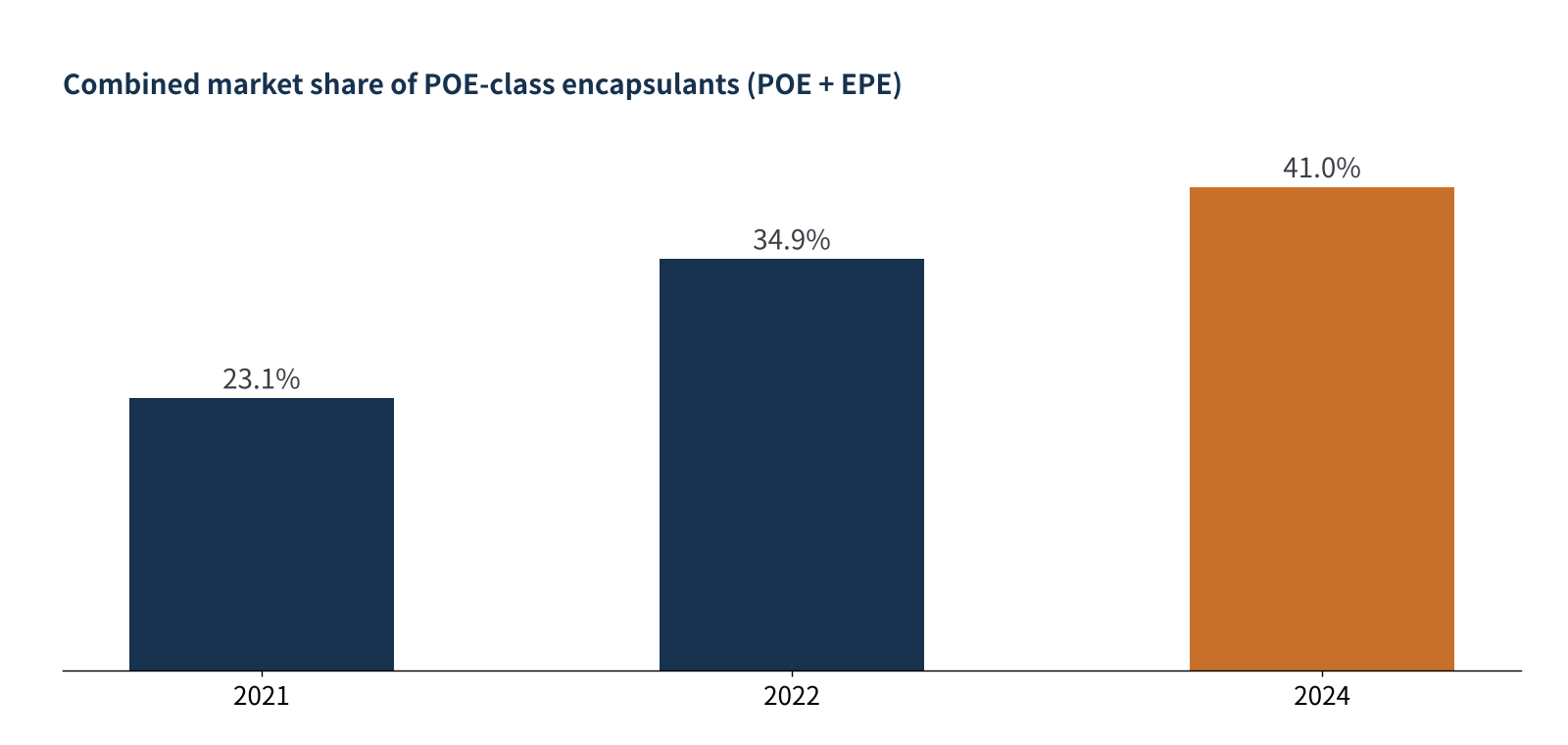
Figure 3 Domestic market share of POE-class encapsulants (POE + EPE) in China (data: CPIA basis, compiled by Guanyan Tianxia and Qianzhan Industry Research Institute)
Notably, growth is shifting from "POE replacing EVA" to "a gear change within the POE class". According to CPIA data cited by TaiyangNews, in 2023 EPE was already slightly above 27% and pure POE about 14%, together about 41%, essentially flat with 2024; CPIA expects the structure to stay broadly stable in 2024 and 2025, with EPE edging up. In other words, pure POE's share has largely peaked, and new demand for water blocking is mainly being met by cheaper EPE. TaiyangNews' 2026 market survey on encapsulants and backsheets likewise lists wider adoption of EPE structures, optimised EVA formulations, UV management solutions and specialty encapsulants as the main trends.
There is no "best" encapsulant, only the one that best matches the cell technology and module structure. Choosing an encapsulant is essentially a trade-off among the five jobs.
09Final thoughts
Looking back at how the encapsulant family diverged, the main line is clear: as cells moved from p-type to n-type and modules from glass-backsheet to glass-glass and from monofacial to bifacial, demands for water blocking, PID resistance, corrosion resistance and UV resistance kept rising, and encapsulant evolved along the path "EVA → POE → EPE → functionalisation". Cost pressure, meanwhile, has meant every upgrade must be carefully costed.
Now that we know the family members, the next step is to open up their "recipes". In the next article we look at resin and additive formulation: how EVA's VA content and melt index affect performance, and what crosslinkers, silane coupling agents and anti-ageing additives each do, which is where encapsulant makers' real core competitiveness lies.
Which encapsulant does your line mainly use now, and what pitfalls did you hit when switching? We would be glad to hear from you.
References
- China Photovoltaic Industry Association: China PV Industry Development Roadmap (2021–2024 editions)
- Qianzhan Industry Research Institute: 2023 China PV encapsulant industry market analysis series (market size, POE encapsulant analysis)
- Guanyan Tianxia: China PV Encapsulant Film Industry Development Trends and Outlook Report (2025–2032), 2025
- TaiyangNews: PV Module Encapsulation Technology Update (Market Survey on Backsheets & Encapsulation 2022-23), https://taiyangnews.info/technology/encapsulation-market-update
- Lesso Solar: Selecting Photovoltaic Encapsulation Films for Outdoor Reliability (EVA vs. POE water vapour transmission)
- GB/T 29848-2018 Ethylene-vinyl acetate copolymer (EVA) film for PV module encapsulation
- TaiyangNews: The State Of Solar Encapsulation Component Market, 2025-03-19, https://taiyangnews.info/technology/the-state-of-solar-encapsulation-component-market
- TaiyangNews: Market Survey on Encapsulation Materials & Backsheets 2026, 2026-06-18, https://taiyangnews.info/reports/taiyangnews-market-survey-on-encapsulation-materials-backsheets-2026
- TaiyangNews: The Growing Role Of Encapsulation Materials (Cybrid down-converting film, SNEC 2026), 2026-06-26, https://taiyangnews.info/technology/cybrid-technologies-raybo-uv-encapsulant-film-energy-storage-materials
- Xinhua: PetroChina achieves large-scale production of high-quality POE, 2026-01-26, https://www.news.cn/energy/20260126/fe4c56af480a405db606c3aee9d1a773/c.html
A PV R&D and technology team with 10+ years of experience | In-depth technical knowledge sharing
Materials · Reliability · Failure Analysis · Standards & Certification · Products · Processes
Exploring AI + PV; collaboration welcome
Disclaimer:
1. Original content reflects the authors' personal views only, is for reference only and does not constitute investment advice.
2. Reposted and cited content is credited to its source, out of respect for original work.
3. Some content was produced with AI assistance (chart generation, data retrieval, concept explanations, etc.); the core framework and key content were written by our technical team and reviewed by people.
4. If anything is inaccurate or infringes your rights, please leave a message or contact us and we will deal with it.