
A Short Process Where Consistency Is Everything: How a Roll of PV Encapsulant Is Made
In brief
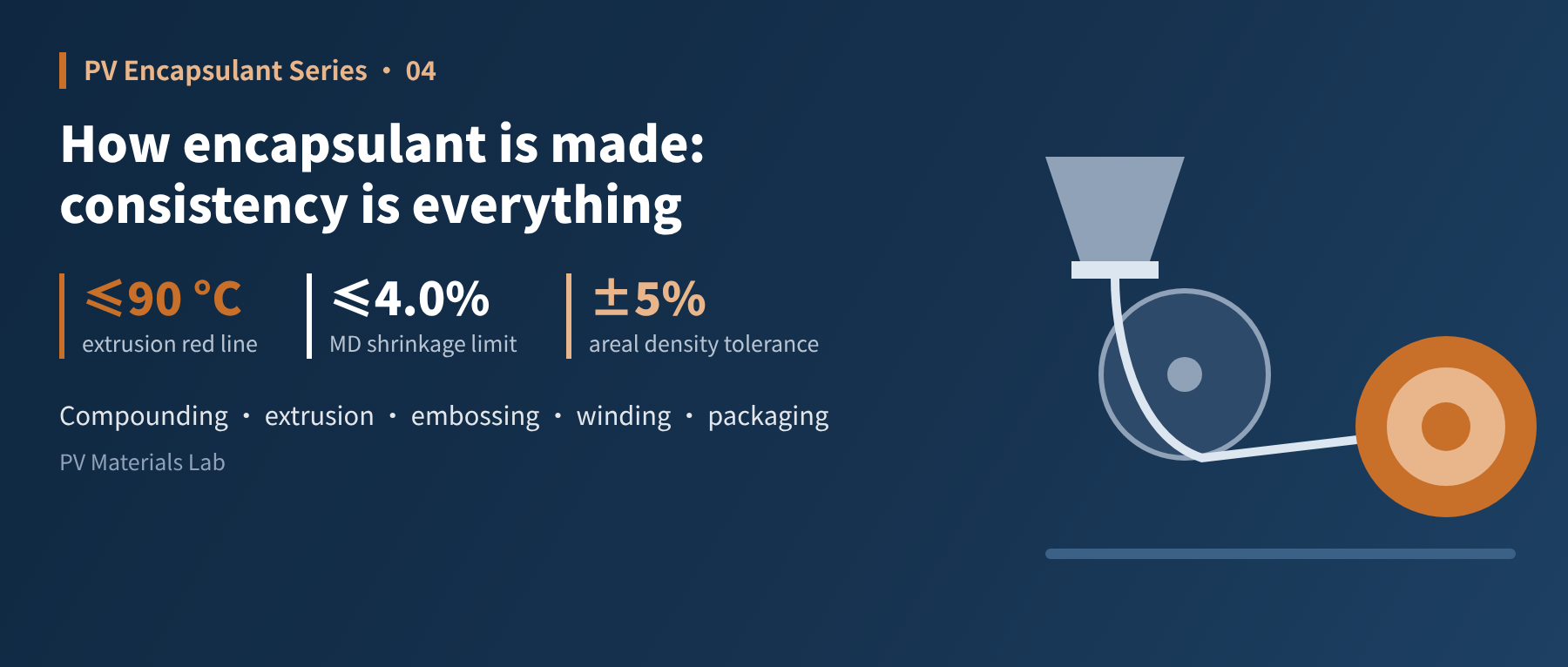
Formulation sets an encapsulant's ceiling; manufacturing decides whether it reaches that ceiling consistently. In this fourth article of our PV encapsulant series, we walk down an encapsulant line (compounding, low-temperature extrusion, embossing and cooling, haul-off and thickness gauging, winding and slitting, and packaging) and focus on pre-crosslinking, shrinkage, grammage uniformity and co-extrusion layer control, and what each looks like at the module plant when it goes out of control.
In the previous article we took apart the encapsulant formulation. But a formulation is only a piece of paper; turning it into roll after roll of good film takes a production line.
The encapsulant production process is actually short, and not especially complex compared with many plastic films. The real difficulty is consistency: with the same formulation, different lines, different shifts, and the middle and edge of the same roll all need almost identical degree of cure, grammage and shrinkage. Many of the batch problems module makers see with encapsulant have their roots here.
01An encapsulant line at a glance
Transparent EVA, white EVA and POE films follow essentially the same main process, and with modification lines can be switched between them. From resin to finished product, the main steps are:
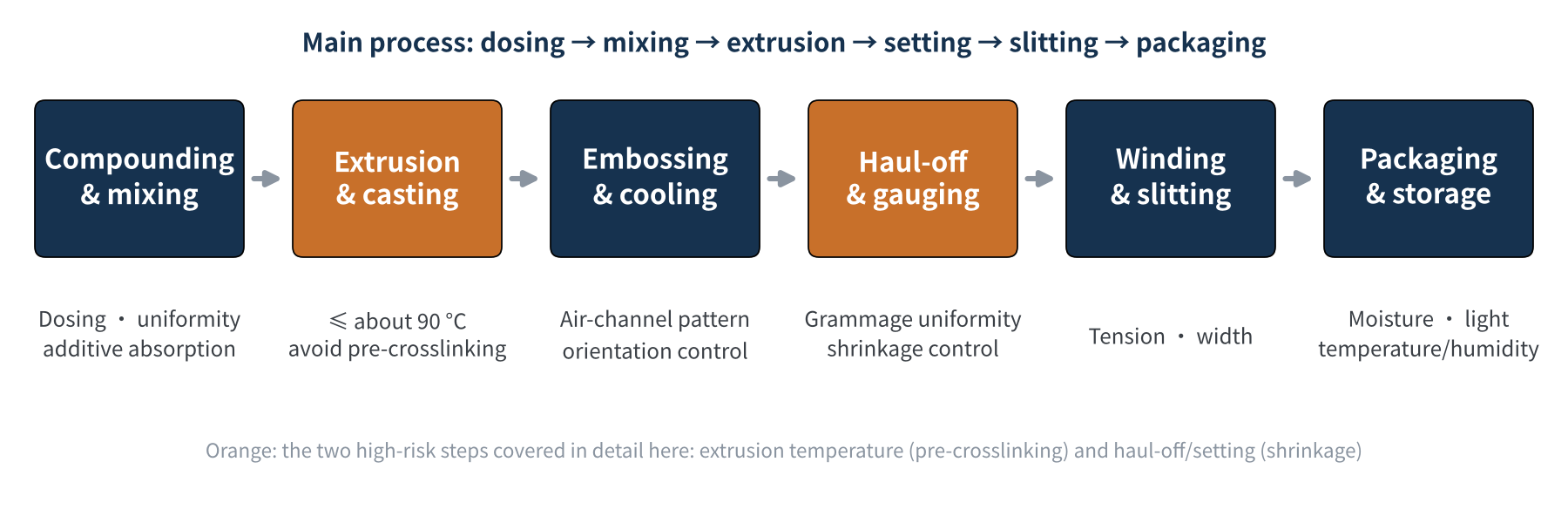
Figure 1 Main production process for PV encapsulant (schematic)
It looks like simply "melt the resin, make it into film, roll it up". But every step has a point that must be held, and we look at each in turn.
02Compounding: getting the additives "absorbed" into the pellets
Many additives, such as crosslinkers and silane coupling agents, are liquids used at only a few parts per thousand. The first step is to weigh them precisely per the formulation, mix them thoroughly with the pellets in mixing equipment, and let the mixture stand so the additives are absorbed into the pellets.
- Accurate dosing: additive amounts are small to begin with, so tiny weighing errors are magnified proportionally and show up directly as variation in degree of cure and adhesion.
- Uniform mixing: if mixing is uneven, crosslinker content differs from place to place on the same roll, and after lamination some areas are well cured while others are under-cured.
- Full absorption: EVA is strongly polar and absorbs additives relatively easily; POE is non-polar, absorbs slowly and in limited amounts, and often needs longer absorption time or addition via masterbatch.
03Low-temperature extrusion: temperature is a red line
The mixed material enters the extruder, is melted and plasticised by the screw, and is pushed through a T-die into a molten sheet of set width; this is called casting.
The biggest difference from ordinary film is that encapsulant is extruded with the crosslinker already in it. As the previous article explained, the crosslinker must stay "dormant" during extrusion and act "fast" only during lamination, so extrusion temperature must be kept strictly below the temperature at which the crosslinker noticeably decomposes; published patents give an upper limit of about 90 °C.
Low-temperature extrusion brings two problems. First, melt viscosity is high and screw shear generates extra heat, so local temperatures can quietly exceed the limit. Second, once any spot overheats, the crosslinker decomposes early and forms pre-crosslinked gel particles, which appear as gels on the film and can become sources of bubbles or defects after lamination. So temperature uniformity in extrusion, screw design and purging after shutdown are basic skills for any encapsulant maker.
04Embossing and cooling: carving "air channels" into the film
The molten sheet leaving the die passes straight through embossing and chill rolls, setting the film while pressing a pattern into its surface. Look closely at any encapsulant and you will see a fine pattern, which is not decoration:
- Air evacuation during lamination: when the laminator pulls vacuum, the gaps between the pattern are the channels through which air escapes; poor embossing design can leave bubbles in the module.
- Anti-blocking: encapsulant is inherently tacky, and embossing reduces the contact area between film layers and between film and rollers, preventing the roll from sticking together.
- Easier lay-up: it reduces sliding and clinging between film, glass and cells, making lay-up easier at the module plant.
Cooling matters just as much. Cooling speed and haul-off speed directly determine the degree of molecular "orientation" in the film, and therefore the shrinkage discussed next.
05Shrinkage: a "memory" hidden in the molecules
During extrusion and haul-off, the polymer chains are stretched and aligned along the production direction (machine direction, MD), and on cooling this orientation is "frozen" into the film. When the film is heated again in the module maker's laminator, the chains try to "return" to their coiled state, and the film shrinks along the machine direction.
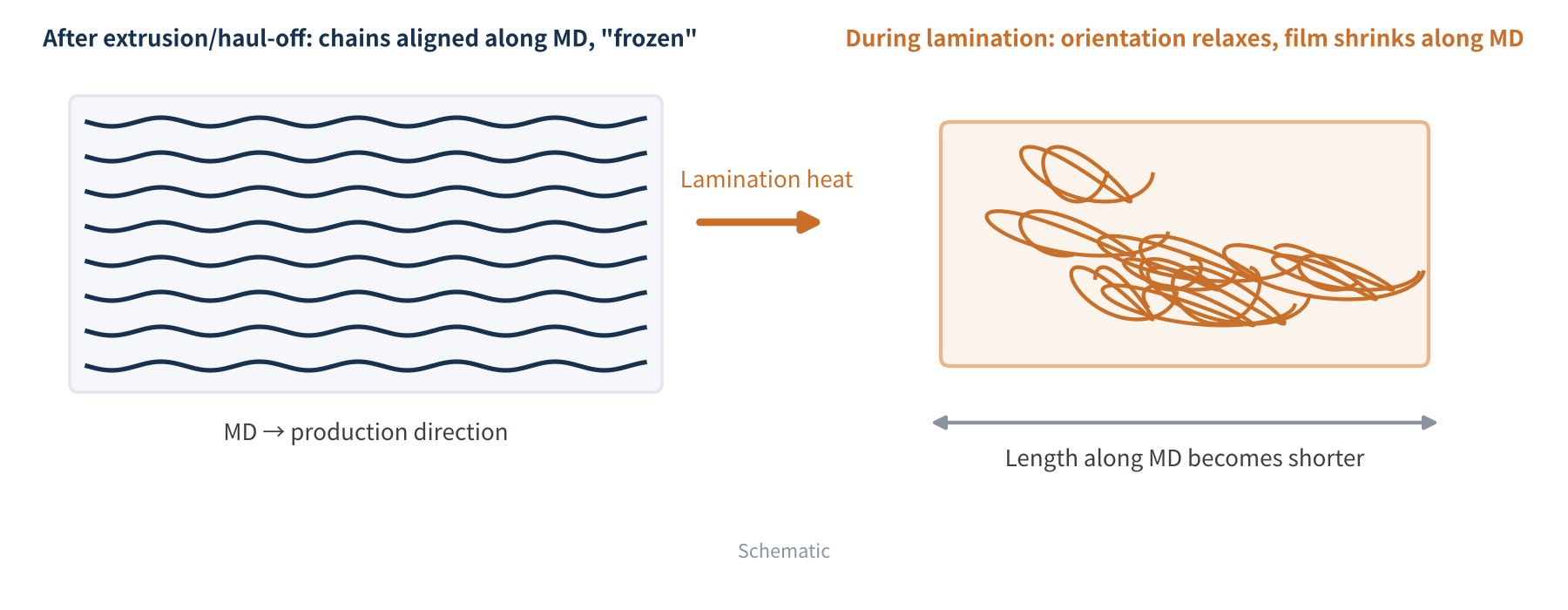
Figure 2 Why encapsulant shrinks: orientation "frozen" in, released on heating (schematic)
Excessive shrinkage shows up at the module plant as cell shift, changes in string spacing, and even cracked cells and missing encapsulant at the edges. That is why shrinkage is a mandatory incoming inspection test. Take the co-extruded encapsulant association standard T/CPIA 0071—2024 issued by the China Photovoltaic Industry Association in 2024: samples are heated on an iron plate at 120 °C ± 5 °C for 3 minutes, and shrinkage must be ≤ 4.0% in the machine direction and ≤ 2.0% in the transverse direction.
There are two ways to reduce shrinkage: reduce orientation during production, for example by controlling the draw ratio and optimising cooling; or add an annealing (relaxation) step before winding, briefly heating the film at a temperature where the crosslinker does not decompose to release internal stress in advance. US patent 9331232 gives a clear example: unannealed EVA film shrank by more than 55% when floating freely in an 80 °C water bath; after annealing at 68–69 °C (just above that EVA's melting point of about 61–63 °C) for 39 seconds, shrinkage fell to about 15%. Either way, some production speed is sacrificed: shrinkage and throughput are inherently at odds.
06Grammage and thickness: accurate and uniform
Encapsulant is usually specified by grammage (areal density, g/m²) rather than thickness, because after embossing thickness is hard to define precisely. Too low a grammage means insufficient filling and protection after lamination; too high wastes cost and tends to squeeze out.
Harder still is uniformity. Output from a T-die is not naturally uniform across the width, and the edges and middle tend to differ. Modern lines generally have online thickness gauging that scans the full width in real time and automatically adjusts the die lip opening. T/CPIA 0071—2024 requires co-extruded encapsulants to have an areal density in the range 250–600 g/m² with a deviation of no more than ±5%.
07EPE co-extrusion: several extruders, one die
Co-extruded EPE needs several extruders to plasticise EVA and POE separately, then combines them through a feedblock or multi-manifold die into an "EVA/POE/EVA" three-layer structure, cast in one step.
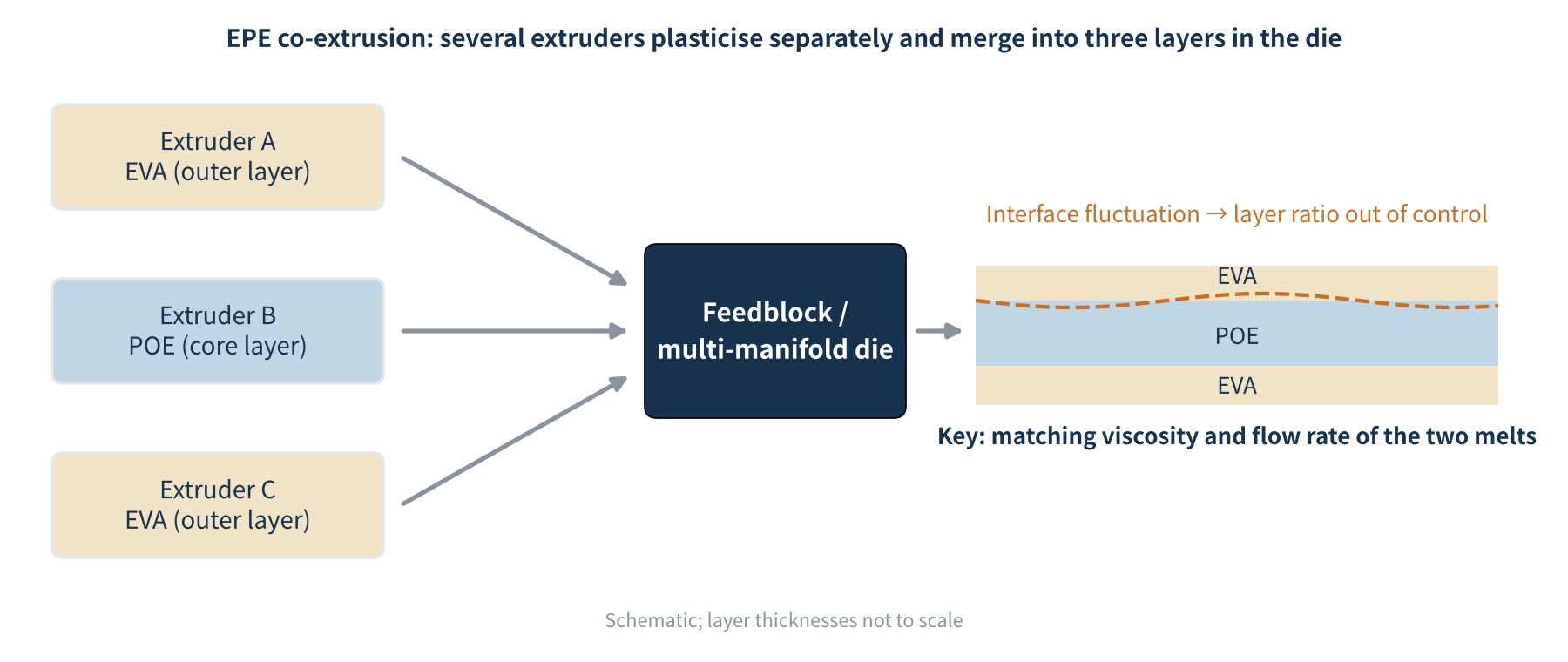
Figure 3 EPE multilayer co-extrusion (schematic)
The difficulty in co-extrusion is keeping the two melts "in step". EVA and POE have different rheology; if their viscosities and flow rates in the die are poorly matched, the interlayer interface fluctuates and the layer thickness ratio goes out of control, leaving the POE core thinner in places and weakening water blocking and PID resistance. T/CPIA 0071—2024 allows a POE layer thickness deviation of ±25%, and that generous tolerance itself shows how hard this control is.
In addition, additives from the two materials migrate between layers, and adhesion between the outer layers and the core needs dedicated verification. These are the ways EPE tests process capability more than single-layer film.
08Winding, slitting and packaging: the last mile matters too
After forming, the film is hauled off, wound, and slit to widths matching the module layout. Winding tension must be just right: too tight and the inner layers near the core are compressed, deformed or even stuck together; too loose and the roll wrinkles and drifts.
Packaging is part of the process as well. Encapsulant must be protected from moisture, light and heat: T/CPIA 0071—2024 requires storage at 0–30 °C and relative humidity below 60%, use within 8 hours after opening the box where possible, and a shelf life of at least 120 days from production. As the previous article explained, silane coupling agents fear moisture, and these requirements exist to protect them.
| Control point | What is controlled | How loss of control shows up at the module plant |
|---|---|---|
| Compounding | Dosing accuracy, uniformity, absorption | Batch variation in degree of cure and adhesion |
| Extrusion temperature | Below crosslinker decomposition temperature | Pre-crosslinking, gels, bubbles |
| Embossing and cooling | Pattern form, cooling rate | Lamination bubbles, blocking |
| Shrinkage | Molecular orientation, annealing | Cell shift, cracked cells, missing encapsulant |
| Grammage uniformity | Online gauging, die adjustment | Insufficient filling or squeeze-out |
| Co-extrusion layer thickness | Melt rheology matching | Uneven water blocking and PID resistance |
| Packaging and storage | Moisture, light, temperature and humidity | Coupling agent failure, lower peel strength |
Table 1 Key control points in encapsulant production and how loss of control shows up in modules
Formulation sets an encapsulant's ceiling; manufacturing decides whether it reaches that ceiling consistently. For module makers, an encapsulant's "consistency" often matters more than how high any single indicator is.
09Final thoughts
The encapsulant process is short, but almost every step wrestles with the same keywords: "temperature", "orientation" and "uniformity". Bubbles, cell shift, variation in degree of cure and unstable peel strength seen at the module plant can often be traced to a corresponding step on the encapsulant line. Understanding the manufacturing process helps us locate problems faster in incoming inspection and failure analysis.
Process capability is also becoming the dividing line in the industry. Taking the leader Hangzhou First as an example, its PV encapsulant shipments were about 1.22 billion m² in the first half of 2026, gross margin recovered to about 17%, and net profit attributable to shareholders rose about 70% year on year; a broker's review attributed this to loss-making firms accelerating their exit from capacity, easing competition, and the leader's scale, process and cost advantages keeping its utilisation above the industry average. Only companies that can turn "consistency" into scale will remain after the price war.
Once the encapsulant is made, how do we judge whether it is good? In the next article we look at key encapsulant performance indicators and test methods: degree of cure, peel strength, transmittance, volume resistivity, water vapour transmission rate, shrinkage and more, explaining what is tested, how, and what each pass line really means.
What problems do you most often see with incoming encapsulant? We would be glad to hear from you.
References
- T/CPIA 0071—2024 Co-extruded encapsulant film for PV modules, China Photovoltaic Industry Association, 2024
- GB/T 29848-2018 Ethylene-vinyl acetate copolymer (EVA) film for PV module encapsulation
- US Patent 9331232 B2: Process for annealing photovoltaic encapsulation polymer film, https://patents.google.com/patent/US9331232
- US Patent 11245045 B2: Encapsulant of a photovoltaic module
- Guanyan Tianxia: 2022 PV encapsulant film industry chain analysis (production process)
- LyondellBasell: A Troubleshooting Guide for Film Coextrusion
- Gelonghui: Review of Hangzhou First (603806) 2026 interim report: encapsulant price rises drive marked profit improvement, https://m.gelonghui.com/news/5304934
A PV R&D and technology team with 10+ years of experience | In-depth technical knowledge sharing
Materials · Reliability · Failure Analysis · Standards & Certification · Products · Processes
Exploring AI + PV; collaboration welcome
Disclaimer:
1. Original content reflects the authors' personal views only, is for reference only and does not constitute investment advice.
2. Reposted and cited content is credited to its source, out of respect for original work.
3. Some content was produced with AI assistance (chart generation, data retrieval, concept explanations, etc.); the core framework and key content were written by our technical team and reviewed by people.
4. If anything is inaccurate or infringes your rights, please leave a message or contact us and we will deal with it.