
Same Resin, Very Different Films: Inside the Resin and Additive Formulation of PV Encapsulants
In brief
Two encapsulant makers can buy the same EVA or POE resin yet produce films that differ widely in crosslinking, adhesion and ageing resistance; the difference lies in the formulation. In this third article of our PV encapsulant series, we break a film down into "resin base + four classes of additives": the trade-offs in EVA's VA content and melt index, why POE resin has long been a bottleneck, what crosslinkers, silane coupling agents, anti-ageing additives and functional additives each do, and why formulation is an art of balance.
When qualifying encapsulants, we often see this: two encapsulant makers use EVA resin from the same petrochemical supplier, with the same grammage and thickness, yet after lamination on the same line and ageing in the same damp heat chamber, one passes and the other delaminates.
The reason is the formulation. In the previous article we got to know the members of the encapsulant family; in this one we take a film apart to see what it is made of and which job each component does.
01An encapsulant's "recipe"
In terms of composition, an encapsulant film can be split into two parts:
- Resin base: EVA or POE resin, the vast majority of the formulation, which sets the film's "basic character": transparency, softness, polarity and water barrier.
- Additive package: usually only a few percent or less in total, yet it decides whether the film crosslinks, how well it bonds, and whether it can withstand 25 years of UV and damp heat.
Additives fall broadly into four classes: the crosslinking system, coupling agents, the anti-ageing system and functional additives. Each maps onto the five jobs described in the first article.
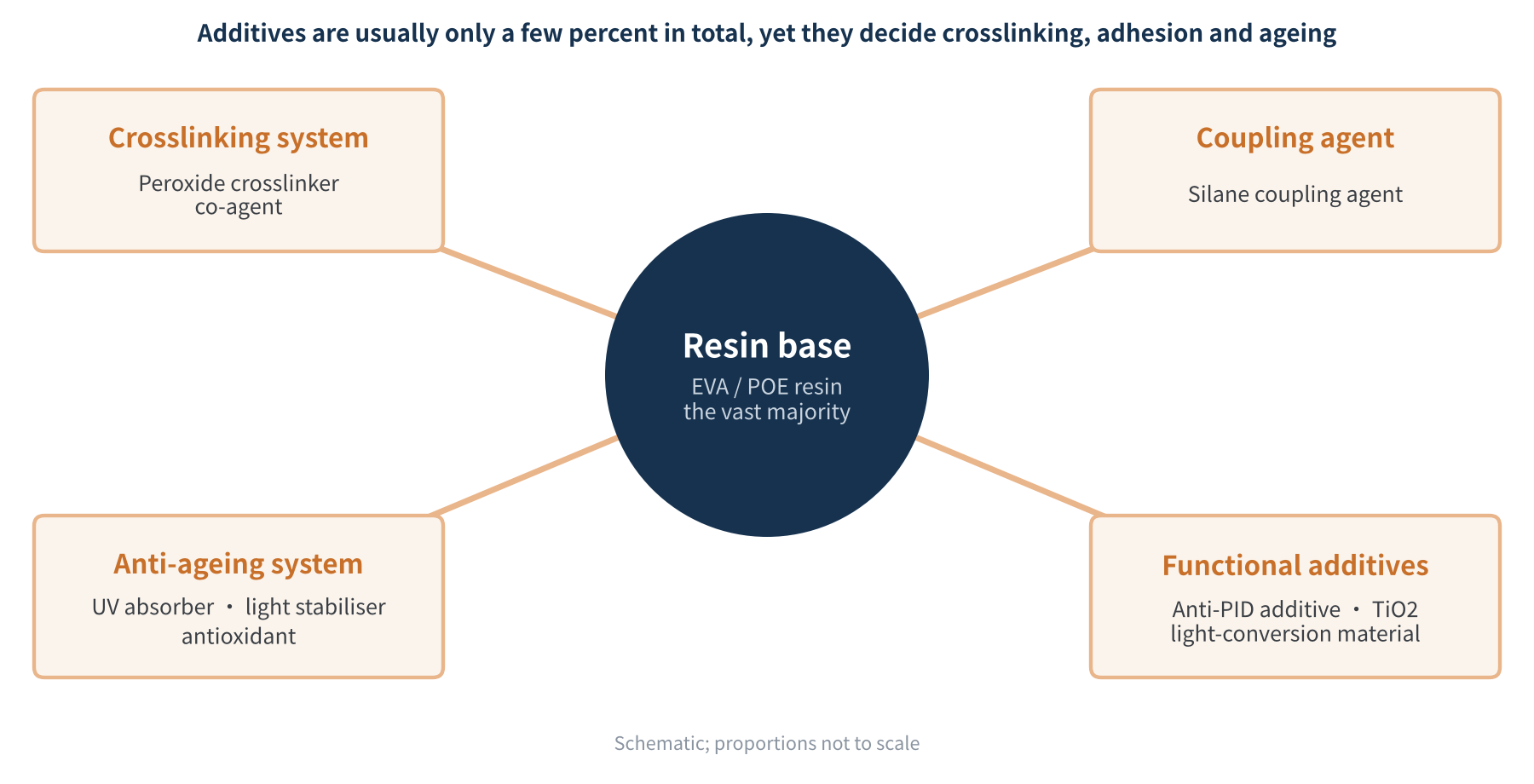
Figure 1 Composition of a PV encapsulant formulation (schematic, not to scale)
02EVA resin: trade-offs in VA content and melt index
EVA is a copolymer of ethylene and vinyl acetate (VA). VA content is its most important parameter; PV-grade EVA typically contains about 28%–33%. VA disrupts the regular crystalline structure of polyethylene, so the higher the VA, the softer and more transparent the material, and the better its adhesion to glass and compatibility with additives.
But more VA is not always better. Higher VA means a lower melting point, so resin pellets and film become tacky and stick to rollers more easily, and there are more groups that can hydrolyse into acetic acid. The VA content of PV-grade resin is essentially a balance point between transparency and adhesion on one side and processing and damp heat resistance on the other.
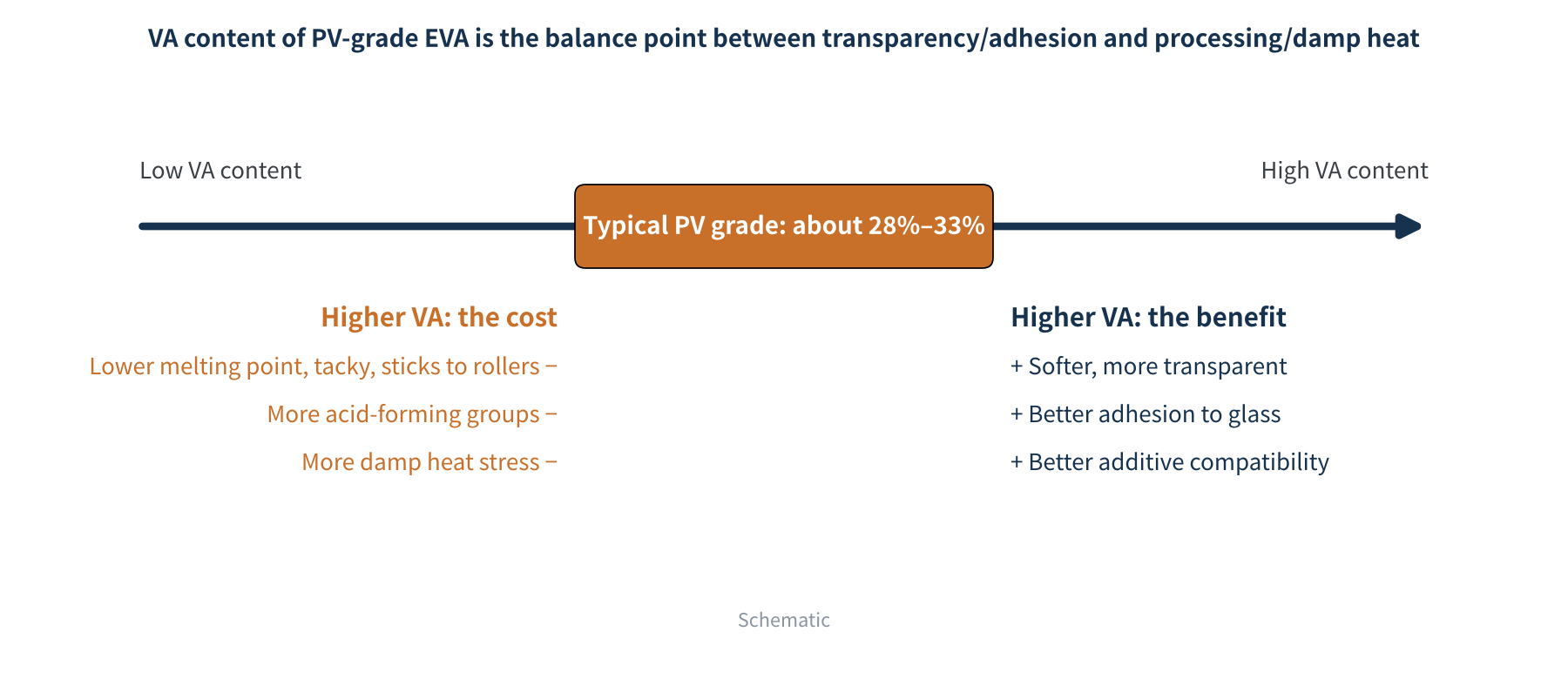
Figure 2 Performance trade-offs as VA content in EVA changes (schematic)
Another key parameter is the melt flow index (MFI), which reflects how easily the melt flows: too low, and extrusion is difficult and gaps are not fully filled during lamination; too high, and the film tends to squeeze out and cells shift during lamination. PV-grade resin also requires very few gels, crystal points and impurities, which would otherwise become defects in the film; this is precisely what makes PV grades harder to produce than ordinary EVA.
On the demand side, PV is now EVA's largest single end use. According to publicly compiled data, China's apparent EVA consumption exceeded 3 million tonnes in 2024, about 43% of it from PV. With rapid expansion of domestic EVA capacity in recent years, import dependence for PV-grade resin has eased markedly.
03POE resin: the long-standing bottleneck
POE is a copolymer of ethylene and an α-olefin (mainly octene) made with single-site catalysts such as metallocenes. Its barriers are twofold: high-performance catalysts and polymerisation processes, and a stable supply of higher α-olefins such as 1-octene. Both have long been held by a few overseas companies such as Dow, ExxonMobil, Mitsui Chemicals and LG Chem.
So for a long time China relied almost entirely on imported POE: imports hit a record of about 690,000 tonnes in 2022, and import dependence was still above 90% as of the first three quarters of 2025. The turning point came in 2025: according to China Daily and Xinhua, PetroChina's Dushanzi Petrochemical used a domestically developed gas-phase process to achieve China's first industrial-scale POE production, with output of nearly 60,000 tonnes for the year, and its PV-grade product is already used to make POE encapsulant; PetroChina expects its total POE capacity to exceed 300,000 tonnes by the end of 2026, with several other domestic POE projects under construction.
For the encapsulant industry, domestic POE matters not just for price but for security of supply. When resin is tight, encapsulant makers have to "cook with whatever resin they can get", and the rapid spread of co-extruded EPE was, to some extent, forced by POE's high price and shortages.
04The crosslinking system: turning "film" into "rubber"
As the first article explained, after lamination the encapsulant turns from a meltable film into an infusible, insoluble elastomer, thanks to the crosslinking system. At its core is an organic peroxide crosslinker: at lamination temperature it decomposes into free radicals, which abstract hydrogen atoms from the resin chains, and adjacent chains then join through carbon–carbon bonds to form a three-dimensional network.
Very little crosslinker is used. In example formulations in published patents, peroxide content is typically 0.1%–0.5% by mass. The key to selection is its decomposition temperature window:
- No decomposition during extrusion: film extrusion temperature must stay below the temperature at which the crosslinker decomposes noticeably; otherwise the film crosslinks prematurely in the encapsulant plant (pre-crosslinking), producing gels and poorer flow. For a commonly used peroxycarbonate crosslinker, the patent gives an extrusion temperature limit of about 90 °C.
- Fast decomposition during lamination: at lamination temperatures of about 140–150 °C, it must decompose fully within the limited lamination time to reach the target degree of cure.
- Co-agents boost efficiency: multifunctional monomer co-agents raise crosslinking efficiency and reduce the peroxide needed, which is especially important for POE, which is "harder" to crosslink.
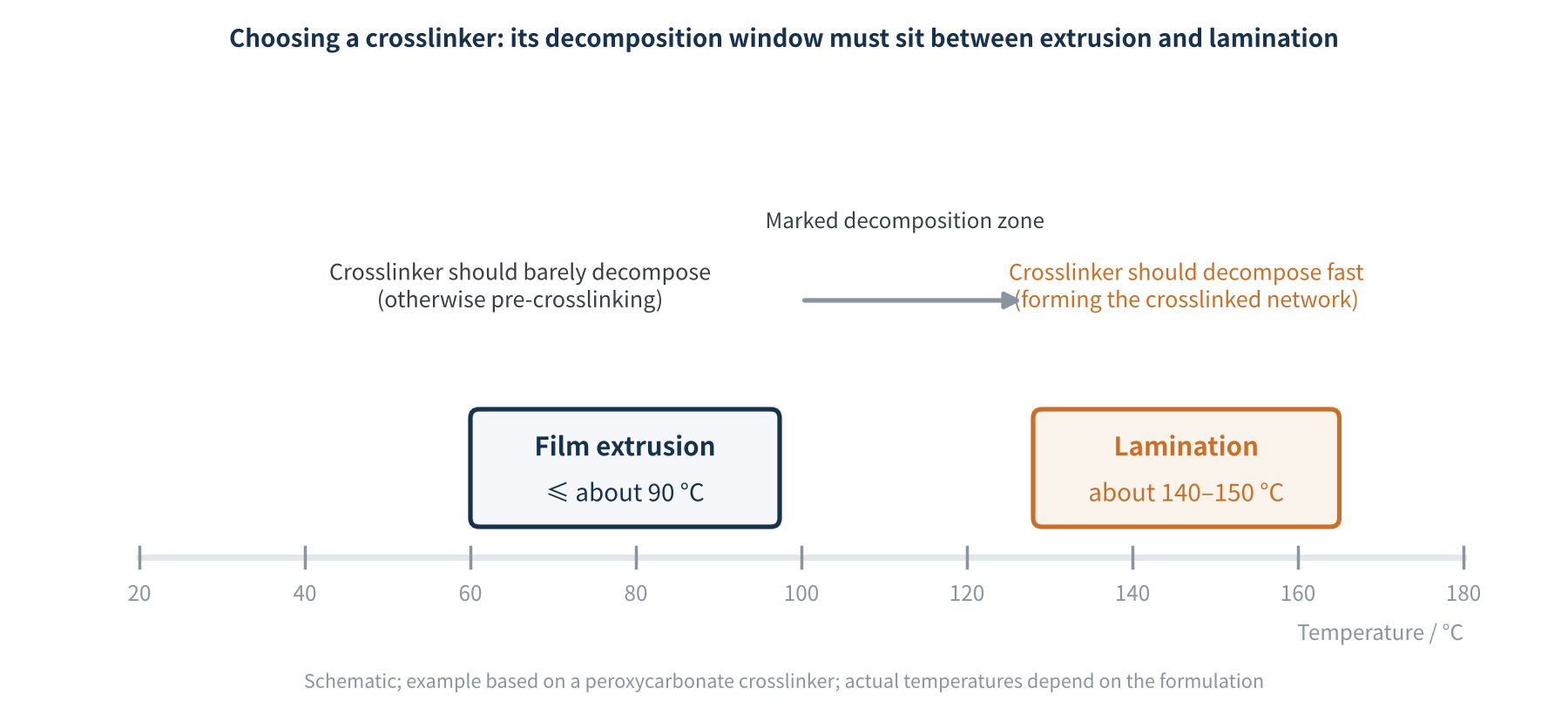
Figure 3 Crosslinker temperature window: "dormant" in extrusion, "fast" in lamination (schematic)
Excess crosslinker or incomplete decomposition also leaves small-molecule decomposition products, which can form bubbles during lamination or later use. So the crosslinking system should not be "the more the better" but just enough, and fully decomposed.
05Coupling agent: the "bridge" between glass and resin
As the first article explained, encapsulant bonds to glass through chemical bonds, and the silane coupling agent does this job. A methacryloxy-functional trimethoxysilane is commonly used, at about 0.3% in patent examples.
Each end of the molecule has its own role: the methoxysilane end hydrolyses and condenses with hydroxyl groups on the glass surface to form Si–O–Si bonds, while the unsaturated double bond at the other end joins the resin network during crosslinking. One small molecule grips both the inorganic glass and the organic resin.
The coupling agent has a practical weakness: it is sensitive to moisture. If encapsulant rolls are stored too long in humid conditions, the silane hydrolyses prematurely and loses effect, showing up as lower peel strength after lamination. That is why encapsulant is sealed in packaging and must be used within a set time after opening: without proper incoming material management, even the best formulation underperforms.
06The anti-ageing system: withstanding 25 years of UV and damp heat
To work outdoors for more than 25 years, encapsulant relies on a set of anti-ageing additives, each with its own role:
- UV absorbers: such as benzophenones and benzotriazoles, absorb UV light and dissipate it as heat. Their type and amount set the encapsulant's UV cut-off wavelength.
- Hindered amine light stabilisers (HALS): do not absorb UV but scavenge the free radicals formed during ageing, breaking the degradation chain reaction, and can act repeatedly.
- Antioxidants: such as hindered phenols and phosphites, prevent the resin degrading during extrusion and in long-term thermal-oxidative exposure.
The difficulty is that additives can "fight" each other. For example, light stabilisers are themselves radical scavengers, so too much of them competes with the crosslinker for free radicals and lowers the degree of cure; and the transformation products of some antioxidants can cause yellowing. Designing the anti-ageing system means repeatedly trading off crosslinking efficiency, transmission and yellowing.
07Functional additives: giving each film its "special power"
On top of the basic formulation, different encapsulants add functional additives, which is where the "functionalisation" described in the previous article comes from:
- Anti-PID additives: capture ions or absorb acidic species, slowing sodium ion migration and acetic acid build-up to improve PID resistance.
- White fillers: such as titanium dioxide, for white high-reflectance encapsulants.
- Light-conversion materials: for down-converting films, converting UV into visible light.
08Formulation is an art of balance
| Component | Main role | Risk if too little | Risk if too much |
|---|---|---|---|
| Crosslinker | Forms the crosslinked network | Under-cure, creep, poor adhesion | Pre-crosslinking, bubbles, brittleness |
| Co-agent | Raises crosslinking efficiency | Slow cure, long cycle | Over-cure, higher cost |
| Silane coupling agent | Chemical bond to glass | Low peel strength, delamination | Migration, higher haze |
| UV absorber | UV cut-off, prevents yellowing | Yellowing, backsheet ageing | Transmission loss, migration |
| Light stabiliser | Scavenges free radicals | Faster long-term ageing | Interferes with crosslinking |
| Antioxidant | Prevents thermal-oxidative degradation | Degradation in processing and long term | Yellowing risk |
Table 1 Roles of the main encapsulant additives and the risks of too little or too much
For POE, this balance is even harder. POE is non-polar, so polar additives are poorly compatible with it and more likely to migrate to the surface, showing up as tacky film, higher haze and weaker adhesion. This is one reason POE encapsulants have a higher technical barrier than EVA.
The resin sets the encapsulant's "foundation"; the additives set its "capabilities". Additives are used in small amounts, but their ratios, compatibility and interactions are an encapsulant maker's real core competitiveness.
09Final thoughts
Back to the opening question: why do films differ so much when the resin is the same? Because what encapsulant makers really sell is not resin but formulation: which crosslinker to choose, how much coupling agent to add, how to combine the anti-ageing system, and how to keep additives from interfering with each other, each a lesson built up through long trial and error. For module makers, understanding the logic of formulation also helps find the root cause faster when switching encapsulants or investigating failures.
Once the formulation is set, it still has to be turned into a good roll of film. In the next article we look at encapsulant manufacturing: compounding, extrusion casting, embossing and co-extrusion, and key control points such as grammage, thickness uniformity, pre-crosslinking and shrinkage.
What formulation-related problems have you run into in encapsulant qualification or failure analysis? We would be glad to hear from you.
References
- US Patent 11245045 B2: Encapsulant of a photovoltaic module (example formulation, crosslinker and extrusion/lamination temperatures), https://patents.google.com/patent/US11245045
- China Daily: China achieves industrial-scale production of POE, 2026-01-27, https://mobile.chinadaily.com.cn/html5/2026-01/27/content_014_6977c543ed50ccabe15210c4.htm
- Guanyan Tianxia: Analysis of China's EVA market (2024 capacity, apparent consumption and PV demand share), 2025
- GB/T 29848-2018 Ethylene-vinyl acetate copolymer (EVA) film for PV module encapsulation
- Qianzhan Industry Research Institute: 2023 China PV encapsulant segment analysis: POE encapsulant market
- Xinhua: PetroChina achieves large-scale production of high-quality POE, 2026-01-26, https://www.news.cn/energy/20260126/fe4c56af480a405db606c3aee9d1a773/c.html
- Oil & Gas 360: Chinese petchem firms betting big on energy transition products (China's 2022 POE imports), https://www.oilandgas360.com/chinese-petchem-firms-betting-big-on-energy-transition-products/
A PV R&D and technology team with 10+ years of experience | In-depth technical knowledge sharing
Materials · Reliability · Failure Analysis · Standards & Certification · Products · Processes
Exploring AI + PV; collaboration welcome
Disclaimer:
1. Original content reflects the authors' personal views only, is for reference only and does not constitute investment advice.
2. Reposted and cited content is credited to its source, out of respect for original work.
3. Some content was produced with AI assistance (chart generation, data retrieval, concept explanations, etc.); the core framework and key content were written by our technical team and reviewed by people.
4. If anything is inaccurate or infringes your rights, please leave a message or contact us and we will deal with it.