
Only 3%–4% of the Cost, Yet the Safety Net for 25 Years: What Does PV Encapsulant Actually Do?
In brief
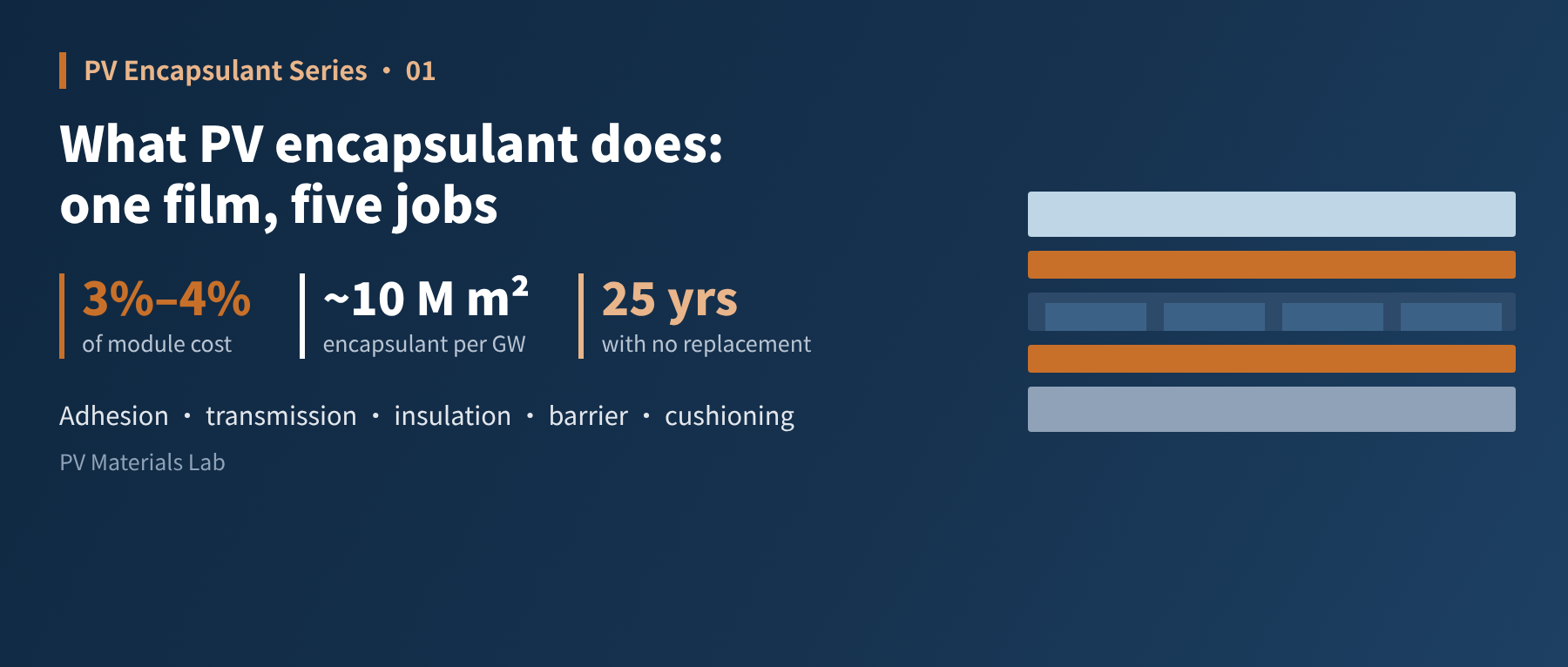
Encapsulant accounts for only about 3%–4% of module cost and all but disappears after lamination, yet it does five jobs at once (adhesion, light transmission, insulation, barrier and cushioning), and once it fails it can hardly be repaired. In this first article of our PV encapsulant series, we start from where encapsulant sits in the module and work through the principle behind each of the five jobs, the key indicators for each, and what goes wrong in the module when a job is not done.
Take a PV module apart and most people can name the glass, cells, ribbon, frame and junction box. What about the encapsulant? After lamination it all but "disappears": transparent and shapeless, noticed only during teardown analysis or when something goes wrong. Yet in our more than ten years of failure analysis, from yellowing, delamination and snail trails to PID and finger corrosion, many problems, when traced to the end, lead back to this film.
This is the first article in our PV encapsulant series, and we begin with the most basic question: what does encapsulant actually do in a module?
01Finding it: the "filling" in the module sandwich
A typical crystalline silicon module, from the sunny side down, is: glass / front encapsulant / cell strings / rear encapsulant / backsheet (or a second sheet of glass in glass-glass modules). The encapsulant sandwiches the cell strings from above and below and is the only encapsulation material in direct, full contact with the cells.
Before lamination, encapsulant is just a roll of embossed film. In the laminator, under vacuum at about 140–150 °C, it first melts and flows, filling every gap between cells and around the ribbons, while the peroxide in its formulation decomposes and crosslinks the resin molecules. When it comes out and cools, it has turned from a meltable "film" into an infusible, insoluble, transparent and elastic "rubber" that wraps the cell strings completely.
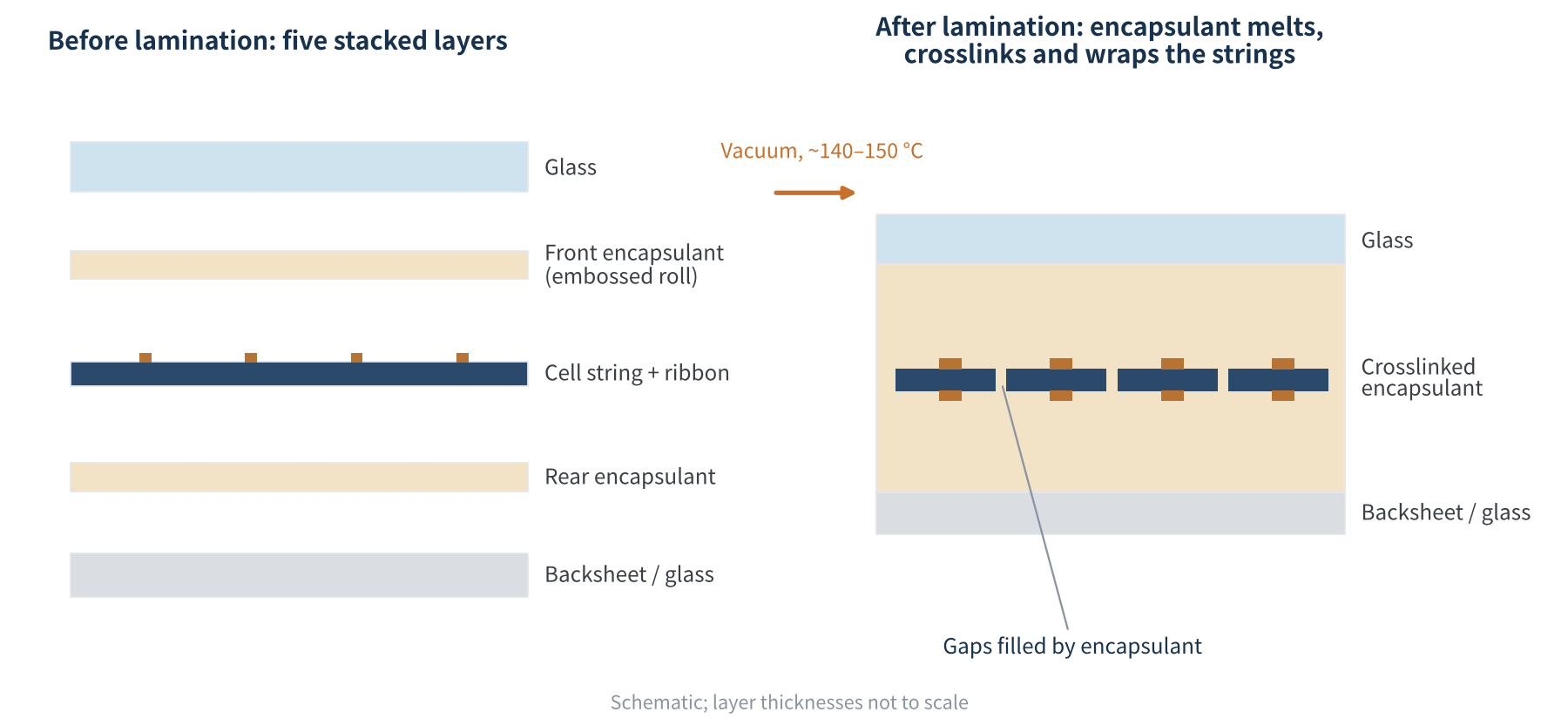
Figure 1 Module encapsulation structure before and after lamination (schematic)
In terms of quantity, a mainstream 2382 × 1134 mm module uses about 5.4 m² of encapsulant for its front and rear layers, weighing about 2.2–2.7 kg at common grammages; at industry scale, each GW of modules needs roughly 10 million m² of encapsulant. For comparison, TaiyangNews estimated that global encapsulant demand in 2024 covered more than 650 GW of modules and about 6.1 billion m², or about 9.4 million m² per GW, the same order of magnitude.
Judging an encapsulant ultimately means judging its state after lamination. All the parameters of the roll exist only to make sure that, once laminated, it can do the five jobs below well.
02Job 1: Adhesion, bonding five materials into one
Glass, silicon, copper ribbon and backsheet differ in thermal expansion and surface chemistry and would not naturally "stick together". The encapsulant's first job is to build interfaces between them that can withstand 25 years of wind and sun.
- To glass: chemical bonds. One end of the silane coupling agent in the formulation condenses with hydroxyl groups on the glass surface to form Si–O–Si bonds, while the other end joins the resin's crosslinked network, creating a chemical bond rather than mere physical adsorption.
- To backsheet: compatibility and diffusion. The backsheet's inner layer (such as a PE or modified EVA layer) and the encapsulant melt and interdiffuse at lamination temperature, forming a bonded interface.
- Indicators: peel strength (encapsulant/glass, encapsulant/backsheet), and more importantly its retention after damp heat and UV ageing, not just the initial value.
When adhesion fails, the result is delamination. Delamination does not necessarily cost power right away, but it opens a path for moisture and is often the starting point of a whole chain of failures.
03Job 2: Light transmission, letting light through "with no loss"
The front encapsulant sits in the light path: sunlight must pass through the glass and front encapsulant before reaching the cells. Two things need to be done well here.
First, the film itself must be transparent. Mainstream transparent encapsulants typically transmit more than 90% from visible to near-infrared wavelengths, and must not yellow over the long term.
Second, the interfaces must be "invisible". EVA and POE have refractive indices of about 1.48–1.49, very close to glass (about 1.5), so there is almost no reflection at the interface; once bubbles or delamination introduce a layer of air, interface reflection losses rise noticeably.
Light transmission also hides a dilemma: ultraviolet light. Encapsulants usually contain UV absorbers that cut off part of the UV to keep the encapsulant itself and the backsheet from yellowing; but the UV that is cut off is light too. The front of n-type TOPCon cells is more sensitive to UV, so the industry has taken two paths: "high cut-off" encapsulants, and "down-converting" encapsulants that turn UV into visible light. We will cover this in detail later in the series.
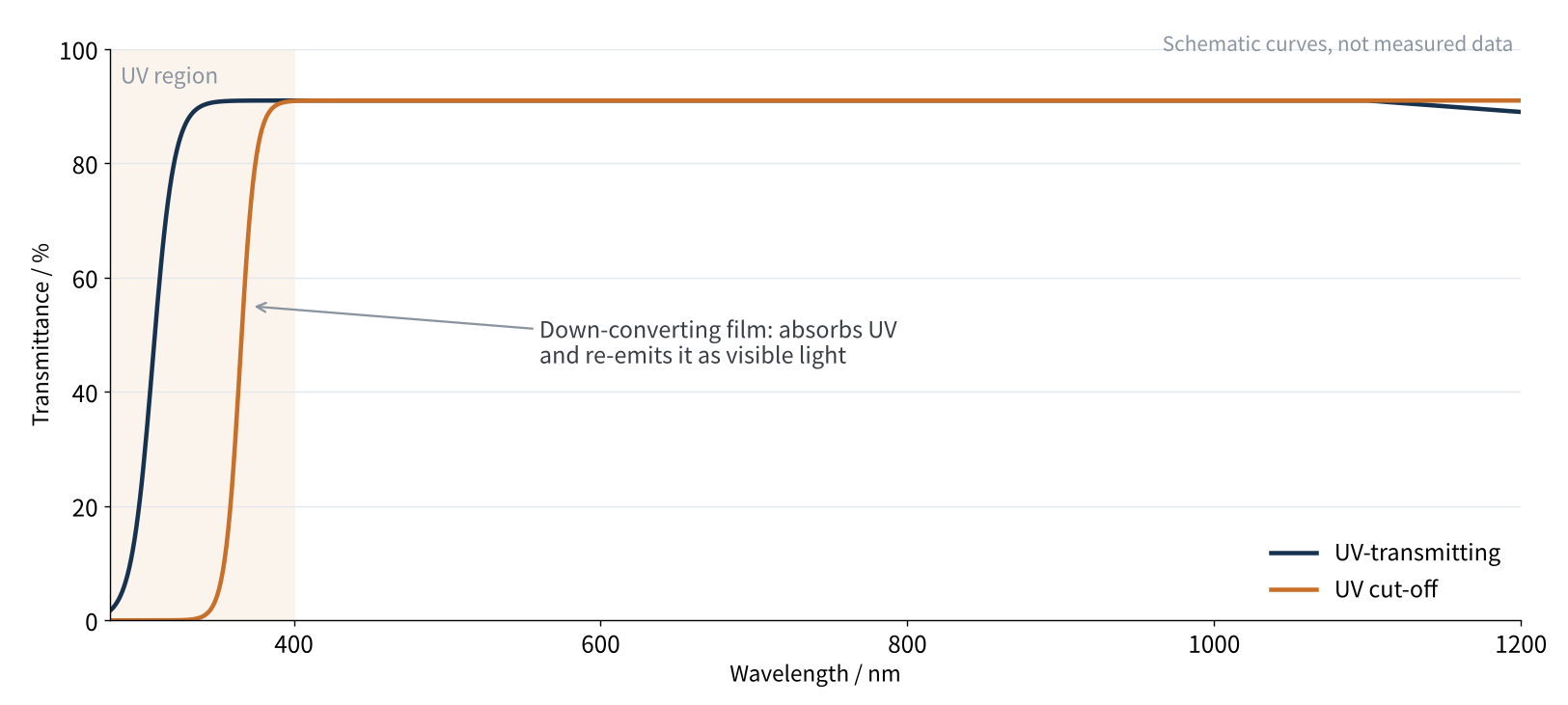
Figure 2 Transmittance of different front encapsulant types (schematic curves, not measured data)
The rear encapsulant comes in two cases: monofacial modules often use white or high-reflectance encapsulant to reflect light that leaks through the gaps between cells back up and raise front-side power; bifacial modules need rear-side light to get in, so their rear encapsulant must be transparent.
04Job 3: Insulation, an "insulating coat" for a high-voltage circuit
Mainstream system voltage has reached 1,500 V. There can be a potential difference of over a thousand volts between a module's cell strings and its grounded frame, and the encapsulant is one of the main insulating media between the cells and the glass and frame.
- Indicator: volume resistivity. POE-type encapsulants are typically an order of magnitude or more higher than EVA, one reason they resist PID better.
- Link to PID: driven by the electric field, sodium ions in the glass migrate towards the cell surface. The higher the encapsulant's resistivity and the slower the ion migration, the later and milder the PID.
- Related tests: module insulation withstand and wet leakage current tests both directly check whether the encapsulant is doing this job.
As we explained in our PID series, a high voltage difference is a necessary condition for PID; and the encapsulant is the first line of defence between that voltage and the cells.
05Job 4: Barrier, keeping moisture out and producing less corrosion
First, a common misconception needs correcting: encapsulant is not a seal; moisture will always get in, the only question is how fast. In glass-backsheet modules moisture enters mainly through the back; in glass-glass modules mainly from the edges.
On barrier performance, EVA and POE differ markedly: POE's water vapour transmission rate is much lower than EVA's. More importantly, EVA has an "original sin": its vinyl acetate groups slowly hydrolyse under damp heat to produce acetic acid. Acetic acid corrodes silver fingers and ribbon surfaces and raises series resistance, a common mechanism of module power loss after damp heat (DH) ageing.
So "barrier" has two meanings: keeping outside water out, and producing less corrosive material itself. This also explains why glass-glass modules and more corrosion-sensitive n-type modules are increasingly turning to POE and co-extruded EPE encapsulants.
06Job 5: Cushioning, protecting ever-thinner cells
Cells are now around 130 μm thick, hard and brittle. And the main materials in a module have very different coefficients of thermal expansion: glass about 9 ppm/K, silicon about 3 ppm/K, copper about 17 ppm/K. With every day–night swing and every winter–summer cycle, they expand and contract by different amounts.
- Absorbing thermal stress: as a flexible layer in between, the encapsulant "absorbs" the mismatched movement between materials, reducing the stress on cells and solder joints.
- Spreading mechanical loads: under wind, snow and hail, the encapsulant spreads concentrated loads, lowering the risk of cracks and breakage.
- Holding ribbon and cells in place: after lamination the encapsulant wraps the ribbon. In 0BB modules, contact between ribbon and fingers depends heavily on the encapsulant pressing and fixing it after lamination, so the encapsulant's flow and modulus directly affect contact reliability, which ties in neatly with our ribbon series.
Low-temperature behaviour matters too: at very low ambient temperatures EVA stiffens markedly, while POE keeps better elasticity and loses less of its cushioning ability.
07Looking at the five jobs together
The five jobs are not independent of one another; they share one "switch": degree of cure (crosslinking). Under-cured encapsulant creeps easily at high temperature, weakening both adhesion and cushioning; over-cured encapsulant becomes brittle, and adhesion drops too. That is why degree of cure is one of the most central indicators in encapsulant incoming inspection and lamination process control.
| Job | Key indicators | Typical problems when the job fails |
|---|---|---|
| Adhesion | Peel strength (initial/after ageing), degree of cure | Delamination, moisture ingress |
| Light transmission | Transmittance, UV cut-off wavelength, yellowness index ΔYI | Yellowing, power loss |
| Insulation | Volume resistivity, insulation withstand | PID, wet leakage failure |
| Barrier | Water vapour transmission rate, acid value/acetic acid release | Finger corrosion, rising series resistance, snail trails |
| Cushioning | Degree of cure, modulus, shrinkage | Cracks, breakage, cell shift |
Table 1 The five jobs of encapsulant, key indicators and typical problems when a job fails
The test methods themselves also deserve attention. Take degree of cure: the gel content tests in the Chinese standard GB/T 29848 and in IEC 62788-1-6 use different extraction times. A 2024 study in EPJ Photovoltaics found that the GB method generally gives higher values, especially in the low gel content range, mainly because its 5-hour extraction is not enough to fully remove uncrosslinked polymer; and the minimum gel content required for some POE encapsulants, 50%–65%, falls exactly in that range. We will cover test method details in the fifth article of the series.
083%–4% of the cost, 25 years of responsibility
Encapsulant makes up only about 3%–4% of module cost (estimates of 4%–7% exist for different periods and bases). But it differs from the frame and junction box in one way: it is laminated inside the module, and once it fails it can hardly be repaired or replaced. For the 25–30 year warranties modules carry, the encapsulant has to go the full distance.
Precisely because of this responsibility, encapsulant types have diversified rapidly in recent years. According to publicly compiled data, transparent EVA still held about 40% of China's encapsulant market in 2024, co-extruded EPE was approaching 30%, and white EVA and POE each had a little over 10%: from "EVA everywhere" to several routes side by side. Data from the China Photovoltaic Industry Association (CPIA) and a 2025 TaiyangNews market survey show a similar structure and expect EPE's share to edge up further, while white EVA, used mainly on the rear of monofacial modules, is losing share as bifacial modules spread.
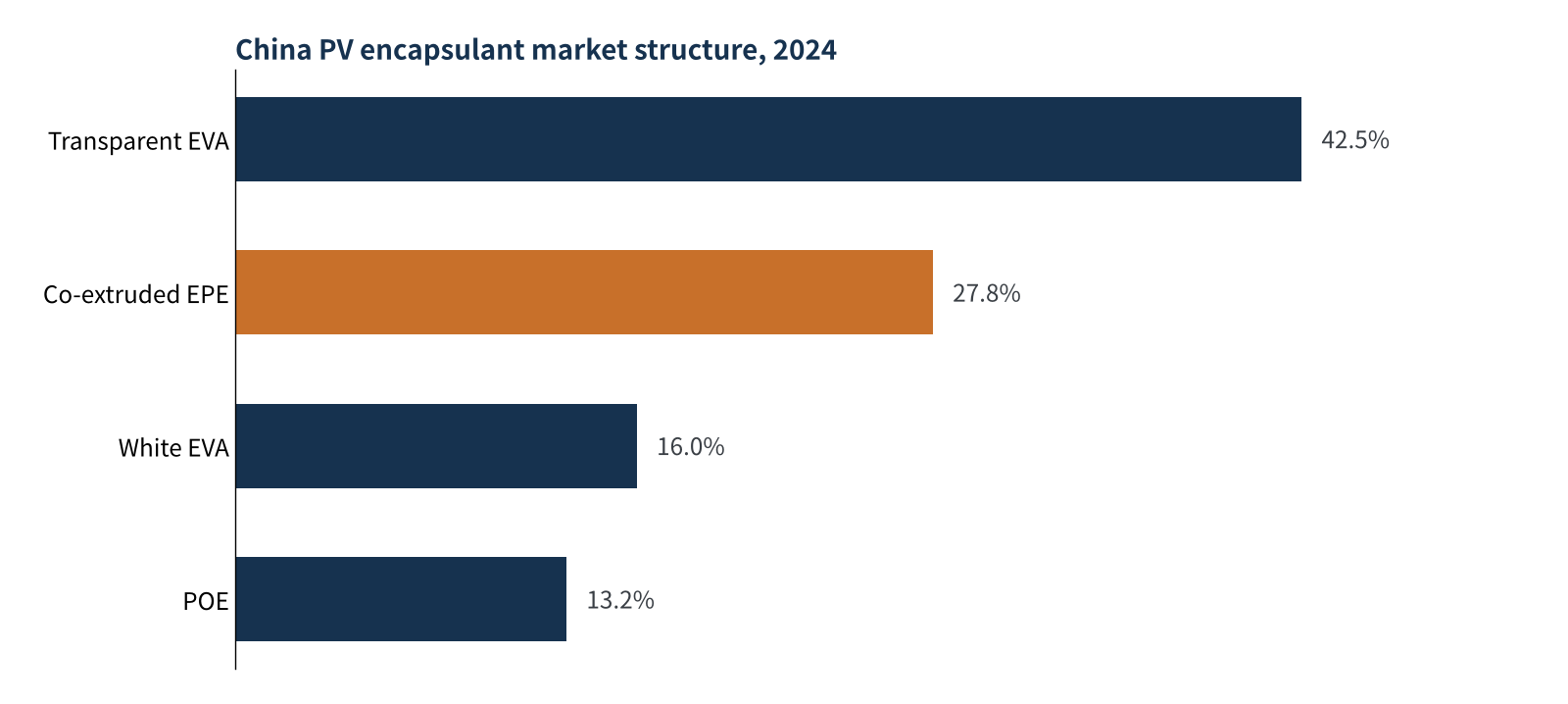
Figure 3 China PV encapsulant market structure, 2024 (data compiled by Guanyan Tianxia)
POE resin supply is changing as well. PV-grade POE used to be almost entirely imported, and as of the first three quarters of 2025 China's POE import dependence was still about 95%. In January 2026, PetroChina's Dushanzi Petrochemical announced large-scale POE production, with output of nearly 60,000 tonnes in 2025, and expects PetroChina's total POE capacity to exceed 300,000 tonnes by the end of 2026. If POE resin can be produced domestically at scale, the cost and supply picture for POE and EPE encapsulants may shift accordingly.
Encapsulant is one of the cheapest materials in a module, yet one of the most important "safety nets": it does five jobs at once (adhesion, light transmission, insulation, barrier and cushioning), and failure in any one of them is amplified over the module's 25-year service life.
09Final thoughts
Back to the opening question: what does encapsulant actually do in a module? The answer is that it is the only material in the module that deals with glass, cells, ribbon and backsheet all at once, one material doing five jobs. With these five jobs understood, the debates over EVA, POE, EPE and down-converting films, lamination processes and failure analysis can all be measured with one ruler: which job does this choice do better, and which job pays the price?
In the next article we survey the encapsulant family: transparent EVA, white EVA, POE, EPE, down-converting films, and niche routes such as PVB and TPO, what each does best and which modules each suits.
What encapsulant-related problems have you run into in your work? We would be glad to hear from you.
References
- GB/T 29848-2018 Ethylene-vinyl acetate copolymer (EVA) film for PV module encapsulation
- T/CPIA 0004-2017 Ethylene-vinyl acetate copolymer (EVA) film for PV module encapsulation, China Photovoltaic Industry Association
- IEC 62788-1-6:2017+AMD1:2020 Measurement procedures for materials used in photovoltaic modules – Part 1-6: Encapsulants – Test methods for determining the degree of cure in EVA
- Update of quality control tests for new PV encapsulation materials, EPJ Photovoltaics, 2024, https://doaj.org/article/c5d19d2bf3c04b3eae7d3c6e146558c1
- Guanyan Tianxia: China PV Encapsulant Film Industry Development Trends and Outlook Report (2025–2032), 2025
- Jiemian News: analysis of the PV encapsulant industry (encapsulant cost share, consumption per GW)
- TaiyangNews: Solar Encapsulation Market Moving From EVA Toward EPE, 2025-03-18, https://taiyangnews.info/technology/solar-encapsulation-market-moving-from-eva-toward-epe
- TaiyangNews: The State Of Solar Encapsulation Component Market, 2025-03-19, https://taiyangnews.info/technology/the-state-of-solar-encapsulation-component-market
- Xinhua: PetroChina achieves large-scale production of high-quality POE, a breakthrough for a key PV material, 2026-01-26, https://www.news.cn/energy/20260126/fe4c56af480a405db606c3aee9d1a773/c.html
A PV R&D and technology team with 10+ years of experience | In-depth technical knowledge sharing
Materials · Reliability · Failure Analysis · Standards & Certification · Products · Processes
Exploring AI + PV; collaboration welcome
Disclaimer:
1. Original content reflects the authors' personal views only, is for reference only and does not constitute investment advice.
2. Reposted and cited content is credited to its source, out of respect for original work.
3. Some content was produced with AI assistance (chart generation, data retrieval, concept explanations, etc.); the core framework and key content were written by our technical team and reviewed by people.
4. If anything is inaccurate or infringes your rights, please leave a message or contact us and we will deal with it.