
Is a "Passing" Degree of Cure Really Enough? Key PV Encapsulant Indicators and Test Methods
In brief
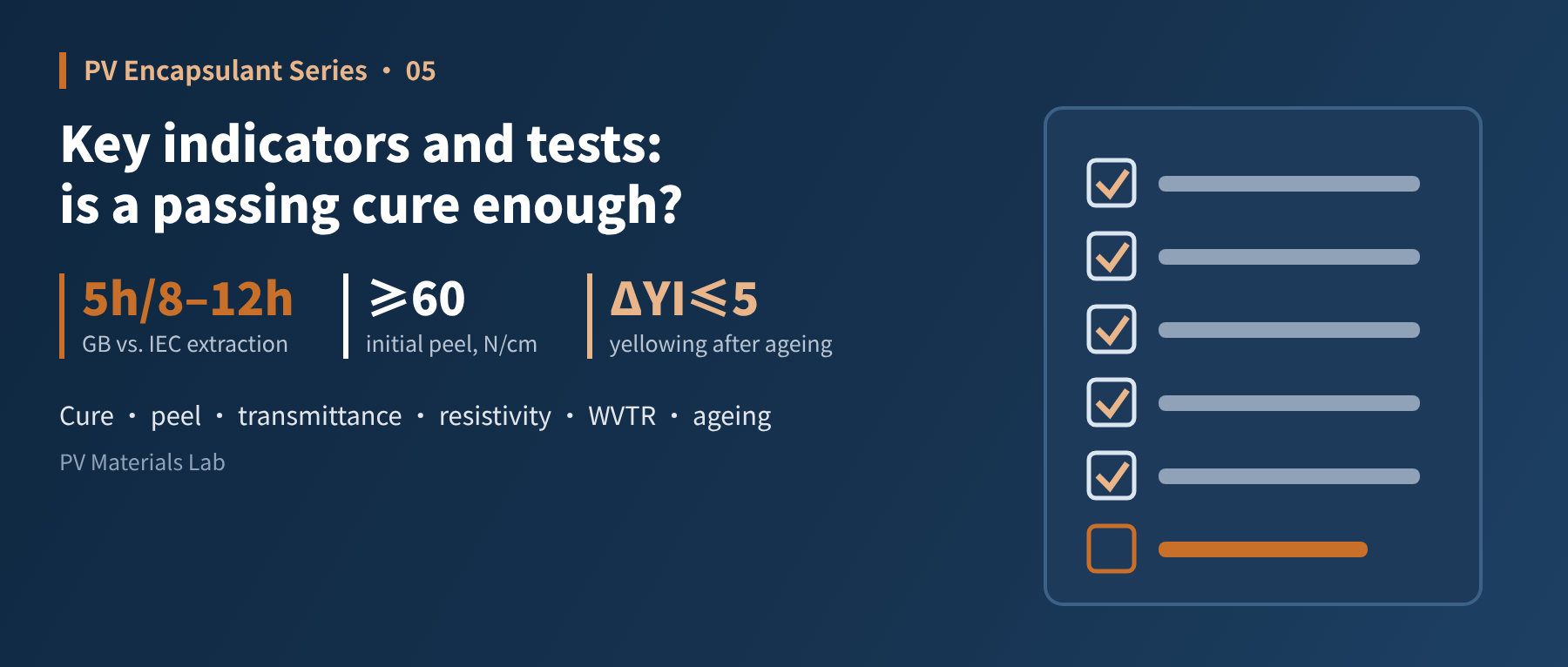
An encapsulant technical agreement or test report often lists a dozen or more indicators. Which matter most? How are the numbers measured? And what does each pass line really mean? In this fifth article of our PV encapsulant series, we group the indicators by the "five jobs" and, drawing on the association standards T/CPIA 0004—2017 (EVA encapsulant) and T/CPIA 0071—2024 (co-extruded encapsulant), explain the test methods, pass lines and common pitfalls for degree of cure, peel strength, transmittance, volume resistivity, water vapour transmission and post-ageing performance.
When qualifying encapsulants, what we face most often is a test report: degree of cure 86%, peel strength 120 N/cm, transmittance 91.5%, each marked "pass". But what really gives confidence is never the word "pass"; it is knowing under what conditions these numbers were measured, and how far the pass line is from what the module actually needs.
The first four articles covered the encapsulant's role, types, formulation and manufacturing. This one answers: once a roll of encapsulant is made, how do we judge whether it is good?
01Two things to get clear first
Before looking at specific indicators, two points need to be clear.
First, most indicators are measured on laminated samples. Encapsulant does its five jobs after lamination, so apart from roll indicators such as grammage, density and shrinkage, degree of cure, peel strength, transmittance, resistivity and ageing performance are all measured on samples laminated with specified parameters and then conditioned at about 23 °C and 50% RH for a period. Lamination parameters and the choice of glass and backsheet all affect the results.
Second, indicators fall into three groups: roll specifications (grammage, thickness, shrinkage), initial performance (degree of cure, peel, transmittance, insulation), and post-ageing performance (peel and yellowing after UV, damp heat and other ageing). The first two decide whether it can be used; the third decides for how long.
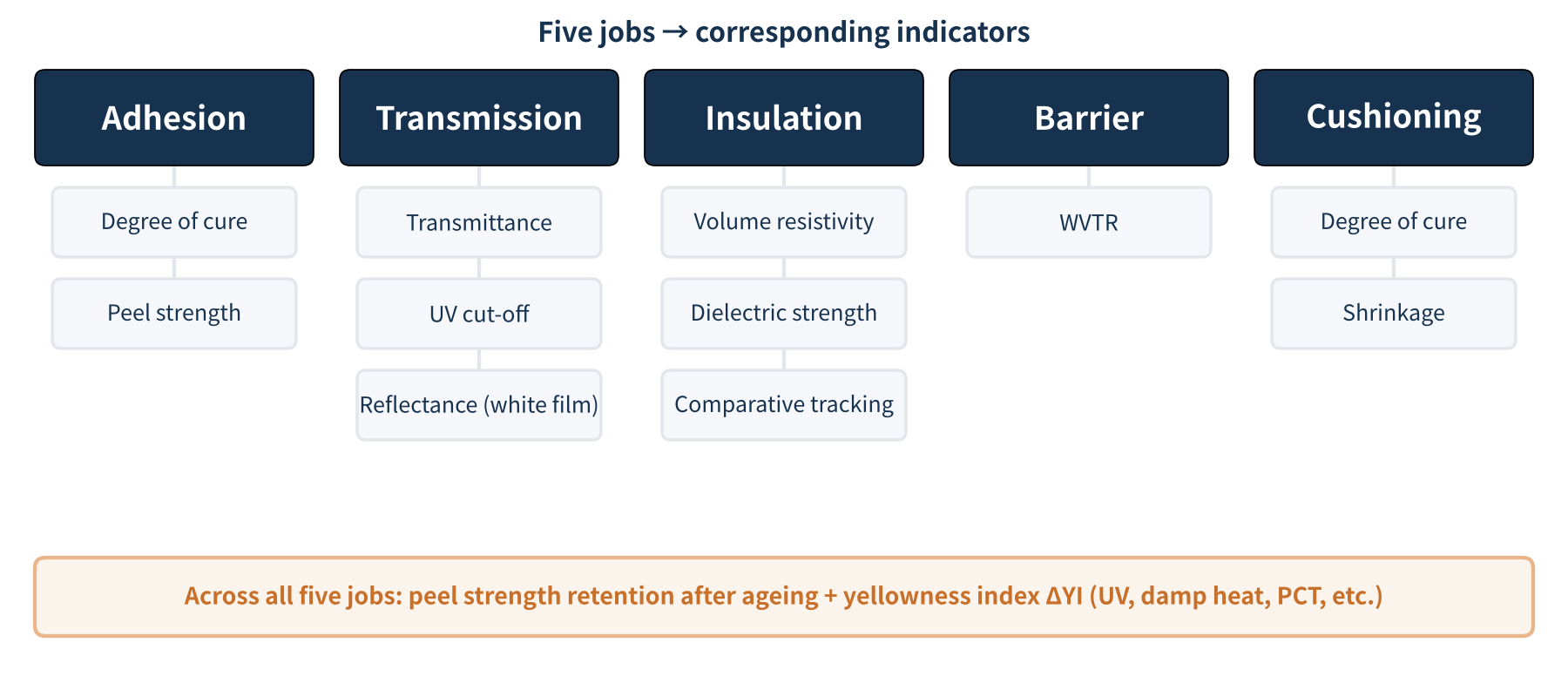
Figure 1 How the encapsulant's five jobs map to key indicators
02Degree of cure: the most central, and the easiest to "flatter"
Degree of cure (gel content) directly reflects how fully the crosslinked network has formed and is the first indicator in incoming inspection and lamination process monitoring.
The referee method is xylene extraction: about 0.5 g of laminated sample is cut into pieces smaller than 3 mm, placed in a 120-mesh stainless steel bag, extracted under reflux in boiling xylene for 5 hours, then vacuum-dried at 140 °C to constant weight. The uncrosslinked portion dissolves away and what remains is the crosslinked network; the mass ratio before and after is the degree of cure. T/CPIA 0004—2017 requires EVA encapsulant to reach ≥ 75%, and T/CPIA 0071—2024 requires co-extruded encapsulant to fall between 75% and 95%.
There is a pitfall to watch here: extraction time. In 2024, a team from PI Berlin and Fraunhofer CSP in Germany compared gel content testing under the Chinese standard GB/T 29848 and IEC 62788-1-6 in EPJ Photovoltaics. The GB method extracts for a fixed 5 hours, while IEC requires 8–12 hours with at least 15 reflux cycles per hour, extended further when gel content is low. The GB method consistently gave higher values, especially in the low gel content range: for the same sample laminated at 130 °C, the GB method gave about 60% and the IEC method only about 30%. Meanwhile, the minimum gel content recommended by some POE encapsulant makers falls right in the 50%–65% range. The team recommends extending the GB extraction time to at least 20 hours, testing promptly after lamination, and testing both front and rear encapsulant layers. In other words, the same sample measured by a different method can give a degree of cure that differs by a factor of two.
IEC 62788-1-6 also provides a differential scanning calorimetry (DSC) method, which judges the degree of cure from the residual reaction enthalpy. It is fast and suits routine line monitoring, but a correlation with the extraction method must first be established.
03Peel strength: the initial value matters, the post-ageing value matters more
Peel strength measures the encapsulant's adhesion. A 180° peel is performed per GB/T 2790: a 10 mm wide strip is cut from the laminated sample and peeled at 100 mm/min, recording the peel force.
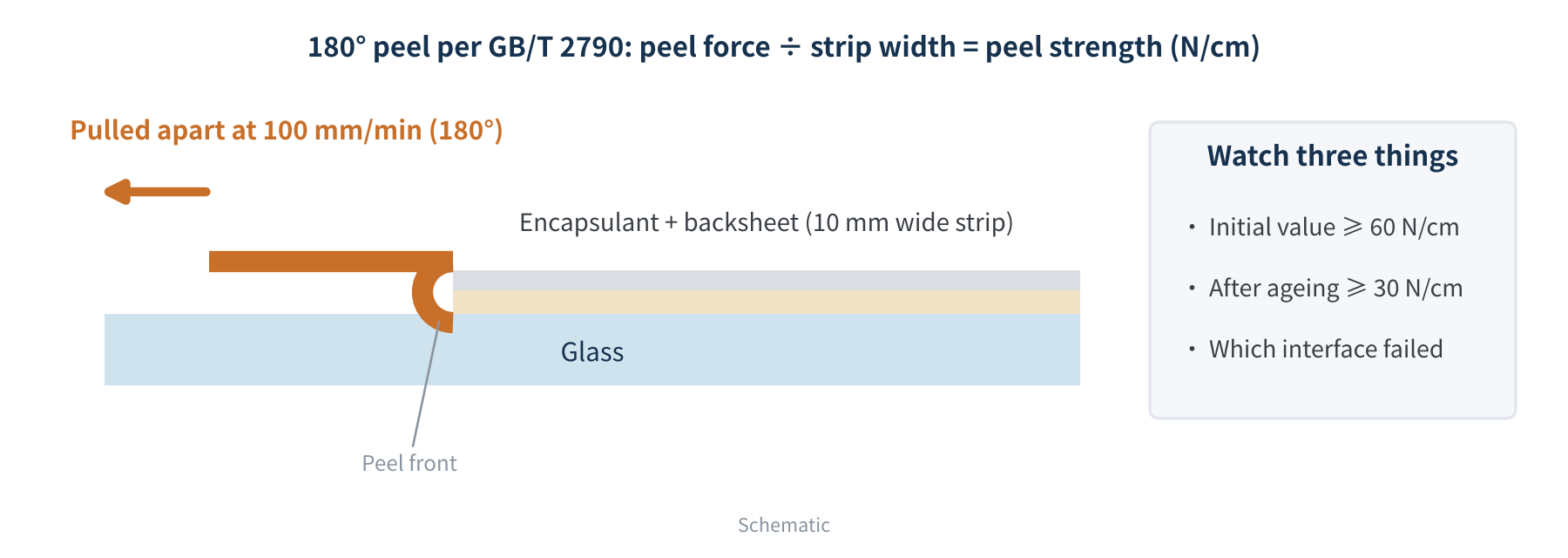
Figure 2 180° peel strength test (schematic)
Both standards require initial encapsulant-to-glass peel strength of ≥ 60 N/cm and ≥ 30 N/cm after ageing. In real technical agreements the initial value is often far above 60 N/cm, so a high initial value is nothing special; how much is retained after ageing is the real test.
- Use the right glass: T/CPIA 0071—2024 specifies 3.2 mm ultra-clear patterned tempered glass for glass-backsheet samples and 2.0 mm ultra-clear patterned or float heat-strengthened glass for glass-glass samples. Results on different glass cannot be compared directly.
- Look at the failure interface: after peeling, determine whether the encapsulant separated from the glass at the interface or the encapsulant itself tore. The same number can mean entirely different things.
04Transmittance and UV cut-off: don't just look at the average
Transmittance is measured with a spectrophotometer fitted with an integrating sphere, scanning 290–1100 nm and averaging over two bands:
- 380–1100 nm: reflects transmission in the main power-generating band; the EVA standard requires ≥ 90.5% and the co-extruded standard ≥ 90%.
- 290–380 nm: reflects transmission in the UV band, with two types: UV-transmitting ≥ 70% and UV-cut ≤ 30%.
- White encapsulant: not transmittance but reflectance over 400–700 nm, which the EVA standard requires to be ≥ 90%.
Averages hide the shape of the curve. For UV-sensitive cells such as TOPCon, where the cut-off wavelength sits and how steep the cut-off edge is are more informative than an average. When qualifying encapsulant, ask for the full spectrum.
05Volume resistivity: the "spokesperson" for insulation and PID resistance
Volume resistivity is measured on laminated samples. T/CPIA 0071—2024 specifies conditioning at 23 °C and 50% RH for at least 48 hours, applying 1,000 V and reading the value at 60 minutes. Pass lines: ≥ 1.0×10¹⁵ Ω·cm for transparent EVA and co-extruded encapsulant, ≥ 1.0×10¹⁴ Ω·cm for white EVA.
The same group of electrical indicators also includes dielectric strength (EVA ≥ 25.0 kV/mm, co-extruded ≥ 28.0 kV/mm) and comparative tracking index (≥ 400 V).
Volume resistivity is very sensitive to temperature and humidity: as temperature rises, resistivity falls markedly. PID happens precisely under hot, humid conditions, so some technical agreements pay extra attention to resistivity at elevated temperature. Meeting the resistivity requirement at room temperature does not mean there is enough margin when hot.
06Water vapour transmission: not in the standards, but often in agreements
Interestingly, neither association standard sets a requirement for water vapour transmission rate (WVTR). Yet in encapsulant technical agreements for glass-glass and n-type modules, it is almost mandatory.
It is commonly measured with the infrared sensor method, usually at 38 °C and 90% RH. Published data put EVA at about 25 g/m²·24 h and POE at about 3 g/m²·24 h. Note that WVTR depends directly on thickness, so results at different thicknesses cannot be compared directly; always check sample thickness and test conditions in the report.
07Post-ageing performance: the real "final exam"
The indicators so far are "initial grades"; ageing tests examine how long the encapsulant will last. The two standards' ageing tests and criteria are broadly the same:
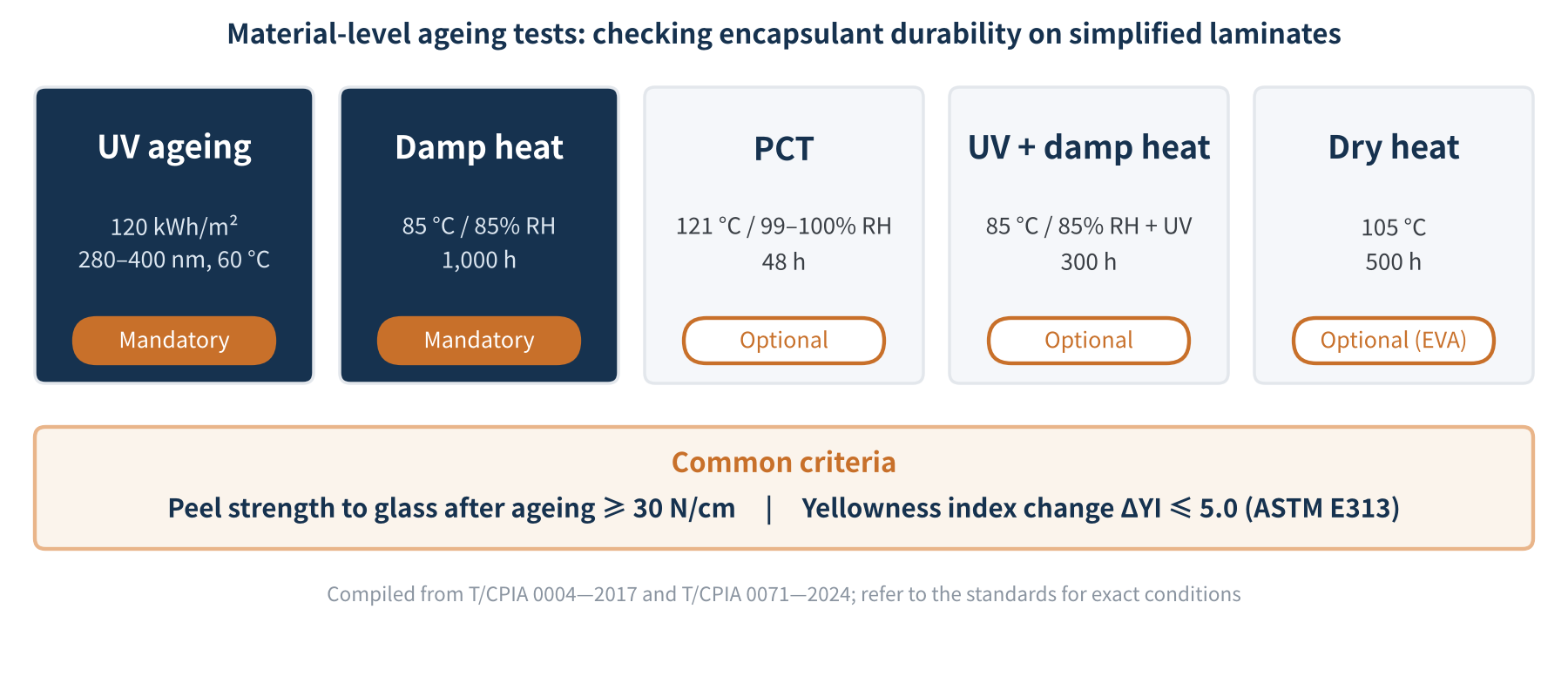
Figure 3 Material-level ageing tests and criteria for encapsulant (compiled from T/CPIA 0004—2017 and T/CPIA 0071—2024)
There are two criteria in both: peel strength to glass after ageing ≥ 30 N/cm, and change in yellowness index ΔYI ≤ 5.0 (measured per ASTM E313). Note that this is material-level ageing on simplified laminated samples; it is a different matter from module-level IEC 61215 reliability testing, which we cover in the tenth article.
| Indicator | Test essentials | EVA encapsulant (T/CPIA 0004—2017) | Co-extruded encapsulant (T/CPIA 0071—2024) |
|---|---|---|---|
| Transmittance 380–1100 nm | Integrating sphere, laminated sample | ≥ 90.5% | ≥ 90% |
| Transmittance 290–380 nm | Integrating sphere, laminated sample | UV-transmitting ≥ 70% / UV-cut ≤ 30% | Same |
| Degree of cure | Xylene extraction | ≥ 75% | 75%–95% |
| Peel strength to glass | 180°, 10 mm, 100 mm/min | > 60 N/cm | ≥ 60 N/cm |
| Volume resistivity | Laminated sample, 1,000 V | ≥ 1.0×10¹⁵ Ω·cm | ≥ 1.0×10¹⁵ Ω·cm |
| Dielectric strength | Power-frequency breakdown | ≥ 25.0 kV/mm | ≥ 28.0 kV/mm |
| After UV / damp heat ageing | 120 kWh/m²; 85 °C/85% RH 1,000 h | Peel > 30 N/cm, ΔYI < 5.0 | Peel ≥ 30 N/cm, ΔYI ≤ 5.0 |
Table 1 Main indicators in the EVA and co-extruded encapsulant association standards compared
08Practical tips for incoming inspection
- Check conditions before numbers: extraction time, lamination parameters, glass type, sample thickness; if conditions differ, numbers from two reports are not comparable. Degree of cure reports in particular should state the extraction time and the standard followed.
- Look at consistency, not single values: variation between rolls in a batch and across positions in a roll often says more than the average.
- Separate every-delivery tests from periodic sampling: shrinkage, grammage and degree of cure suit every-batch testing, with DSC for fast monitoring; ageing tests take long and rely on type testing plus periodic sampling.
- Ask for curves, not just numbers: transmittance spectra and peel curves contain more information than an average.
Standard pass lines are a floor, not a target. Understanding test conditions and watching post-ageing retention and batch consistency mean more than chasing a higher value on any single indicator.
09Final thoughts
Back to the opening question: is a "passing" degree of cure really enough? The answer depends on the conditions under which it was measured, how much margin it leaves over what your module actually needs, and how much remains after ageing. Indicators are the "common language" between encapsulant and module makers; learn to read it and qualification and failure analysis involve far fewer detours.
Encapsulant that passes testing still has to get through lamination at the module plant. In the next article we look at encapsulant and the lamination process: how the lamination profile affects curing, and how common problems such as bubbles, cell shift, squeeze-out and under-cure arise.
Which indicators in your encapsulant technical agreements are tighter than the standards? We would be glad to hear from you.
References
- T/CPIA 0004—2017 Ethylene-vinyl acetate copolymer (EVA) film for PV module encapsulation, China Photovoltaic Industry Association
- T/CPIA 0071—2024 Co-extruded encapsulant film for PV modules, China Photovoltaic Industry Association
- GB/T 29848-2018 Ethylene-vinyl acetate copolymer (EVA) film for PV module encapsulation
- IEC 62788-1-6:2017+AMD1:2020 Measurement procedures for materials used in photovoltaic modules – Part 1-6: Encapsulants – Test methods for determining the degree of cure in EVA
- Lust S., Weber T., Kuntamukkula S. R., Mordvinkin A., Wendt M.: Update of quality control tests for new PV encapsulation materials, EPJ Photovoltaics 15, 5 (2024), https://www.epj-pv.org/10.1051/epjpv/2024006
- Lesso Solar: Selecting Photovoltaic Encapsulation Films for Outdoor Reliability (EVA vs. POE water vapour transmission)
A PV R&D and technology team with 10+ years of experience | In-depth technical knowledge sharing
Materials · Reliability · Failure Analysis · Standards & Certification · Products · Processes
Exploring AI + PV; collaboration welcome
Disclaimer:
1. Original content reflects the authors' personal views only, is for reference only and does not constitute investment advice.
2. Reposted and cited content is credited to its source, out of respect for original work.
3. Some content was produced with AI assistance (chart generation, data retrieval, concept explanations, etc.); the core framework and key content were written by our technical team and reviewed by people.
4. If anything is inaccurate or infringes your rights, please leave a message or contact us and we will deal with it.