
Why Does the Same Roll of Encapsulant Behave Differently on Two Lines? Encapsulant and the Lamination Process
In brief
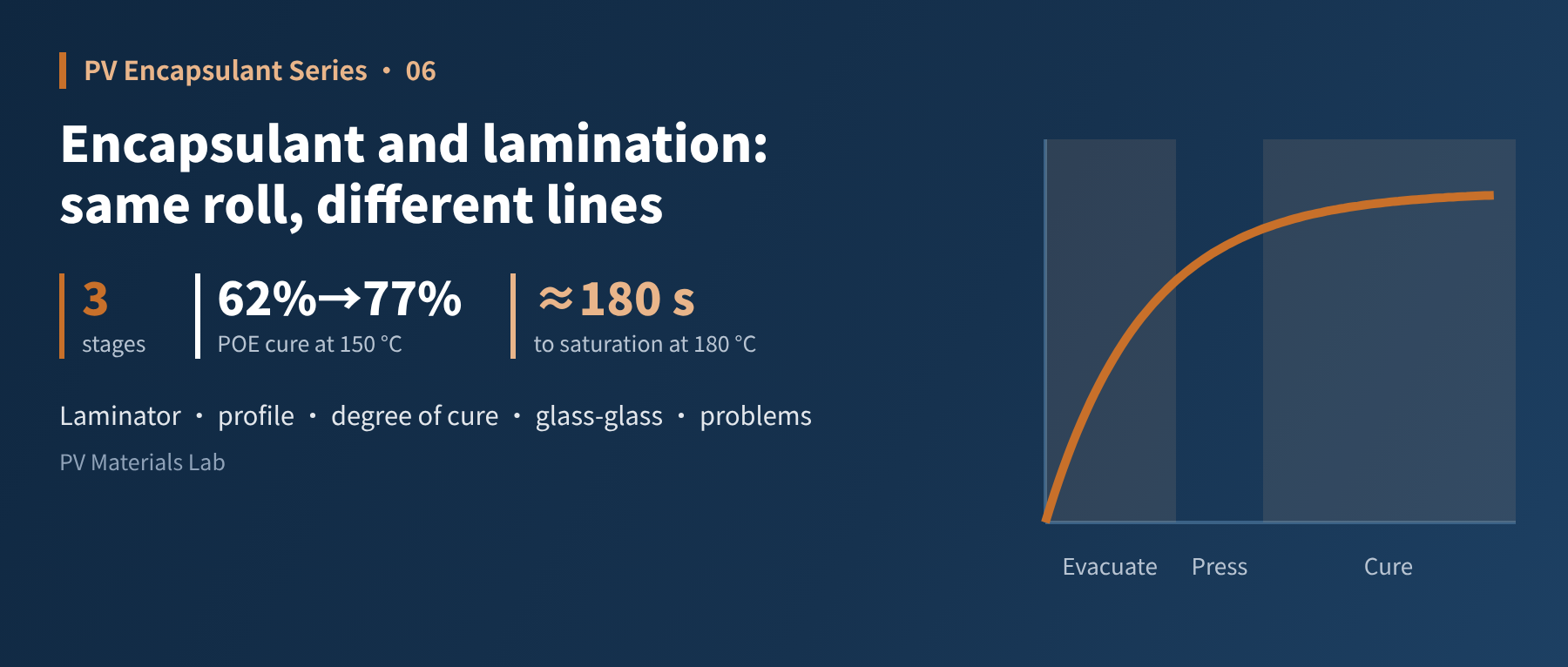
All five of the encapsulant's jobs are "completed" in the laminator, so the same good roll can give different results under a different lamination profile. In this sixth article of our PV encapsulant series, we start from how a laminator works, break down the evacuation, pressing and curing stages, use measured data to show why degree of cure is a function of "time × temperature", compare lamination of EVA, POE and glass-glass modules, and set out the causes of and fixes for common problems such as bubbles, cell shift, squeeze-out and under-cure.
The previous article covered how to judge whether a roll of encapsulant is good. But at module plants we often see another situation: encapsulant from the same batch, passing every test, laminates fine on line A yet shows bubbles and cell shift on line B, or a degree of cure that jumps up and down.
The reason is simple: all five of the encapsulant's jobs are "completed" in the laminator. A passing encapsulant is only the precondition; whether the lamination profile matches it decides the final result.
01The laminator: a "heat press" with a vacuum
Mainstream laminators use an upper and lower dual-chamber design. The module lay-up (glass, encapsulant, cell strings, encapsulant, backsheet or glass) sits on the heating plate in the lower chamber, and the upper chamber holds a heat-resistant rubber diaphragm.
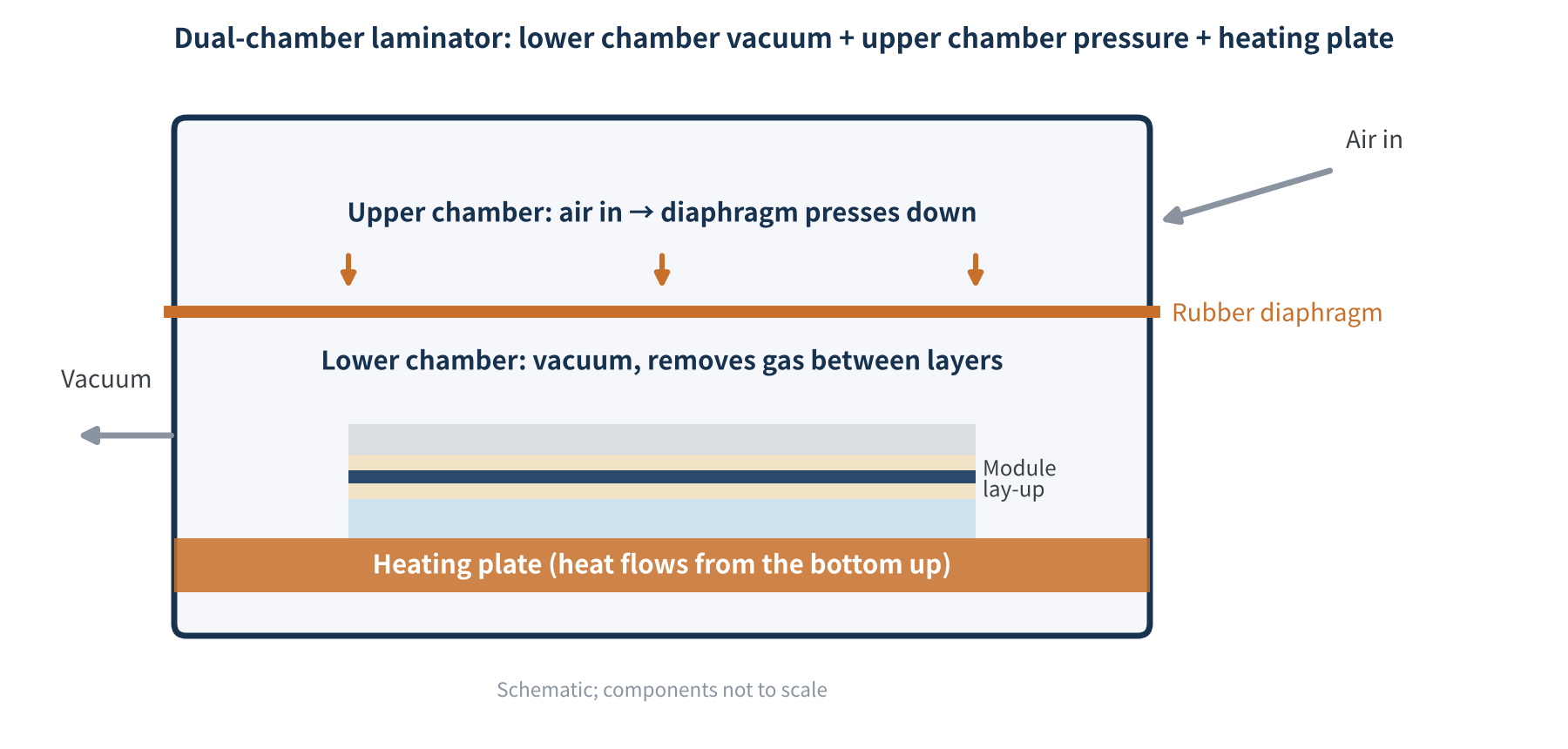
Figure 1 How a dual-chamber laminator works (schematic)
- Lower chamber evacuation: removes air, moisture and volatiles from between the layers, the key to avoiding bubbles.
- Upper chamber pressurisation: when air enters the upper chamber, the diaphragm presses down on the module, applying uniform pressure of the order of one atmosphere so the molten encapsulant flows and fills the gaps.
- Heating plate: heat flows from the bottom up, bringing the encapsulant to the temperatures needed for melting and curing.
To raise throughput, most lines now use multi-stage lamination: the first stage handles evacuation, pressing and initial curing, the next continues curing at temperature, and the module then enters a cooling stage. Dwell time in each machine is shorter, but the total "thermal history" must still meet the encapsulant's curing needs.
02The three stages of a lamination profile
A lamination profile describes how temperature, vacuum and pressure change over time. However the parameters are tuned, there are always three stages:
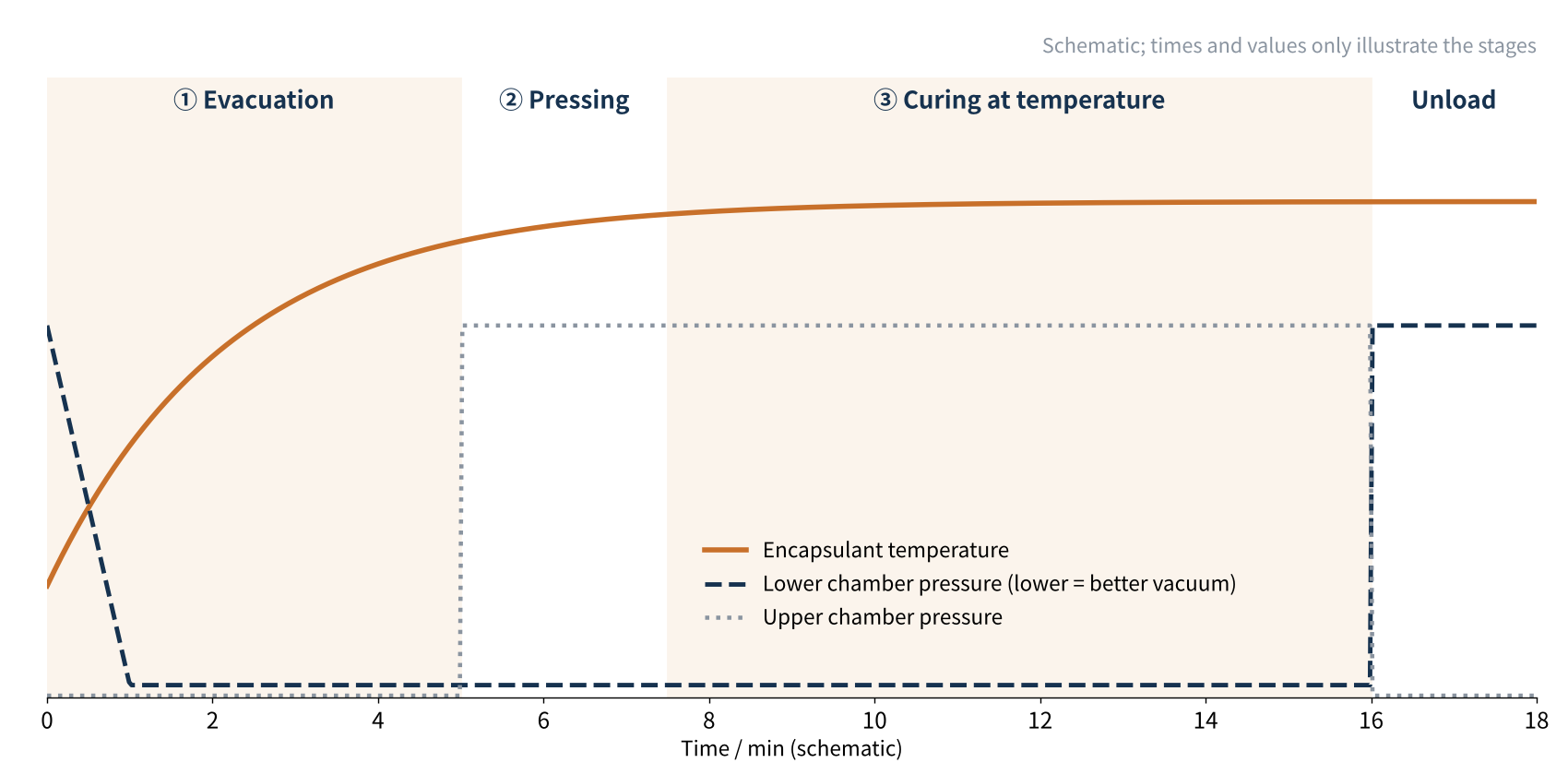
Figure 2 Typical lamination profile: temperature, lower chamber vacuum and upper chamber pressure over time (schematic)
- Stage 1: evacuation (heat-up and degassing). Remove as much gas as possible after the encapsulant starts to soften but before it flows much. Too short, and residual gas forms bubbles; too long, and the encapsulant is already flowing or even curing, sealing the edge escape paths instead.
- Stage 2: pressing. The upper chamber is pressurised and the encapsulant flows under pressure, wrapping the cells and ribbons. Pressing too fast or too hard easily cracks thin cells and can "wash" strings out of position.
- Stage 3: curing at temperature. Temperature is held so the crosslinker decomposes fully and the degree of cure reaches target. EVA is typically laminated at about 140–150 °C, with a total lamination time on the order of a dozen or so minutes, depending on formulation and equipment.
Finally the module enters cooling, where the crosslinked network sets. Cooling too fast or under uneven load can also cause warpage and residual stress.
03Degree of cure: the product of time and temperature
Degree of cure is not set by any single parameter but is the combined result of temperature and time. A study presented by Fraunhofer ISE and laminator maker Robert Bürkle at the 8th World Conference on Photovoltaic Energy Conversion (WCPEC-8) in 2022 measured the degree of cure of a POE encapsulant used in heterojunction modules at different lamination times:
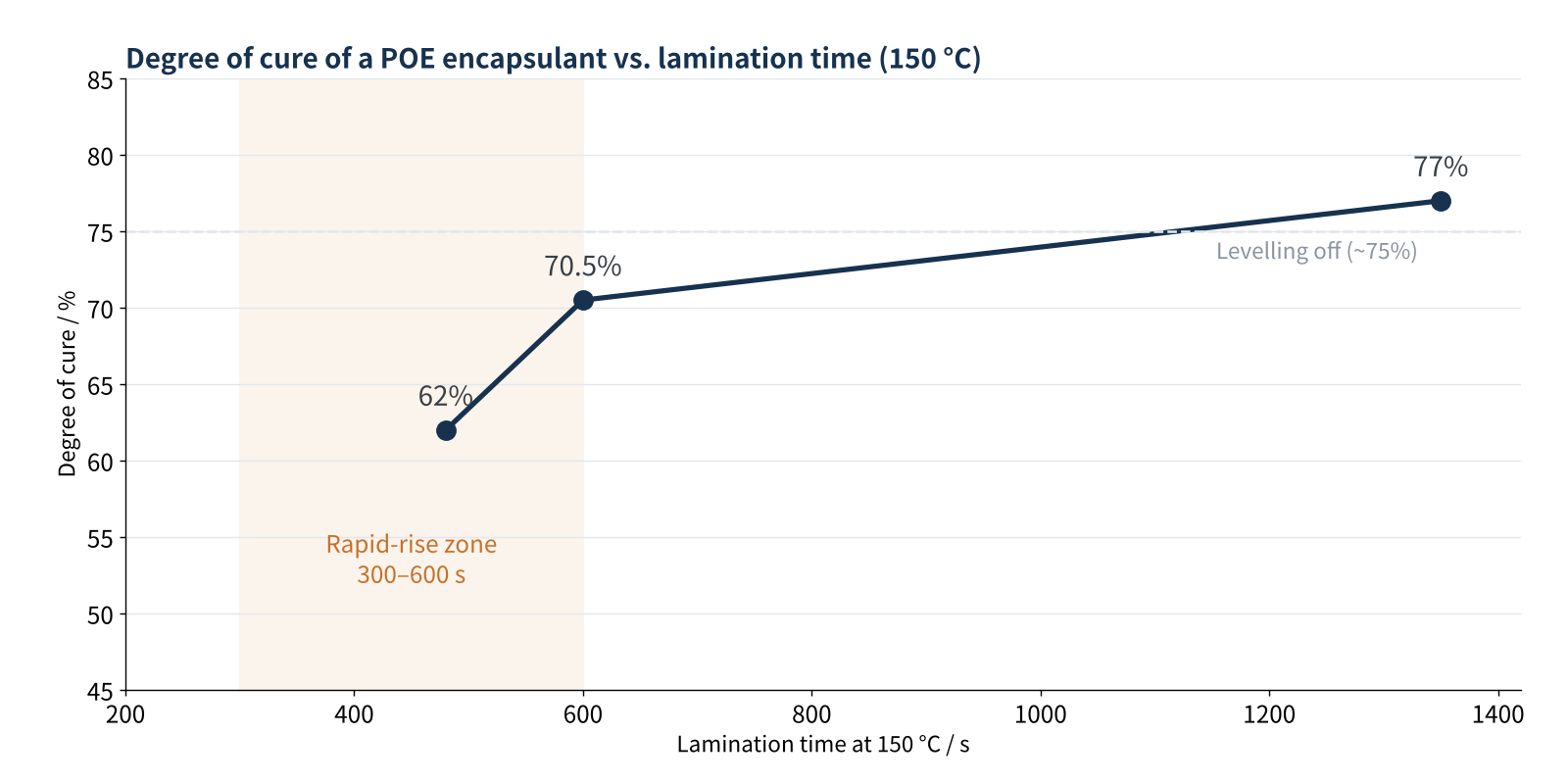
Figure 3 Degree of cure of a POE encapsulant vs. lamination time at 150 °C (data: Fraunhofer ISE, WCPEC-8, 2022)
At 150 °C, the degree of cure rose rapidly between 300 and 600 seconds and then levelled off: about 62% at 480 s, about 70.5% at 600 s and about 77% at 1,350 s. Raising the peak temperature to 180 °C made 120–150 s the critical window for crosslinking, with the degree of cure close to saturation after about 180 s. On this basis the study developed a 2.5-minute lamination process, cutting lamination energy per module by about 46%; after damp heat ageing, the high-temperature fast process did not cause noticeably worse moisture ingress.
These data show two things. First, raising temperature can indeed shorten the lamination cycle dramatically, which is why the industry keeps exploring "fast lamination"; but higher temperatures also cost bubbles, yellowing, squeeze-out and energy. Second, the "climbing" part of the cure curve is very steep, so a slightly short lamination time drops the degree of cure noticeably.
Another easily overlooked factor is heating plate temperature uniformity. There are temperature differences between the edges and middle of the plate, so the degree of cure differs from place to place in the same module. When measuring degree of cure, sample at several points in the middle and corners of the module rather than just one.
A newer route to fast lamination is "heating from both sides". In 2025, a team including Fraunhofer ISE reported in EPJ Photovoltaics that heating from top and bottom at the same time can cut lamination time by 10%–30%, reaching a gel content of 75%–80% in about 3–4 minutes; full-size glass-backsheet modules made with their one-step 170 °C, 5-minute process passed IEC 61215 thermal cycling, damp heat and mechanical load tests with less than 2% power loss. But processes of 4 minutes or less still gave insufficient cure uniformity across the module: speed is ultimately limited by uniformity.
04EVA, POE and glass-glass: different lamination windows
- EVA: the widest window. Good flow, fast curing and easy adhesion to glass make it the most "forgiving" material to laminate.
- POE: slower and "slipperier". It usually cures more slowly than EVA, often needing longer curing time or higher temperature; it is more prone to cell slip and shift as it flows; and poor additive compatibility can affect adhesion stability.
- EPE: the best of both. The outer EVA layers improve flow, adhesion and the lamination window, one of the process reasons it has quickly replaced pure POE.
Glass-glass modules pose extra challenges. First, with glass on both sides, heat reaches the upper encapsulant layer more slowly from the heating plate, so under the same profile its actual temperature may be lower. In Fraunhofer ISE's 2023 measurements on glass-glass EVA modules heated from one side, the degree of cure of the rear encapsulant (farther from the heating plate) was about 6.5% lower than that of the front, and the gap narrowed with heating from both sides. Second, neither side breathes, so gas between the layers can only escape from the edges; the escape path is long and bubbles are more likely at both the edges and the middle. Glass-glass modules therefore usually need longer evacuation and tighter lay-up control.
05Common lamination problems: symptoms, causes and fixes
| Symptom | Common causes | Fixes |
|---|---|---|
| Bubbles | Insufficient evacuation, damp encapsulant, gas from crosslinker decomposition, temperature too high | Longer evacuation, control encapsulant storage, optimise temperature |
| Cell / string shift | Pressing too fast, high encapsulant shrinkage, excessive flow | Gradual staged pressing, control shrinkage, add fixing |
| Squeeze-out | Grammage too high, high melt flow, excessive pressure | Match grammage and edge margin, adjust pressure |
| White overflow | White encapsulant flows up excessively | Use pre-crosslinked white film, control temperature |
| Under-cure | Insufficient time or temperature, heating plate non-uniformity, crosslinker failure | Optimise profile, regular temperature checks, incoming material control |
| Cracks / breakage | Excessive or too-fast pressure, foreign matter in lay-up | Cushioned pressing, better cleanliness |
| Early delamination | Coupling agent failure, contaminated glass surface, under-cure | Keep encapsulant dry, clean glass, monitor cure |
Table 1 Common lamination problems: symptoms, causes and fixes
Many of these problems map directly onto encapsulant properties covered in earlier articles: high shrinkage causes cell shift, damp coupling agent causes delamination, and a crosslinker temperature window mismatched to the profile causes under-cure or bubbles. Troubleshooting lamination often means looking at both encapsulant and process together.
060BB and thin cells: lamination's new exam questions
As cells get thinner, the lamination pressure window narrows. 0BB (zero busbar) technology goes further: contact between ribbon and fingers depends heavily on the encapsulant pressing and fixing it after lamination, as we explained in the ribbon series.
This means that in 0BB modules, the encapsulant's flow, modulus and post-cure shrinkage all directly affect the reliability of electrical contact. The lamination profile and encapsulant choice must be qualified together with ribbon and cell.
07Day-to-day monitoring of lamination
- Regular degree of cure sampling: sample at multiple points per shift or batch and build trend charts rather than just checking pass/fail. For glass-glass modules, test both front and rear layers.
- Heating plate temperature checks: regularly measure temperatures across the plate with a temperature-mapping board to catch growing differences early.
- Replace consumables on schedule: as release sheets and rubber diaphragms age, pressure uniformity and release both worsen.
- Revalidate whenever the encapsulant changes: when changing encapsulant supplier, type or even batch formulation, reconfirm the lamination profile; never simply carry it over.
A passing encapsulant is only the precondition; matching the lamination profile to it is what delivers the result. Degree of cure is the product of time and temperature, and if either falls short, all five jobs fall short with it.
08Final thoughts
Back to the opening question: why does the same roll of encapsulant behave differently on two lines? Because lamination is not simply "heat it and press it"; it is about making the encapsulant's flow, degassing and curing happen at exactly the right time across the evacuation, pressing and curing stages. Encapsulant and lamination are partners that have to be tuned together.
Changes in the lamination window often reflect changes in cell and module technology. In the next article we look at how encapsulant follows cell technology: from PERC to TOPCon, HJT and BC, and from glass-backsheet to glass-glass, what new demands each places on encapsulant.
What is the most troublesome lamination problem on your line? We would be glad to hear from you.
References
- Öz A.K. et al., 2.5 Minutes Lamination Process and the Influences of the Degree of Cross-Linking and the Moisture Ingress on the Degradation of PV Modules, WCPEC-8, 2022 (Fraunhofer ISE / Robert Bürkle GmbH), https://www.ise.fraunhofer.de/content/dam/ise/de/documents/publications/conference-paper/wcpec-8/Oez_3DV112.pdf
- Öz A.K. et al., Temperature Distribution During the Lamination Process of PV Modules and Its Influence on the Degree of Crosslinking for EVA: Simulation vs. Test Results, EU PVSEC 2023, https://www.ise.fraunhofer.de/content/dam/ise/de/documents/publications/conference-paper/40th-eupvsec-2023/Oez_3AV15.pdf
- Sraisth et al., Reducing process time of PV module lamination by using double-side heating system, EPJ Photovoltaics 16, 26 (2025), https://www.epj-pv.org/10.1051/epjpv/2025014
- T/CPIA 0071—2024 Co-extruded encapsulant film for PV modules, China Photovoltaic Industry Association
- T/CPIA 0004—2017 Ethylene-vinyl acetate copolymer (EVA) film for PV module encapsulation, China Photovoltaic Industry Association
- IEC 62788-1-6:2017+AMD1:2020 Encapsulants – Test methods for determining the degree of cure in EVA
A PV R&D and technology team with 10+ years of experience | In-depth technical knowledge sharing
Materials · Reliability · Failure Analysis · Standards & Certification · Products · Processes
Exploring AI + PV; collaboration welcome
Disclaimer:
1. Original content reflects the authors' personal views only, is for reference only and does not constitute investment advice.
2. Reposted and cited content is credited to its source, out of respect for original work.
3. Some content was produced with AI assistance (chart generation, data retrieval, concept explanations, etc.); the core framework and key content were written by our technical team and reviewed by people.
4. If anything is inaccurate or infringes your rights, please leave a message or contact us and we will deal with it.