
From PERC to TOPCon, HJT and BC: Every New Cell Technology Sets Encapsulant a New Exam
In brief
Almost every encapsulant upgrade has a change in cell or module technology behind it. In this seventh article of our PV encapsulant series, we follow the path from PERC through bifacial glass-glass, TOPCon, HJT and BC to see the new questions each generation put to encapsulant, from PID to UV, from water barrier to corrosion, and on to rear-side insulation, and draw on research from Kiwa PVEL, Fraunhofer ISE and UNSW to discuss what encapsulant can and cannot fix.
Looking back at the earlier articles, encapsulant has changed fast in recent years, from EVA dominance to POE, EPE and down-converting films all flourishing. But encapsulant's evolution is not decided by encapsulant makers themselves: it is "pushed along" by cell and module technology.
Every time cells switch track, a new "weak spot" is exposed, and as the only material that fully wraps the cell, encapsulant is always the first asked to fill the gap. In this article we follow the cell technology roadmap and look at the questions encapsulant has been set.
01A timeline: as cells change, encapsulant changes
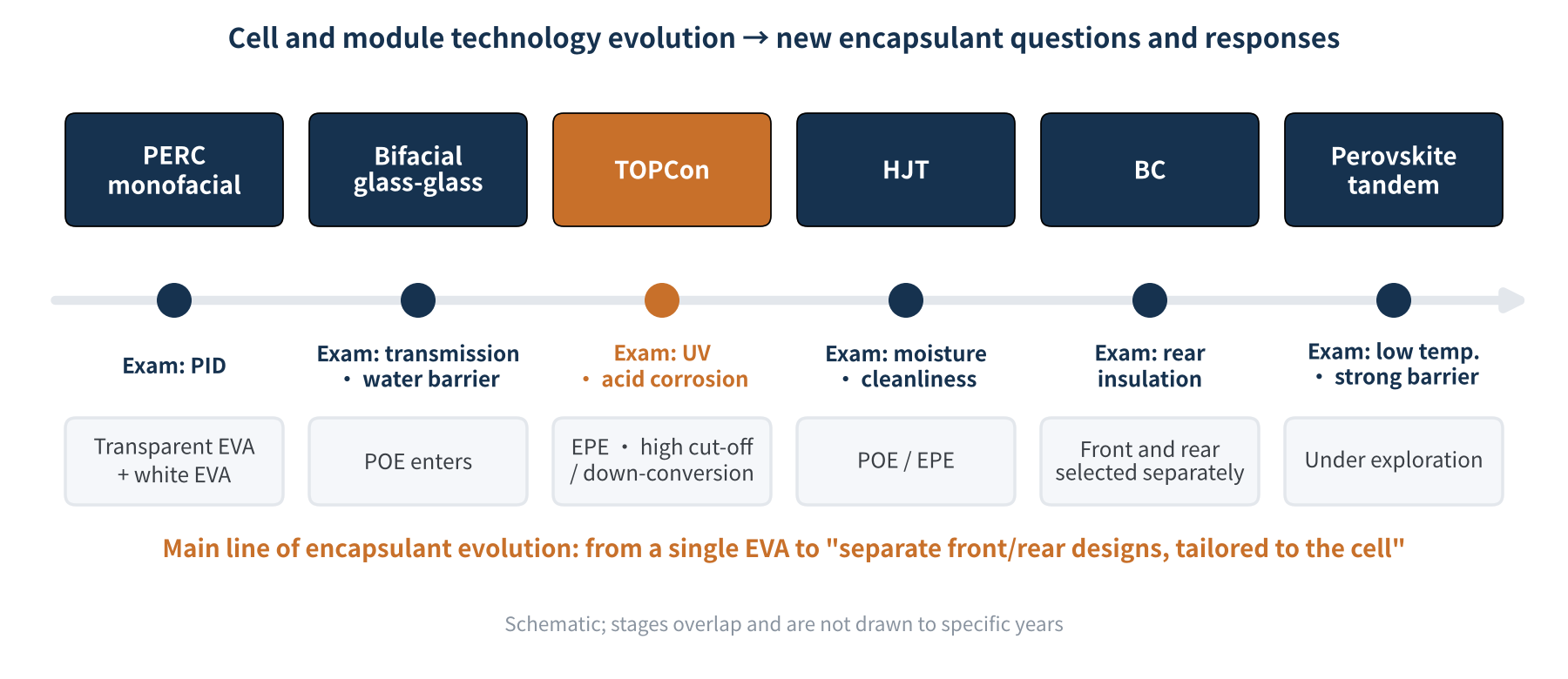
Figure 1 How cell and module technology changes have driven encapsulant requirements (schematic)
In market terms, n-type cells have fully taken over. According to China Photovoltaic Industry Association (CPIA) data compiled by TaiyangNews in May 2026, TOPCon held about 87% of the cell market in 2025, BC about 7% and HJT about 2.6%; CPIA expects TOPCon to fall back to about 69% by 2030, BC to rise to about 23% and HJT to reach about 7.5%. Expectations for BC differ widely: consultancy Exawatt expects BC to reach about 38% by 2030, while the International Technology Roadmap for Photovoltaic (ITRPV) expects about 17% by 2029.
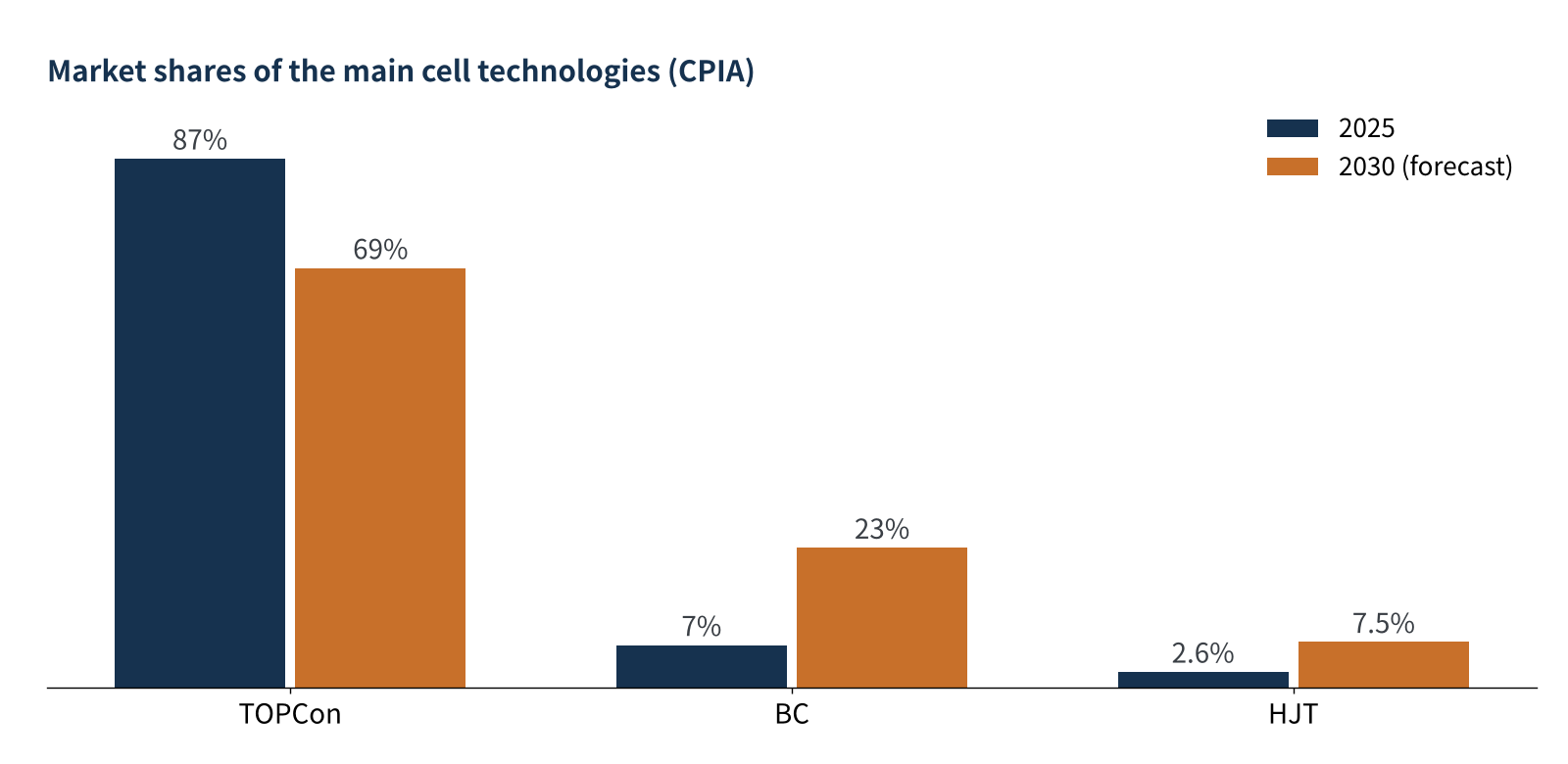
Figure 2 Market shares of the main cell technologies: 2025 and 2030 forecast (data: CPIA, compiled by TaiyangNews)
This means that in the coming years, encapsulant must both serve TOPCon, the "core business", well and prepare for the growth of BC, HJT and even tandem cells.
02The PERC and glass-backsheet era: EVA's golden age
When p-type PERC cells and monofacial glass-backsheet modules were mainstream, the encapsulant configuration was almost a standard answer: transparent EVA on the front, white or transparent EVA on the rear, with a backsheet.
The biggest question this era set encapsulant was PID. As system voltages rose to 1,000 V and 1,500 V, modules suffered severe potential-induced degradation under heat and humidity. Encapsulant makers responded with PID-resistant EVA, raising volume resistivity and reducing ion migration through formulation. This is where the "insulation" job described in the first article first came to be stressed again and again.
03Bifacial and glass-glass: the rear encapsulant must "see light"
Bifacial cells let the rear of the module generate power too, directly changing the role of the rear encapsulant: white encapsulant could no longer be used, and the rear encapsulant had to be transparent. Bifacial modules also mostly use a glass-glass structure, bringing two new problems:
- Higher water barrier requirements: in glass-glass modules moisture mainly enters from the edges and, once in, has difficulty getting out, leaving the module in a long-term "humid and hot" state that demands more water blocking and hydrolysis resistance from the encapsulant.
- Higher PID resistance requirements: with glass on both sides, PID risk rises further.
At this stage, POE encapsulant came onto the scene with its high water barrier, high resistivity and freedom from acid, ramping up first in bifacial PERC glass-glass modules and then being widely replaced by co-extruded EPE to balance cost.
04TOPCon: from "PID resistance" to "UV resistance"
TOPCon is the undisputed workhorse of n-type cells, and it set encapsulant a new question: UV. The passivation structure on the front of TOPCon cells is more sensitive to UV, and long-term UV exposure can cause power loss, known as UV-induced degradation (UVID).
Third-party test lab Kiwa PVEL found in its reliability testing that HJT and TOPCon modules are relatively sensitive to UVID, especially when paired with UV-transmitting encapsulant. Its test condition is 120 kWh/m² of front-side UV irradiation at 60 °C, roughly equivalent to one to two years of outdoor UV dose; in recent tests, some commercial PERC modules also showed UVID-related power loss. In RETC's 2026 PV Module Index, 8% of tested models still failed the UVID test.
That said, lab results need to be read in an outdoor context. A comparative study published by Fraunhofer ISE in April 2025 found that modules lost notable power in dark storage after conventional UV tests, while outdoor light exposure produced a significant recovery: with a light-stabilisation step added, most modules showed minimal degradation, though a few still lost up to 5%. The institute concluded that conventional UV tests overstate TOPCon UVID, while noting that many TOPCon modules are still UV-sensitive. In other words, UVID is a real problem, just not as severe as some tests suggest.
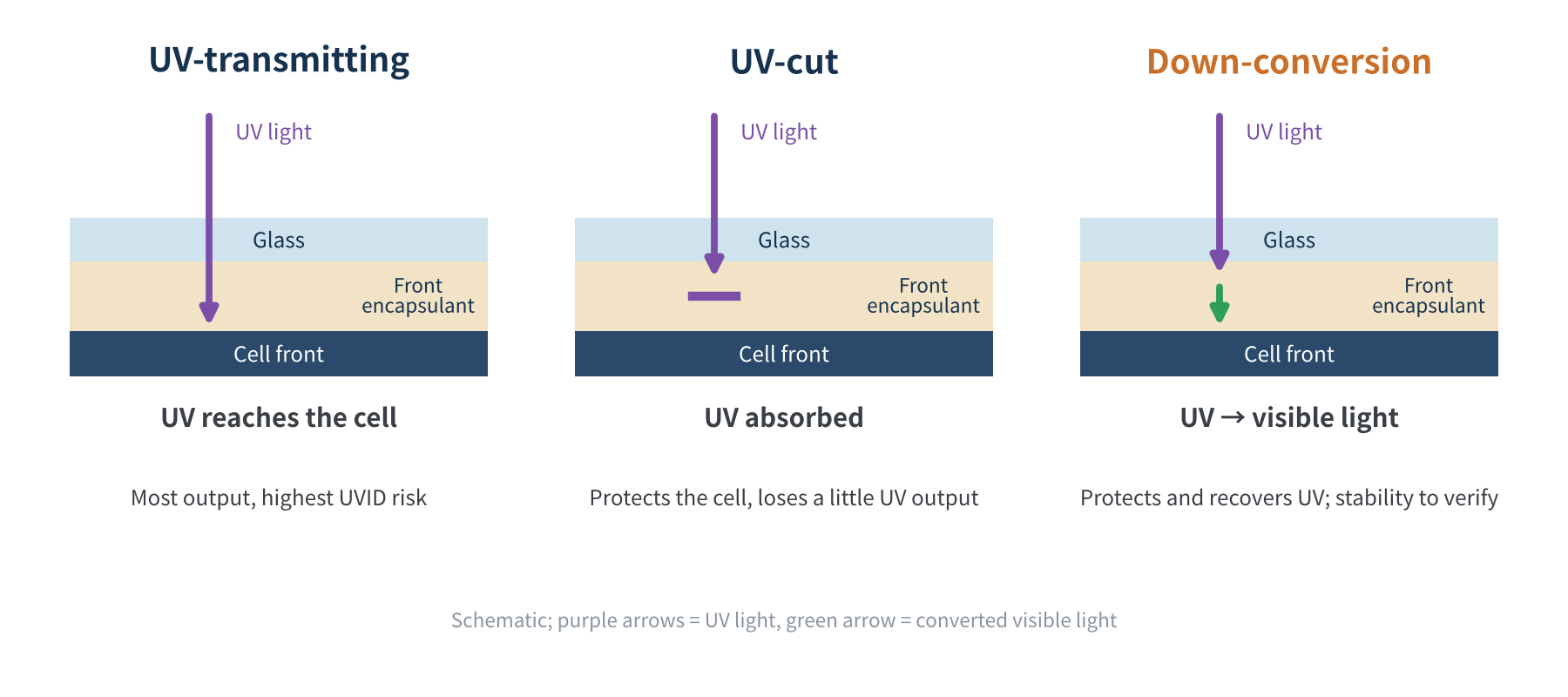
Figure 3 Three ways the front encapsulant can handle UV (schematic)
Encapsulant has three possible responses: first, UV-transmitting, which maximises output but carries the highest risk; second, UV-cut, which protects the cell at the cost of a little output in the UV band; third, down-conversion, which turns UV into visible light, balancing protection and output, but the long-term stability of the down-converter must be verified (introduced in the second article).
TOPCon is also relatively sensitive to metallisation corrosion caused by acetic acid and other acidic species, one reason TOPCon glass-glass modules generally use EPE or POE.
05HJT: the most "delicate" of all
HJT cells use amorphous silicon passivation and transparent conductive oxide (TCO), with low-temperature silver paste. The whole process runs at low temperature, and the structure is fairly sensitive to moisture, acid and UV, so it usually needs encapsulant with a high water barrier, no acid generation and good UV management; POE-class encapsulants are a common choice.
But one research finding deserves attention. A 2024 study from the University of New South Wales (UNSW) found that severe damp heat failures in HJT and TOPCon modules were linked mainly to contact contamination during cell production: sodium, calcium and other ions introduced by nitrile gloves, bare hands, vacuum grippers and test stages, which together with moisture under damp heat increase recombination and corrode metal contacts. After 1,000 hours of damp heat, a contaminated HJT module (EVA-encapsulated) lost about 10% of its power in relative terms, and a contaminated TOPCon module lost about 15.6% even with POE; pre-cleaned HJT cells lost only 1%–2%. The study recommends rinsing cells with deionised water and using clean gloves and stages before encapsulation.
Encapsulant can slow the action of moisture and ions, but it cannot "cure" contamination of the cells themselves. High-end cells demand a lot of the encapsulant, and just as much of cleanliness management across the whole line.
06BC: a "clean" front and a "crowded" rear
BC (back-contact) cells move both positive and negative electrodes to the rear, leaving the front free of any fingers: a clean look and high front-side efficiency, especially popular in the distributed market.
For encapsulant, BC is "relaxed at the front, tight at the rear". The front encapsulant mainly needs to handle transmission and UV management; the rear is different: positive and negative electrodes are interleaved at small spacing, so the rear encapsulant must ensure long-term insulation between the dense electrodes and prevent corrosion under damp heat. Some BC products also emphasise an all-black look, placing requirements on the colour and hiding power of the rear encapsulant.
07One table: cell route × encapsulant needs
| Cell / module route | Main encapsulant questions | Common encapsulant solutions |
|---|---|---|
| PERC monofacial glass-backsheet | PID, cost | Transparent EVA + white EVA |
| Bifacial PERC glass-glass | Rear transmission, PID, water barrier | POE / EPE |
| TOPCon glass-glass | UV, acid corrosion, water barrier | EPE / POE, high cut-off or down-converting |
| HJT | Moisture, acid, UV | POE / EPE, UV management |
| BC | Rear insulation and corrosion protection, appearance | Front and rear selected separately |
| Perovskite tandem | Low temperature, strong water barrier, heat sensitivity | Thermoplastic encapsulants, edge sealing, etc. (under exploration) |
Table 1 Main encapsulant requirements for different cell/module routes
The main line of encapsulant evolution is therefore: from a single EVA to "separate front and rear designs, tailored to the cell". In future, the front and rear encapsulants of the same module are likely to differ more and more.
Every time cells switch track, encapsulant has to answer a new exam: PERC tested PID, glass-glass tested water barrier, TOPCon tests UV, HJT tests cleanliness and water barrier, and BC tests rear insulation.
08Final thoughts
The encapsulant story is essentially a "follower's" story: every step up in cell efficiency exposes a new sensitivity, and encapsulant must fill the gap in time. But the UNSW research also reminds us that encapsulant is not a cure-all: it can delay problems but cannot make up for defects in the cells and the line itself; and Fraunhofer ISE's UV work reminds us that, when evaluating encapsulant solutions, the test conditions themselves must stand up to scrutiny.
Every gap filled comes with added cost. In the next article we look at cost reduction and efficiency gains for encapsulant: where the limit of reducing grammage lies, how much EPE really saves over POE, and whether the power gain of down-converting film covers its cost.
What new problems have you met in selecting encapsulants for TOPCon or BC modules? We would be glad to hear from you.
References
- TaiyangNews: Projected Market Shares Of Different Solar Cell Technologies (citing CPIA, ITRPV and Exawatt data), 2026-05-18, https://taiyangnews.info/technology/projected-market-shares-of-different-solar-cell-technologies
- Kiwa PVEL: UV-Induced Degradation (PQP test procedure description)
- Sen C., Wang H., Zhu Z., Li A., Khan M.U., Hoex B., Hidden Fingerprints: How Solar Cell Handling Leads to Damp Heat Failures in HJT and TOPCon Modules, APVI Solar Research Conference, 2024, https://apvi.org.au/solar-research-conference/wp-content/uploads/2024/12/Sen_C_Hidden_Fingerprints_How_Solar_Cell_Handling_Leads_to_Damp_Heat_Failures_in_HJT_and_TOPCon_Modules.pdf
- T/CPIA 0071—2024 Co-extruded encapsulant film for PV modules, China Photovoltaic Industry Association
- TaiyangNews: TOPCon UVID: Less Severe Than Assumed (Fraunhofer ISE), 2025-04-15, https://taiyangnews.info/technology/fraunhofer-ise-uvid-uv-stabilization-topcon
- Fraunhofer ISE: Fraunhofer ISE evaluates common UV tests for TOPCon modules for practical relevance, 2025-04, https://www.ise.fraunhofer.de/en/press-media/press-releases/2025/fraunhofer-ise-evaluates-common-uv-tests-for-topcon-modules-for-practical-relevance.html
- pv magazine USA: Latest RETC solar module quality report reveals significant issues, 2026-06-03, https://pv-magazine-usa.com/2026/06/03/latest-retc-solar-module-quality-report-reveals-significant-issues/
A PV R&D and technology team with 10+ years of experience | In-depth technical knowledge sharing
Materials · Reliability · Failure Analysis · Standards & Certification · Products · Processes
Exploring AI + PV; collaboration welcome
Disclaimer:
1. Original content reflects the authors' personal views only, is for reference only and does not constitute investment advice.
2. Reposted and cited content is credited to its source, out of respect for original work.
3. Some content was produced with AI assistance (chart generation, data retrieval, concept explanations, etc.); the core framework and key content were written by our technical team and reviewed by people.
4. If anything is inaccurate or infringes your rights, please leave a message or contact us and we will deal with it.