
With Modules Below RMB 0.7/W, How Should the Encapsulant Cost-and-Efficiency Sums Be Done?
In brief
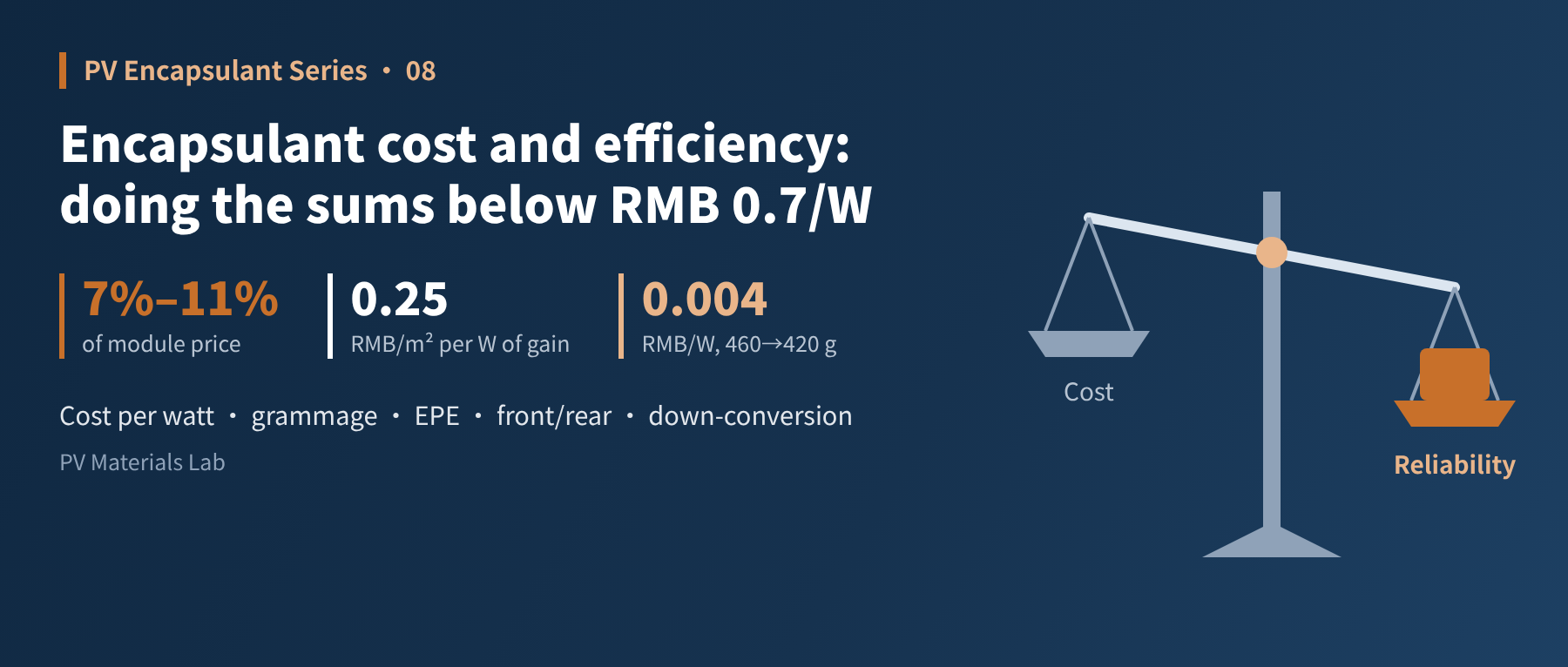
As module prices keep falling, encapsulant's share of module cost has risen by default. In this eighth article of our PV encapsulant series, we use 2026 public prices to work through three sums: what the encapsulant in a module is worth; how much reducing grammage, replacing POE with EPE and differentiating front and rear can each save; and how many watts of gain "efficiency" solutions such as white and down-converting films need to cover their premium. Finally, we flag the sum most easily overlooked: reliability.
Cost reduction and efficiency gains are the eternal theme of the PV industry, and encapsulant is no exception. The first seven articles covered encapsulant's roles, formulation, manufacturing, testing and technology routes; this one takes a different angle: doing the sums.
First, a caveat: all estimates below are based on public prices and simplified assumptions, intended to show orders of magnitude and method, not to replace any company's actual BOM costing. The specific assumptions are listed in the calculation notes at the end.
01First sum: what is the encapsulant in a module worth?
Take a 2382 × 1134 mm TOPCon module of about 620 W, with about 5.4 m² of encapsulant in its front and rear layers. According to SOLARZOOM data cited in a BOC International research report, in March 2026 transparent EVA encapsulant cost about RMB 5.59/m² and POE about RMB 8.58/m²; in a central state-owned enterprise tender at the end of September 2026, the first-ranked bid for TOPCon modules was RMB 0.685/W.
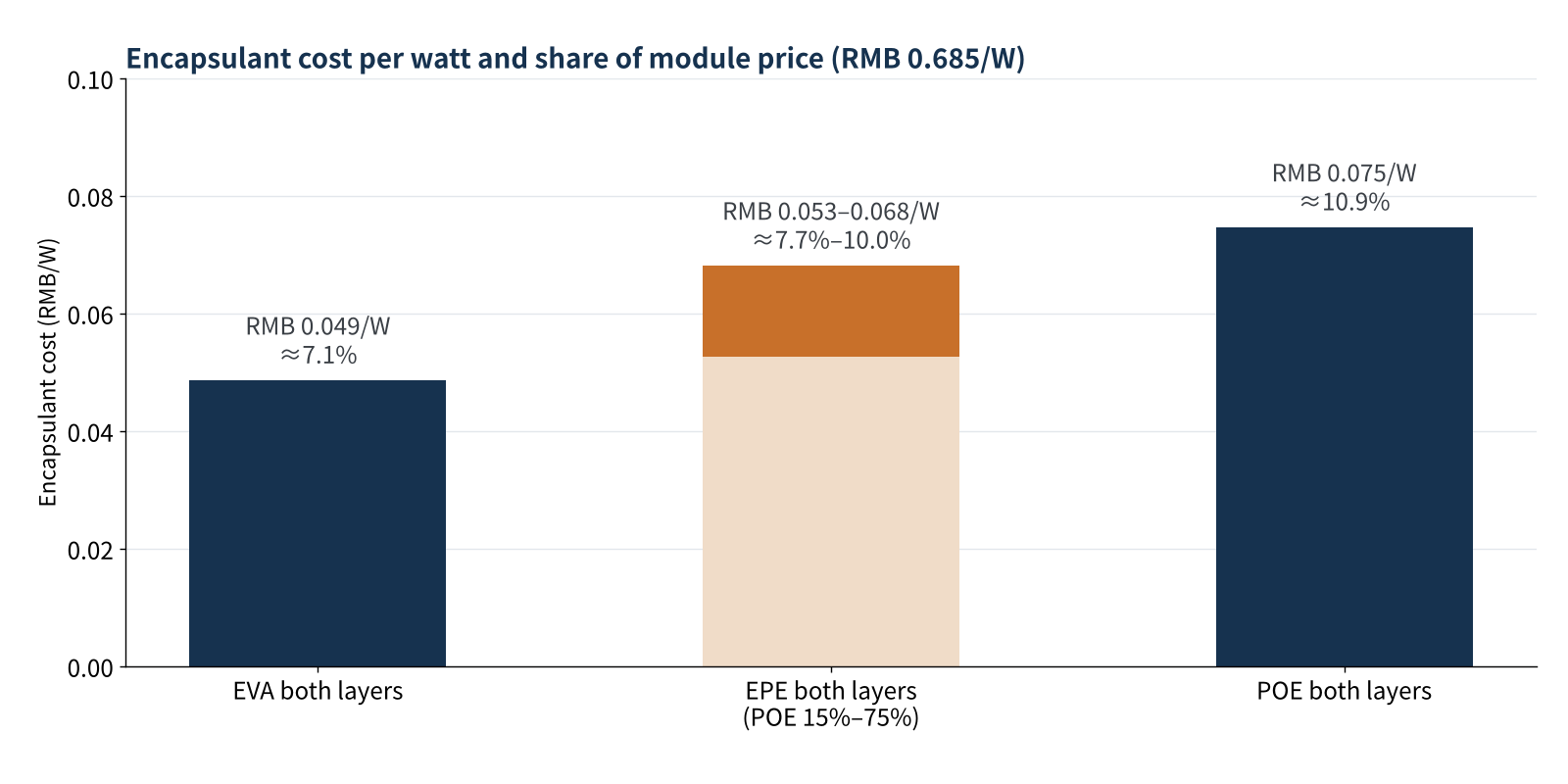
Figure 1 Encapsulant cost per watt and its share of module price for different configurations (estimate)
On this basis, using EVA for both layers costs about RMB 0.049/W, about 7% of the module price; using POE for both costs about RMB 0.075/W, close to 11%.
There is a notable change here. The first article cited the figure "encapsulant makes up 3%–4% of module cost", which reflects an earlier period. Module prices have fallen sharply in recent years while encapsulant prices have fallen less, so encapsulant's share of the module price has risen by default. Encapsulant is no longer a "negligible minor material".
Prices themselves fluctuate, too. According to Shanghai Metals Market (SMM) quotes at the end of July 2026, 420 g/m² transparent EVA was about RMB 5.04–5.10/m², 380 g/m² EPE about RMB 5.13–5.19/m², and centralised TOPCon modules about RMB 0.71/W. Recalculated with these figures, two layers of EVA cost about RMB 0.044/W, about 6.2% of the module price: the order of magnitude holds, while the exact figure moves with the market, so always use current prices for BOM estimates.
02Lever 1: reducing grammage, and where its limit lies
The most direct way to cut cost is to reduce grammage. Raw materials make up most of encapsulant cost, so price varies roughly linearly with grammage. For transparent EVA, going from 460 g/m² to 420 g/m² cuts grammage by about 8.7%, saving about RMB 0.004/W on the assumptions above, about 0.6% of the module price.
Not much, but not nothing when modules are costed to the last fraction of a cent. The problem is that grammage cannot be reduced indefinitely; its limit is set by the encapsulant's five jobs:
- Filling: too low a grammage cannot fill the gaps between cells and around ribbons during lamination, leading to missing encapsulant and bubbles.
- Cushioning: a thinner layer protects cells less, raising cracking risk in thin-cell and 0BB modules.
- Insulation: layer thickness directly affects the margin for insulation and PID resistance.
- Standard limit: T/CPIA 0071—2024 specifies an areal density range of 250–600 g/m² for co-extruded encapsulant.
The right way to reduce grammage is to validate it together with cell thickness, ribbon diameter and lamination process, not to squeeze the encapsulant specification on its own. Kiwa PVEL's 2026 reliability scorecard also lists "thinner encapsulants" among the cost-driven changes linked to higher degradation or failure risk.
03Lever 2: replacing POE with EPE
As the second article explained, a major point of co-extruded EPE is cost reduction. At the prices above, POE encapsulant costs about 53% more than EVA, and using POE for both layers adds about RMB 0.026/W compared with EVA for both.
EPE's cost lies between the two, depending on its POE content. T/CPIA 0071—2024 specifies a POE mass fraction of 15%–75% in co-extruded encapsulant. Roughly interpolating linearly by POE content, EPE saves about RMB 0.007–0.022/W relative to pure POE.
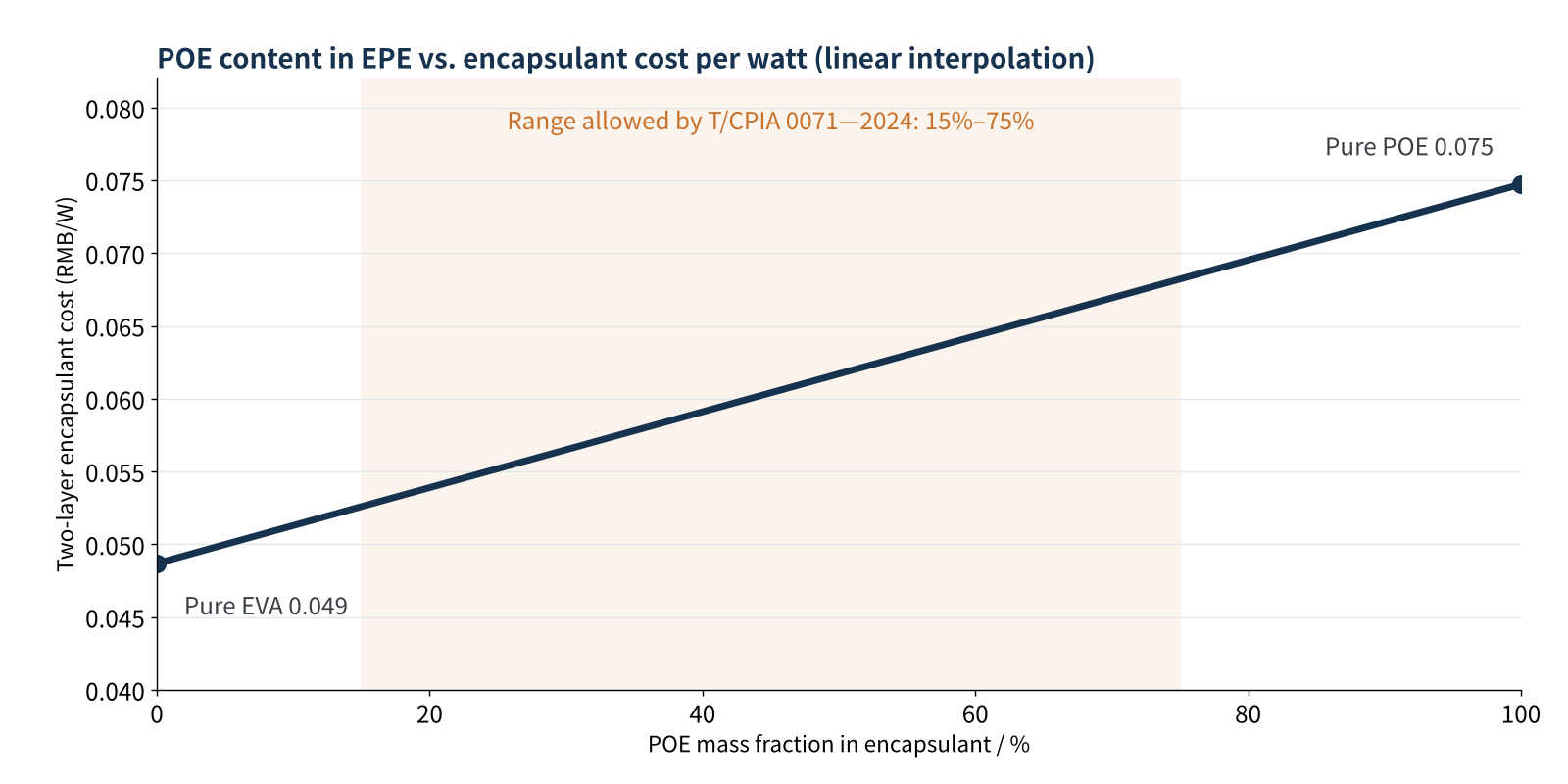
Figure 2 POE content in EPE vs. cost per watt (rough linear interpolation)
Actual market prices are also affected by grammage. In SMM's July 2026 quotes, 380 g/m² EPE and 420 g/m² transparent EVA were almost the same price per square metre: EPE's savings come partly from its POE content and partly from lower grammage.
But remember the warning from the fourth article: the lower the POE content, the cheaper the film, but also the smaller the margin for water blocking and PID resistance; and co-extrusion itself carries risks in layer ratio, interlayer adhesion and additive migration. When grammage is cut at the same time, these margins shrink further. Choosing POE content and grammage is essentially a trade-off between cost and reliability margin.
04Lever 3: differentiating front and rear
The seventh article noted that encapsulant is moving towards "separate front and rear designs". This is also a cost-reduction idea: put the expensive material where it is needed most.
- Allocate by risk: the front handles transmission and UV management, the rear handles insulation and water blocking; the two sides have different needs, so there is no need to use the same high-spec encapsulant across the board.
- Allocate by structure: for example, BC modules have high UV management requirements at the front and high insulation and corrosion protection requirements at the rear, so each side can be selected separately.
- Allocate by application: high-risk sites such as hot and humid, coastal and floating plants can use a different encapsulant configuration from conventional ground-mounted plants.
Differentiation requires a clear understanding of the failure risks on each side, and verification of the combined solution through reliability testing.
05Efficiency: the "sum" for white and down-converting films
Efficiency-enhancing encapsulants (white high-reflectance and down-converting films) cost more than standard encapsulant; whether they are worth it depends on whether the gain covers the premium. Here is a simple formula:
Affordable premium per encapsulant layer (RMB/m²) ≈ module power gain (W) × module price (RMB/W) ÷ area of one encapsulant layer (m²)
At RMB 0.685/W and 2.70 m² per layer, each watt of power gain covers a premium of about RMB 0.25/m² for one encapsulant layer. If a 620 W module gains 1% (about 6.2 W), the affordable premium is about RMB 1.6/m².
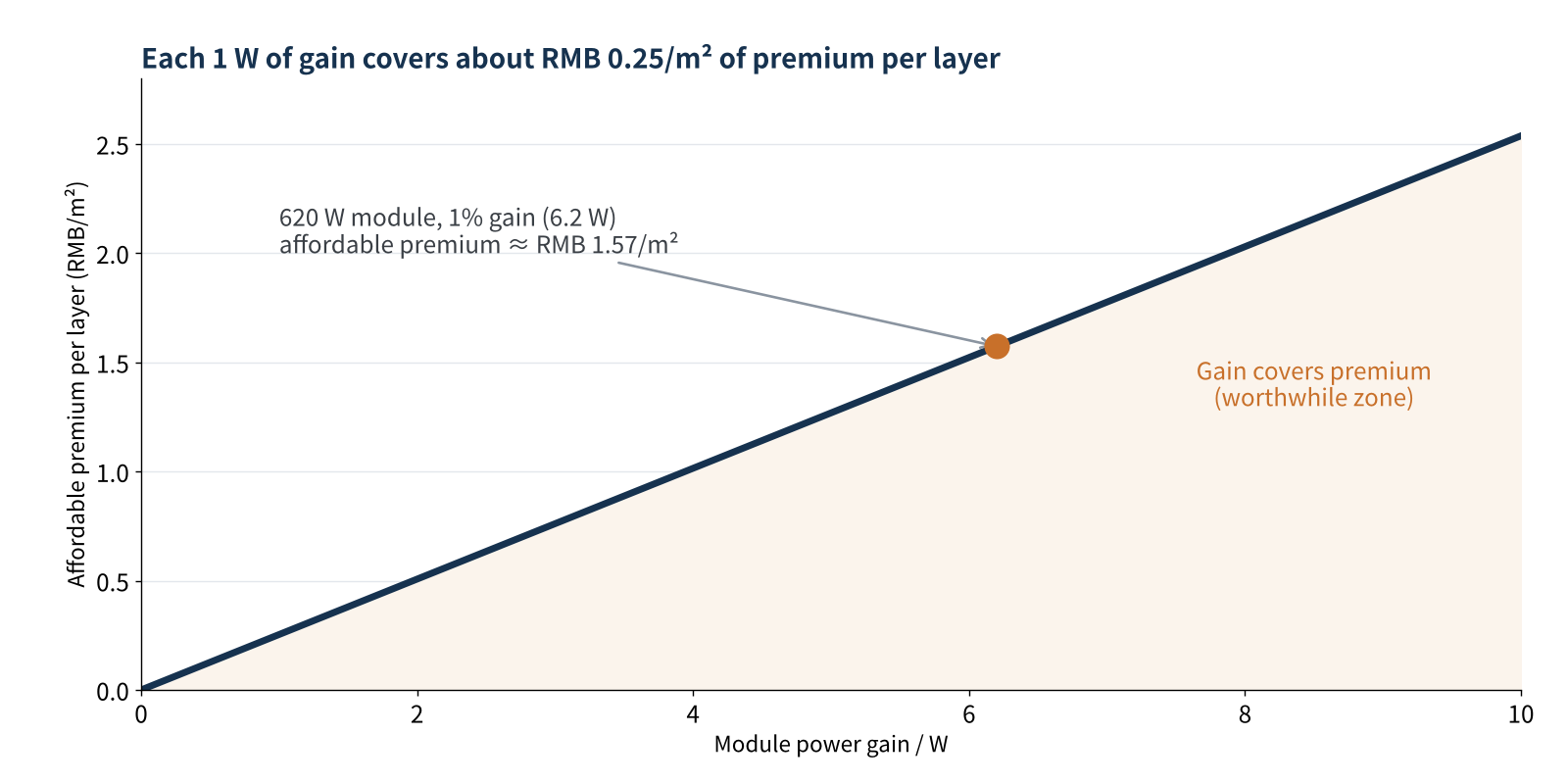
Figure 3 Power gain vs. affordable premium per encapsulant layer (at RMB 0.685/W and 2.70 m² per layer)
Some encapsulant makers already claim their down-converting films raise module power by more than 1%. Three points to watch when doing the sums:
- Like-for-like measurement: the gain must be measured in comparison on the same cells and process.
- Net of degradation: the gain must be discounted for post-ageing decline; if the down-converter fails within a few years, the gain is gone.
- Whether it crosses a power bin: modules are priced by power bin, and whether the gain "crosses a bin" makes a big difference to the real return.
06The sum most easily overlooked: reliability
Everything above is a "visible sum", counted in fractions of a cent per watt. But encapsulant also has an "invisible sum": once it fails, it can hardly be repaired.
Yellowing, delamination, corrosion, PID: if any of these breaks out in a plant, what is lost is years of generation, possibly with warranty claims and brand damage on top, often far exceeding the fractions of a cent saved on encapsulant. Encapsulant cost reduction must never breach the reliability floor.
| Lever | Order of benefit (estimate) | Main risks |
|---|---|---|
| Lower grammage (460→420 g/m²) | About RMB 0.004/W | Missing encapsulant, bubbles, reduced cushioning and insulation margin |
| EPE instead of pure POE | About RMB 0.007–0.022/W | Water barrier and PID margin, interlayer and migration risks |
| Front/rear differentiation | Depends on the solution | Combined solution needs reliability verification |
| White / down-converting films | Each 1 W of gain covers about RMB 0.25/m² premium | Gain degradation, measurement basis, whether it crosses a bin |
Table 1 Encapsulant cost and efficiency levers: order of benefit and main risks
Encapsulant is no longer a negligible minor material. Cost reduction must count every fraction of a cent, efficiency gains must be net of degradation, and every sum rests on not compromising reliability.
07Final thoughts
The lower module prices go, the more carefully encapsulant costs must be counted; yet encapsulant is the module's "safety net", so the room for cost reduction is bound to be limited. Real cost reduction and efficiency gain is not simply swapping in cheaper material, but, with the five jobs understood, spending every yuan where the risk is greatest.
In the next article we look at common module failures caused by encapsulant: yellowing, delamination, bubbles, snail trails, acetic acid corrosion, PID, white overflow and more, taking each apart by "symptom, mechanism, troubleshooting, prevention", and seeing how the sums that were not done properly are eventually "paid back".
What have you tried to cut encapsulant cost? What worked, and where did you hit pitfalls? We would be glad to hear from you.
References
- BOC International: Hangzhou First — leading beneficiary of encapsulant price rises, ample room for profit recovery, 18 March 2026 (citing SOLARZOOM encapsulant price data)
- PV Price Watch (8 October 2026): bid candidates in a central SOE's first 2026 batch of n-type (TOPCon) module procurement
- T/CPIA 0071—2024 Co-extruded encapsulant film for PV modules, China Photovoltaic Industry Association
- Guanyan Tianxia: 2022 PV encapsulant film industry chain analysis (raw material cost share)
- East Money: Mingguan New Material — proprietary light-conversion film can raise module power by more than 1.0% (company claim)
- SMM: EVA Prices to Continue Slight Uptrend, Cell Prices Remain Divergent (silicon-based PV morning meeting minutes), 2026-07-30, https://news.metal.com/en/newscontent/104031811-eva-prices-to-continue-slight-uptrend-cell-prices-remain-divergent-smm-silicon-based-pv-morning-meeting-minutes
- Solar Power World: Latest PV module reliability scorecard shows unsettling uptick in failures (Kiwa PVEL 2026), https://www.solarpowerworldonline.com/2026/05/latest-pv-module-reliability-scorecard-shows-unsettling-uptick-in-failures/
A PV R&D and technology team with 10+ years of experience | In-depth technical knowledge sharing
Materials · Reliability · Failure Analysis · Standards & Certification · Products · Processes
Exploring AI + PV; collaboration welcome
Disclaimer:
1. Original content reflects the authors' personal views only, is for reference only and does not constitute investment advice.
2. Reposted and cited content is credited to its source, out of respect for original work.
3. Some content was produced with AI assistance (chart generation, data retrieval, concept explanations, etc.); the core framework and key content were written by our technical team and reviewed by people.
4. If anything is inaccurate or infringes your rights, please leave a message or contact us and we will deal with it.