
To Crosslink or Not? How Perovskites, Flexible Modules and Recycling Are Rewriting the Future of PV Encapsulants
In brief
This is the final article of our PV encapsulant series. The first twelve covered the encapsulant of today; this one looks at tomorrow: crosslinking-free thermoplastic encapsulants, low-temperature encapsulation, the encapsulation challenges of perovskite and tandem cells, new applications in lightweight flexible modules and space PV, and the new demands that recycling places on encapsulants. Drawing on NREL and Dow's perovskite encapsulation research, an EPJ Photovoltaics recycling study and 2026 industry developments, we try to answer where encapsulants go next, which directions are already under way and which still need time.
Over twelve articles we started from the encapsulant's five jobs and went on through formulation, processing, testing, lamination, technology routes, cost, failures, reliability, qualification and the industry landscape. All of that is the encapsulant's "today".
In this last article we talk about its "tomorrow". Any outlook involves judgement: research findings cited here are referenced, while our assessments of trends and maturity are our team's views based on industry experience and are for reference only.
01Four forces pushing encapsulants forward
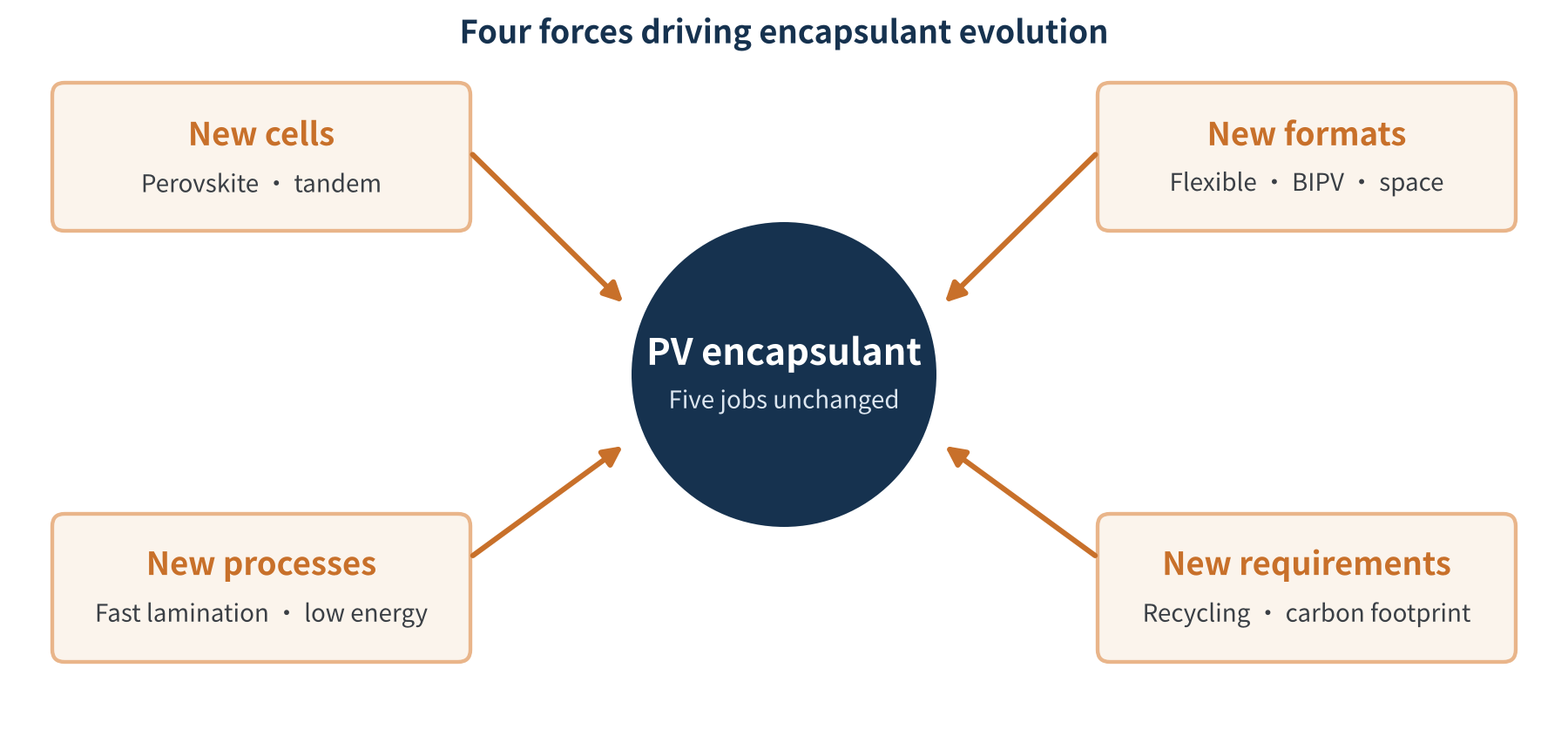
Figure 1 Four forces driving encapsulant evolution (schematic)
Looking back over the past decade and more, encapsulant development has always been driven by a few forces. Looking ahead, we see four main ones:
- New cells: Perovskite and tandem cells are extremely sensitive to temperature, moisture and chemical environment, and demand far more from encapsulation than crystalline silicon.
- New formats: Lightweight flexible modules, BIPV and space PV take the encapsulant out of its "glass–cell–glass" comfort zone.
- New processes: Faster lamination cycles and lower energy use push encapsulants from "crosslinked" towards "crosslinking-free".
- New requirements: Module recycling and carbon footprint require the encapsulant, for the first time, to consider what happens after retirement.
02Direction 1: crosslinking-free thermoplastic encapsulants
Today's mainstream EVA and POE encapsulants must crosslink during lamination (Articles 3 and 6). Crosslinking makes them heat- and creep-resistant, but it also brings problems: long lamination times, possible bubbles from crosslinker decomposition, side reactions between peroxides and sensitive cells, and crosslinked films that are hard to recycle.
Thermoplastic encapsulants (such as TPO) take a different route: no crosslinker, melting to bond during lamination and setting on cooling. Their potential advantages are clear:
- Faster lamination: No need to wait for the crosslinking reaction, so lamination cycles may shorten.
- Gentler on cells: No peroxides or decomposition products, reducing chemical interference with sensitive cells.
- Easier recycling: They soften again on heating, opening the way to module disassembly and material recovery.
Their core challenge is creep resistance at high temperature: modules can reach 70–80 °C outdoors in summer, and an uncrosslinked material must hold its shape and adhesion through its own crystallinity or molecular design.
In 2026 this direction moved from concept to product launches. At SNEC 2026, Crown Advanced Material (明冠新材) showed a TPO thermoplastic encapsulant for perovskite and tandem cells, highlighting a "zero-additive" formulation, low-temperature encapsulation, creep resistance and anti-yellowing, and said it had been sent to several companies for testing; Betterial (百佳年代) launched a halogen-free TPO film designed to avoid halide residues corroding the perovskite layer, in UV-transmitting and UV-cut versions. Whether thermoplastics can replace crosslinked encapsulants in the mainstream silicon market, however, still needs longer outdoor validation.
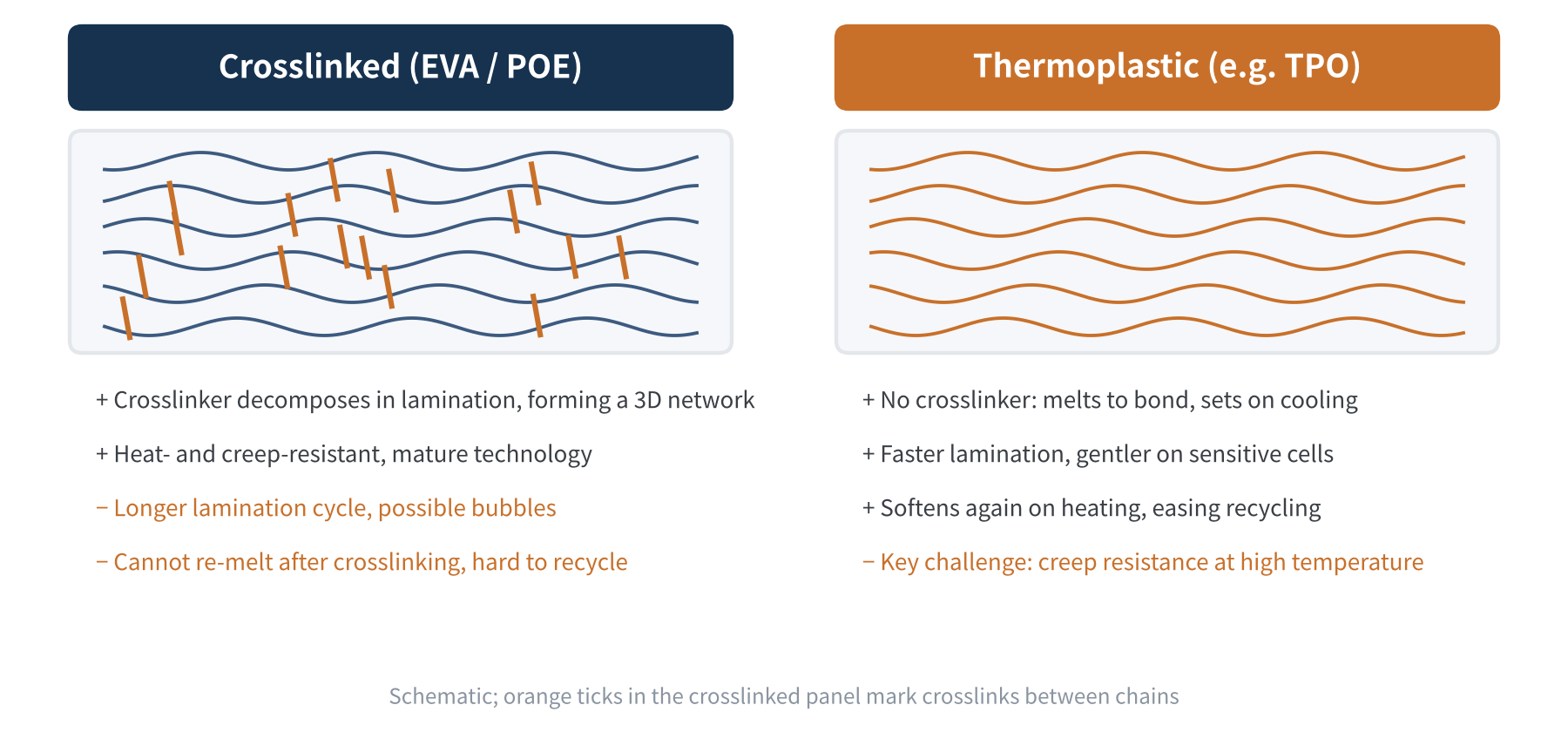
Figure 2 Crosslinked vs thermoplastic encapsulants (schematic)
03Direction 2: lower temperatures for more delicate cells
As Article 6 explained, crystalline silicon modules are usually laminated at around 140–150 °C. But new-generation cells are increasingly heat-sensitive.
A perovskite encapsulation study by the US National Renewable Energy Laboratory (NREL) and Dow Chemical (November 2024) provides clear evidence:
- Hot, long lamination is itself the problem: Under the 150 °C, 20-minute conditions common for silicon modules, perovskite cells lost performance regardless of encapsulant, with EVA samples losing about 2–3 percentage points of efficiency; the researchers attributed this mainly to the lamination conditions rather than the encapsulant chemistry.
- Cooler and shorter performs best: Samples laminated at 120 °C for 12 minutes degraded least, and one anhydride-grafted, low-crystallinity POE sample recovered to its initial efficiency of 18%. Dow's silane- or anhydride-linked POEs achieve sufficient glass-interface reactions at about 120 °C.
- The harsher the lamination, the more silver migration: In devices with a BCP buffer layer, more silver was detected as lamination temperature and time increased; with a SnOx buffer layer, silver was essentially undetectable and degradation was much lower.
This means future encapsulants must bond at lower temperatures and in shorter times while remaining reliable, and the cell-side barrier layers must be optimised together with the encapsulant. That is an entirely new challenge for formulation design.
04Direction 3: perovskite and tandem — encapsulation moves centre stage
For silicon modules, the encapsulant is the material that "holds everything together"; for perovskite and tandem modules, encapsulation almost decides whether the product can exist at all. Perovskite materials are extremely sensitive to moisture, oxygen, heat and UV, and can react chemically with some encapsulation materials.
- Much higher barrier requirements: The NREL report notes that commercial perovskite modules will need edge seals and desiccants as the primary defence against moisture. The encapsulant is no longer the only barrier; it becomes a system of "encapsulant + edge seal".
- Chemical compatibility: Crosslinkers, additives and their decomposition products may react with the perovskite or its transport layers, so formulations must be re-examined.
- Mechanical stress: Tandem structures have more and thinner layers, so encapsulant modulus and shrinkage have a larger effect on interfaces. In NREL's thermal cycling tests, samples showed no delamination after 100 cycles and performance generally declined by 150–200 cycles; but unencapsulated controls degraded too, and the researchers concluded this degradation was not caused by moisture or oxygen.
Industry sent signals in 2026 as well: Hanwha Qcells announced that its two-terminal perovskite/silicon tandem technology passed IEC and UL 61215 certification by TÜV Rheinland, claiming to be the first; Trina Solar unveiled a 907 W tandem module with 29.2% efficiency. Certification is only a starting point, but it shows that encapsulation solutions can now clear the hurdle of standard reliability tests. The industrialisation of perovskite and tandem cells will be closely tied to progress in encapsulation materials. Whoever solves encapsulation first will be one step closer to mass production.
05Direction 4: lightweight flexible and space PV — encapsulants without glass
Lightweight flexible modules and BIPV often replace glass with a polymer frontsheet. Without glass as a shield, the encapsulant takes on more responsibility:
- Water barrier: Polymer frontsheets are much poorer water barriers than glass, so moisture enters more easily from the front, raising the bar for the combined barrier of encapsulant and frontsheet.
- UV resistance: The encapsulant is more directly exposed to UV, so the anti-ageing system must be redesigned.
- Mechanical performance: Flexible modules bend and take loads, so the encapsulant must protect the cells while accommodating deformation.
Space PV is an even more extreme case: outgassing in vacuum, high-energy particle irradiation, atomic oxygen (in low Earth orbit) and severe thermal cycling place requirements on encapsulation materials completely different from those on the ground. This field has traditionally used special materials such as silicones; with the growth of low-orbit satellite constellations, low-cost, scalable space encapsulation solutions are attracting attention. We will keep following space PV.
06Direction 5: recycling — the encapsulant's "retirement problem"
Discussions of encapsulants used to focus almost entirely on their 25 years inside the module; now what happens after retirement is also a question the encapsulant must answer.
A study by Grand et al. published in EPJ Photovoltaics in February 2026 assessed whether encapsulants and backsheets mechanically separated from end-of-life modules and production scrap could serve as feedstock for pyrolysis chemical recycling. It found:
- EVA and POE encapsulants are usually peroxide-crosslinked during lamination; crosslinked materials have rheology different from the original thermoplastic polymers and are hard to reuse directly, which challenges closed-loop recycling of module polymers.
- Mechanical separation brings a certain amount of metal into the polymer fraction; inorganic content ranged from below 0.1 wt.% to 22 wt.%, and only some polymer-rich recovered materials looked suitable as pyrolysis feedstock.
- The authors state that the sample set is limited and describe the work as a "first pass assessment".
This is another reason thermoplastic encapsulants attract high hopes. But recycling is not the encapsulant's job alone; it requires coordination across module design, disassembly processes and the recycling system.
07Our view: what is under way and what still needs time
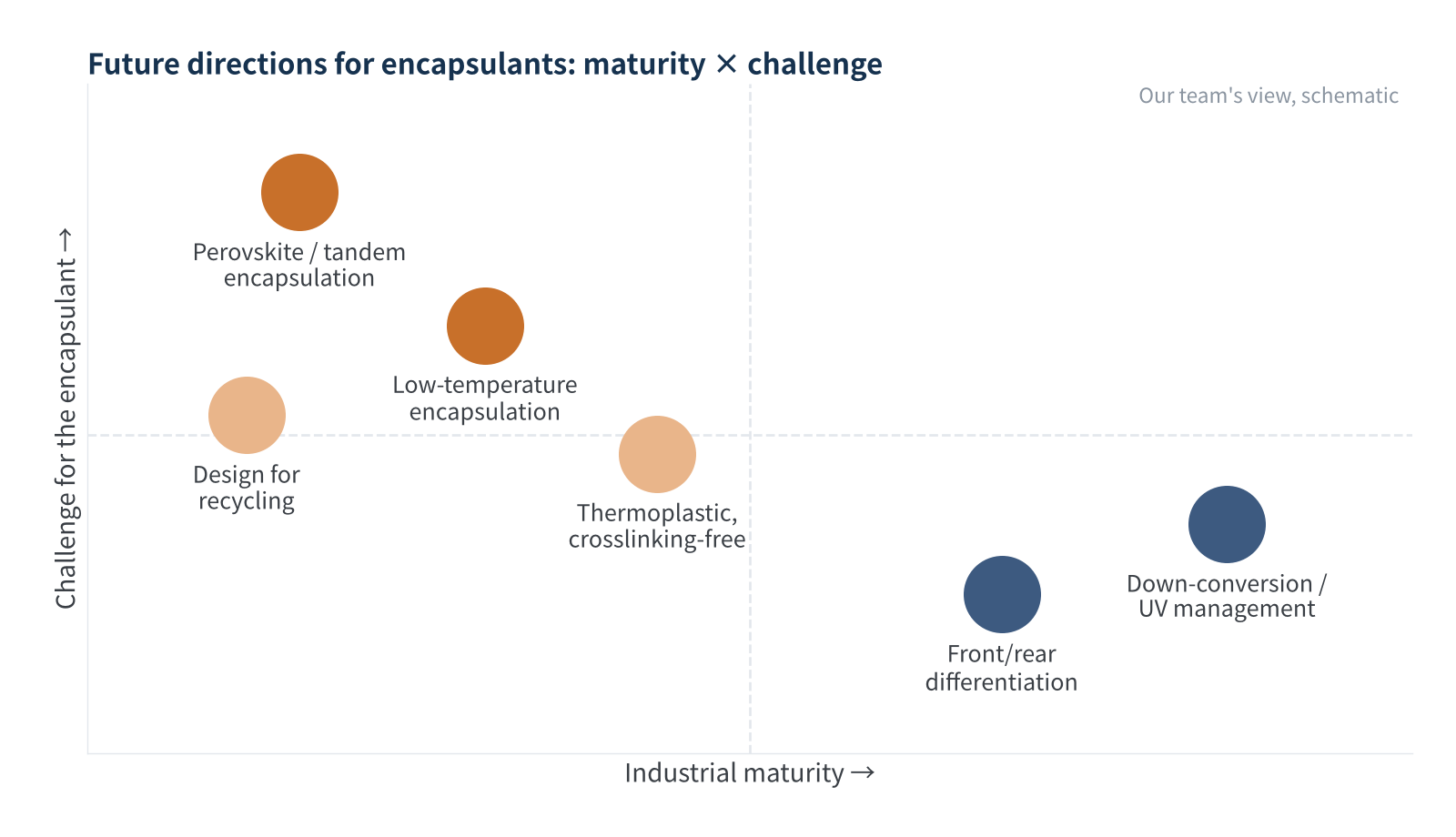
Figure 3 Maturity and challenge of future encapsulant directions (our team's view, schematic)
| Direction | Main driver | Current stage (our view) | Key challenge |
|---|---|---|---|
| Down-conversion / UV management | UV sensitivity of TOPCon | In volume use | Long-term stability validation |
| Front/rear differentiation | BC, cost reduction | Spreading quickly | Reliability of combinations |
| Thermoplastic, crosslinking-free | Perovskite, fast lamination, recycling | Early adoption; products launched in 2026 | High-temperature creep, outdoor data |
| Low-temperature encapsulation | HJT, perovskite | R&D and small batches | Adhesion and reliability at low temperature |
| Perovskite / tandem encapsulation | Industrialisation of new cells | Pilot scale; first certifications | Water barrier, chemical compatibility, edge seal |
| Design for recycling | Recycling regulation, carbon footprint | Research stage | Whole-chain coordination |
Table 1 Maturity of future encapsulant directions (our team's view)
The future of encapsulants is decided half by the cells and half by the module's life cycle: low temperature, crosslinking-free, high barrier and recyclable will be the keywords of the next decade.
08Final thoughts: after thirteen articles
In thirteen articles, we have tried to explain one thin film thoroughly: it does five jobs in the module, is made of resins and additives, is formed in an extruder, crosslinks in a laminator, and is tested in chambers and outdoors; it evolves with cell technology routes, gets reshuffled in price wars, and keeps evolving under the push of new cells, new formats and recycling.
Looking back, one sentence has recurred throughout this series: the encapsulant is a low-cost material in the module, yet the one that "holds everything together". However technology changes, the five jobs — adhesion, transmission, insulation, barrier and cushioning — stay the same; only the way they are done changes.
Thank you for reading all the way here. This concludes our PV encapsulant series; we will continue with more in-depth content on other PV materials, reliability and failure analysis. What would you most like our next series to cover? We would be glad to hear from you.
References
- Witteck R., Habersberger B., Gaulding E.A., Luther J.M., Wheeler L.M.: Encapsulation Materials Tailored to Perovskite Photovoltaics, NREL/TP-5K00-89857, November 2024, https://nrel.gov/docs/fy25osti/89857.pdf
- Grand C., Dunkle M.N., Palitzsch W., Ferreira A., Beaucarne G.: Characterization of mechanically recovered photovoltaic encapsulants and backsheets as potential feedstocks for pyrolysis chemical recycling, EPJ Photovoltaics 17, 6 (2026), https://www.epj-pv.org/10.1051/epjpv/2025030
- China.com: Crown Advanced Material's full-route encapsulation solutions at SNEC 2026 (in Chinese), 10 June 2026, https://m.tech.china.com/hea/articles/20260610/202606101890014.html
- Perovskite-Info: Betterial introduces halogen-free TPO encapsulation film for perovskite modules, 2 August 2026, https://www.perovskite-info.com/betterial-introduces-halogen-free-tpo-encapsulation-film-perovskite-modules
- PV Tech: Qcells secures 'first' UL, IEC certifications for perovskite tandem tech, 17 July 2026, https://www.pv-tech.org/qcells-secures-first-ul-iec-certifications-for-perovskite-tandem-tech/
- pv magazine: Trina Solar announces 907 W tandem solar module with 29.2% efficiency, 1 June 2026, https://www.pv-magazine.com/2026/06/01/trina-solar-announces-907-w-tandem-solar-module-with-29-2-efficiency/
- Kiwa PVEL: UV-Induced Degradation; 2026 PV Module Reliability Scorecard
- TaiyangNews: Projected Market Shares Of Different Solar Cell Technologies (CPIA, ITRPV data)
A PV R&D and technology team with 10+ years of experience | In-depth technical knowledge sharing
Materials · Reliability · Failure Analysis · Standards & Certification · Products · Processes
Exploring AI + PV; collaboration welcome
Disclaimer:
1. Original content reflects the authors' personal views only, is for reference only and does not constitute investment advice.
2. Reposted and cited content is credited to its source, out of respect for original work.
3. Some content was produced with AI assistance (chart generation, data retrieval, concept explanations, etc.); the core framework and key content were written by our technical team and reviewed by people.
4. If anything is inaccurate or infringes your rights, please leave a message or contact us and we will deal with it.