
One Company Holds Half the Market While the Rest Shake Out Through Losses: The PV Encapsulant Industry Landscape
In brief
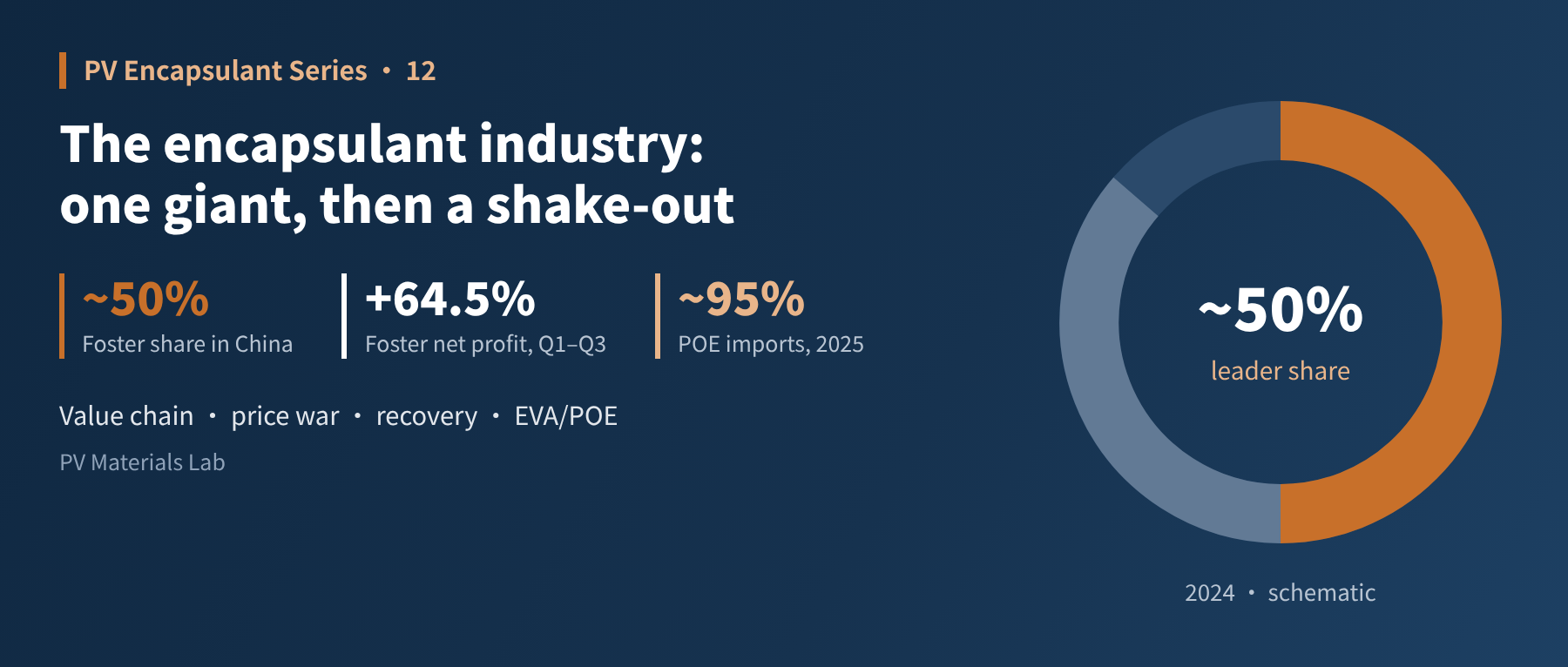
The first eleven articles were about technology; this one is about the industry. In this twelfth article of our PV encapsulant series, we follow the chain from upstream resins to midstream encapsulants to downstream modules and use 2025 annual reports and the latest 2026 periodic reports to answer three questions: how the "one giant, several strong players" structure formed, who is losing money and who is recovering after this round of price war, and what domestic production of EVA and POE resins has changed for the industry.
In the previous eleven articles we covered encapsulant technology: functions, formulation, processing, testing, failures and qualification. This article takes a different angle and looks at the industry behind the encapsulant.
One note first: all figures here come from listed-company disclosures and public industry statistics. We only organise and interpret them, and nothing here is investment advice. Industry data date quickly, so please note the period each figure refers to (data in this article are as of October 2026).
01The value chain: squeezed between two heavyweights
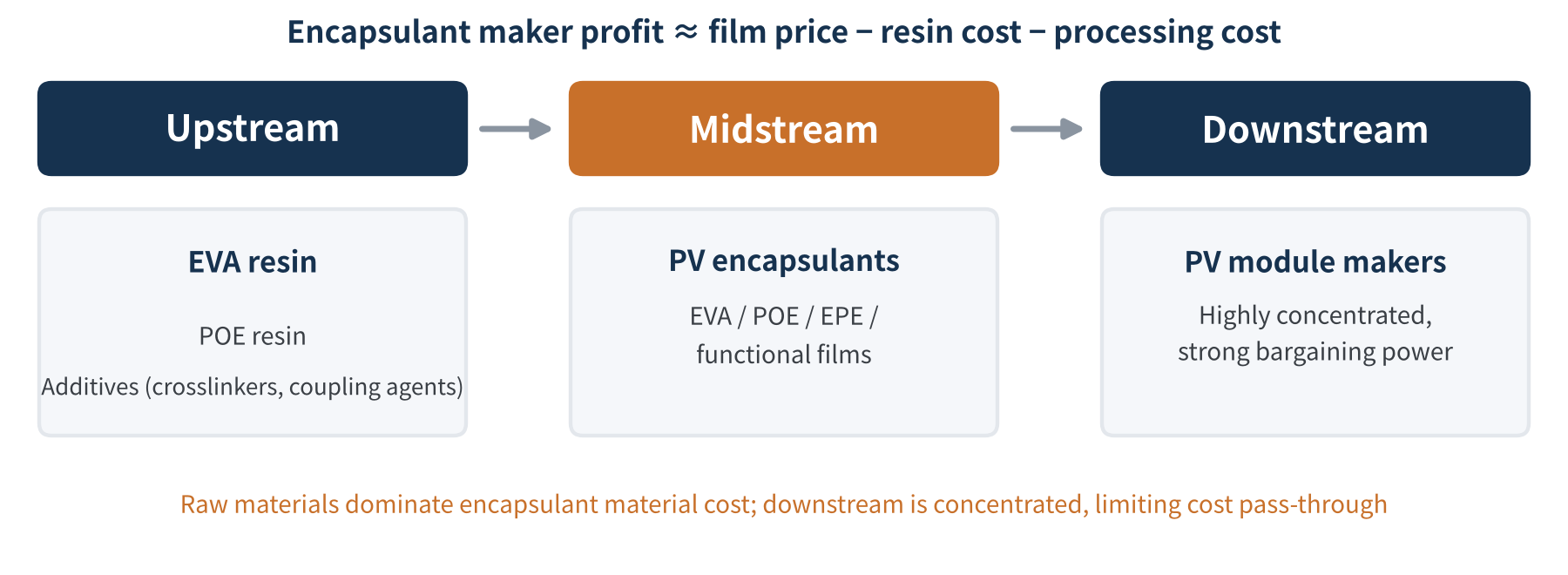
Figure 1 The PV encapsulant value chain (schematic)
Encapsulants sit in the middle of the PV value chain: upstream are EVA and POE resins and various additives, downstream are module makers. This position has two features:
- Upstream raw materials dominate cost: Public sources indicate that EVA resin accounts for more than 80% of the material cost of EVA film. When resin prices move, encapsulant costs move with them.
- Downstream customers are highly concentrated: The module segment is concentrated and has strong bargaining power, so encapsulant makers have limited ability to pass costs on.
An encapsulant maker's profit therefore depends essentially on the spread between resin prices and film prices, and on the cost advantages of scale and yield. This makes the industry naturally favour the leaders.
02Structure: "one giant, several strong players"
China's encapsulant industry is often described as "one giant, several strong players". Public 2024 sales data show Foster at about 2.81 billion m², Sveck about 655 million m² and Betterial about 600 million m², followed by HIUV, Xiangbang, Cybrid, Lushan, Tianyang and Mingguan, among others.
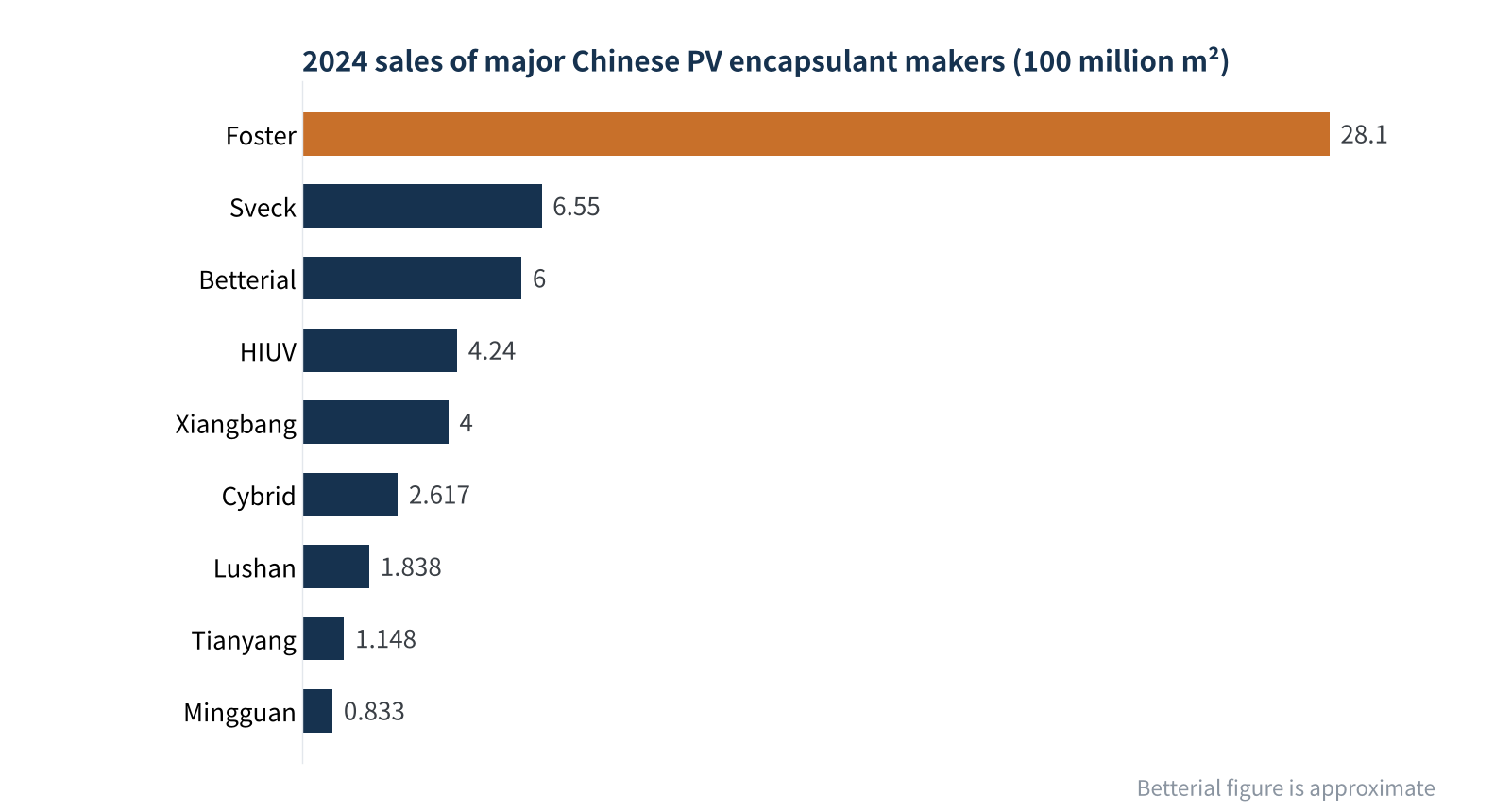
Figure 2 2024 sales of major Chinese PV encapsulant makers (source: compiled by ChinaBaogao)
Against domestic encapsulant demand of about 5.65 billion m² that year, Foster alone accounted for about half, and the top three for about 70%. Foster's 2025 annual report also states that its global market share remains above 50%, more than the second to fourth players combined. The "giant's" position has not weakened in this cycle; if anything, it has become more secure.
032025: more volume, less profit in a price war
2025 was the trough year for encapsulants. With module prices falling and new encapsulant capacity coming online, the industry fell into fierce price competition. Here are the annual reports of two listed companies:
| Indicator (2025) | Foster | HIUV |
|---|---|---|
| Revenue | RMB 15.491 bn, −19.1% YoY | RMB 1.161 bn, −55.2% YoY |
| Net profit attributable to shareholders | RMB 770 m, −41.1% YoY | Loss of RMB 493 m (loss narrowed YoY) |
| PV encapsulant revenue | RMB 13.963 bn, about −20% | About RMB 1.025 bn |
| PV encapsulant sales volume | — | 225 million m², −47.0% YoY |
| Gross margin | PV encapsulants 10.46%, −4.26 pp YoY | Company-wide −3.48%, −2.94 pp YoY |
Table 1 Key 2025 operating data: Foster vs HIUV
The leader's profit halved but it stayed profitable, while second-tier players fell into losses. In its annual report Foster attributed this to overcapacity and a "vicious price war" waged by some companies to win share. HIUV adopted a cautious sales strategy, deliberately cutting volume to control risk; its average encapsulant price was about RMB 4.56/m² ex-tax, down about 23% year on year, and it booked asset impairment losses of about RMB 191 million. Notably, HIUV's gross margin recovered to 4.51% in Q4 2025, up about 11 percentage points quarter on quarter.
In a price war, scale, cost and cash flow decide who survives. A positive versus a negative gross margin means two completely different situations.
042026: recovery after the shake-out
Things changed in 2026. Foster's 2026 interim report shows H1 revenue of RMB 6.988 billion, down 12.2% year on year, but net profit attributable to shareholders of RMB 842 million, up 69.89%, with gross margin at 17.05%, up 4.9 percentage points. PV encapsulant sales were about 1.22 billion m², down about 12%, with revenue of RMB 6.133 billion.
Volume and revenue fell while profit rose sharply. The company's explanation: loss-making firms cut output and some smaller players exited, the competitive landscape improved and encapsulant profitability recovered significantly; together with its own advantages in scale, process and cost, its capacity utilisation was well above the industry average. Broker research also noted a round of encapsulant price increases around March 2026.
The Q3 report released in October adds a new chapter to this recovery. Foster's revenue for Q1–Q3 2026 was RMB 10.638 billion, down 9.76%, and net profit attributable to shareholders was RMB 1.131 billion, up 64.5% — already more than the whole of 2025. However, Q3 net profit of RMB 289 million, although up 50.57% year on year, was clearly below Q2's roughly RMB 530 million; working back from the Q1–Q3 and H1 gross margins, Q3 gross margin was about 15%, below Q2's 20.07%. Media commentary attributes the revenue decline mainly to lower encapsulant prices, with the profit recovery relying more on lower costs and new businesses.
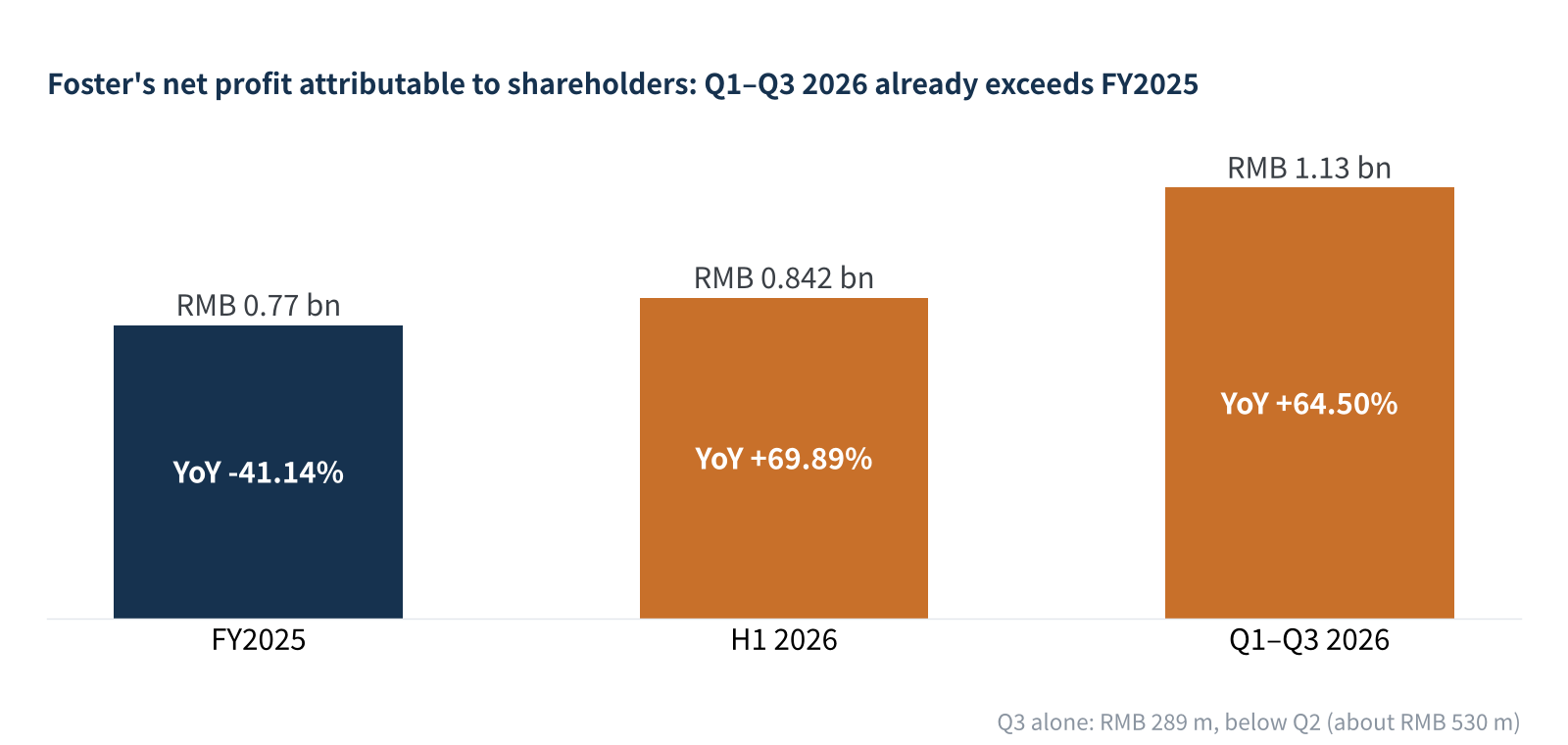
Figure 3 Foster's net profit attributable to shareholders: FY2025, H1 2026 and Q1–Q3 2026 (source: company disclosures)
This is a classic shake-out in a cyclical industry: the price war removes tail capacity, and the leaders' profits recover. But the quarter-on-quarter dip in Q3 is a reminder that recovery is not a straight line — with industry output falling and encapsulant prices fluctuating, whether the recovery lasts still depends on downstream demand.
05Upstream: EVA resin from shortage to surplus
PV-grade EVA was long dependent on imports, and there was a severe shortage in 2021–2022. Domestic EVA capacity has since expanded rapidly: according to ChinaBaogao, China's EVA capacity grew from an average of about 0.97 million tonnes in 2017–2020 to about 2.91 million tonnes in 2024, a compound annual growth rate above 30%. In 2024 domestic EVA output was about 2.38 million tonnes and imports fell 34.22% to 0.9156 million tonnes, implying apparent consumption of about 3.05 million tonnes. PV encapsulant film is the largest downstream use of EVA, accounting for more than 55% in 2023.
For encapsulant makers, EVA supply went from a "chokepoint" to oversupply. Resin prices fell, easing encapsulant cost pressure but also removing support for encapsulant prices — one of the backdrops to the 2025 price war.
06Upstream: domestic POE takes a key step in 2025
As Article 3 explained, POE's barriers are metallocene catalysts and higher α-olefins, and the market was long dominated by Dow, ExxonMobil, Mitsui Chemicals, LG Chem and other overseas companies. According to an expert from the Chemical Industry and Engineering Society of China quoted by China Daily, about 95% of China's POE still came from imports through the first three quarters of 2025.
Domestic units had in fact already started to appear: Hainan Beiouyi's 30,000 t/yr unit started at the end of 2023, and Wanhua Chemical's 200,000 t/yr unit started in June 2024. The highlight of 2025 was CNPC's Dushanzi Petrochemical: its POE project produced nearly 60,000 tonnes in the year, the first industrialisation in China of a domestically developed gas-phase POE process; CNPC expects its total POE capacity to exceed 300,000 t/yr by the end of 2026. Satellite Chemical, Jingbo Petrochemical, Maoming Petrochemical and others are also advancing POE projects.
Domestic POE will affect the encapsulant industry over the long term, through supply security and lower costs. Once the price gap between POE and EVA narrows significantly, the cost logic of EPE replacing POE described in Article 8 may be rewritten.
07Several variables for the future
- Technology routes: As BC, HJT and tandem cells gain share (Article 7), demands on encapsulants become more differentiated, favouring companies with R&D and formulation expertise.
- Resin landscape: The pace and price of domestic POE will shape the mix between POE, EPE and EVA.
- Going overseas and localisation: Overseas module capacity is pulling encapsulant makers into Southeast Asia and elsewhere, while trade-policy uncertainty remains.
- Second growth curves: Leading encapsulant makers are generally expanding into electronic and automotive materials to hedge the PV cycle. Foster's photosensitive dry film sales rose about 22% in H1 2026, and HIUV's automotive smart-glass film is growing quickly.
The encapsulant industry is a cyclical business "squeezed in the middle": upstream resins set costs, downstream modules set prices, and scale and cash flow decide who makes it through the cycle.
08Final thoughts
Technically, the encapsulant is the material that "holds everything together" in a module; industrially, it is a thin-margin, clearly cyclical business. After this round of price war, concentration has risen further, the leaders' profits have begun to recover, and domestic POE is changing the rules of the game upstream.
The next article is the last in this series. We will look at the future of encapsulants: crosslinking-free thermoplastic encapsulants, low-temperature encapsulants, encapsulation for lightweight flexible modules, and the new challenges that perovskite and tandem cells pose for encapsulation.
How do you see the encapsulant industry developing from here? We would be glad to hear from you.
References
- Foster (福斯特): 2025 Annual Report, 2026 Interim Report, 2026 Q3 Report and related coverage
- Gelonghui: Foster (603806) 2026 interim review: encapsulant price rises lift profit, electronic materials ramp up (in Chinese), https://m.gelonghui.com/news/5304934
- Sohu: Foster (603806) 2026 Q3 report brief (in Chinese), https://www.sohu.com/a/1094018058_115377
- OFweek: Net profit RMB 1.13 bn, up 64.5%: encapsulant leader's strong Q1–Q3 recovery (in Chinese), October 2026, https://mp.ofweek.com/solar/a156714078607
- HIUV (海优新材): 2025 Annual Report; Gelonghui: HIUV (688680): 2025 bottom of the PV encapsulant cycle is clear (in Chinese), https://m.gelonghui.com/news/5230251
- ChinaBaogao: Status of China's PV encapsulant industry in 2024 (in Chinese), https://www.chinabaogao.com/market/202508/761732.html
- ChinaBaogao: China EVA market status analysis (in Chinese), https://www.chinabaogao.com/market/202505/751308.html
- China Daily: China achieves industrial-scale production of POE, 27 January 2026, https://www.chinadaily.com.cn/a/202601/27/WS69781559a310d6866eb35e83.html
- Argus: China's Wanhua starts up polyolefin elastomer unit, https://argusmedia.com/en/news-and-insights/latest-market-news/2586975-china-s-wanhua-starts-up-polyolefin-elastomer-unit
- BOC International Securities: Foster — encapsulant price rises benefit the leader, ample room for profit recovery (in Chinese), March 2026
A PV R&D and technology team with 10+ years of experience | In-depth technical knowledge sharing
Materials · Reliability · Failure Analysis · Standards & Certification · Products · Processes
Exploring AI + PV; collaboration welcome
Disclaimer:
1. Original content reflects the authors' personal views only, is for reference only and does not constitute investment advice.
2. Reposted and cited content is credited to its source, out of respect for original work.
3. Some content was produced with AI assistance (chart generation, data retrieval, concept explanations, etc.); the core framework and key content were written by our technical team and reviewed by people.
4. If anything is inaccurate or infringes your rights, please leave a message or contact us and we will deal with it.