
If the Module Already Passed IEC 61730, Why Do Junction Boxes and Backsheets Need Their Own Certification?
01 First, Which Materials Need Separate Certification?
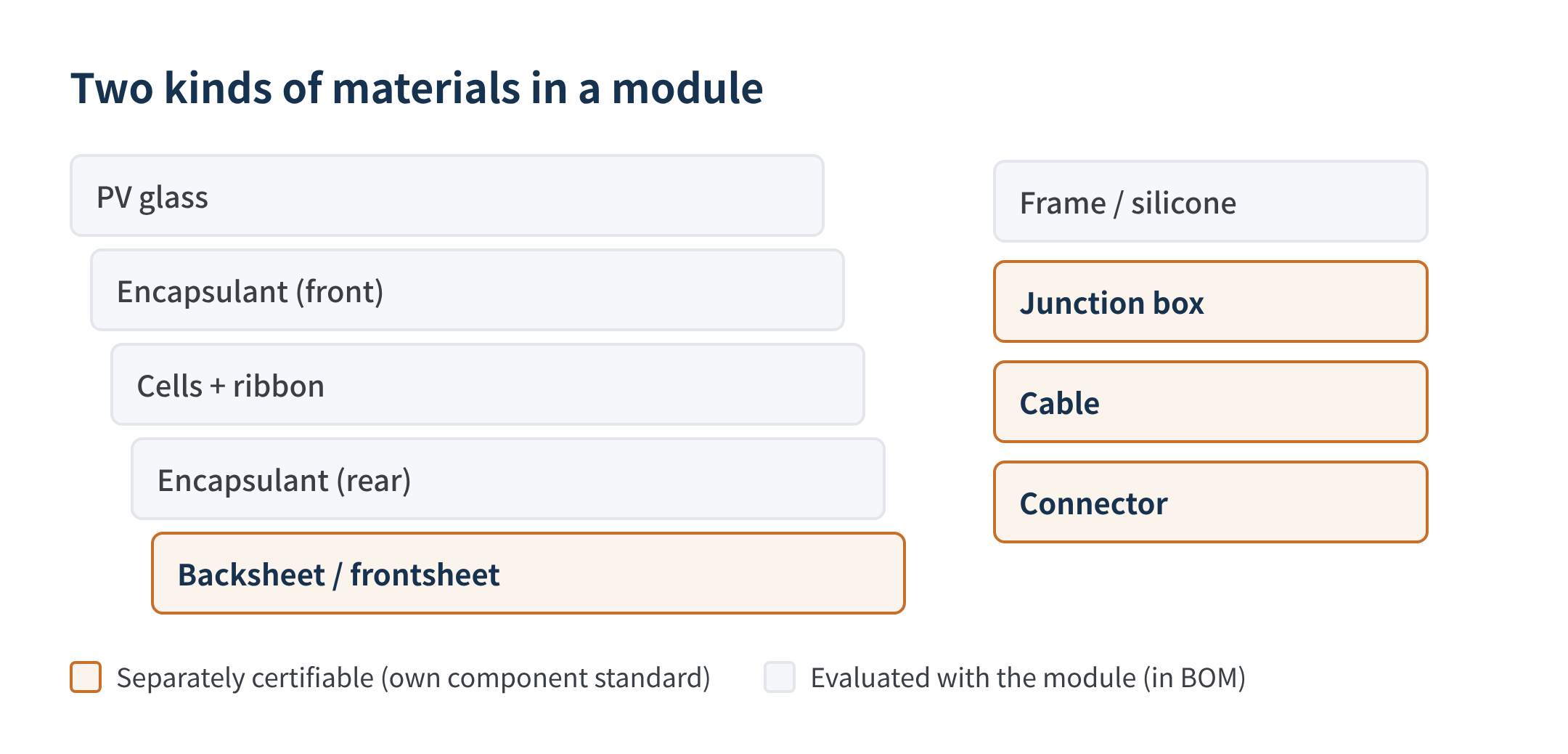
A module is made of a dozen or more materials, but in the context of safety certification they are not treated equally. Roughly, they fall into two groups:
- Components with their own “safety identity”: junction boxes, connectors, PV cables, and backsheets (including frontsheets) used as insulation. Each has a dedicated IEC component standard and can be tested and certified on its own.
- Materials evaluated at module level: glass, encapsulant, ribbon, frame, sealing silicone and so on. They usually do not carry a standalone safety certificate; they are listed in the module bill of materials (BOM) and tested and certified together with the module.
The main standards for the separately certified components are:
| Material | Main IEC component standard | Key safety concerns | Common North American counterpart |
|---|---|---|---|
| Junction box | IEC 62790 | Shock protection, heat resistance, IP rating, diode heating | UL 3730 |
| Connector | IEC 62852 | Contact resistance, mating under voltage, non-intermateability, water ingress | UL 6703 |
| PV cable | IEC 62930 (EN 50618 in Europe) | Insulation, weathering, flame retardancy, thermal endurance | UL 4703 |
| Backsheet / frontsheet | IEC 62788-2-1 | Dielectric strength, partial discharge and post-ageing properties as relied-upon insulation | UL 746 series (RTI, etc.) |
Table 1 Main separately certified materials and their standards
The criterion is not “how important is this material”, but whether it directly performs a shock- or fire-protection function and can be evaluated on its own.
02 Why These? Three Shared Traits
- They perform safety functions directly: Junction boxes, connectors and cables are among the few live parts exposed on the outside of a module; installers wire and mate them by hand. The backsheet is the insulation that keeps internal high voltage away from the rear surface. When they fail, the result is electric shock or fire, not just power loss.
- Their failure modes are specific: Contact-resistance drift and mating wear in connectors, long-term thermal endurance of cables, partial discharge and long-term thermal ageing of backsheets are component-level issues. Module TC, DH and UV sequences are designed for the whole module, with different sample sizes and emphases, and do not cover these details.
- They are standard parts shared across products: One junction box or connector model may go into dozens of module types; one backsheet may be supplied to several module makers. Verifying safety once at component level lets every downstream product reuse the result.
The second point deserves a closer look. Take the Relative Thermal Index (RTI) commonly used for backsheets: it is determined through long-term thermal ageing, which often takes a year or more per material [3][4]. Such tests cannot be rerun for every new module design; they are done once at material or component level and then referenced by module certification.
Separate certification targets components whose safety risk is concentrated, whose failure modes are specific, and which are shared by many products. Verifying them up front is more reliable and more economical than repeating the work in every module.
03 Necessity #1: The Module Standard Itself Calls for It
Separate certification of auxiliary materials is not primarily a supplier marketing need; it follows from how the module safety standard is built. IEC 61730-1 sets construction requirements for modules, but for junction boxes, connectors and cables it does not define a complete test programme of its own. Instead, it requires them to comply with their respective component standards.
Backsheets are the clearest example. In September 2023 new editions of IEC 61730-1 and -2 were published, and a key change was bringing frontsheets and backsheets in at component level, with the component tests moved into IEC 62788-2-1 [5]. IEC 62788-2-1 states plainly that a frontsheet or backsheet must meet its requirements for the module to meet the design requirements of IEC 61730-1 [6].
Components also nest inside each other. The second edition of IEC 62790 (2020) changed its cable reference from EN 50618 to IEC 62930 and added a requirement to provide RTE/RTI or TI information for materials [1]. In other words: the cable certificate supports the junction box certificate, which in turn supports the module certificate.
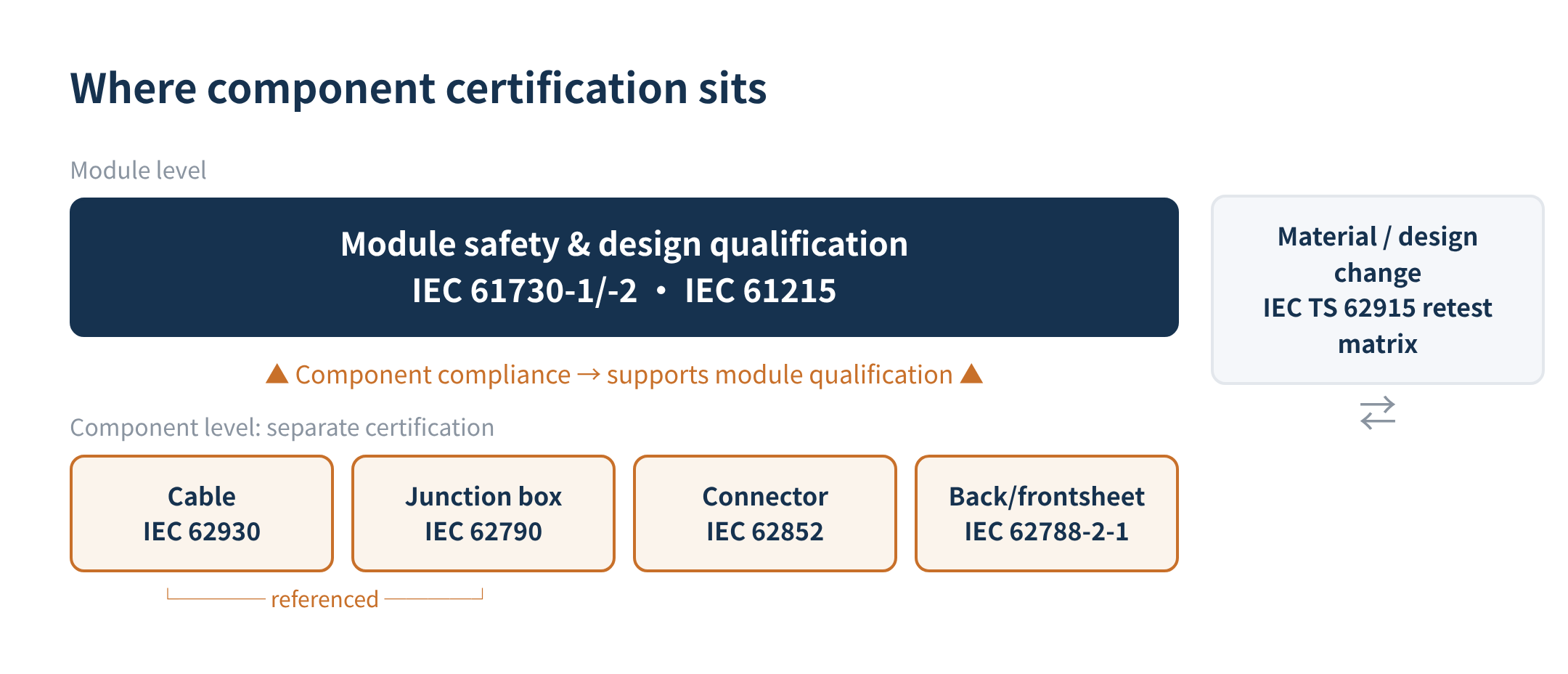
A component certificate is a prerequisite for module certification, not a substitute. IEC 62788-2-1 likewise makes clear that component-level compliance does not replace safety qualification of the complete module [6].
04 Necessity #2: Material Changes, Multiple Suppliers and Cost
For module makers, the more practical value of separate certification shows up in material changes. Cost-reduction work brings a new junction box, backsheet or cable spec almost every quarter. The question is: after swapping a material, is the module certificate still valid, and which tests must be repeated?
That question is answered by IEC TS 62915, the module retesting guideline. Its second edition, published in 2023, provides a matrix of retest requirements covering material and design changes, and adds references to the IEC 62788-1 and 62788-2 component standards specifically to handle changes to critical sub-components [7][8].
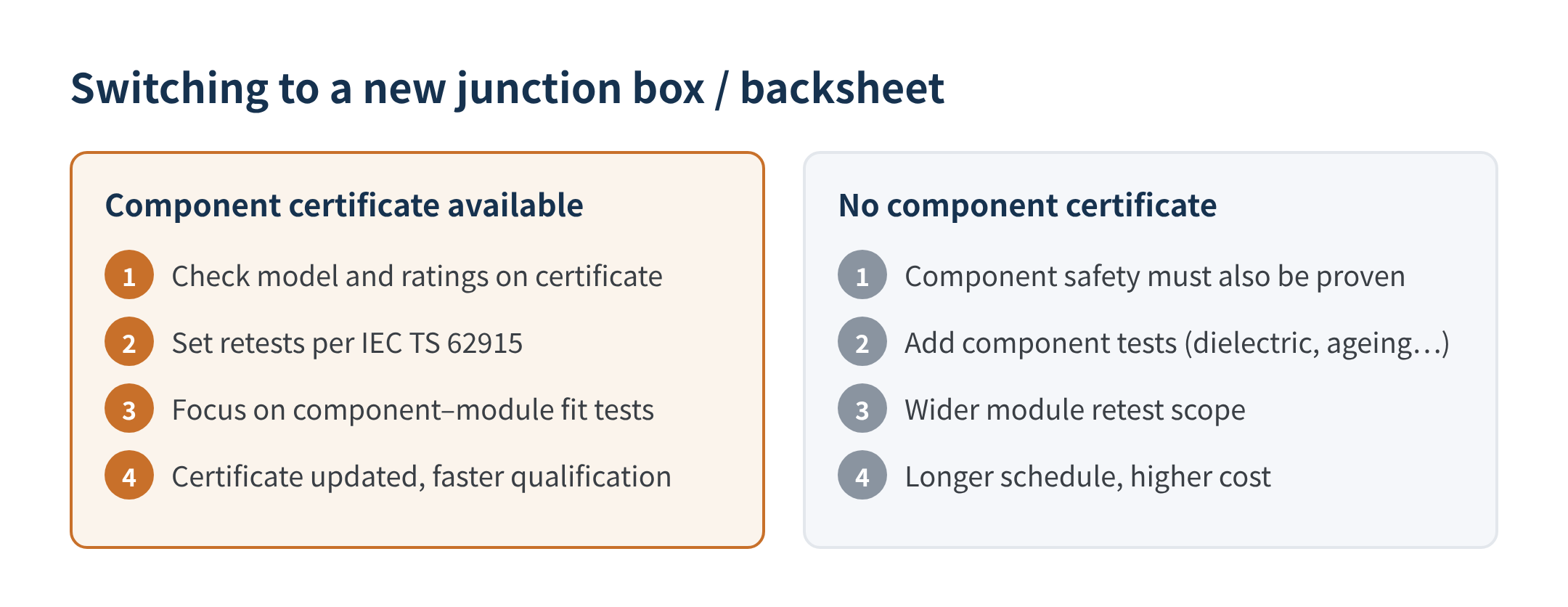
In practice, if the replacement junction box or backsheet already holds the corresponding component certificate and its ratings cover the module design, retesting can usually focus on how the component interacts with the module, such as adhesion, wet leakage current, hot spot and diode temperature rise. Without a component certificate, the safety of the component itself must also be proven inside the module project, which noticeably lengthens schedule and raises cost. The guideline itself also notes that engineering judgement is still needed to set the exact scope [7].
The benefits can be summarised in four points:
- Faster qualification: With the component already certified, the module only needs to verify the fit, greatly shortening material-change cycles.
- Easier alternate BOMs: Several certified suppliers can be qualified for the same position, reducing supply risk and improving purchasing leverage.
- Clearer responsibility and traceability: Certificates are tied to specific models and ratings, so issues can be traced quickly to component level.
- Smoother market access: North America has a mature component recognition system, for example the QIHE2 category commonly used for PV polymeric materials, so module makers can pick already-recognised components [2][9].
05 Three Common Misconceptions
- Misconception 1: if every component is certified, the module is safe: A component certificate only proves the component itself. How it works with the module, such as adhesion, heat dissipation and sealing, must still be verified in module certification.
- Misconception 2: a certificate is enough, no need to check ratings: Rated voltage, current, temperature range and compatible cable sizes on the certificate must each be checked against the module design. Connectors especially: IEC 62852 requires designs that prevent incorrect mating, and cross-mating between brands is one of the most common field failures [10]. A certificate is only valid for the same-model pair.
- Misconception 3: materials without their own certificate don’t matter: Glass, encapsulant and ribbon usually have no standalone safety certificate, but they are listed in the module BOM, so changes must still be assessed for retesting under IEC TS 62915; encapsulants also have measurement methods in the IEC 62788-1 series.
Final Thoughts
Back to the opening question: if the module already passed IEC 61730, why do auxiliary materials still need separate certification?
The answer is simple: verify, once and up front at component level, the parts where safety risk is most concentrated and that are shared by the most products. Module certification then has a solid basis, retesting after material changes has clear rules, and the supply chain becomes more flexible.
In upcoming articles of the Standards & Certification column, we will break down the key test items in the junction box, connector and backsheet standards. Stay tuned.
References
- IEC 62790:2020 Junction boxes for photovoltaic modules – Safety requirements and tests (Ed.2)
- UL Solutions. Solar materials and components certification (UL 746B/746C, UL 3730, UL 6703, UL 4703)
- UL. PV Standards and Long Term Thermal Aging (LTTA) Overview, 2015 (NIST workshop)
- pv magazine / EnergyTrend. Reports on BioSolar backsheet UL RTI recognition (long-term thermal ageing duration)
- TÜV Rheinland. Solar safety qualification – IEC 62788 client information
- IEC 62788-2-1:2023 Measurement procedures for materials used in PV modules – Part 2-1: Frontsheet and backsheet – Safety requirements
- IEC TS 62915:2023 PV modules – Type approval, design and safety qualification – Retesting (Ed.2)
- IEC 61730-1:2023 PV module safety qualification – Part 1: Requirements for construction
- Dunmore. PV Backsheets (UL QIHE2 PV polymeric materials component recognition)
- IEC 62852:2014+AMD1:2020; SecondSol. Connectors in Photovoltaic Systems – Hazards and Risks
Disclaimer: 1. Original content reflects the authors' personal views, is for reference only, and does not constitute investment advice. 2. Reproduced and cited content is attributed to its sources, with respect for original work. 3. Some content was AI-assisted (chart generation, data retrieval, concept explanations, etc.); the core framework and key content were written by our technical team and reviewed by humans. 4. If anything is inaccurate or infringing, please leave a comment or contact us.