
Junction Box Series 8 | What Does a Certificate Really Prove? Junction Box Standards, Certification Bodies and Certificates
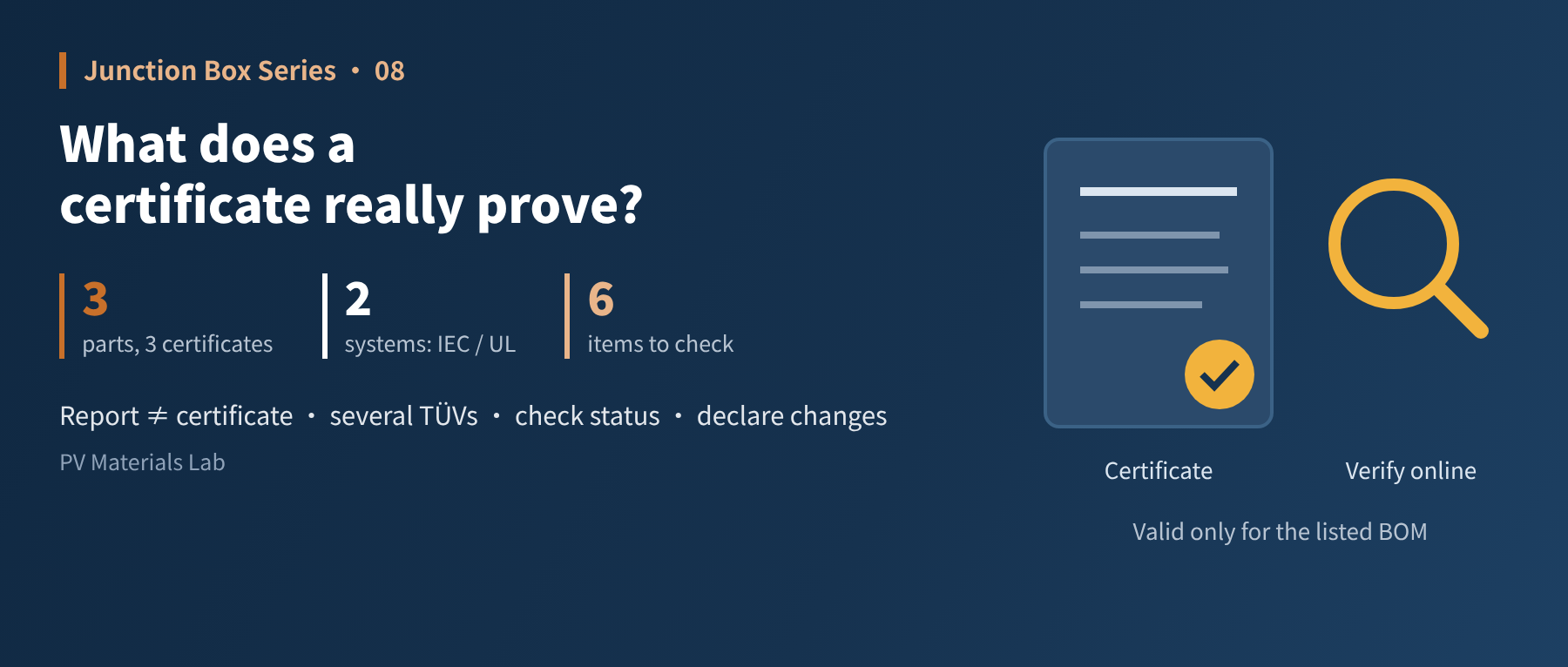
In brief
What IEC and UL each cover, whether TÜV is one organisation, and which items to check on a certificate — junction box certification explained in one place. This is the eighth article in our junction box series (Standards and Reliability: Certification).
Across the first seven articles, terms such as IEC 62790, IEC 62852 and "certificate" came up dozens of times. The last article covered what is tested and how. This one goes a level higher: who does the testing, who issues the certificate, and what the certificate actually proves.
Certification is a hard gate for procurement and market access, and it is also one of the most frequently misread things in the supply chain. Is "a TÜV report" the same as "a TÜV certificate"? Is TÜV a single organisation? If a certificate is still valid, does that mean the product is fine?
This article sorts these questions out: which standards apply, which bodies are involved, and how to read a certificate.
01Four terms to tell apart
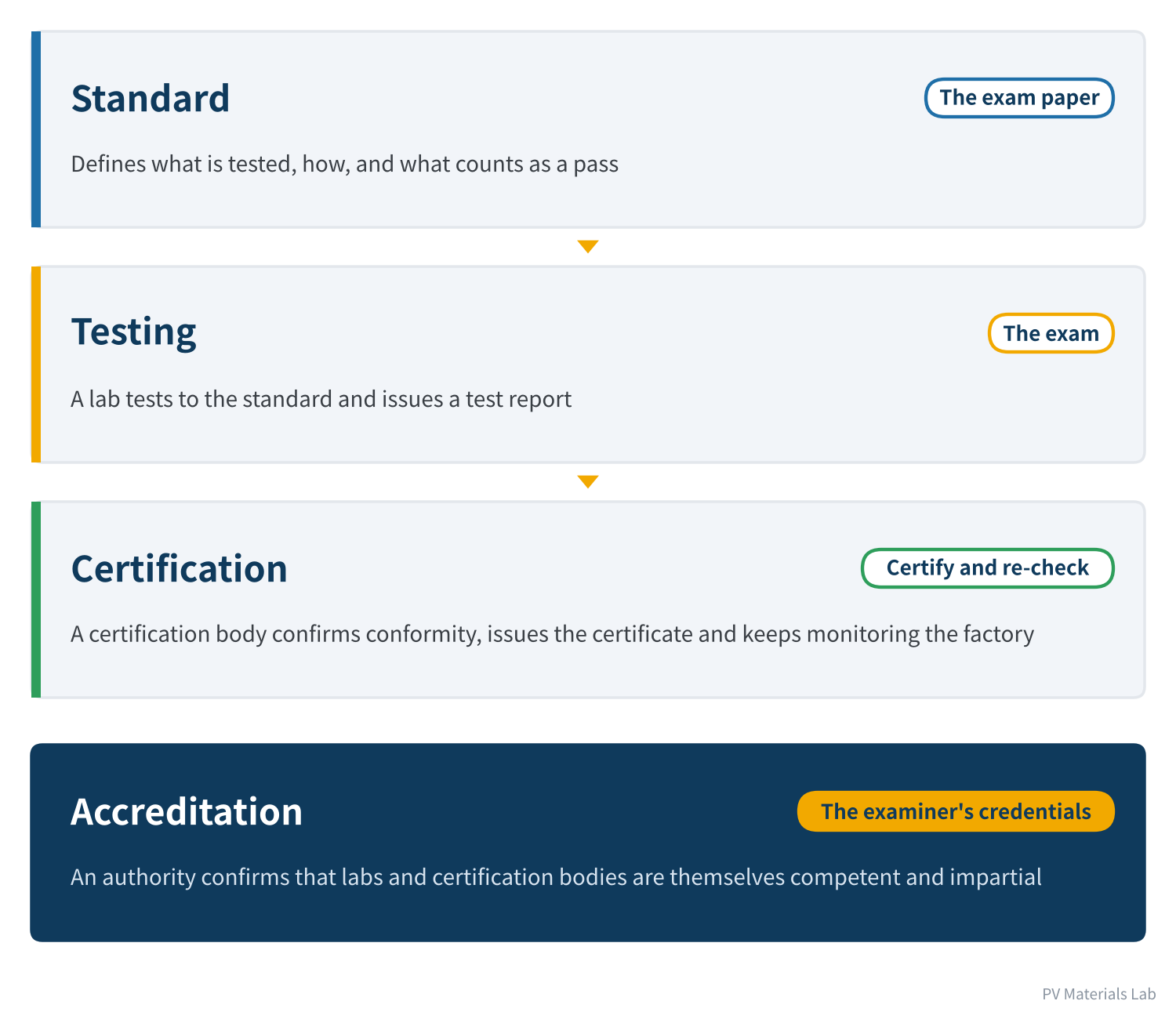
Figure 1 Standard, testing, certification and accreditation: how the four relate
- Standard: the exam paper. It defines what is tested, how, and what counts as a pass.
- Testing: the exam. A laboratory tests to the standard, and the result is a test report.
- Certification: certifying and re-checking. A certification body reviews the report, inspects the factory, issues a certificate when everything conforms, and keeps monitoring afterwards.
- Accreditation: managing the examiners' credentials. An authority (such as CNAS in China or DAkkS in Germany) confirms that laboratories and certification bodies are themselves competent and impartial.
A test report only says that "these samples, as submitted, passed in this test". A certificate adds two more things: the factory has been inspected and can consistently produce the same product, and the product remains under surveillance while the certificate is valid. A product with a report but no certificate lacks exactly these two safeguards.
02The standards map: three components, two systems
A junction box system consists of three components — the junction box, the connector and the cable — and each has its own standard. Depending on the market, these fall into two systems: IEC and North American UL.
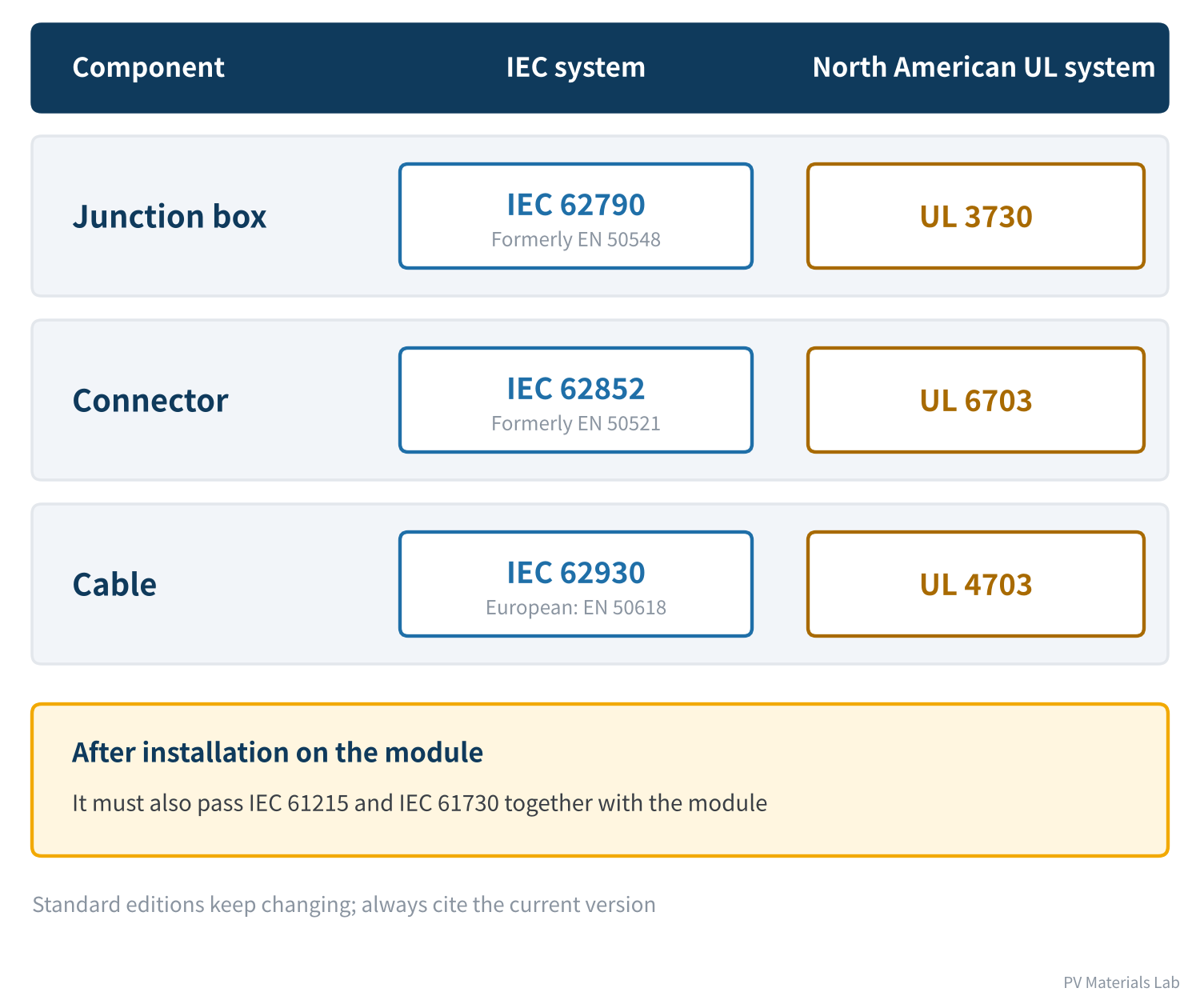
Figure 2 Standards map of the junction box system
Three points stand out:
- Three components, three certificates: the junction box, connector and cable are certified separately. A finished junction box with cable and connectors usually corresponds to three certifications.
- IEC and UL are not interchangeable: to enter North America, a product must be certified separately under the UL system. An IEC certificate cannot be used directly.
- Component certification is only the first gate: once mounted on a module, the junction box must also pass IEC 61215 and IEC 61730 together with the module. That is the topic of the next article.
Where these standards came from
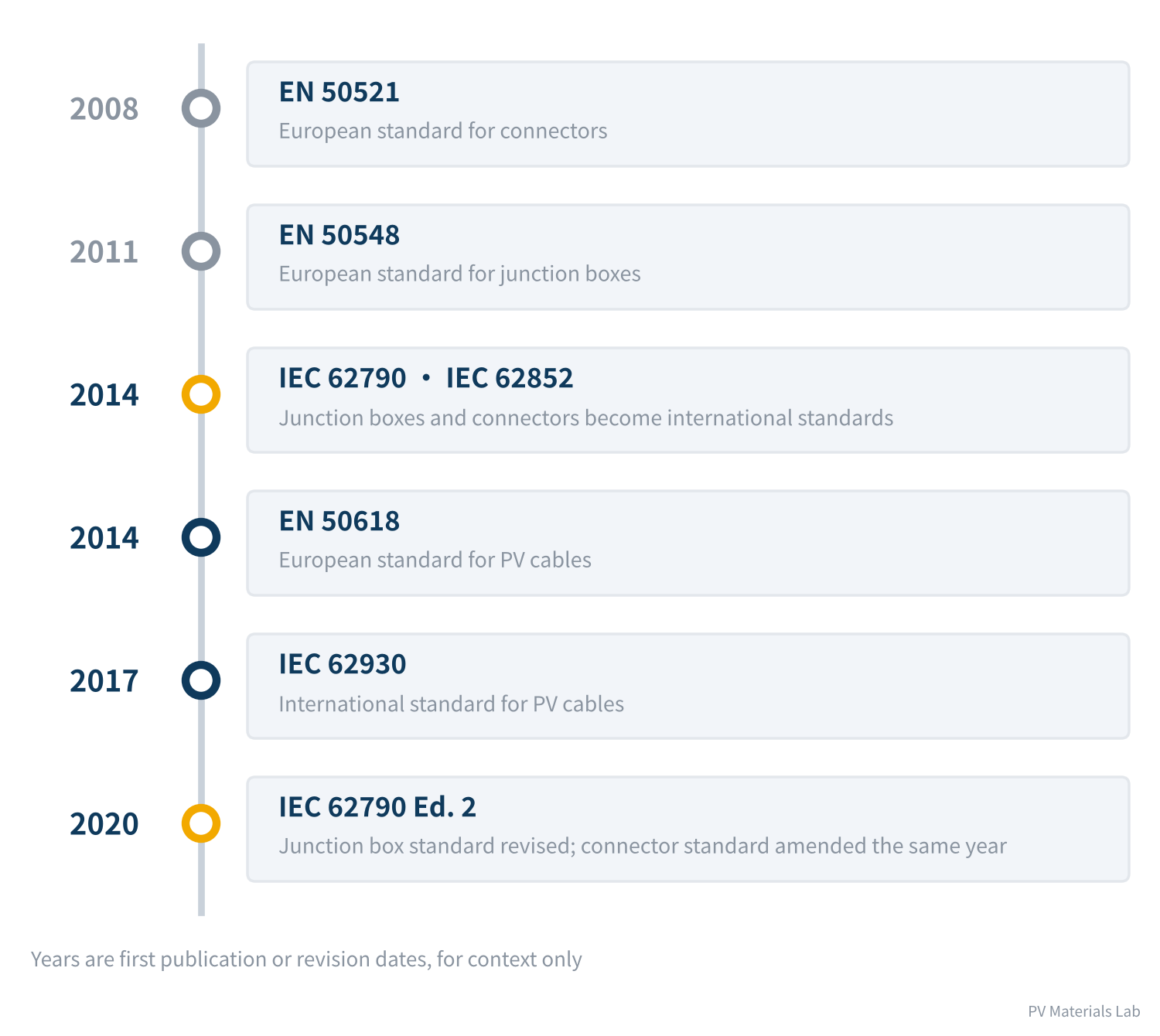
Figure 3 From European to international standards
Standards for PV components followed a "Europe first, then international" path. Early PV markets were concentrated in Europe, so junction boxes and connectors first had European standards, EN 50548 and EN 50521. As the industry globalised, these were raised to international standards, IEC 62790 and IEC 62852 (both first published in 2014), which replaced the European ones. The current editions are IEC 62790:2020 (Ed. 2) and IEC 62852:2014+AMD1:2020.
Cables followed the same path. Earlier, the industry relied on certification bodies' own specifications (such as TÜV Rheinland's 2 PfG 1169), and cables of that generation were designated PV1-F. After the European standard EN 50618 was published in 2014, the designation became today's familiar H1Z2Z2-K. IEC 62930, published in 2017, is the corresponding international standard.
So when reading a certificate, which standard and which edition it refers to matters. A certificate issued against an early standard and one issued against the current edition do not assess the same things.
In North America, UL 3730 is still the first edition from 2014, but a revision dated 10 July 2024 rewrote its corrosive-atmosphere requirements (salt spray and CO₂/SO₂ testing, referring to UL 2703), effective 10 July 2026. Boxes made of plastic, stainless steel or aluminium are exempt. According to Intertek's public notice, reports not updated to the new requirements by that date are withdrawn. If you rely on UL 3730-certified products, it is worth confirming with the supplier that the update has been completed.
03IEC vs UL: where they differ
| Item | IEC system | North American UL system |
|---|---|---|
| Main markets | Europe, China and most global markets | United States, Canada |
| Junction box standard | IEC 62790 | UL 3730 |
| Material evaluation | Focus on testing the finished product | Plastics have their own separate recognition files |
| Form of component certification | Component certificate | Mostly "Recognized Components", with conditions of use assessed in the end product |
| Factory surveillance | Typically annual factory inspection | Follow-Up Services: regularly scheduled visits with sample re-testing; frequency depends on product category |
Table 1 Main differences between the IEC system and the North American UL system
The most notable difference between the two systems is how they treat materials.
In the UL system, each plastic has its own recognition file recording its flammability rating, relative thermal index (RTI), suitability for outdoor use and other data. The housing material a junction box maker chooses must be found in that file and meet the requirements. The IEC system relies more on testing the finished junction box and letting its performance speak.
The practical consequence: a junction box that needs both IEC and UL certification has a narrower choice of materials than one certified under only one system.
04Certification bodies: some common misconceptions
TÜV is not one organisation
TÜV is an abbreviation of the German for "Technical Inspection Association". TÜV Rheinland, TÜV SÜD and TÜV NORD, the names commonly seen in the market, are independent companies, each issuing its own certificates under its own mark. When someone says a product "has TÜV certification", they should say which one.
Bodies' own specifications
Besides international standards, some certification bodies publish their own technical specifications. These usually appear in two situations: no international standard exists yet, so the body writes one first (the PV1-F cable specification mentioned above is an example); or existing standards do not cover a particular requirement. Ammonia resistance testing for livestock farm environments, for instance, started with body specifications and now has an international standard, IEC 62716. Certificates issued against a body's own specification need to be judged case by case for scope and recognition.
Common certification bodies
| Body | Based in | Notes |
|---|---|---|
| TÜV Rheinland, TÜV SÜD, TÜV NORD | Germany | Independent of one another; all widely active in PV |
| UL | United States | The main certification body for North America |
| CQC | China | China Quality Certification Centre; voluntary certification of PV products |
| CGC | China | China General Certification Center; focused on renewable energy |
| Others | Various | e.g. VDE, CSA, Intertek, DEKRA |
Table 2 Common certification bodies for PV junction boxes
Which body to choose depends mainly on the target market and what customers recognise. Export products usually rely on certificates from international bodies, while domestic projects in China often require certification from Chinese bodies.
The CB Scheme: test once, certify in many countries
To reduce repeat testing, there is an international mutual recognition mechanism: the IECEE CB Scheme. Once a product has been tested by a member body and has obtained a CB test certificate and report, these can be used to apply for local certificates from bodies in other member countries, usually with only the national-difference tests added. It is a common route into multiple markets.
05The certification process: how a certificate is earned
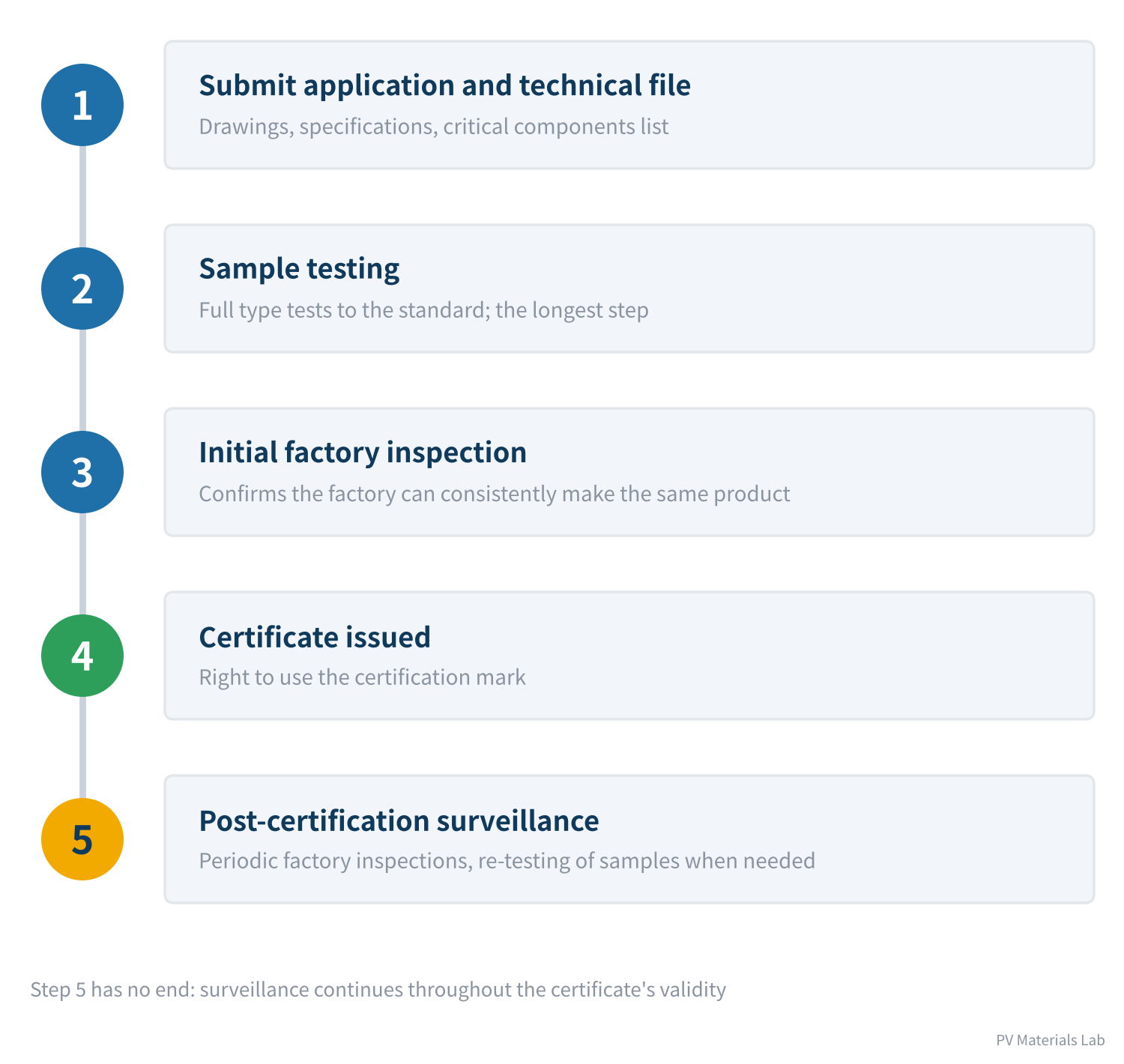
Figure 4 How a certificate is earned
Three of the five steps deserve a closer look:
- The critical components list is fixed in step one: the application includes a list of critical components — housing material grade, diode type, potting compound, cable, connector and so on. Test samples must be built to this list, and the certificate is issued for this list.
- Testing takes the longest: within type testing, 1000 hours of damp heat alone runs for about 42 days. Add the other test sequences and queuing time, and the whole cycle is usually measured in months.
- The certificate is not the finish line: post-certification surveillance is the fundamental difference between certification and one-off testing. If surveillance finds the product differs from what was certified, the certificate can be suspended or even withdrawn.
The damp heat test lasts 1000 hours: 1000 ÷ 24 ≈ 42 days.
That is just the net running time of one test. Certification time must be built into the development plan early; sending samples just before production starts is too late.
06Reading a certificate: check these six items
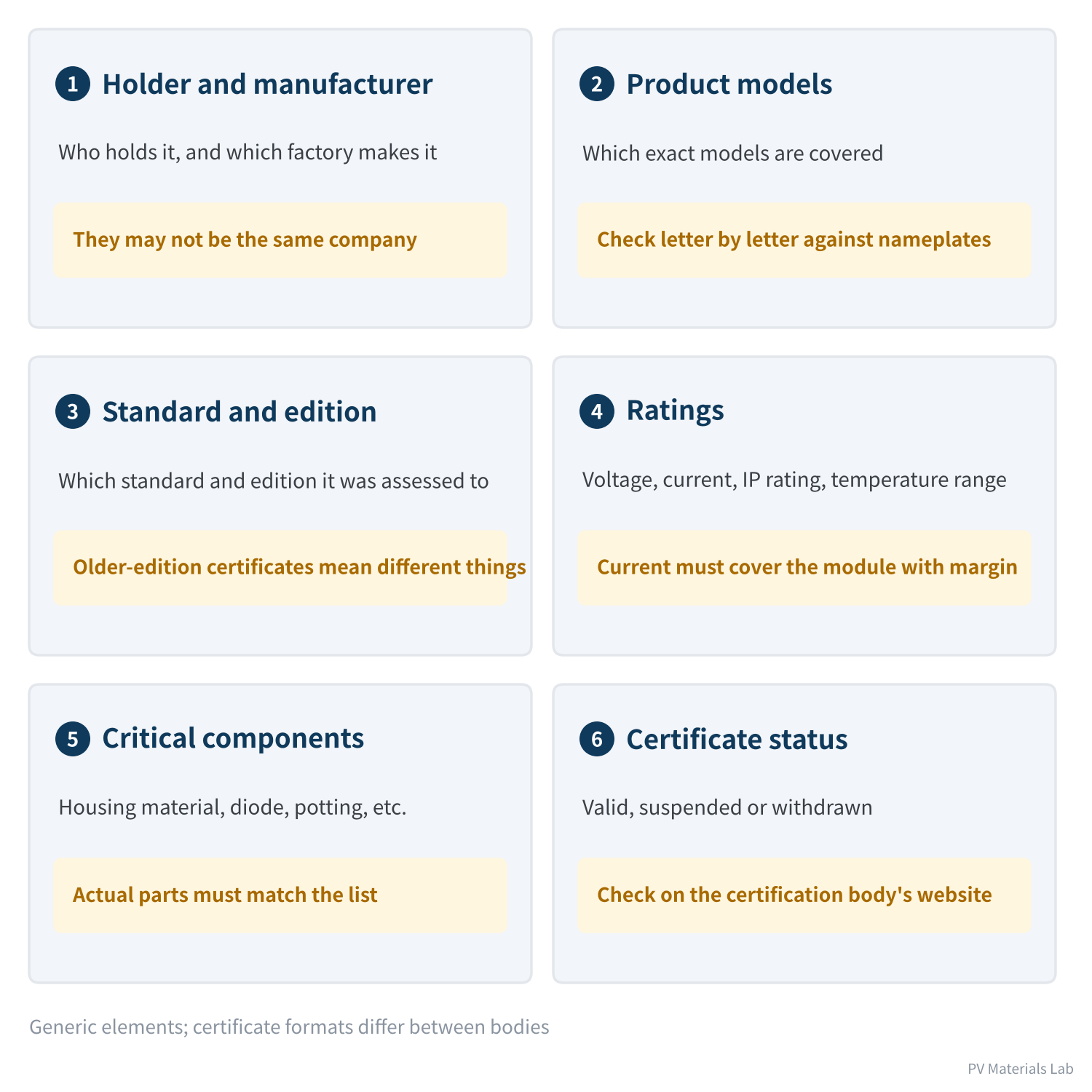
Figure 5 Six items to check on a certificate
As a buyer or a module maker's engineer, you can check a supplier's certificate against these six items one by one. Three of them cause the most problems:
- Model mismatch: the certificate lists model A, but what arrives is a similar-looking model B, or an "improved" model A. Model numbers must be checked character by character.
- Insufficient current rating: the rated current on the certificate was certified under specific conditions. Make sure it covers the short-circuit current of the module with margin; for bifacial modules, include the rear-side gain.
- Components not matching the list: this is the hardest to spot. The certificate is genuine and the model is right, but the diode or housing material inside has been changed. Only incoming inspection and factory audits will catch it.
These problems get amplified at module level. Kiwa PVEL's 2026 PV Module Reliability Scorecard reports that 21% of participating manufacturers had junction box-related failures, including 9% with junction box wet-leakage safety failures and 4% with lids coming off. The junction boxes used in tested modules have usually already been certified at component level.
A certificate can be suspended or withdrawn because of failed surveillance, unpaid fees or voluntary withdrawal by the company, and the PDF in the supplier's hands does not update itself. The major certification bodies all offer online certificate lookup: enter the certificate number to confirm its current status. It takes only a few minutes.
07Change management: the promise behind the certificate
At its core, a certificate is a promise from the factory to the certification body: what we produce from now on will be the same as the samples you tested.
So any change that could affect product safety or performance must be declared to the certification body before it is implemented, and the body decides whether additional testing is needed:
| Type of change | Example | Usual handling |
|---|---|---|
| Critical material | Housing plastic changes grade or supplier | Declare; most need additional testing |
| Critical component | Diode changes type or manufacturer | Declare; thermal performance must be verified |
| Design | Changes to dimensions, terminals or sealing | Declare; retest according to impact |
| Production site | New or relocated factory | Declare; factory inspection needed |
Table 3 Common junction box changes and how they are usually handled
Undeclared changes are among the most serious violations in any certification system. The "change management" check we described in the factory audit in article 5 looks for exactly this.
The impact of a change also passes downstream: if the junction box changes, the certification of modules using it may need re-evaluation. Which module tests to repeat is covered by a dedicated guideline, IEC TS 62915:2023 (retesting for type approval of PV modules). We will look at this in the next article.
08Final thoughts
The most common misreadings of certification come down to five misconceptions:
- "Having a report means being certified": a report covers only the samples; a certificate also includes factory inspection and ongoing surveillance.
- "TÜV is one organisation": Rheinland, SÜD and NORD are independent, with different certificates and marks.
- "An IEC certificate lets you sell in North America": North America requires certification under the UL system.
- "A certified junction box is fine once mounted on a module": after component certification comes assessment together with the module.
- "A valid certificate means the product conforms": a certificate covers a specific combination of materials and design; once the materials change, the certificate no longer describes the product.
1. The standard is the exam paper, testing is the exam, certification is certifying and re-checking, and accreditation oversees the examiners.
2. The junction box, connector and cable are certified separately; the IEC and UL systems are not interchangeable.
3. The core of the certification process is the critical components list and post-certification surveillance.
4. Check six items on a certificate: holder and factory, model, standard edition, ratings, critical components and certificate status.
5. A certificate is a promise of ongoing consistency, and change management is its lifeline.
In the next article, Junction Box Series 9 looks at the junction box's role in module certification: how standalone certification differs from certification with the module, and which tests must be repeated when the junction box changes.
Have you come across cases where the certificate was right but the actual product was not? We would be glad to hear from you.
References
- IEC 62790:2020 Junction boxes for photovoltaic modules – Safety requirements and tests
- IEC 62852:2014+AMD1:2020 Connectors for DC-application in photovoltaic systems – Safety requirements and tests
- IEC 62930:2017 Electric cables for photovoltaic systems; EN 50618:2014 Electric cables for photovoltaic systems
- UL 3730 Photovoltaic Junction Boxes; UL 6703 Connectors for Use in Photovoltaic Systems; UL 4703 Photovoltaic Wire
- IEC 61215 and IEC 61730 Terrestrial PV modules – Design qualification and type approval; PV module safety qualification
- IEC 62716:2013 Photovoltaic (PV) modules – Ammonia corrosion testing
- IEC TS 62915:2023 Photovoltaic (PV) modules – Type approval, design and safety qualification – Retesting
- Intertek: UL 3730 revision dated 10 July 2024, effective 10 July 2026, https://w3inte.intertek-france.com/siteassets/resources/sun/2024/ul-3730-sun-rev-7-10-2024-ed-7-10-2026.pdf
- UL Solutions: Getting Started with UL Follow-Up Services, https://www.ul.com/news/getting-started-ul-follow-services
- Kiwa PVEL: 2026 PV Module Reliability Scorecard – Failures, https://2026scorecardsbx.pvel.com/failure
A PV R&D and technology team with 10+ years of experience | In-depth technical knowledge sharing
Materials · Reliability · Failure Analysis · Standards & Certification · Products · Processes
Exploring AI + PV; collaboration welcome
Disclaimer:
1. Original content reflects the authors' personal views only, is for reference only and does not constitute investment advice.
2. Reposted and cited content is credited to its source, out of respect for original work.
3. Some content was produced with AI assistance (chart generation, data retrieval, concept explanations, etc.); the core framework and key content were written by our technical team and reviewed by people.
4. If anything is inaccurate or infringes your rights, please leave a message or contact us and we will deal with it.