
Junction Box Series 12 | The Junction Box Industry in Three Sets of Financial Reports: Revenue Held Up, So Where Did the Profit Go?
In brief
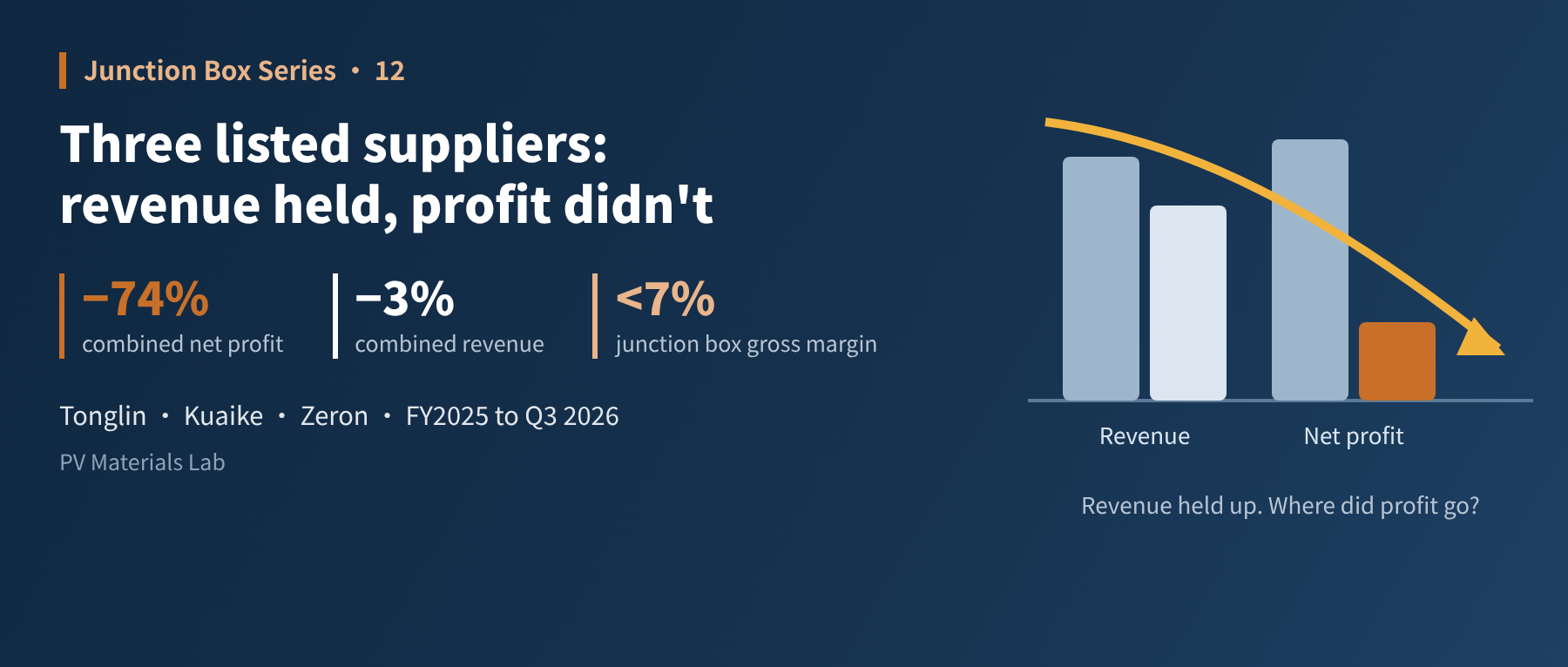
Putting the 2025 annual reports and 2026 interim and third-quarter reports of three listed suppliers — Tonglin, Kuaike and Zeron — side by side: combined 2025 net profit fell by more than 70%, and junction box gross margins dropped below 7%. This is the twelfth article in our junction box series (Market and Trends: business performance and shipments of Chinese suppliers).
The first eleven articles were all about technology. With this one we enter the final part, "Market and Trends", from a different angle: how are the companies that make junction boxes actually doing?
Three companies listed on China's A-share market have junction boxes as their main business: Tonglin (Jiangsu Tonglin Electric, 301168), Kuaike (Suzhou Kuaike PV Electronics, 301278) and Zeron (Jiangsu Zeron New Energy, 301636). Their annual and quarterly reports are the most reliable public window onto the industry.
This article lays out their 2025 annual reports and 2026 interim and third-quarter reports side by side and looks only at the numbers: what happened to revenue, profit, shipments and gross margin.
All data in this article come from the listed companies' published periodic reports and related coverage, up to the 2026 third-quarter reports (which are unaudited). The article is an industry observation only and is not investment advice. Unlisted companies have no reliable public data, so we make no rankings or market share estimates.
01The conclusion first: three numbers
- Combined net profit fell by more than 70%: the three companies' 2025 net profit attributable to shareholders totalled about RMB 79 million, against about RMB 302 million a year earlier, a drop of about 74%.
- Revenue fell only about 3%: combined revenue was about RMB 3.26 billion, against about RMB 3.37 billion a year earlier.
- Junction box gross margins fell below 7%: 6.85% for Tonglin's diode junction boxes and 6.79% for Kuaike's junction boxes.
Revenue largely held up; profit did not. That is the story all three annual reports tell. In the first three quarters of 2026, combined revenue fell by a further 16% or so, and combined net profit by about 56%.
02Revenue: one down, one up, one flat
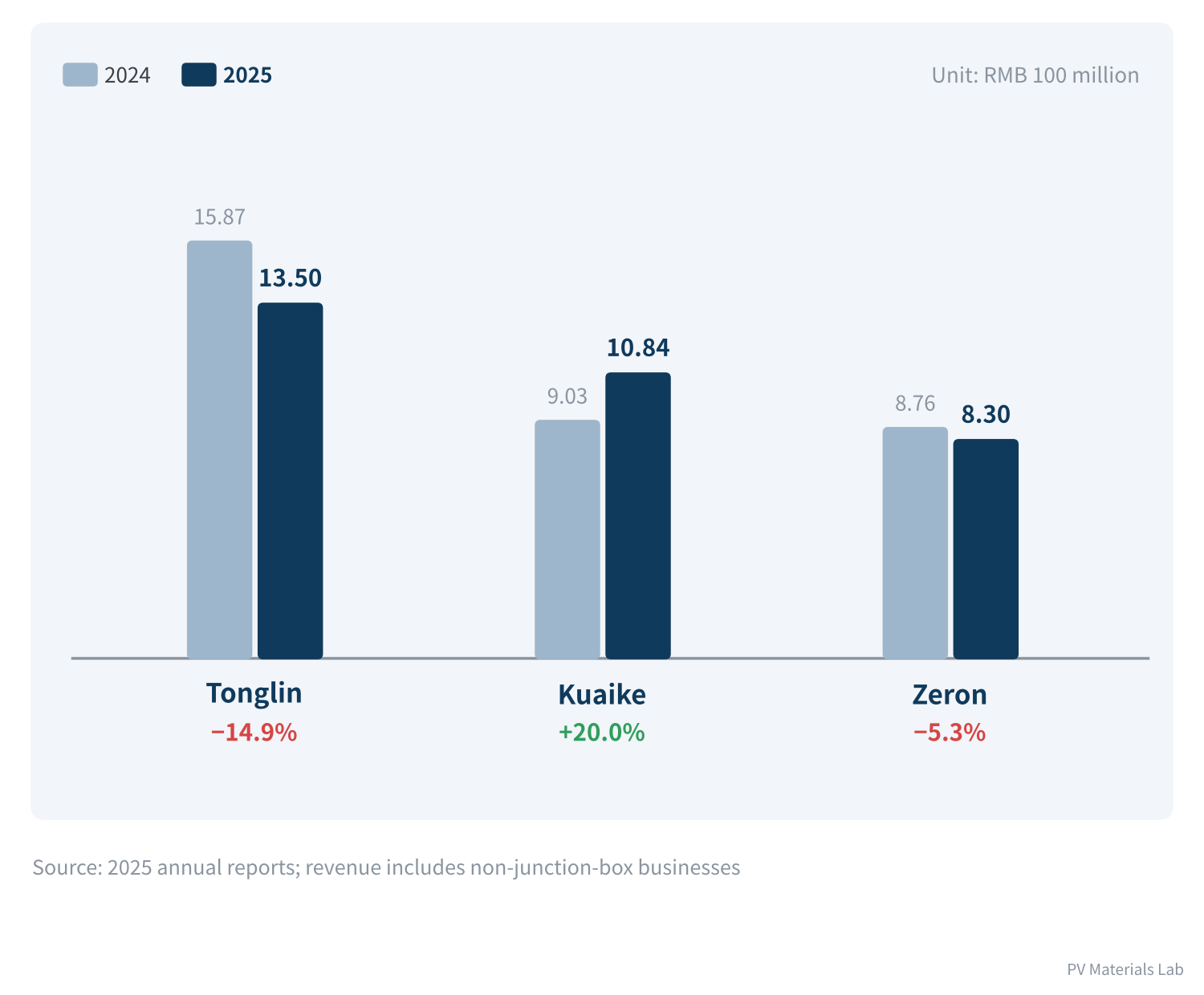
Figure 1 Revenue of the three listed companies
| Company | 2025 revenue | YoY |
|---|---|---|
| Tonglin | RMB 1.350 billion | −14.91% |
| Kuaike | RMB 1.084 billion | +20.02% |
| Zeron | RMB 830 million | −5.25% |
Table 1 2025 revenue of the three listed companies
The three moved in different directions: Tonglin fell, Kuaike grew and Zeron slipped slightly. Note, however, that revenue is not all junction boxes. A quarter of Tonglin's revenue comes from automotive exterior parts, and Zeron also has an EV parts business. To see junction boxes themselves, we need to break the numbers down.
03Net profit: all three down by more than 60%
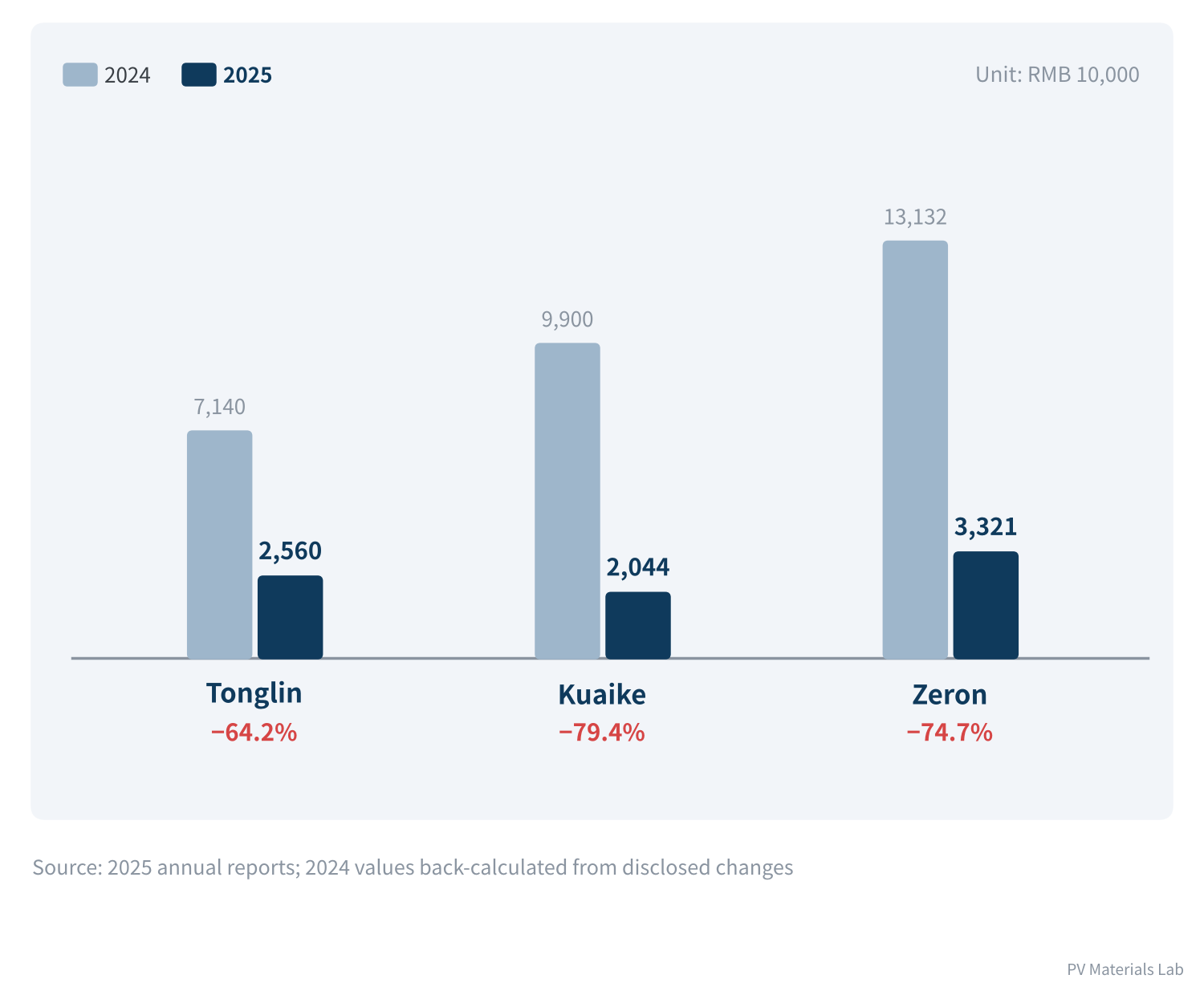
Figure 2 Net profit attributable to shareholders of the three listed companies
| Company | 2025 net profit attributable to shareholders | YoY |
|---|---|---|
| Tonglin | RMB 25.60 million | −64.15% |
| Kuaike | RMB 20.44 million | −79.35% |
| Zeron | RMB 33.21 million | −74.71% |
Table 2 2025 net profit attributable to shareholders
Whether revenue rose or fell, net profit dropped sharply at all three, by between 64% and 79%. Two details stand out:
- Tonglin posted a quarterly loss in Q4 2025: net profit attributable to shareholders was −RMB 19.13 million, reportedly its first.
- Kuaike's revenue grew 20% while net profit fell nearly 80%: it sold more and earned less.
04Shipments: one's loss, the other's gain
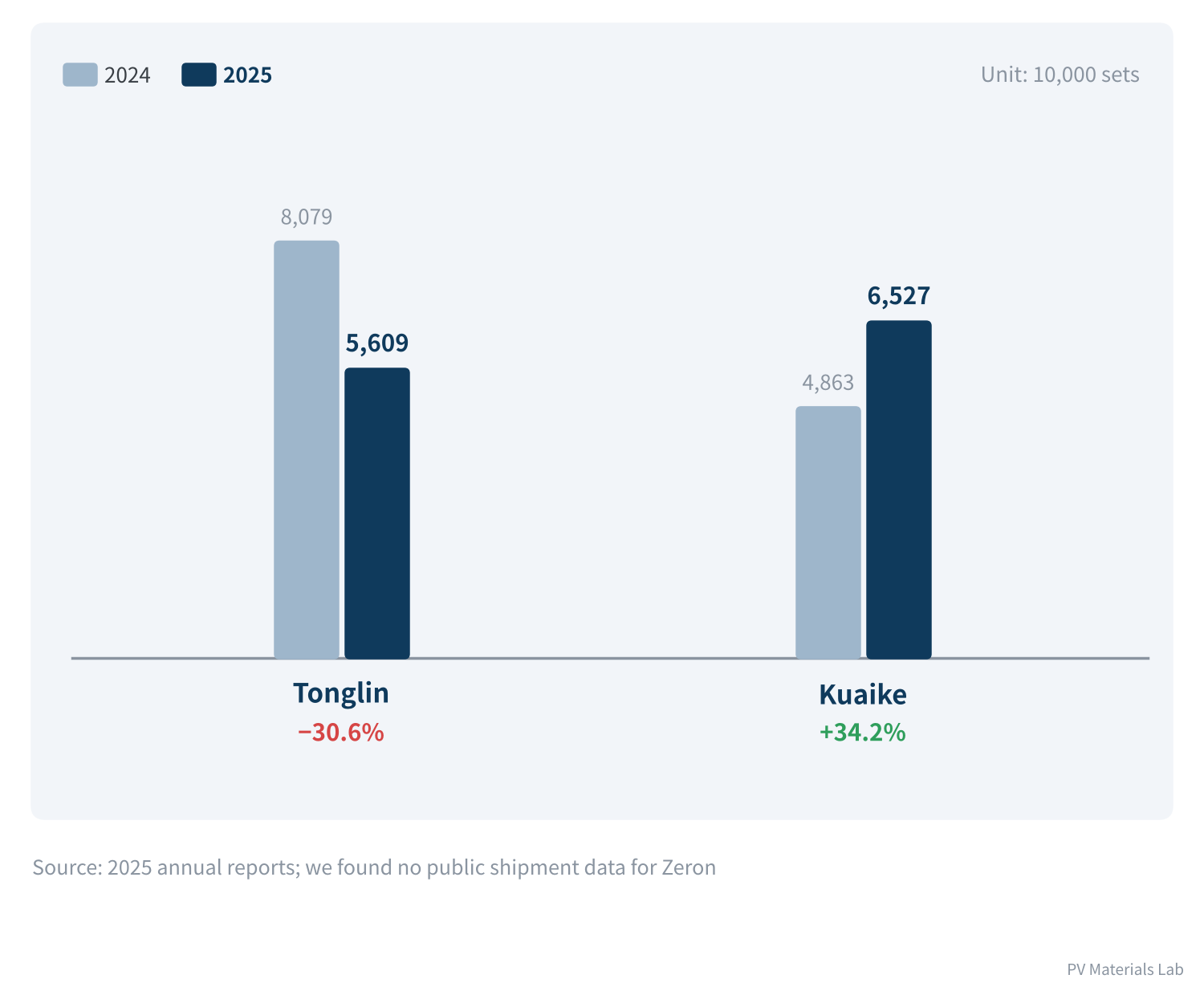
Figure 3 Junction box shipments
Tonglin and Kuaike disclosed junction box shipments in their annual reports, and they moved in opposite directions: Tonglin fell from 80.79 million to 56.09 million sets, down 30%; Kuaike rose from 48.63 million to 65.27 million sets, up more than 30%. By volume, Kuaike overtook Tonglin in 2025. We found no public shipment data for Zeron.
Tonglin's annual report gave two reasons for the decline: first, industry overcapacity, with some leading module makers producing their own junction boxes, sharply reducing orders for independent suppliers; second, the company deliberately tightened credit to some customers to control receivables risk.
Assume one junction box set per module and 600 W per module:
Kuaike 65.27 million sets × 600 W ≈ 39 GW
Tonglin 56.09 million sets × 600 W ≈ 34 GW
This is a rough conversion to give a sense of scale. Actual module power varies, so these are not precise figures for the volume supplied.
A quick look at unit prices
Dividing junction box revenue by shipments gives a rough average selling price per set:
| Company | 2024 | 2025 |
|---|---|---|
| Tonglin | ~RMB 12.8 per set | ~RMB 12.3 per set |
| Kuaike | ~RMB 13.8 per set | ~RMB 14.3 per set |
Table 3 Rough average junction box selling price (revenue ÷ shipments)
Both average a little over RMB 10 per set. This figure depends heavily on product mix — integrated or split boxes, with or without cables, current rating — so it cannot be used directly to compare the two companies' pricing, nor read simply as a price rise or cut.
05Gross margin: the heart of the matter
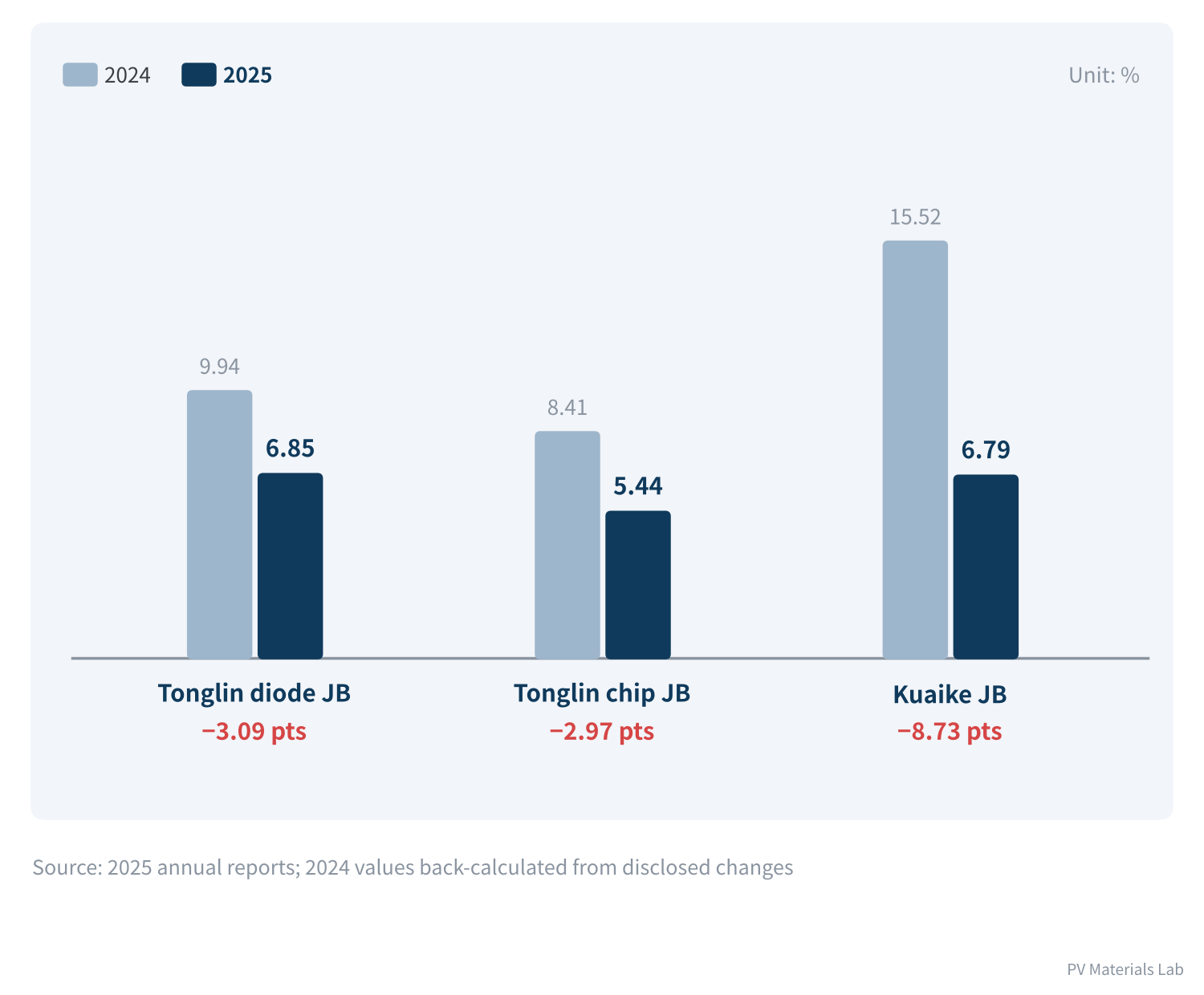
Figure 4 Gross margin of the junction box business
This is the key chart of the article. Gross margins fell in all three business lines, and all landed below 7%:
- Tonglin diode junction boxes: 6.85%, down 3.09 percentage points;
- Tonglin chip junction boxes: 5.44%, down 2.97 points, with revenue from this line down 69.41%;
- Kuaike junction boxes: 6.79%, down 8.73 points from over 15% a year earlier.
Zeron's overall gross margin in 2025 was 15.86%, against 24.07% a year earlier; in the first half of 2026, the gross margin of its PV module junction box business was 12.02%, down 7.23 points year on year.
What does a 7% gross margin mean? After selling, administrative, R&D and financial expenses, the junction box business on its own can hardly contribute any profit.
Squeezed from both ends
The companies' annual reports agree on why margins fell so fast:
- Prices: falling module prices pass pressure on to components, and junction box prices dropped markedly.
- Costs: copper prices stayed high and volatile. As we explained in article 2, copper is the metal used in the largest quantity in a junction box: conductive terminals, cables and connector contacts all depend on it.
- Demand: leading module makers are accelerating in-house junction box production, shrinking the market open to independent suppliers.
Prices going down, costs going up, and the addressable market shrinking: put the three together and you get Figure 4.
06One industry, three responses
Tonglin: shrinking junction boxes, diversifying
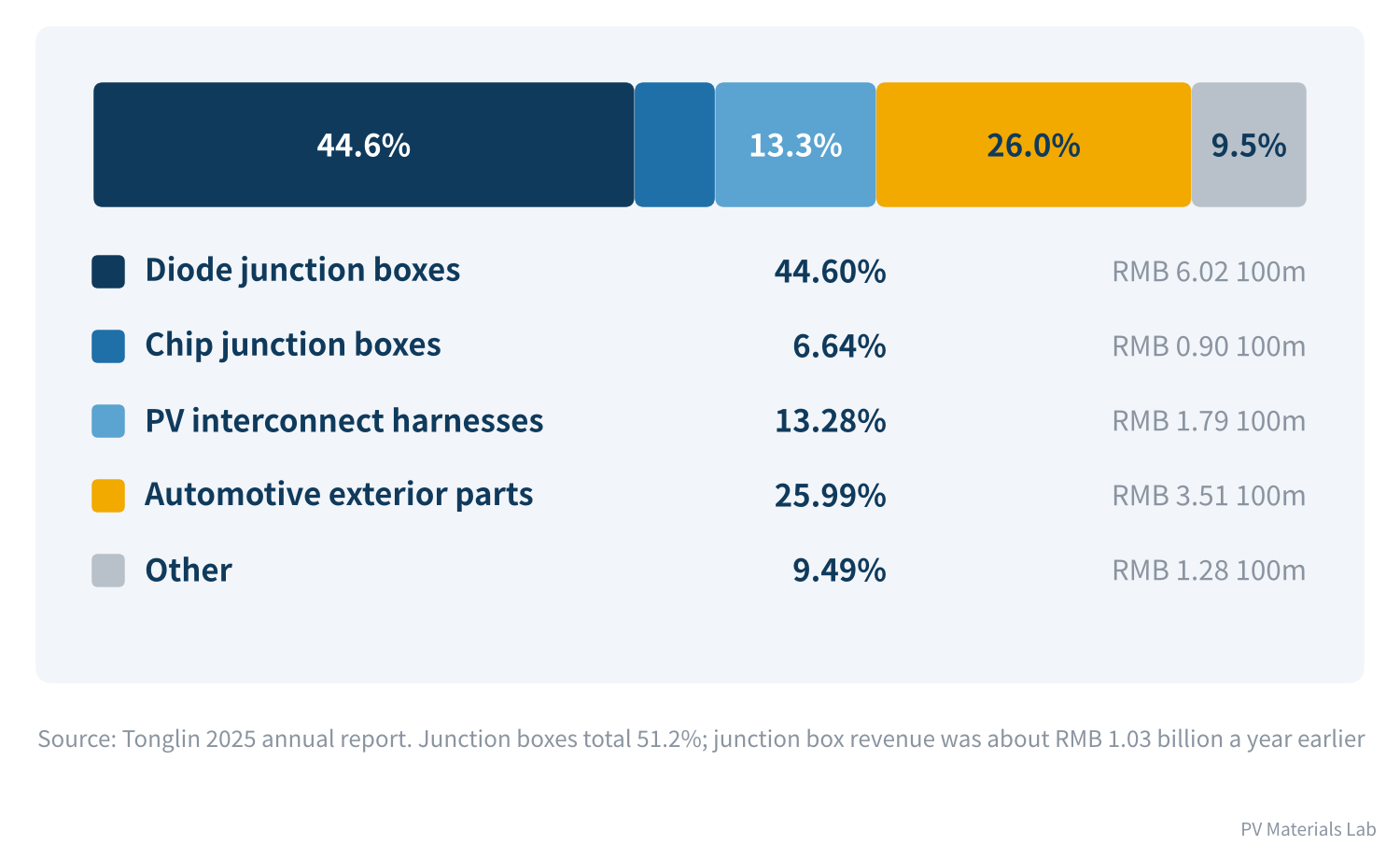
Figure 5 Tonglin 2025 revenue mix
Tonglin's 2025 junction box revenue (diode plus chip) totalled about RMB 692 million, against about RMB 1.03 billion a year earlier, and its share of total revenue fell to 51.2%. Meanwhile, automotive exterior parts revenue reached RMB 351 million, up 17.02%, close to 26% of the total, and PV interconnect harness revenue reached RMB 179 million, up 52.05%.
Tonglin's customer concentration is high: its top five customers account for 75.12% of sales. With downstream module makers under pressure and starting to make their own junction boxes, this is both the reason for tightening credit and the reason for falling shipments.
Kuaike: growing shipments against the trend
Kuaike's junction box shipments grew 34.22%, and junction box revenue reached RMB 932 million, up 38.36%, or 85.94% of total revenue. It has the highest share of junction box business of the three.
The price of growth shows in gross margin: junction box gross margin fell from 15.52% to 6.79%. In addition, Kuaike's connector revenue fell 45.16%, although that business still earned a 25.43% gross margin, well above junction boxes.
Zeron: building a second business
Zeron's revenue slipped 5.25% in 2025. Its changes show more clearly in the first half of 2026: PV module junction box revenue was RMB 250 million, down 34.05% year on year, while EV parts revenue was RMB 75.40 million, up 412.12% (from a low base).
Cash flow deserves attention: Zeron's net operating cash flow was −RMB 99.56 million in 2025 and −RMB 67.26 million in the first half of 2026, negative in both periods.
072026: a weaker first half, divergence in the third quarter
| Company | Revenue | Net profit attributable to shareholders |
|---|---|---|
| Tonglin | RMB 554 million (−29.76%) | RMB 3.08 million (−90.16%) |
| Kuaike | RMB 421 million (−10.74%) | RMB 16.04 million (+21.73%) |
| Zeron | RMB 405 million (−9.83%) | RMB 8.74 million (−84.62%) |
Table 4 First half of 2026 (year-on-year change in brackets)
In the first half of 2026, revenue fell year on year at all three. The backdrop was a sharp drop in installations: according to China's National Energy Administration, new solar capacity installed nationwide in January–June 2026 was 72.07 GW, down 66.04% year on year.
Profit diverged. Tonglin and Zeron's net profit kept falling sharply; Kuaike was the only one to grow net profit, with overall gross margin recovering to 14.8%, although its Q2 revenue fell 33.01% year on year.
In late October, all three published their 2026 third-quarter reports:
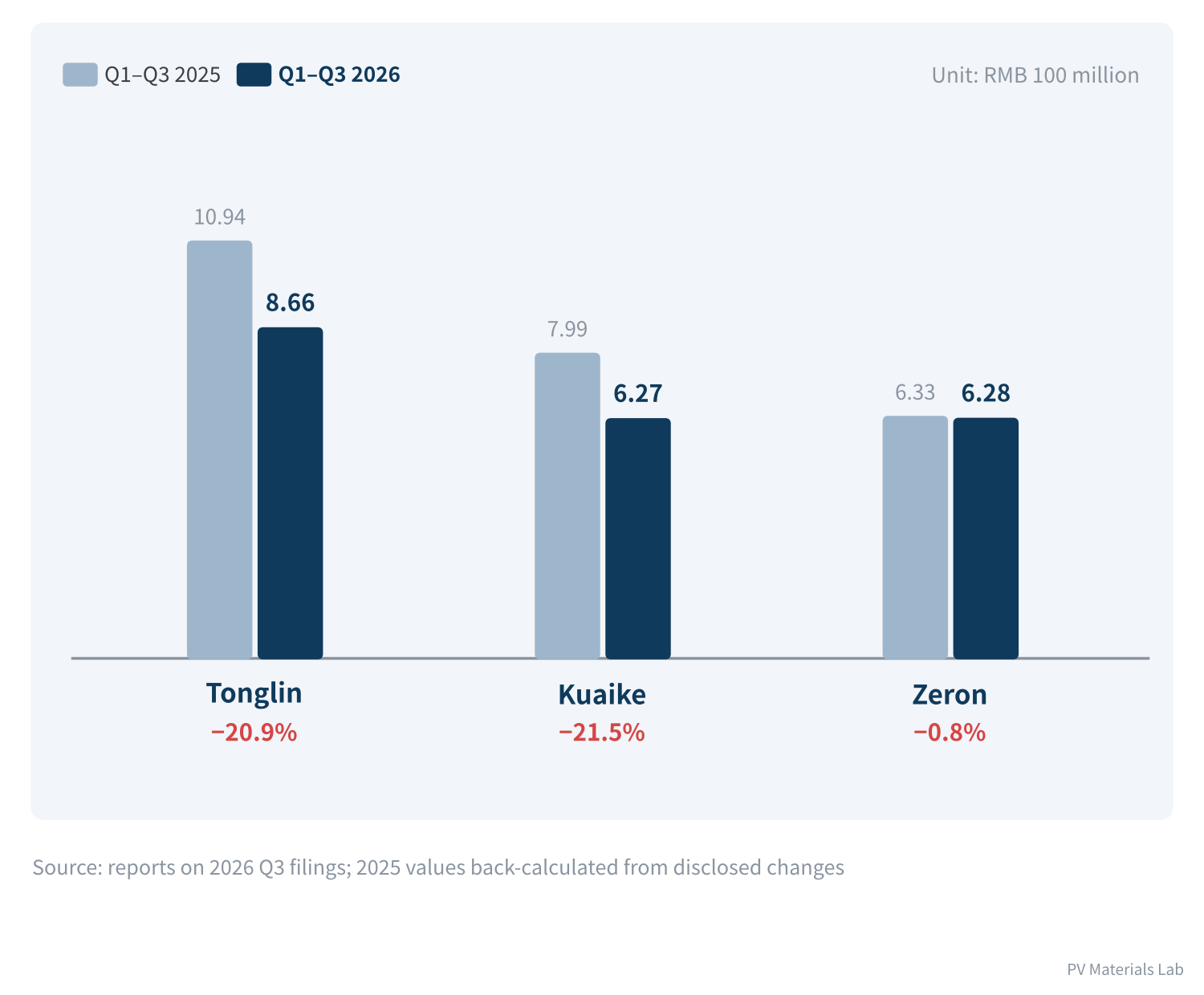
Figure 6 Revenue in the first three quarters of 2026
| Company | Q1–Q3 revenue | Q1–Q3 net profit | Q3 revenue | Q3 net profit |
|---|---|---|---|---|
| Tonglin | RMB 866 million (−20.87%) | RMB 10.92 million (−75.59%) | RMB 312 million (+2.04%) | RMB 7.84 million (−41.58%) |
| Kuaike | RMB 627 million (−21.49%) | RMB 23.44 million (+17.43%) | RMB 207 million (−36.95%) | RMB 7.40 million (+9.07%) |
| Zeron | RMB 628 million (−0.80%) | RMB 16.97 million (−67.96%) | RMB 224 million (+21.15%) | RMB 8.23 million (+313.39%) |
Table 5 First three quarters and third quarter of 2026 (net profit attributable to shareholders; year-on-year change in brackets)
The third-quarter reports carry some new signals:
- Combined scale kept shrinking: combined revenue for the first three quarters was about RMB 2.12 billion, down about 16%; combined net profit was about RMB 51 million, down about 56%.
- Quarterly results began to diverge: Tonglin and Zeron returned to year-on-year revenue growth in Q3, and Zeron's quarterly net profit rebounded sharply from a low base; Kuaike's Q3 revenue fell nearly 40%, but its profit kept growing.
- Gross margins recovered slightly but remain low: Kuaike's overall gross margin for the first three quarters was 16.86% and Zeron's 13.84%. These are company-wide figures including other businesses; the third-quarter reports do not disclose junction box margins separately.
Tonglin's 2025 annual report forecast that market demand would shrink in 2026 and the industry would face oversupply. The first three quarters largely bear this out. Part of the Q3 rebound reflects a low base a year earlier; whether it marks a turning point will take more quarters of data to confirm.
08What the numbers tell us
Reading the three companies' reports together, several industry-level points emerge:
- Junction boxes have become a thin-margin link: gross margins below 7% are common to all three companies, not one company's operating problem.
- The biggest structural change is in-house production by module makers: Tonglin's annual report names leading companies such as Tongwei and LONGi as accelerating in-house production. This changes not prices but the boundaries of the market open to independent suppliers.
- Diversification has become a common choice: Tonglin is moving into automotive exterior parts and interconnect harnesses, Zeron into EV parts — both looking for profit beyond junction boxes.
- Scale and profit no longer move together: Kuaike's shipments rose 30% while its gross margin fell nearly nine points, showing that current growth comes at a cost.
What this means for module makers
From the technical perspective of this series, these numbers carry an implication worth watching.
In article 2 we said the copper thickness of terminals is "the easiest place to cut costs, and the last place you should cut them lightly"; article 5 covered regrind ratios and change management; article 8 explained that a certificate covers a specific combination of materials. When a link's gross margin is squeezed below 7% and copper prices are high, the pressure on suppliers to cut costs in materials and processes is very real.
For buyers, the lower the price, the more important it is to be thorough with incoming inspection, factory audits and material consistency checks. This is not a judgement on any company, but a general risk in a low-margin environment.
09What this article does not cover
The three listed companies are not the whole industry. Several important parts of the picture lack reliable public data, so we left them out of the comparison:
- Unlisted independent suppliers: besides Kuaike and Zeron, the main competitors listed in Tonglin's annual report include Suzhou Xietong Photovoltaic Technology and Jiangsu Haitian Microelectronics. They publish no periodic reports.
- Module makers' in-house production: there is no unified public measure of how many junction boxes leading module makers produce themselves.
- Industry-wide market share: there is no authoritative third-party statistic to cite, so we make no market share ranking.
10Final thoughts
1. The three listed companies' combined 2025 revenue fell only about 3%, while combined net profit attributable to shareholders fell about 74%.
2. Junction box gross margins generally fell below 7%, squeezed by falling prices, high copper prices and in-house production by module makers.
3. Shipments moved in opposite directions: Tonglin down about 30%, Kuaike up more than 30%.
4. The three responded differently: Tonglin shrank and diversified, Kuaike grew volume against the trend, and Zeron is building an EV parts business.
5. In the first three quarters of 2026, combined revenue fell about 16% and combined net profit about 56%; Q3 results diverged, but a turning point is not yet confirmed.
6. In a low-margin environment, buyers need to guard material consistency and incoming quality all the more.
With profit squeezed this far, a natural question follows: what exactly makes up the cost of a junction box, where can it still be cut, and where can it not? That is the subject of the next article.
In the next article, Junction Box Series 13 looks at cost structure and cost-reduction paths: how much copper, diodes, plastics and potting each account for, and where the line between cost reduction and reliability lies.
What changes in price and quality have you noticed in junction box procurement recently? We would be glad to hear from you.
References
- Jiangsu Tonglin Electric Co., Ltd.: 2025 annual report, 2026 interim report and 2026 third-quarter report (in Chinese)
- Suzhou Kuaike PV Electronics Co., Ltd.: 2025 annual report and summary, 2026 interim report and 2026 third-quarter report (in Chinese)
- Jiangsu Zeron New Energy Technology Co., Ltd.: 2025 annual report summary, 2026 interim report and 2026 third-quarter report (in Chinese)
- Guandian (via Sohu): Tonglin Q1–Q3 revenue RMB 866 million, net profit down 75.59% (in Chinese), https://www.sohu.com/a/1090741912_114984
- Jiemian: Tonglin Q3 net profit RMB 7.84 million, down 41.58% (in Chinese), https://www.jiemian.com/article/15218314.html
- Securities Star (via Sohu): Kuaike 2026 Q3 report summary (in Chinese), https://www.sohu.com/a/1093134764_115377
- Securities Star (via FX168): Zeron 2026 Q3 report summary (in Chinese), https://www.fx168news.com/article/1107341
- Jiemian: Zeron's core net profit down more than 80% (in Chinese), https://www.jiemian.com/article/15219970.html
- Tencent News: China H1 2026 new PV installations (in Chinese), https://news.qq.com/rain/a/20260724A0CFNI00
A PV R&D and technology team with 10+ years of experience | In-depth technical knowledge sharing
Materials · Reliability · Failure Analysis · Standards & Certification · Products · Processes
Exploring AI + PV; collaboration welcome
Disclaimer:
1. Original content reflects the authors' personal views only, is for reference only and does not constitute investment advice.
2. Reposted and cited content is credited to its source, out of respect for original work.
3. Some content was produced with AI assistance (chart generation, data retrieval, concept explanations, etc.); the core framework and key content were written by our technical team and reviewed by people.
4. If anything is inaccurate or infringes your rights, please leave a message or contact us and we will deal with it.