
Junction Box Series 16 | The Buyer's View: How to Select Junction Boxes and Audit Suppliers
In brief
The series finale. The first fifteen articles distilled into four selection steps, eight datasheet items, three levels of validation, six audit stations and eight red flags — a checklist you can use directly. This is the sixteenth article in our junction box series (Market and Trends: the buyer's view on selection and factory audits).
For fifteen articles we have looked at junction boxes from the angle of what they are, how they are made and how they fail. This article changes position and stands with the buyer: purchasing and quality teams at module makers, and plant owners and their inspectors.
For a buyer, knowledge must finally turn into two actions: which product to choose, and which supplier to use.
This article introduces no new knowledge. It does one thing: organises what came before into checklists to work through item by item when selecting products and auditing factories.
The checklists here are a general framework built on the technical logic of the earlier articles, not any company's audit standard. Every company differs in products, markets and risk appetite, so treat this as a starting point and adjust it with your own experience.
01First, be clear about what you are buying
The junction box is a small share of module cost, as article 13 showed. But the consequences of its failure are out of all proportion to its price: the failures in articles 10 and 11 — diode failures, overheating contacts, failed seals — cost energy at best and burn modules or start fires at worst. They are not rare: in Kiwa PVEL's 2026 Scorecard, 21% of participating manufacturers had junction box-related failures and 17% had bypass diode failures.
So when you buy a junction box, you are not buying a plastic box with a few diodes, but the probability of 25 trouble-free years.
Once that is clear, many trade-offs answer themselves: the small saving on unit price has to be weighed against the risk to the whole module and even the whole plant. Article 12's financial reports showed that margins in this industry are already very thin, and article 13 calculated that with copper around RMB 108,000/t in 2026, the copper in a set with 2.4 m of cable alone is worth more than RMB 9. In such a market, a quote clearly below competitors must be saving cost somewhere, and the buyer's job is to find out where.
02Four steps of selection
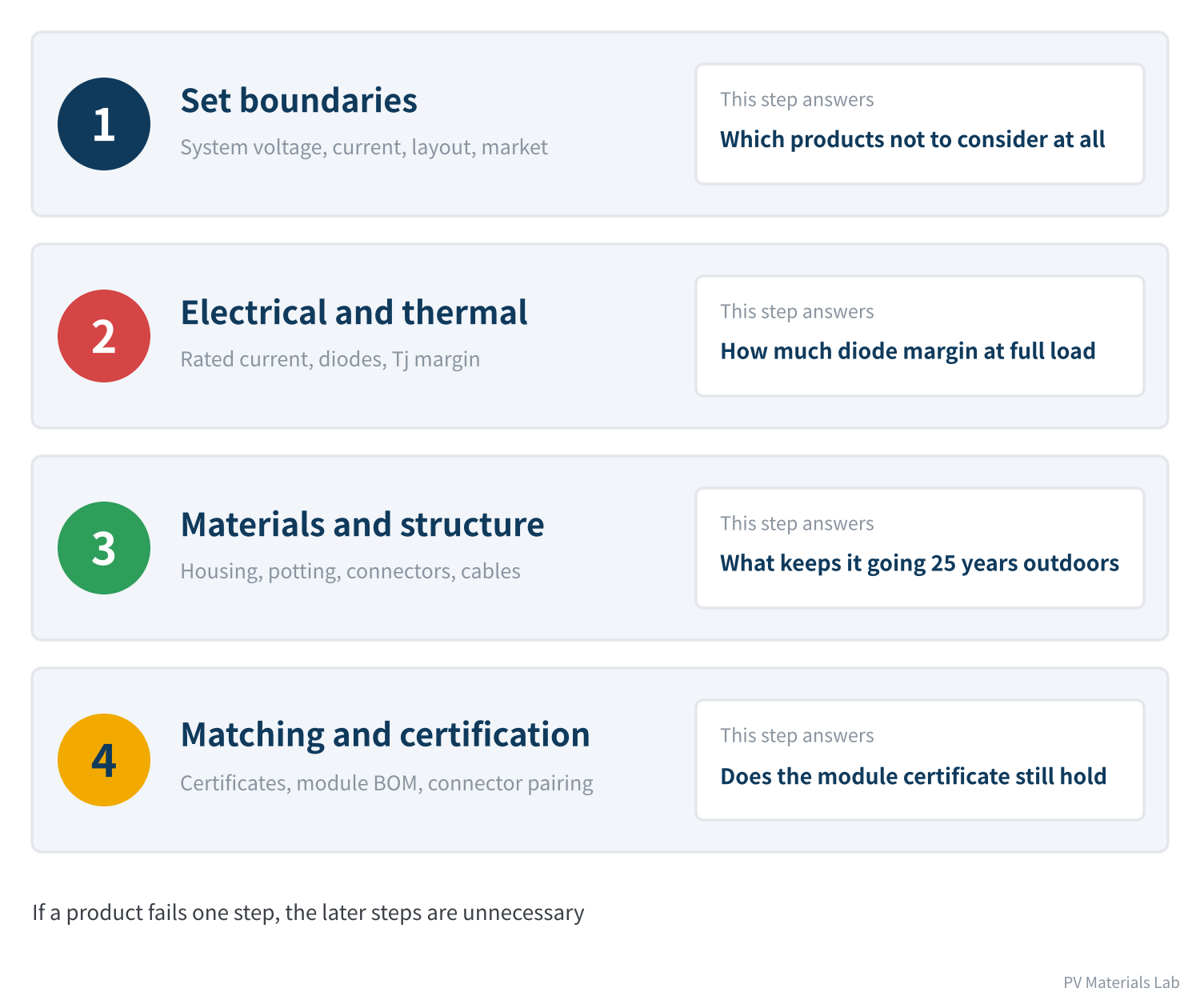
Figure 1 Four steps of selection: from elimination to confirmation
Step 1: set boundaries
Start by ruling out unsuitable products with hard conditions:
- System voltage: whether the plant is 1000 V, 1500 V or 2000 V, the voltage ratings of the junction box, connectors and cables must all match. As article 15 explained, products of different voltage classes must not be mixed.
- Module current: what is the module's short-circuit current; for bifacial modules, rear-side gain must also be considered. As calculated in article 9, under the BSI condition of IEC 61215:2021, the diode test current for bifacial modules can exceed a front-side-only estimate. Leave margin on the junction box's current rating.
- Module layout: full or half-cut cells, integrated or split junction boxes, cable length. These are set by module design.
- Target market: where the product will be sold and which certifications are needed. As article 8 explained, different markets recognise different certificates; in North America, the UL 3730 revision took effect on 10 July 2026, so confirm that reports for affected products have been updated.
Step 2: electrical and thermal
The thread running through the whole series is heat dissipation, and in selection this is where to spend the most time.
There is really only one core question: with the module at full load in the hottest conditions, how far is the diode junction temperature from its limit? This comes from the diode thermal tests in articles 7 and 9. Look not at the word "pass" but at the gap between measured value and limit, and at whether the test current and ambient temperature cover your module and region.
Step 3: materials and structure
Article 2 took the junction box apart. In selection, check four things against it: what plastic the housing uses, what system the potting compound is, whose connectors they are, and what cable specification. These four determine how long it lasts outdoors.
Step 4: matching and certification
As article 9 explained, the junction box is written into the module certification bill of materials. Changing the junction box — even one with a full set of its own certificates — may require repeating some module tests under IEC TS 62915. So the last step confirms two things:
- Certificate consistency: whether the model, diodes and materials on the junction box's own certificate match what is actually supplied.
- Bill of materials: whether it is already on your module BOM, and if not, which tests must be added.
03How to read a datasheet
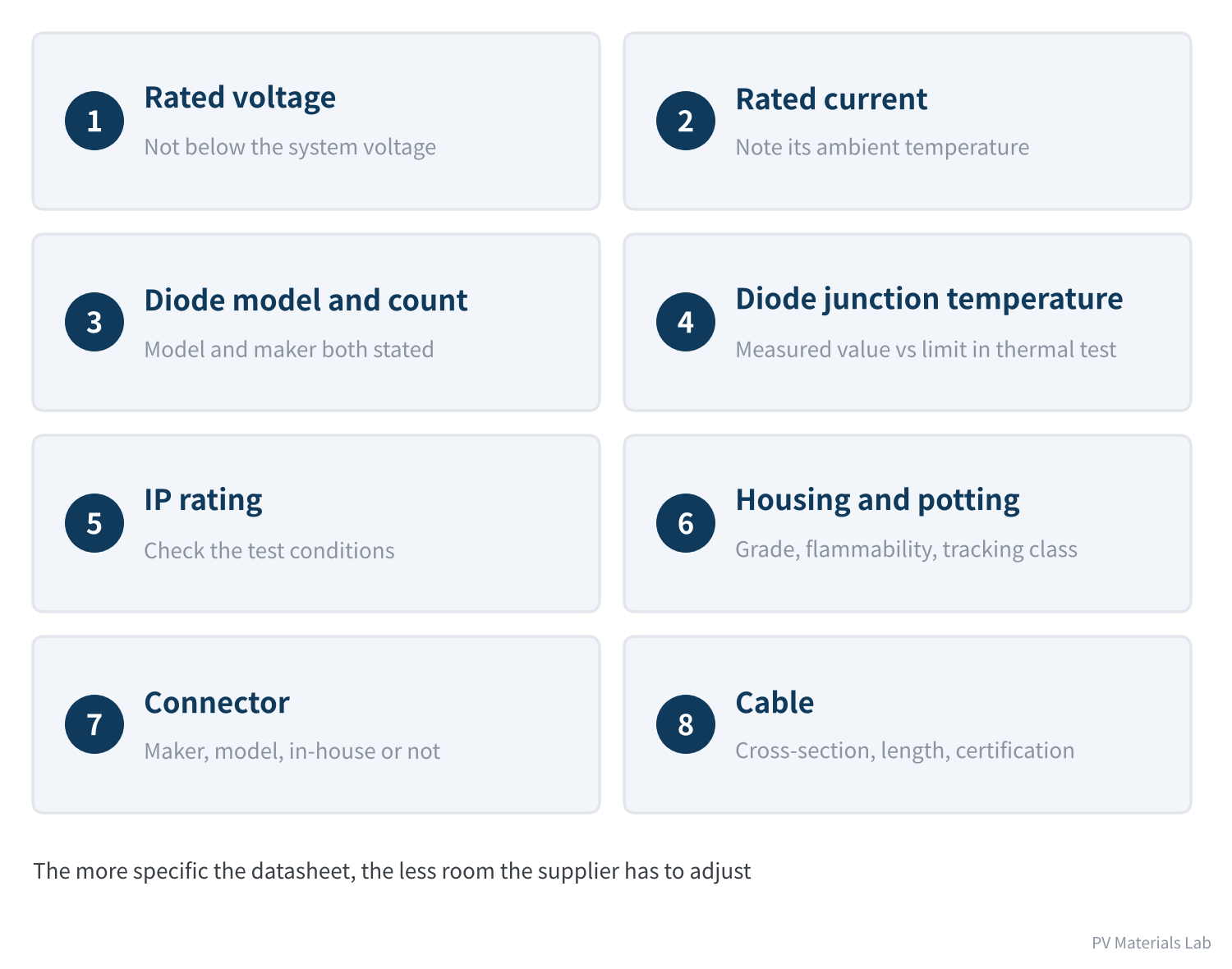
Figure 2 Eight items to check on a datasheet
A datasheet is an agreement between buyer and seller. The principle for reading it: the more specific, the better. "Schottky diode" and a stated model and maker are two different things — the former means the supplier can change it at any time.
| Item | What to check | Article |
|---|---|---|
| Rated voltage | Not below the system voltage | 15 |
| Rated current | At what ambient temperature | 1, 3 |
| Diodes | Model, maker, number, voltage and current ratings | 3 |
| Diode junction temperature | Measured value and margin in the thermal test | 7, 9 |
| IP rating | Test conditions; before or after potting | 2, 6 |
| Housing and potting materials | Grade, flammability class, tracking class | 2 |
| Connectors | Maker, model, in-house or not | 4 |
| Cables | Cross-section, length, certification | 4 |
Table 1 Eight items to check on a datasheet
As article 4 explained, connectors from different makers should not be mated even if they look alike. In selection, look beyond the connectors fitted to the junction box to what happens downstream: which connectors will mate with them on site, and whether extension cables and inverter ends can be sourced from the same maker and model. Field inspection data cited in article 11 found at least one connector issue in 83% of inspected projects.
04Sample validation: three levels
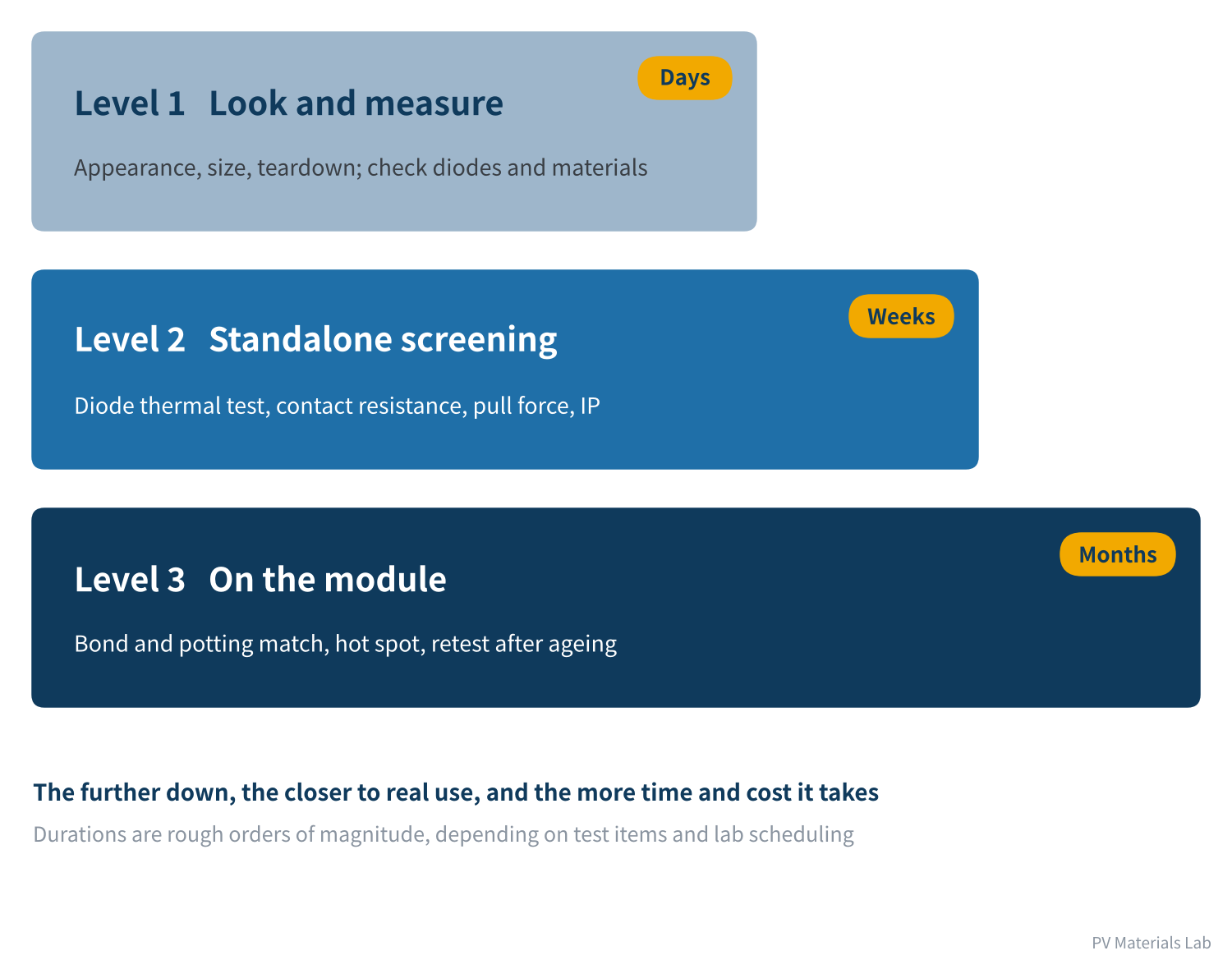
Figure 3 Three levels of sample validation
The datasheet is written by the supplier and needs to be verified with samples. Validation can be done at three levels, each more expensive and each closer to real conditions.
- Level 1, look and measure: appearance, dimensions, weight; open one up to check that the diode model matches the datasheet, look at the quality of solder or crimp joints, the internal structure and creepage paths. The cheapest level, yet it finds a good share of problems.
- Level 2, standalone screening: a few key tests on the junction box alone: diode thermal test, contact resistance, cable and connector pull force, IP rating. Methods are in article 7.
- Level 3, on the module: mount it on modules with your own process, check that bonding and potting match (article 6), run a hot-spot test, then ageing such as damp heat and thermal cycling, and remeasure diodes and contact resistance afterwards.
Level 3 is the easiest to skip, yet it matters most. As article 10 explained, many junction box problems lie not in the box itself but in how it works with the backsheet, the adhesives and the ribbons — which only shows once it is on a module.
05Factory audit: walk the process flow
A qualified sample only shows that the supplier "can make a good product". The audit answers a different question: can it make the same product, batch after batch?
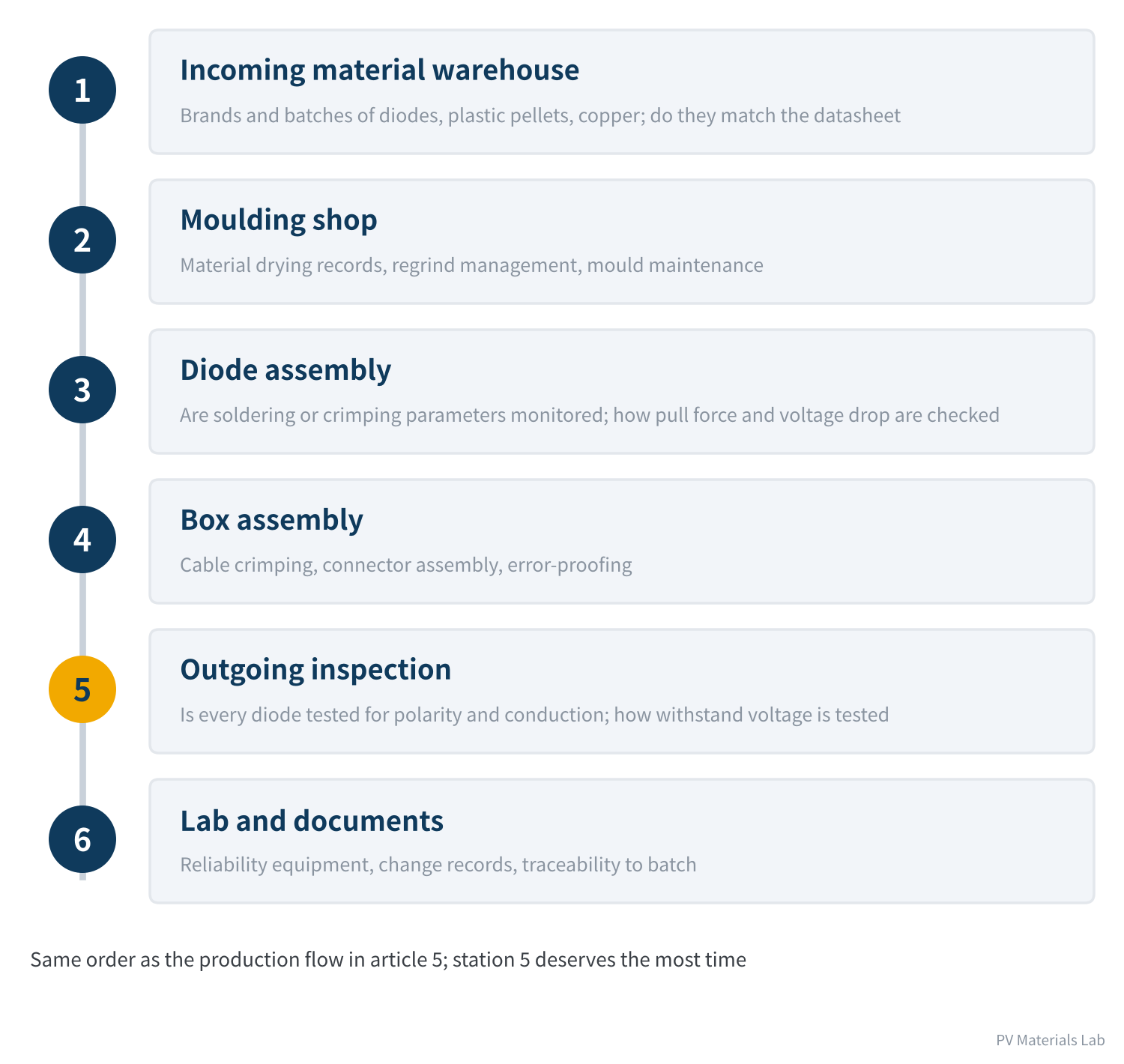
Figure 4 Audit route: walking the process flow
The audit route can follow the production flow from article 5, from incoming materials to shipment.
Station 1: incoming material warehouse
Look at physical stock in the warehouse, not just documents. Check the brands and models on the labels of diodes, plastic pellets and copper, and whether they match the datasheet and certification reports. Then look at batch control: if a batch of junction boxes has a problem, can you trace which batch of diodes it used?
Station 2: moulding shop
Are pellets dried before moulding, and is it recorded? How are sprues and ground-up rejects handled as regrind, is there a specified ratio, and is it followed on the floor? Too much regrind lowers housing strength and ageing resistance, and that cannot be seen from the outside.
Station 3: diode assembly
This is the core process of the junction box. Whether diodes are soldered or crimped to the terminals, look at three things: whether process parameters are automatically monitored and recorded by equipment; how and how often joint strength is checked; and how suspect products are isolated and handled after an equipment alarm.
Station 4: box assembly
Crimping cables to terminals and assembling connectors. Look at how crimp quality is controlled and what error-proofing exists — for example, whether positive and negative cables can be swapped, or parts of different models mixed.
Station 5: outgoing inspection
This station deserves the most time. The key point: is every single diode tested for polarity and conduction? As article 11 explained, a reversed or poorly connected diode is completely invisible while the module operates normally and only shows when bypass is needed — by which time the module is long installed in the plant. Sampling cannot catch occasional individual defects; this test must be 100%.
Station 6: lab and documents
See whether the supplier has its own reliability test equipment, and whether it samples production regularly for reliability testing or only tests once for certification. Finally, look at change management: which materials and suppliers changed in the past year, what verification was done beforehand, and whether customers were notified.
During an audit, keep asking "can you show me the records?". Writing a procedure down is easy; following it every day is hard.
06Eight red flags
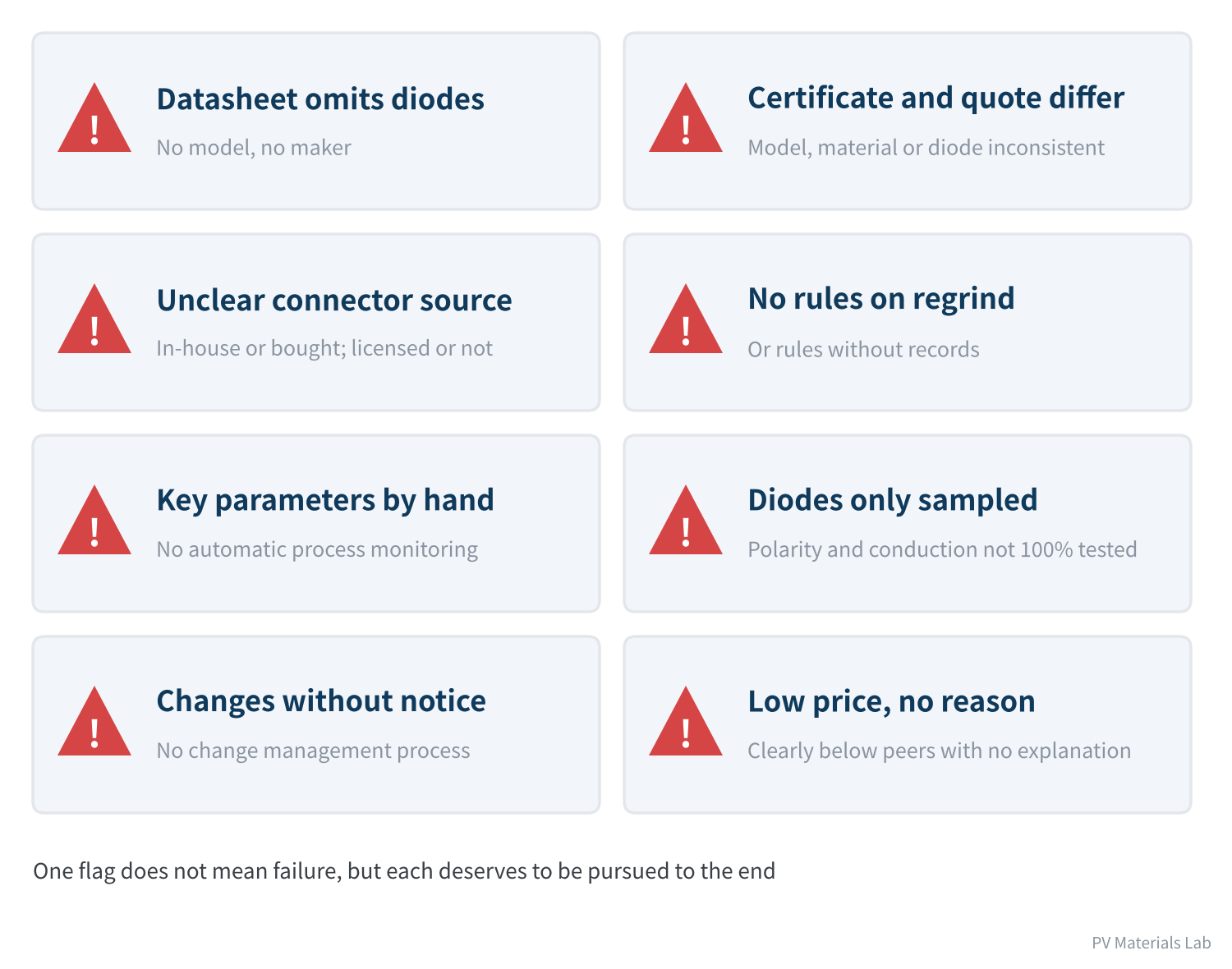
Figure 5 Eight red flags
Turn everything above around and you get a list of red flags. Any one of them does not mean the supplier fails, but each deserves to be pursued to the end.
The one to watch most closely is change management. The junction box industry is under heavy cost pressure, and article 13 described the cost-cutting routes: changing diodes, reducing copper, changing plastics, using less potting. These are all normal engineering measures in themselves; the question is whether they were re-verified and whether customers were told. One sample submitted for certification and another supplied in volume is the risk buyers find hardest to detect and the most serious in its consequences. The higher copper goes, the greater this risk.
Beyond technical measures, the purchase agreement can specify: the critical materials list as a contract annex; any change to be notified in writing in advance and approved by the buyer; and the buyer's right to take random samples for third-party testing. In periods of sharp copper price swings, a transparent copper price adjustment formula can also be agreed, so suppliers need not quietly cut material to absorb costs. These clauses cannot replace audits, but they give change management a firm basis.
07One checklist
Finally, the whole article in one table, ready to copy into your own documents.
| Stage | What to confirm |
|---|---|
| Selection | Voltage and current ratings match the module and system, with margin (bifacial modules checked under BSI conditions) |
| Selection | Measured diode junction temperature and margin in the thermal test; test conditions cover actual use |
| Selection | Model, diodes and materials on the certificate match actual supply; certificate status valid |
| Selection | Already on the module certification BOM, or the additional tests needed are identified |
| Datasheet | Diodes, housing material, potting, connectors and cables all specified by model and maker |
| Samples | Teardown to check diode model and internal structure |
| Samples | Standalone screening: thermal test, contact resistance, pull force, IP |
| Samples | On the module: bonding and potting match, hot spot, retest after ageing |
| Audit | Incoming materials match the datasheet; batches traceable |
| Audit | Regrind rules exist and are recorded |
| Audit | Diode joining process parameters automatically monitored |
| Audit | Every diode tested for polarity and conduction |
| Audit | Reliability testing on production samples |
| Audit | A change management process, with past change records available |
| Contract | Critical materials list in the contract; changes approved in advance; copper price adjustment if needed |
Table 2 Junction box selection and audit checklist
08Final thoughts
1. Buying a junction box means buying the probability of 25 trouble-free years; unit price must be weighed against the risk to the module and the plant.
2. Four selection steps: set boundaries, electrical and thermal, materials and structure, matching and certification.
3. The more specific the datasheet, the better; diodes must be specified by model and maker.
4. Sample validation has three levels; the on-module level is the last one to skip.
5. Audit along the process flow; at outgoing inspection, check whether every diode is tested.
6. The biggest hidden risk is undisclosed change.
That completes all sixteen articles of the junction box series. Looking back, the four parts answer four questions:
| Part | Question answered |
|---|---|
| Fundamentals (1–4) | What it is: functions, structure and materials, bypass diodes, connectors and cables |
| Manufacturing and quality (5–7) | How it is made: production process, installation on the module, test methods |
| Standards and reliability (8–11) | What makes it qualified and how it fails: certification, its role in module certification, reliability, failure analysis |
| Market and trends (12–16) | Who makes it, what it costs, where it is going, how to buy it: suppliers, cost, smart junction boxes, future directions, selection and audits |
Table 3 Structure of the sixteen-article junction box series
A small junction box can fill sixteen articles because it sits right at the intersection of electricity, heat, materials, processes and reliability. The same is true of the other materials in a module.
That brings the junction box series to a close. Thank you for reading all the way through. If you have cases from selection, audits or failure analysis worth sharing, we would be glad to hear from you.
References
- IEC 62790:2020 Junction boxes for photovoltaic modules – Safety requirements and tests
- IEC 62852:2014+AMD1:2020 Connectors for DC-application in photovoltaic systems – Safety requirements and tests
- IEC 61215:2021 / IEC 61730:2023 PV module design qualification and safety qualification
- IEC TS 62915:2023 Photovoltaic (PV) modules – Type approval, design and safety qualification – Retesting
- Kiwa PVEL: 2026 PV Module Reliability Scorecard – Failures, https://2026scorecardsbx.pvel.com/failure
- Solar Power World: HelioVolta study: Solar connector failures remain major threat to systems (2025-06-18), https://www.solarpowerworldonline.com/2025/06/heliovolta-study-solar-connector-failures-remain-major-threat-to-systems/
- Articles 1–15 of this series
A PV R&D and technology team with 10+ years of experience | In-depth technical knowledge sharing
Materials · Reliability · Failure Analysis · Standards & Certification · Products · Processes
Exploring AI + PV; collaboration welcome
Disclaimer:
1. Original content reflects the authors' personal views only, is for reference only and does not constitute investment advice.
2. Reposted and cited content is credited to its source, out of respect for original work.
3. Some content was produced with AI assistance (chart generation, data retrieval, concept explanations, etc.); the core framework and key content were written by our technical team and reviewed by people.
4. If anything is inaccurate or infringes your rights, please leave a message or contact us and we will deal with it.