
Turning UV into Blue Light: Is Light Conversion Film a Power Booster or an Insurance Layer?
Over the past two years, UV-induced degradation (UVID) has gone from an almost-forgotten issue to one of the most talked-about reliability topics for n-type modules. As a result, an encapsulant originally developed for heterojunction (HJT) modules — the light conversion film — is now finding its way into the bill of materials of TOPCon and back-contact (BC) modules. What is it, how does it work, how much extra power does it deliver, and what are the pitfalls? In this article we walk through materials, module integration, mass production and reliability.
01 Why n-type modules are sensitive to UV again
UV light makes up only a small share of sunlight — wavelengths below 400 nm account for roughly 4–5% of terrestrial solar irradiance — but each photon carries a lot of energy. UV has long been an adversary of the polymers in a module and of the cell's passivation layers.
In the early days, the UV problem showed up mainly as encapsulant yellowing. It was largely solved by adding UV absorbers to EVA and simply "cutting off" light below roughly 400 nm. The turning point came with n-type cells:
- Thinner, more UV-transparent passivation: The front side of TOPCon cells and the passivation stack of HJT cells are more sensitive to UV. High-energy photons can break Si–H bonds and create interface defects, reducing open-circuit voltage and fill factor.
- Testing exposed the issue: RETC's 2024 PV Module Index reported that about 40% of tested modules lost at least 5% of their power after UV testing. At 120 kWh/m² of UV exposure, Kiwa PVEL saw losses as high as 16.6% in some TOPCon modules.
- A low bar in the standard: The UV preconditioning in IEC 61215 is only 15 kWh/m², designed mainly to weed out the weakest products — yet a module in Dubai receives roughly 5.4 times the UV dose of one in Berlin.
So here is the dilemma: if you simply cut off UV as before, the cell is protected, but those photons are wasted and initial power drops. Is there a way to protect the cell and still put that energy to use? Light conversion film is the answer to that question.
Key takeaway
UVID is not a new problem — high-efficiency n-type cells have simply amplified an old one. Cutting off UV protects the cell but costs power; light conversion film tries to get the best of both.
02 Materials: the light conversion agent is the heart
The structure of a light conversion film (LCF, also called a UV down-shifting or down-conversion film) is simple: a small amount of light conversion agent is added to a conventional EVA, POE or EPE encapsulant. The agent absorbs UV photons and re-emits them as longer-wavelength visible light.
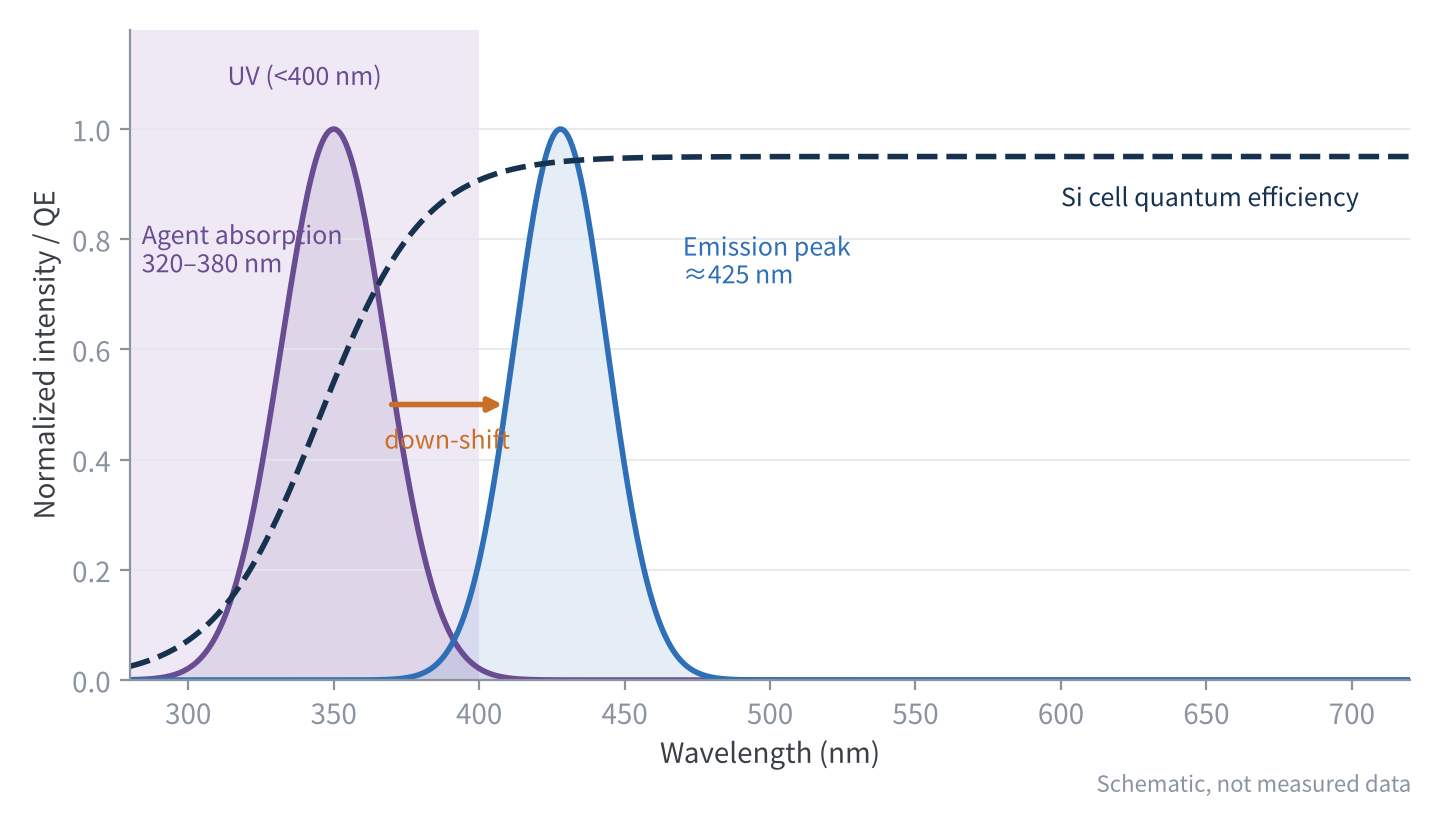
Taking published data as examples, FIRST's down-conversion film absorbs UV in the 320–380 nm range and emits with a peak around 425 nm. The additive used in a CEA/3SUN study absorbs 250–400 nm, emits 380–550 nm, and has a photoluminescence quantum yield of about 95%. Blue light falls right in the range where crystalline silicon cells have high quantum efficiency — "harmful light" becomes "useful light."
Chemically, light conversion agents fall into roughly three classes:
- Rare-earth organic complexes: A rare-earth ion such as Eu³⁺ serves as the emission center. The organic ligand absorbs UV first and then transfers the energy to the rare-earth ion, which emits — the so-called "antenna effect." Eu³⁺ emits red light around 610 nm, which also falls in the cell's high-response range. Advantages: a large Stokes shift and little self-absorption. Weaknesses: susceptibility to moisture quenching, and quantum yield that depends heavily on the ligand.
- Organic fluorescent molecules: Flexible molecular design and easily tuned absorption/emission bands, but operating under UV for years exposes them to photo-oxidation and photobleaching.
- Inorganic phosphors / quantum dots: Promising stability, but dispersion, transparency and cost are engineering challenges; they are relatively rare in PV encapsulants today.
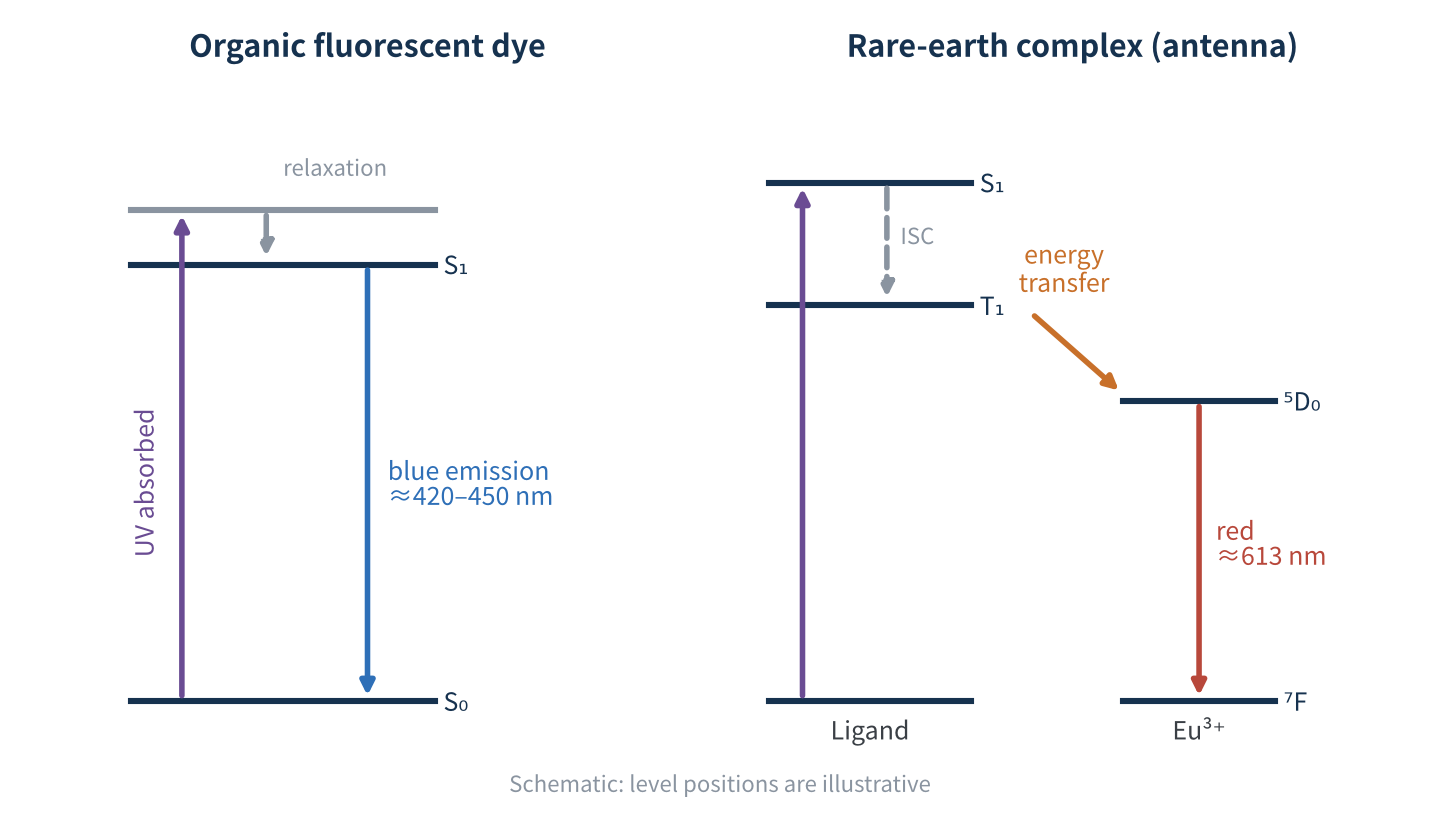
For an encapsulant maker, choosing the agent is only the first step. The harder part is dispersing it stably in the film: it must survive extrusion and lamination temperatures, must not interfere with crosslinking, must not migrate out, and must stay "alive" under 20–30 years of outdoor light. That is why leading suppliers treat the agent as a core raw material and make it in-house — Cybrid disclosed back in 2023 that it had completed pilot production of its light conversion agent in China and validated the mass-production process.
03 Inside the module: how it is used and how much it adds
Light conversion film is normally placed between the front glass and the cells, replacing the conventional high-transmittance or UV-cut encapsulant. There are broadly three ways a front encapsulant can handle UV:
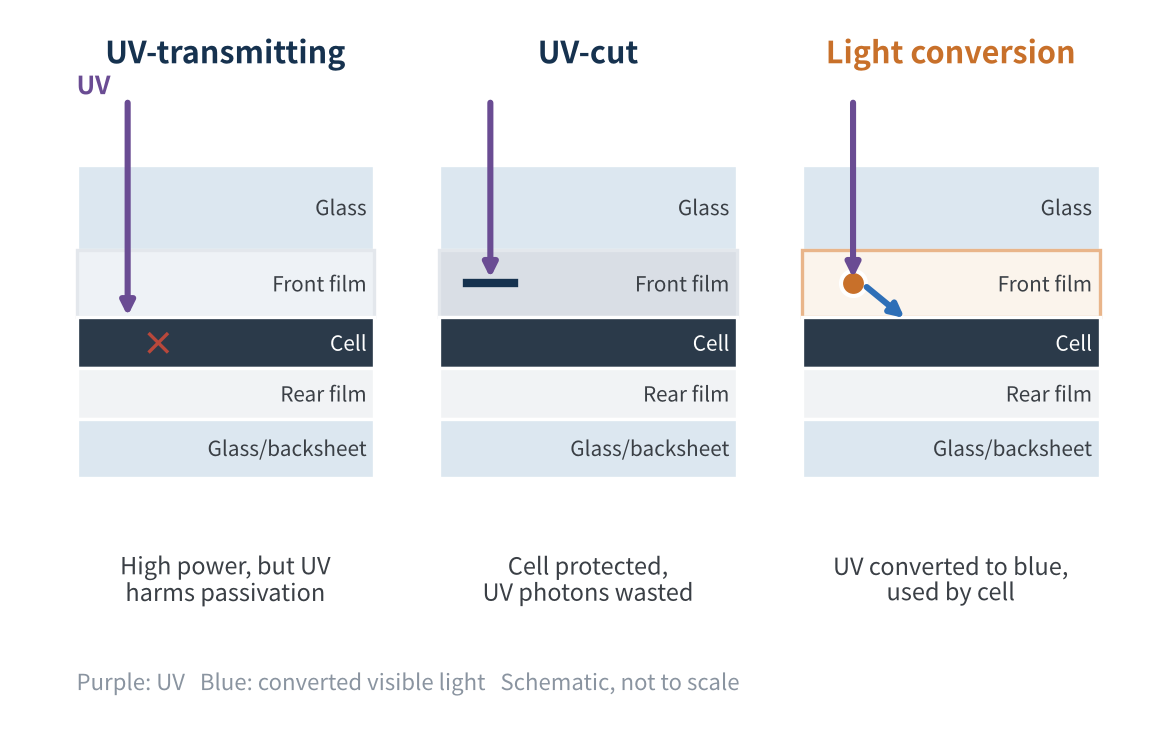
| Strategy | UV reaching the cell | Initial power | UVID risk | Cost |
|---|---|---|---|---|
| UV-transmitting | High | High | High | Low |
| UV-cut | Very low | Lower | Low | Low |
| Light conversion | Very low | In between, close to UV-transmitting | Low | Slightly higher |
How large is the gain? Published figures are of a similar order of magnitude:
- FIRST: up to about 1.35% higher initial efficiency than a UV-cut film, with less than 1% power loss in the first year.
- CEA/3SUN: 1.5–1.75% higher short-circuit current than a conventional UV-cut film.
- Risen Energy: about 10 W more per HJT module than a high-cut-off encapsulant solution.
- Cybrid: up to about 0.53% more energy output for TOPCon modules compared with a standard high-transmittance film.
There is an easily overlooked question here: compared with what? Against a UV-cut film, light conversion film "recovers" the photons that were being cut off, and the gain is around 1%. Against a high-transmittance film, it also blocks some UV that would otherwise reach the cell directly, so the gain is smaller and its main value shifts to preventing degradation. By our estimate, under the AM1.5G spectrum, if all 320–380 nm photons were converted and collected by the cell, the theoretical upper limit would be roughly 1.3–1.5% of short-circuit current — broadly consistent with the measured figures above.
Two more engineering details deserve attention:
- Don't forget the rear side: The rear of a bifacial module also receives UV. If light conversion film goes on the front, the rear needs a corresponding UV-cut or conversion solution — something Risen Energy specifically addressed during development.
- Higher concentration is not always better: Too much agent leads to agglomeration, self-absorption and stability problems. Risen Energy also noted that agent concentration plays a crucial role in film stability.
Bottom line
The "power boost" of light conversion film is relative to a UV-cut film and is on the order of 1%. Relative to a high-transmittance film, it is more like an insurance layer that costs very little power.
04 Mass production: from HJT to TOPCon and BC
The commercialization path of light conversion film closely follows "who fears UV most":
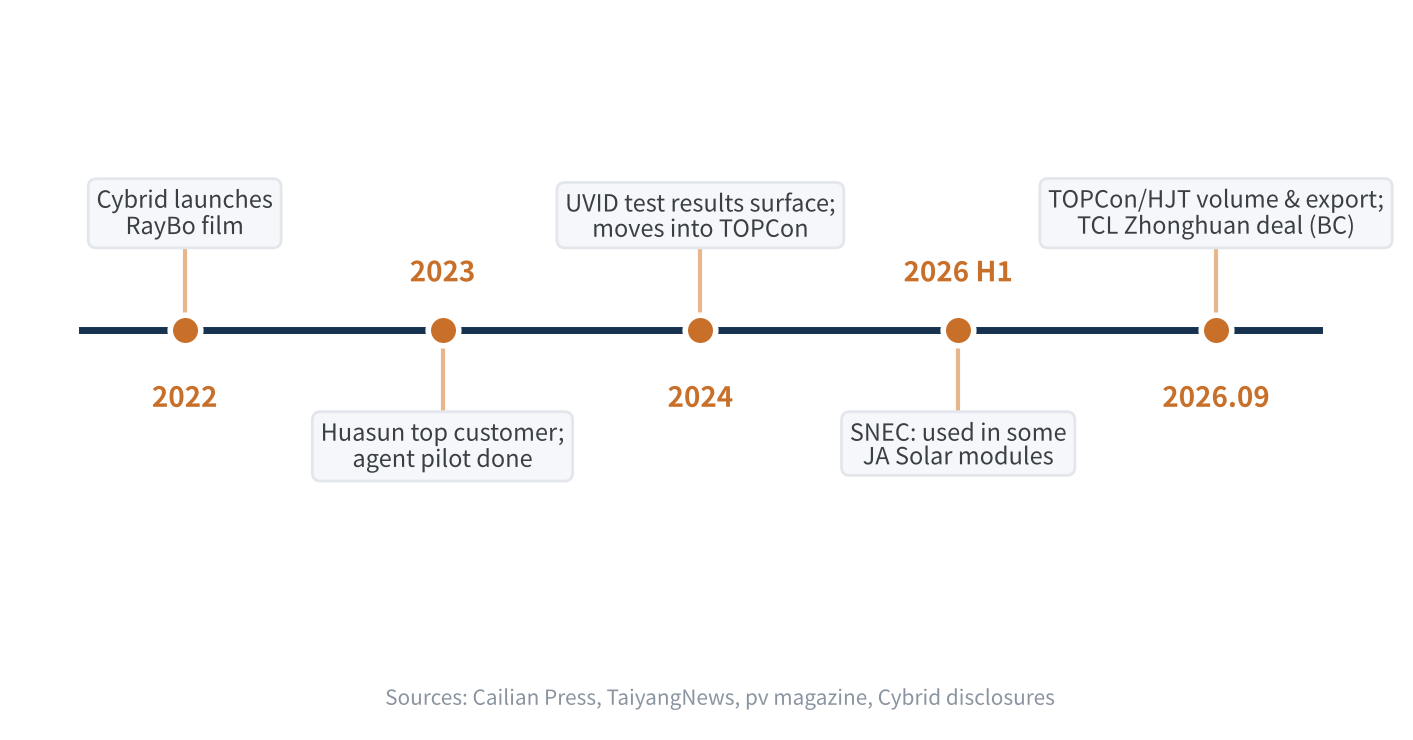
- HJT first: Heterojunction cells are the most UV-sensitive and were the first to adopt light conversion film. Cybrid launched its RayBo film in 2022, and in 2023 its largest customer was Huasun. Huasun has said that the added cost — about USD 0.50/m² by Cybrid's estimate — is largely offset by the efficiency gain.
- TOPCon follows: After UVID became a hot topic in 2024, light conversion film began moving into TOPCon. Because TOPCon is more sensitive to corrosion and its customers are more cost-sensitive, the formulation has to be adjusted separately. By September 2026, Cybrid told investors that both its TOPCon and HJT light conversion films were in mass production and shipping in volume overseas. At SNEC 2026, Cybrid also highlighted the film's use in several JA Solar modules.
- BC becomes the new battleground: In September 2026, Cybrid signed a strategic cooperation agreement on light conversion film with TCL Zhonghuan, focusing on BC modules while also advancing TOPCon applications.
- Multiple suppliers on board: Besides Cybrid, other leading encapsulant makers such as FIRST also offer down-conversion films.
Note that there is currently no authoritative public statistic on the market penetration of light conversion film, and suppliers disclose little about volumes. Our assessment: it has moved from an "HJT-only" material to an optional configuration for n-type modules, but it is far from standard — many TOPCon manufacturers prefer to tackle UVID at the cell level by optimizing the passivation stack.
05 Reliability: pitfalls to see in advance
Light conversion film is meant to solve a reliability problem, but it also introduces new reliability variables. Based on published research and our own experience, focus on the following:
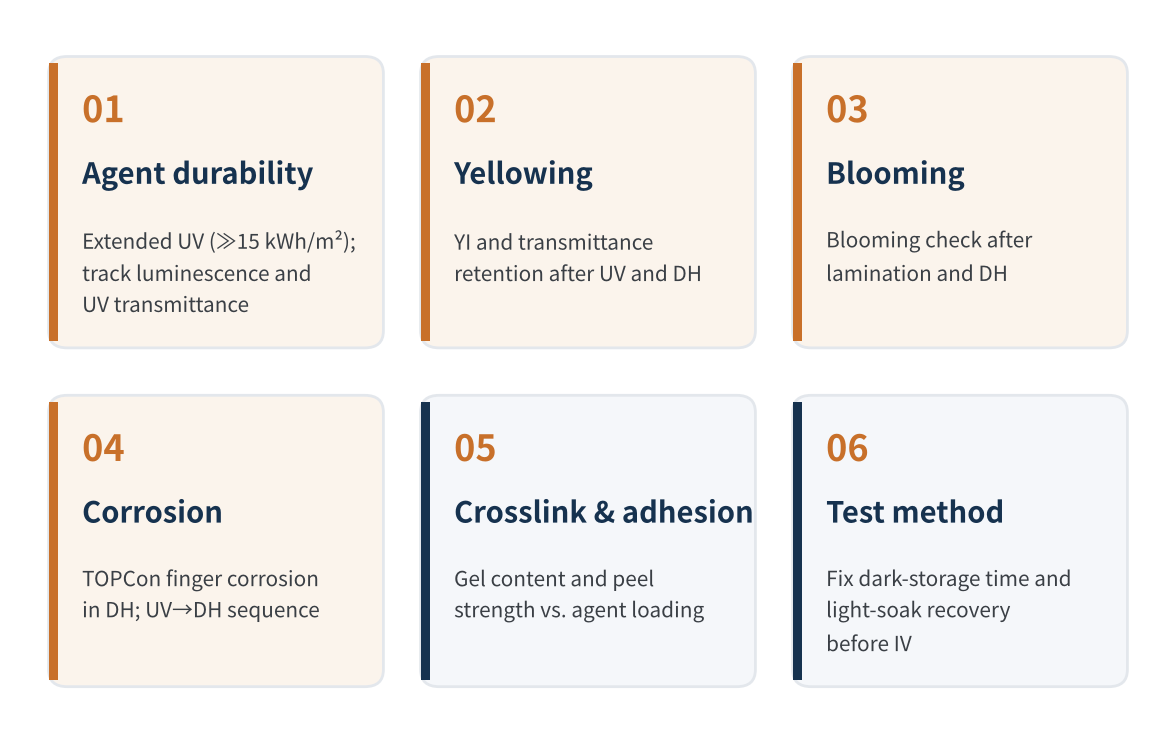
- Durability of the agent itself: The agent absorbs UV every day and ages too. A 2026 study by Forschungszentrum Jülich found that a down-shifting EVA could not convert all UV, and its conversion effect declined with UV exposure, presumably due to photo-oxidation. The researchers proposed a dual-layer structure — a down-shifting layer over a UV-blocking layer — which retained more than 98% of initial performance after 120 kWh/m².
- Migration, blooming and yellowing: Poor compatibility between additive and matrix can cause the agent to migrate or bloom during lamination or damp heat, and even trigger yellowing that directly reduces transmittance.
- Compatibility with TOPCon metallization: UNSW found that a UV-related additive in one POE encapsulant broke down under damp heat into organic acids, worsening finger corrosion in TOPCon modules. The lesson: any new functional additive must pass damp-heat and corrosion testing. The good news is that in the CEA/3SUN study, the down-shifting additive introduced no new failure modes after 3,000 hours of damp heat.
- Moisture quenching: Rare-earth complexes are inherently sensitive to water. The film's moisture barrier and the hydrophobic design of the ligand determine how long it keeps "glowing" in humid environments.
- Test methodology: Dark storage after UV testing causes temporary power loss in TOPCon modules, most of which recovers under light. Studies by Fraunhofer ISE and NREL both suggest current methods may overestimate degradation. So when comparing light conversion film with standard film, measurement timing must be consistent, or the data will not be comparable.
Key takeaway
Don't qualify light conversion film on initial power gain alone. At a minimum, run: extended UV exposure (well beyond 15 kWh/m²), UV followed by damp heat, TOPCon corrosion-related damp heat, yellowing and transmittance retention, gel content and peel strength, and monitoring of the agent's residual luminescence.
Final thoughts
Back to the question in the title: is light conversion film a power booster or an insurance layer?
Our view: it is essentially a UV insurance layer that costs very little power. Compared with a UV-cut film, it recovers about 1% of power; compared with a high-transmittance film, it buys UV stability at a small power cost. For HJT it is almost a must-have; for TOPCon and BC it is one option alongside cell-level passivation optimization. Whether it pays off depends on the cell's own UV sensitivity, the UV intensity at the installation site, and whether the extra cost per square meter is covered by the extra energy yield.
What ultimately determines its value is whether the light conversion agent can work stably inside the module for 20–30 years. Current accelerated tests cannot fully answer that yet; longer-term outdoor data will be needed.
What issues have you run into when qualifying light conversion film? Share your experience in the comments.
Calculation notes / data basis
- UV share: Under the AM1.5G reference spectrum, irradiance below 400 nm accounts for roughly 4–5% of the total; this is an order-of-magnitude estimate.
- Theoretical gain limit: Under AM1.5G, irradiance in the 320–380 nm band is about 20–25 W/m², corresponding to a photon flux of about 4×10¹⁹ s⁻¹·m⁻². The short-circuit current limit for usable photons in a crystalline silicon cell under AM1.5G is about 46 mA/cm² (about 2.9×10²¹ s⁻¹·m⁻²). The ratio is about 1.3–1.5%. This assumes all photons are absorbed, converted and collected, ignoring quantum yield, emission escape losses and cell quantum efficiency — it is a theoretical upper limit.
- The company figures cited use different baselines (UV-cut, high-cut-off or high-transmittance films) and different test conditions, so they should not be compared directly. All company figures are as publicly disclosed and have not been independently verified by us.
References
- pv magazine, Solving the UV problem of n-type solar, 2024-10.
- TaiyangNews, HANGZHOU FIRST: TOPCon/HJT encapsulant reliability (Reliable PV Module Design Conference 2024).
- TaiyangNews, Cybrid RayBo UV light conversion film, 2024.
- TaiyangNews, Cybrid's encapsulant solution for TOPCon reliability.
- TaiyangNews, Cybrid at SNEC 2026: RayBo UV conversion film, 2026.
- Risen Energy, Mastering UV down-conversion encapsulation film, Renewable Energy Magazine, 2024-10.
- K. Zhang et al., Mitigation of UV-induced degradation in lightweight SHJ solar modules via a UV-downshifting encapsulation strategy, Progress in Photovoltaics (reported by pv magazine, 2026-05).
- CEA-Liten, Sun protection for photovoltaic systems (CEA/3SUN UV-DS EPE study), 2026.
- UNSW, The dark side of certain POE encapsulant: chemical pathways to metallisation corrosion in TOPCon modules, Solar Energy Materials and Solar Cells (reported by pv magazine).
- UNSW, Energy-dependent increase in Dit and larger capture cross sections drive UV-induced degradation, SOLMAT (reported by pv magazine, 2026-05).
- Fraunhofer ISE, Current UV tests overestimate TOPCon solar module degradation (reported by pv magazine).
- NREL, UV-induced degradation in n-type TOPCon modules: exploring metastability and recovery pathways, IEEE PVSC 2025.
- Cailian Press, Cybrid: mass production of light conversion film and agent this year, 2023-05-30 (in Chinese).
- Cybrid investor relations activity record (survey on 2026-08-31), via 10jqka iNews, 2026-09-02 (in Chinese).
- Cybrid and TCL Zhonghuan sign strategic cooperation agreement on light conversion film, 2026-09-21 (in Chinese).
- Liu Bin et al., Research progress of rare earth organic complex fluorescent materials, China Powder Science and Technology, 2018 (in Chinese).
PV Materials Lab
10+ years of PV R&D and technology experience | In-depth technical knowledge sharing
Materials · Reliability · Failure Analysis · Standards & Certification · Products · Processes
Exploring AI + PV — collaboration welcome
Disclaimer:
1. Original content reflects the authors' personal views only, is for reference, and does not constitute investment advice.
2. Reproduced and cited content is attributed to its source, with respect for original work.
3. Some content is AI-assisted (chart generation, data retrieval, concept explanations, etc.); the core framework and key content are written by our technical team and reviewed by humans.
4. If anything is inaccurate or infringing, please leave a comment or contact us.