
Inside a Bottle of PV Soldering Flux: Composition and Classification Explained
In brief
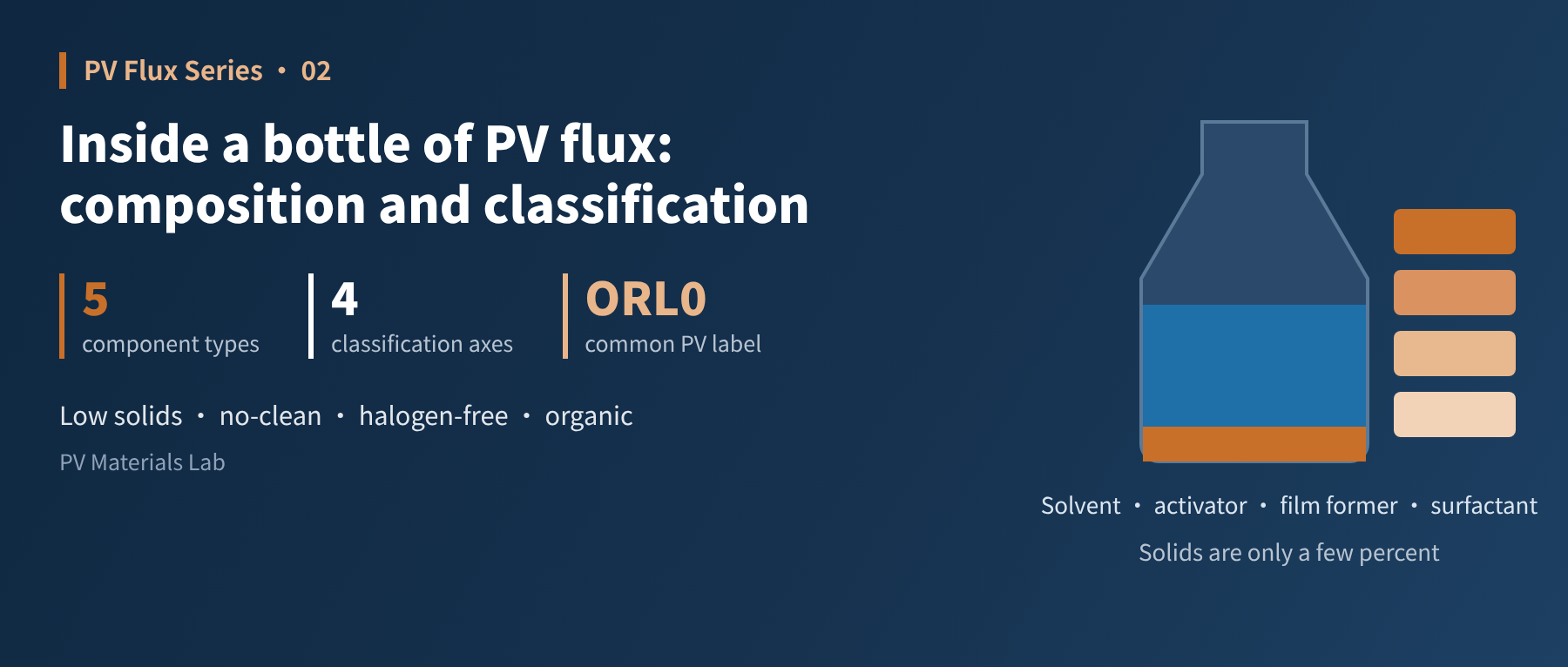
A bottle of PV flux is mostly solvent; the solids that do the work are only a few percent, yet each has a clear role: activators remove oxide, film formers protect and carry, surfactants help spreading, and corrosion inhibitors "clean up afterwards". This article breaks down each component and its trade-offs, sorts flux classification along four dimensions — composition, solvent, halogen and solids content — and explains why PV modules have generally moved to "low-solids, no-clean, halogen-free" fluxes. This is the second article in our PV soldering flux series.
In the last article we covered the four things flux does during soldering: removing oxide, promoting wetting, shielding from air and aiding heat transfer. In this one we "take apart" a bottle of flux to see which components deliver each function, and what actually lies behind the industry's labels — rosin, no-clean, alcohol-based, water-based, halogen-free.
01What is in a bottle of flux
If you put a bottle of low-solids PV flux in an oven and bake off the solvent, what remains at the bottom of the cup is often just a thin film. Two dedicated PV fluxes from public data sheets, for example, list theoretical solids contents of about 1.5% and about 2.0%. In other words, a bottle of flux is mostly solvent, and the solids that do the work are only a few percent.
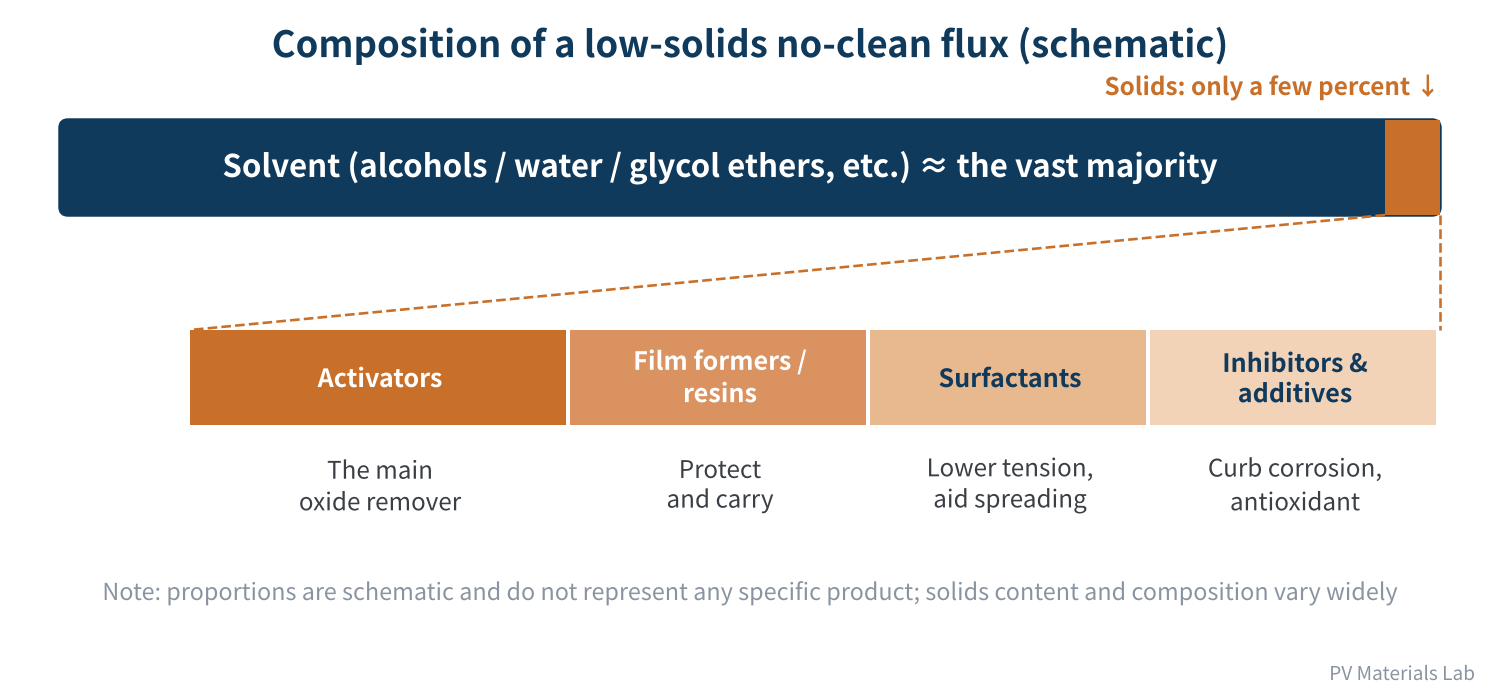
Figure 1 Composition of a low-solids no-clean flux (schematic)
Small as the solid fraction is, it has a clear division of labour. By function, flux components fall into five groups:
| Component | Main role | Common substance classes | Too much / too little |
|---|---|---|---|
| Solvent | Dissolves and carries the other components for application | Alcohols such as isopropanol and ethanol, water, glycol ethers | Evaporates too fast: thickens, dosage drifts; too slow: spatter during soldering, tacky residue |
| Activator | Reacts with metal oxides to clean the surface | Organic acids (mostly dicarboxylic acids), organic amines, halogen activators | Too little: cold joints; too much: higher residue corrosion risk |
| Film former / resin | Covers and protects during soldering; forms a residue film afterwards | Rosin and modified rosin, synthetic resins | Too much: thick, tacky residue; too little: weak protection and carrying |
| Surfactant | Lowers surface tension, aids spreading and penetration | Non-ionic surfactants, etc. | Too little: slow wetting; too much: may add hygroscopic residue |
| Corrosion inhibitors and additives | Curb residue corrosion of metals, antioxidant, stabilise the formulation | Azole inhibitors, antioxidants, stabilisers | Poor choice may affect soldering activity or compatibility with encapsulant |
Table 1 The five component groups of flux
Below we look more closely at the three most important: solvent, activator and film former.
02Solvent: the largest share, the "carrier"
The solvent does not take part in removing oxide, but it decides how the flux goes on, how much, and when it leaves. On a stringer, flux is applied to the ribbon by dipping or spraying, and the solvent must evaporate before or early in the heating zone, leaving only the active components at the joint. By solvent system, PV fluxes fall into two groups, alcohol-based and water-based:
| Item | Alcohol-based flux | Water-based flux |
|---|---|---|
| Main solvent | Mainly alcohols such as isopropanol and ethanol | Mainly water, often with a little alcohol or glycol ether |
| Evaporation rate | Fast; more forgiving preheat window | Slow; more demanding preheat and drying |
| Surface tension | Low; spreads easily by nature | High; relies on surfactants to wet |
| Safety and environment | Flammable; VOC emissions | Non-flammable; low VOC |
| Main risk | Evaporation causes concentration drift; specific gravity must be monitored and thinner added | If water is not fully removed, instant vaporisation during soldering can cause spatter and solder balls |
Table 2 Alcohol-based versus water-based flux
Alcohol-based flux is still common in stringing, while water-based routes attract attention where environmental and safety requirements are stricter. Either way, the solvent's evaporation rate must match the equipment cycle time and preheat temperature — something we will discuss in detail in the process article.
03Activator: the main oxide remover
The activator is the soul of the flux. Its job is to react, at soldering temperature, with the oxides on the ribbon's tin coating and the cell's finger surface, "eating" the oxide film so molten solder contacts the metal directly. Activators in PV no-clean fluxes are mostly organic acid systems, typically a class of organic acids with two carboxyl groups (dicarboxylic acids); some formulations add organic amines to adjust activity and pH; halogen-containing fluxes use halogen activators for stronger activity.
The difficulty in activator design is timing. Ideally it should become fully active in the window from late preheat to around the solder melting point, doing its oxide-removal job; after soldering it should be consumed, decomposed or evaporated as far as possible, leaving no "activity" in the residue. If activation temperature and the soldering temperature profile do not match, one of two things happens: activation comes too early and is "spent" by the time soldering starts; or it comes too late or decomposes incompletely, leaving acid in the residue to keep reacting with metal in damp heat.
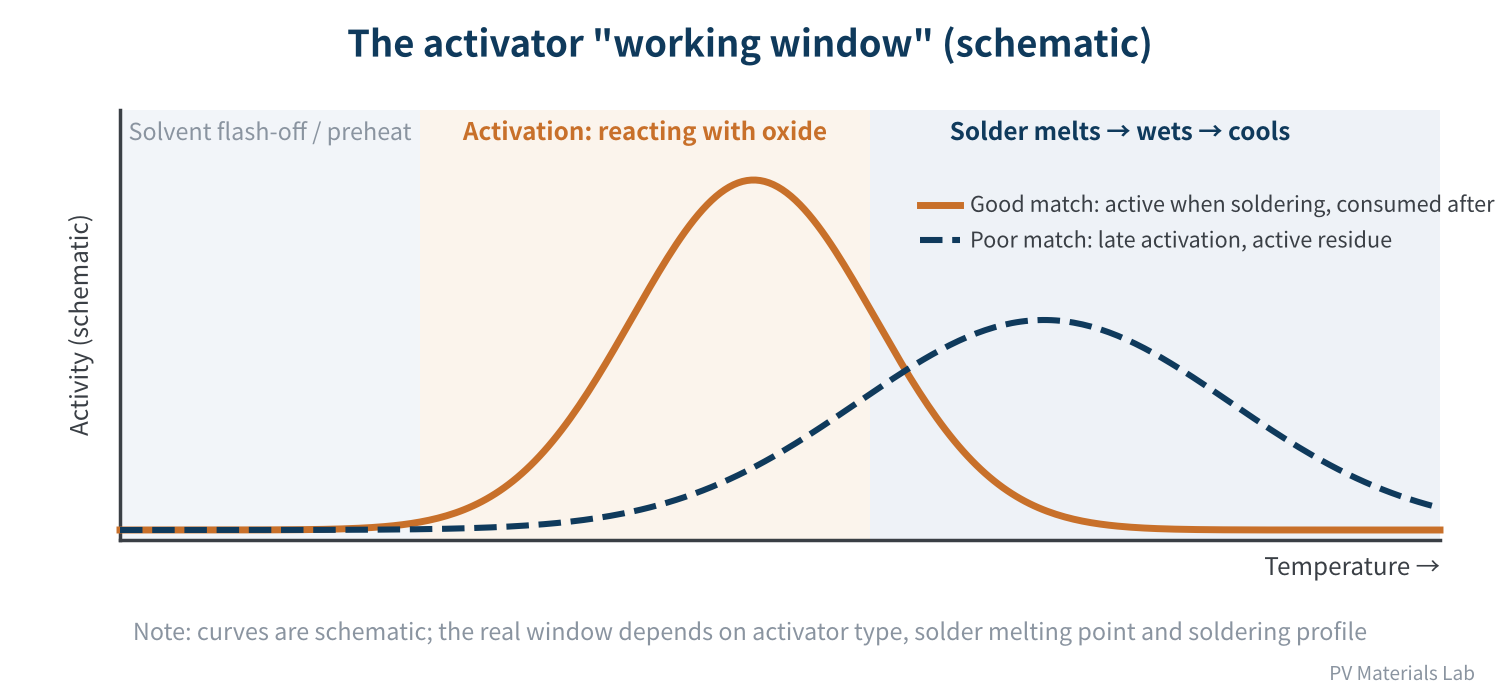
Figure 2 Matching the activator "working window" to the soldering temperature (schematic)
This also explains why flux usually has to be re-verified after changing ribbon (for example to low-temperature ribbon) or heating method. UNSW's TOPCon research likewise observed that halogen-containing flux is markedly more corrosive, but halogen-free flux with dicarboxylic acid activators also causes considerable degradation, so the team recommended controlling both halogen and acid content. In the team's late-2025 follow-up tests, a halogen-containing flux based on azelaic acid and a halogen-free flux based on succinic acid both caused clear contact corrosion in damp heat — the acid itself is a source of risk, so attention cannot stop at halogens.
Stronger is not better for an activator. It should "act when needed and stop when the joint is made". Activity, temperature window and residue corrosivity must be considered together.
04Film formers, surfactants and other supporting roles
- Film formers / resins: traditional electronics fluxes are often rosin-based. Rosin melts over the joint during soldering and cools into a fairly stable residue film that "encapsulates" leftover active substances. To reduce residue, low-solids PV fluxes often cut rosin sharply or drop it altogether, which weakens this encapsulating effect and raises the bar for the activator itself to be low-corrosion.
- Surfactants: used in tiny amounts but with a clear effect on wetting speed, and practically indispensable in water-based systems. They help the flux spread evenly over the ribbon and help molten solder penetrate the gap between ribbon and fingers.
- Corrosion inhibitors: dedicated to "cleaning up": they form a protective layer on metal surfaces, reducing corrosion of copper, silver and tin by residue in damp heat.
- Other additives: antioxidants, stabilisers and the like, keeping the flux stable in storage and use, without separating or discolouring.
In PV, these supporting components face one extra test: compatibility with EVA/POE encapsulant. Residue is in direct contact with the encapsulant during lamination, and any poorly chosen component may show up in later ageing as yellowing, bubbles or delamination. We will cover this in the reliability article.
05Four dimensions that sort out flux classification
The industry has many names for fluxes, but they reduce to four dimensions. Once the dimensions are clear, the terms stop getting mixed up.
- By composition: IPC J-STD-004 classifies flux by the largest constituent of its non-volatile portion: rosin (RO), resin (RE), organic (OR) and inorganic (IN). Low-solids no-clean PV fluxes, containing little rosin or resin, are usually classed as OR. Note that OR does not mean "must be water-washed" — many OR products are precisely no-clean.
- By solvent system: alcohol-based and water-based, compared above.
- By halogen content: J-STD-004B and later (currently Revision C) draw the line at 0.05% (by weight) of halide ions in the flux solids: below it is designated "0", strictly "halide-free"; at or above it, "1". According to industry sources, the original version's threshold was 0.5%, so a product labelled "L0" in old data may become "L1" under the new version — check the version when comparing data. As the last article explained, "halogen-free" is a different measure; do not mix the two.
- By solids content: fluxes with lower solids are usually called low-solids fluxes. The lower the solids, the less residue, but the more is demanded of the formulation's activity and wetting.
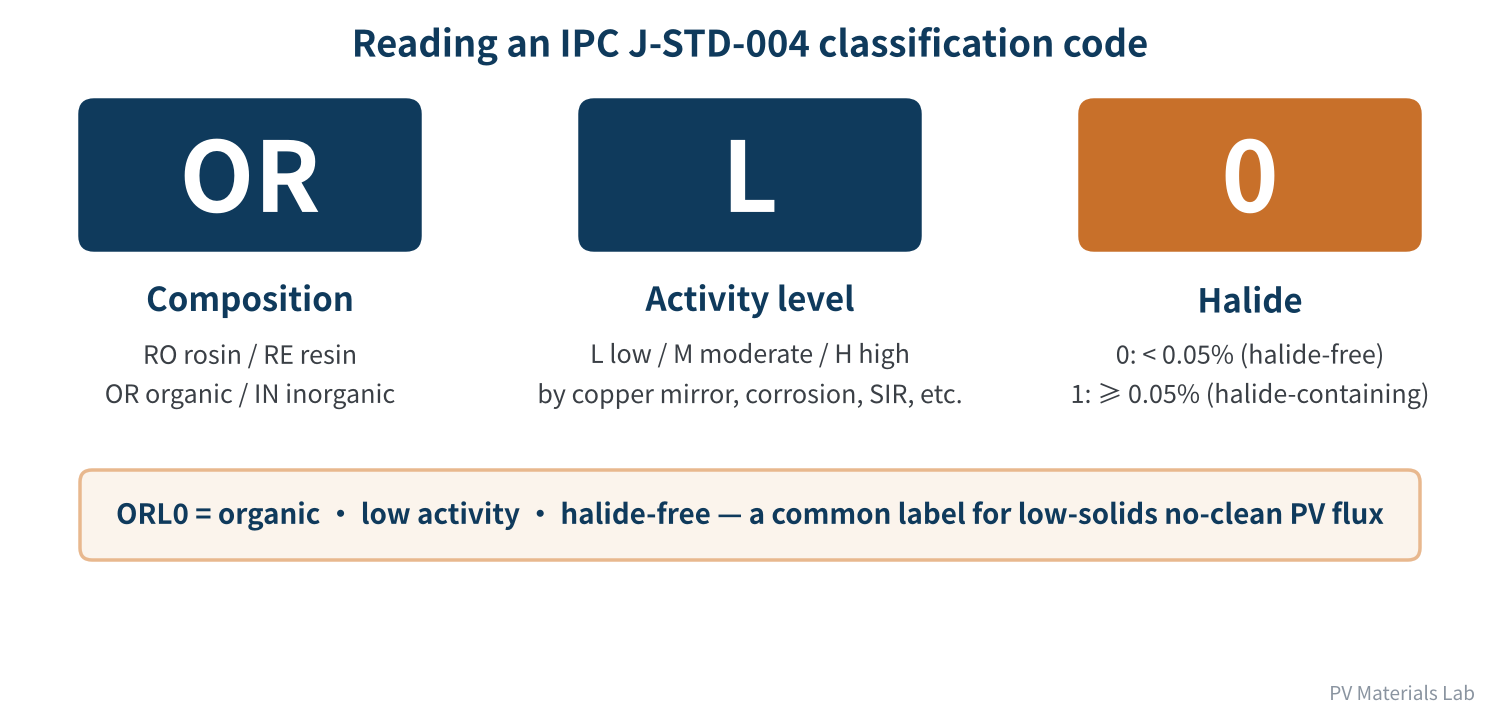
Figure 3 Reading an IPC J-STD-004 classification code
Put these dimensions together and you can read the classification codes in product data. For example, the technical data sheet for one multi-busbar (MBB) PV flux, updated in April 2026, lists it as ORL0 — organic, low activity, halide-free — with a stated solids content of 2.0%, an acid value of about 15.8 mg KOH/g, suitability for fine round wire ribbon of 0.4 mm diameter or less, and passes in both IEC 61249 and JEDEC low-halogen tests. Note too that "no-clean", as commonly used, is not a J-STD-004 class but a way of use: residue small and "quiet" enough that no cleaning is needed after soldering.
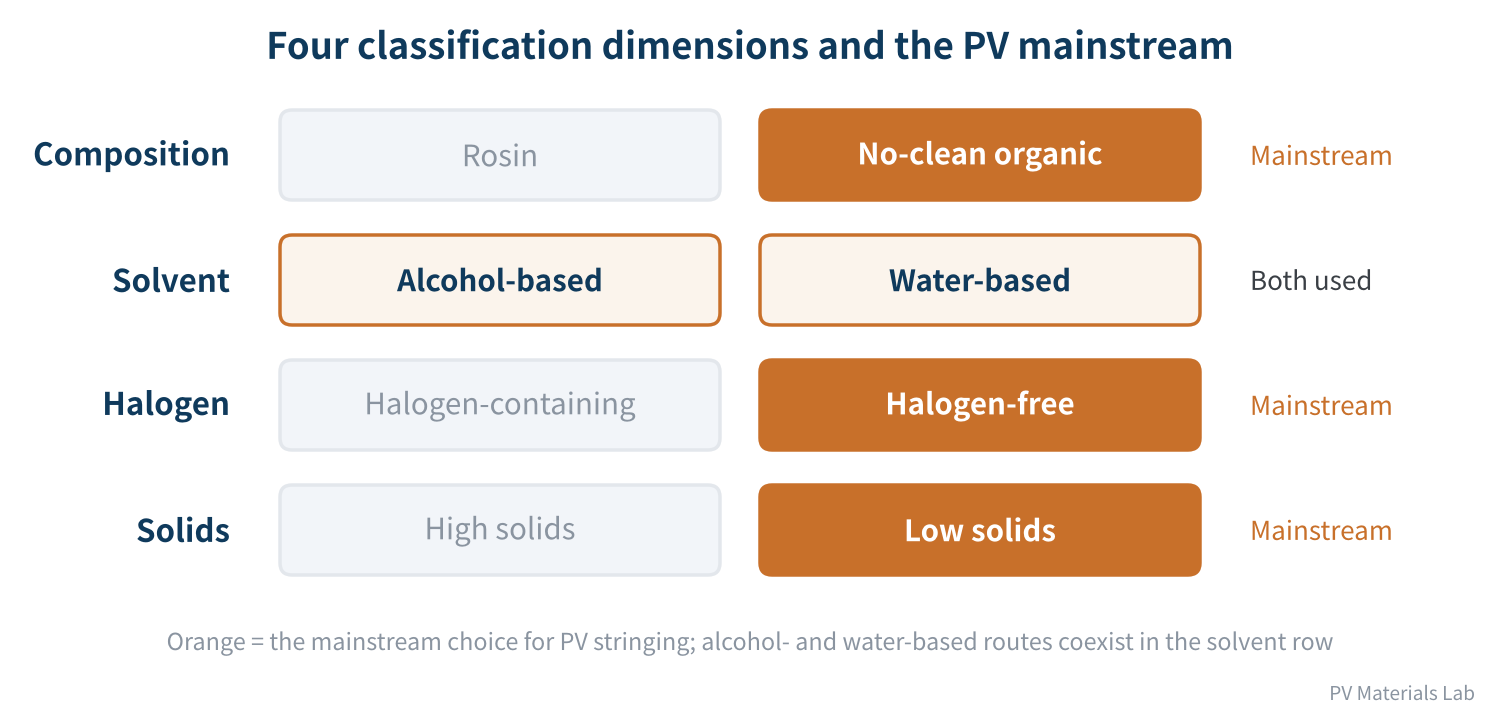
Figure 4 Four classification dimensions and the mainstream choice for PV modules
No cleaning after soldering, residue sealed in permanently by lamination, and two or three decades outdoors: these three conditions together push PV flux towards the combination of "low solids + no-clean + halogen-free + organic".
06Final thoughts
Taking a bottle of flux apart, three points are worth remembering:
- Solvent is the bulk: it decides how the flux goes on, how much and when it leaves, affecting process stability;
- The activator is the core: it decides whether the joint forms and whether the residue stays "quiet"; activity and corrosivity must be weighed together;
- Classification has four dimensions: composition, solvent, halogen and solids content — understand these and product data stops being confusing.
Knowing what flux is made of, the next question is how to judge whether a flux is any good. In the next article we will read a flux technical data sheet (TDS) and certificate of analysis (COA) together, looking at what solids content, acid value, specific gravity, halogens, spread rate, copper mirror corrosion and surface insulation resistance each mean, and how values that are too high or too low show up on the production line.
Is your line using alcohol-based or water-based flux? What pitfalls did you hit when switching? We would be glad to hear from you.
References
- IPC J-STD-004C with Amendment 1, Requirements for Soldering Fluxes, IPC, 2022
- Indium Corporation: What a J-STD-004 Classification of OR Means and What It Doesn't Mean, https://www.indium.com/blog/what-a-j-std-004-classification-of-or-means-and-what-it-doesnt-mean/
- PCBSync: J-STD-004 Flux Classification Explained (on halide threshold changes between versions), https://pcbsync.com/j-std-004/
- MacDermid Alpha: ALPHA SF828-MBB PV flux technical data sheet, April 2026, https://www.macdermidalpha.com/sites/default/files/2026-04/ALPHA-SF828-MBB-LFX-TDS-GL-EN-01Apr2026.pdf
- MacDermid Alpha: Kester SF800-LR PV flux technical data sheet, 2021, https://www.macdermidalpha.com/sites/default/files/2022-04/Kester-SF800-LR-Soldering-Flux-EN-22Jan21-TB.pdf
- pv magazine: UNSW study shows impact of soldering flux on TOPCon solar cell degradation, 2025, https://www.pv-magazine-india.com/2025/08/18/unsw-study-shows-impact-of-soldering-flux-on-topcon-solar-cell-degradation
- A. Li et al.: Elucidating the Impact of Soldering Flux-Induced Degradation on the Reliability of TOPCon Solar Cells with and without Laser-Assisted Firing under Damp-Heat Stress, APVI Solar Research Conference, December 2025, https://apvi.org.au/solar-research-conference/wp-content/uploads/2025/12/48.pdf
- GB/T 9491-2021 Soldering Fluxes, State Administration for Market Regulation and Standardization Administration of China, 2021 (in Chinese)
A PV R&D and technology team with 10+ years of experience | In-depth technical knowledge sharing
Materials · Reliability · Failure Analysis · Standards & Certification · Products · Processes
Exploring AI + PV; collaboration welcome
Disclaimer:
1. Original content reflects the authors' personal views only, is for reference only and does not constitute investment advice.
2. Reposted and cited content is credited to its source, out of respect for original work.
3. Some content was produced with AI assistance (chart generation, data retrieval, concept explanations, etc.); the core framework and key content were written by our technical team and reviewed by people.
4. If anything is inaccurate or infringes your rights, please leave a message or contact us and we will deal with it.