
How Is PV Soldering Flux Tested? Standards, Test Methods and Three Tiers of Validation
In brief
The last article covered which flux indicators to look at; this one covers how they are measured. We map the main flux standard systems (GB/T 9491-2021, IPC J-STD-004 with IPC-TM-650, ISO 9454/9455, JIS Z 3197), explain the principle and method of each core test, divide testing into three tiers — incoming inspection, type testing and qualification — and finish with simple tests a factory lab can run itself. The core point: these are all general soldering standards, and module makers must fill in the PV-specific risks themselves. This is the fourth article in our PV soldering flux series.
In the last article we read the indicators on a TDS and COA. The natural follow-up questions are: how are these numbers measured, to which standard, and which can our own lab test? This article answers them. The conclusion first: flux standards are mature, but none of them were written for PV.
01The standards map: four main systems
Flux-related standards fall into four main systems. Their test approaches are broadly similar; they differ more in how they are organised and how they are used.
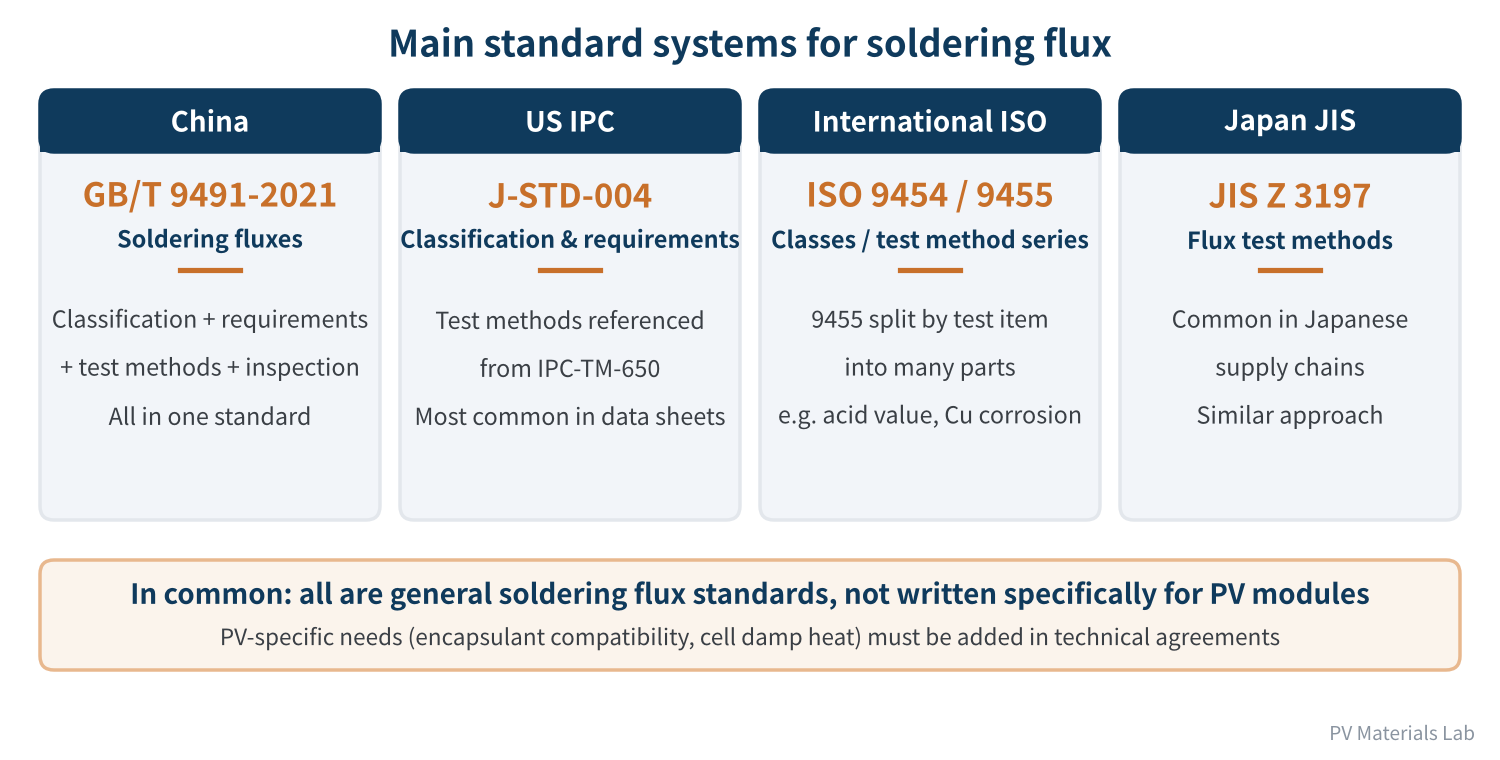
Figure 1 Main standard systems for soldering flux
- GB/T 9491-2021 Soldering Fluxes: China's current national standard, issued at the end of 2021 and replacing the 2002 edition. The old edition was titled "Liquid fluxes for soldering (rosin-based)"; the new one drops the "rosin-based" restriction and covers a wider range. Its classification is close to international practice — composition by rosin, resin, organic and inorganic, subdivided by activity and halogen content. It puts classification, technical requirements, test methods and inspection rules all in one standard, making it fairly self-contained.
- IPC J-STD-004 + IPC-TM-650: J-STD-004 sets out flux classification and requirements, and refers to individual methods in the IPC-TM-650 test methods manual for how to test. Most international suppliers label their data sheets under this system, such as the ORL0 mentioned in earlier articles. Note that IPC released Revision D (J-STD-004D) at the end of 2023, while most supplier documents are still labelled under Revision B or C, so check the version when comparing data.
- ISO 9454 / ISO 9455: ISO 9454 covers classification; ISO 9455 is a series divided by test item, with separate parts for acid value, solubility of residues, spattering, residue tackiness, copper corrosion and so on.
- JIS Z 3197: Japan's test method standard for fluxes, common in Japanese materials and equipment supply chains.
In practice, Chinese suppliers' reports are mostly issued to GB/T 9491 and international brands' to J-STD-004. When comparing two suppliers' data, the first step is to confirm they used the same standard and the same version; otherwise the numbers are not comparable.
02How the core tests are done
Taking IPC-TM-650 as the example, the table below lists the core flux tests and their methods. GB/T 9491 has corresponding tests on essentially the same principles.
| Test | What it measures / how | IPC-TM-650 method |
|---|---|---|
| Solids content | Weigh, dry, calculate the non-volatile share | 2.3.34 |
| Acid value | Titrate with potassium hydroxide solution, potentiometric or indicator method | 2.3.13 |
| Halides (qualitative) | Silver chromate paper for a quick check for chloride and bromide | 2.3.33 |
| Halides (quantitative) | Ion chromatography for halide content | 2.3.28.1 |
| Fluoride | Spot test, qualitative | 2.3.35.1 |
| Copper mirror corrosion | Flux on vacuum-coppered glass; check whether the film is penetrated | 2.3.32 |
| Copper plate corrosion | Hold soldered specimens in damp heat; look for corrosion products | 2.6.15 |
| Spread | Melt solder on a coupon and measure how far it spreads | 2.4.46 |
| Wetting balance | Measure wetting force over time to judge wetting speed | 2.4.14.2 |
| Surface insulation resistance (SIR) | Comb electrodes, heat and humidity, bias, continuous resistance monitoring | 2.6.3.7 |
| Electrochemical migration (ECM) | Look for dendrite growth under long-term bias | 2.6.14.1 |
| Residue dryness | Is the residue tacky after soldering? | 2.4.47 |
Table 1 Core flux tests and IPC-TM-650 methods
Of these, copper mirror and SIR are the most informative and the most easily misread, so we explain them separately.
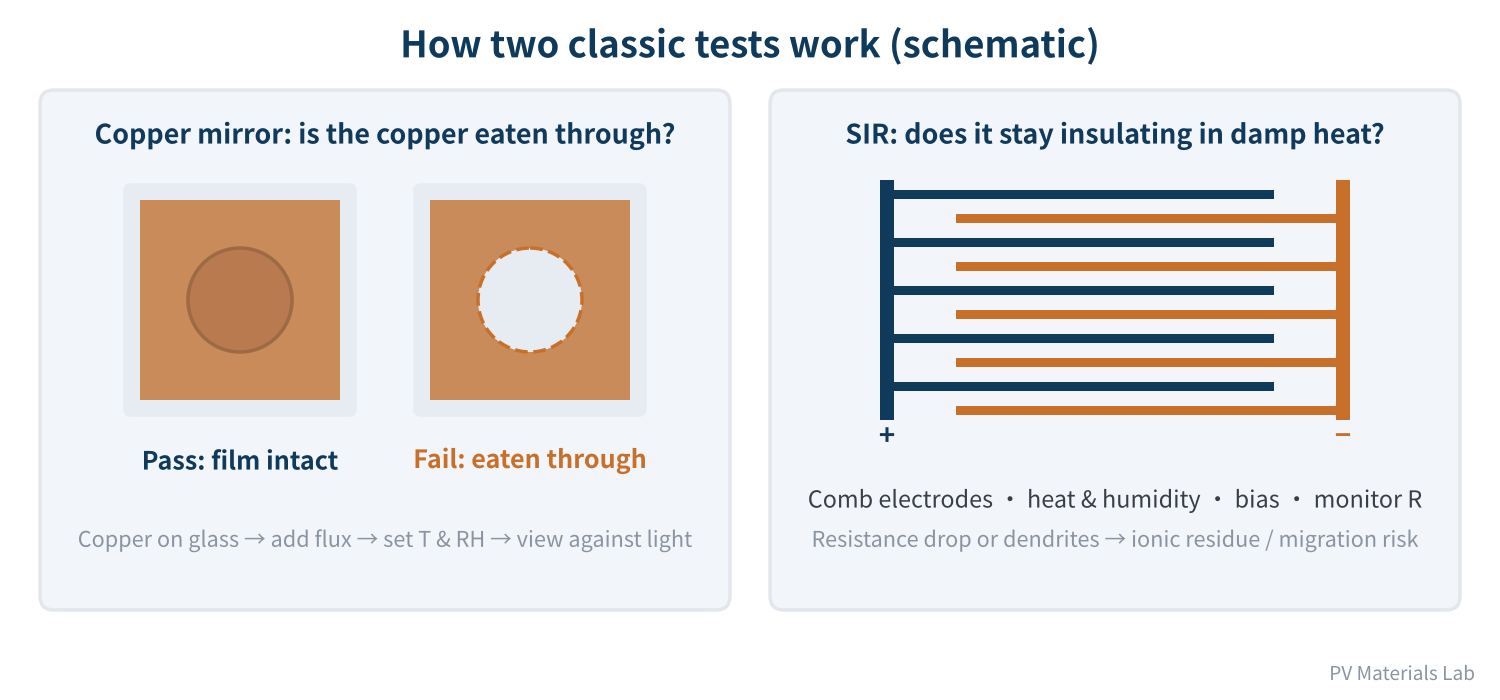
Figure 2 How the copper mirror and SIR tests work (schematic)
- Copper mirror corrosion: the copper film is very thin and highly sensitive to corrosion, so this is a "magnifying glass" style quick screen. Passing shows the residue's short-term corrosion tendency is low, but it does not simulate long-term damp heat or involve silver, ITO and other electrode materials common in PV.
- SIR: it examines whether residue becomes a conductive path under damp heat and bias — essentially an electronics reliability test. Its optional 85 °C/85% RH condition matches module damp heat testing and is somewhat informative, but the test vehicle is a PCB comb electrode, not a cell surface.
Standard tests answer "which class does this flux belong to, and are batches consistent?". They cannot answer "will it survive two or three decades in my cell and encapsulant system?".
03Three tiers: who tests, what, and when
Putting every test into incoming inspection is neither realistic nor necessary. We suggest dividing flux testing into three tiers:
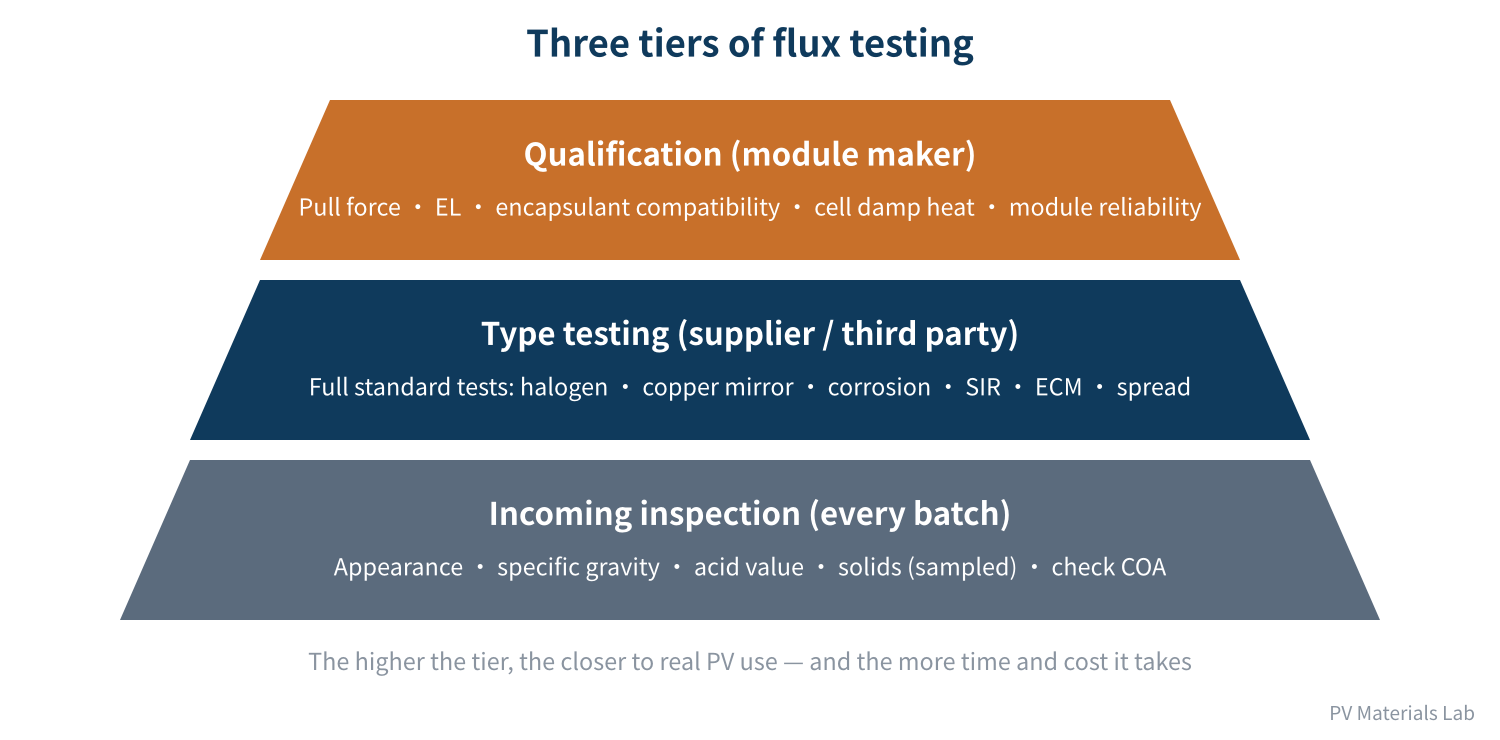
Figure 3 Three tiers of flux testing
| Tier | Who | Main items | When |
|---|---|---|---|
| Incoming inspection | Module maker's IQC | Appearance, specific gravity, acid value, solids (sampled), COA check | Every batch |
| Type testing | Supplier or third-party lab | Full standard tests: halides, copper mirror, corrosion, SIR, ECM, spread, etc. | New product introduction, formulation or process change, periodic review |
| Qualification | Module maker's R&D / process / reliability teams | Pull force, EL, encapsulant compatibility, cell-level damp heat, module reliability | New product introduction, change of cell or ribbon system |
Table 2 Three tiers of flux testing
Two lessons from experience:
- Type test reports need a date and a version: third-party reports from suppliers should state the standard version and test date. When the formulation, raw material source or production site changes, old reports no longer apply and must be reissued through a product change notification (PCN).
- Incoming inspection needs a baseline: during qualification, use your own methods and equipment to set baselines and control ranges for acid value, specific gravity and solids on the batches that passed validation. Compare every later batch with that baseline, not just with the TDS.
04Simple tests a factory lab can run
Not every test has to go to a third party. A typical module maker's lab can set up the following with modest investment, for incoming re-checks and troubleshooting:
- Acid value titration: weigh a sample of flux, dissolve it in alcohol, titrate to the end point with standard potassium hydroxide solution, and calculate acid value from the volume used. The manual indicator method costs very little; an automatic potentiometric titrator is more repeatable. As the last article explained, it is the most useful concentration monitor for low-solids flux.
- Solids content: weigh, then dry at a set temperature and time to constant weight, and calculate the non-volatile share. Use the same conditions every time so results can be compared with the baseline.
- Specific gravity: measure with a hydrometer or digital density meter. Fast and fine for initial screening, but record the temperature too.
- Halides (qualitative): silver chromate paper gives a quick result in minutes, useful for spot-checking "halogen-free" products for anomalies.
- Copper mirror corrosion: mirror slides can be bought ready-made and held in a climate chamber under set conditions before inspection. Simple to run.
- Post-solder residue observation: solder real ribbon to real cells on the line or bench, examine the shape, extent and colour of residue around joints under a microscope, and photograph it as a reference for later batches and anomalies.
The point of simple tests is not precision but spotting batch-to-batch anomalies quickly. Once a simple test shows a deviation, there is still time to send samples to a third party or ask the supplier to retest.
05PV-specific validation: what general standards do not cover
As far as our public searches show (as of November 2026), there is still no national or industry standard specifically for flux used in PV modules. Common practice is to use GB/T 9491 or J-STD-004 as the general basis, with module makers adding PV-specific requirements through technical agreements and internal validation. These mainly include:
- Encapsulant compatibility: laminate small samples using the actual flux, ribbon, cells and EVA/POE, then after UV and damp heat ageing check for yellowing, bubbles or delamination around the ribbons.
- Cell-level damp heat: UNSW's research recommends damp heat testing of unencapsulated cells before module encapsulation, to screen quickly for a flux's corrosion risk to the metal contacts and transparent conductive films of TOPCon and HJT cells. These tests are short and cheap, suiting early screening during qualification. The team's late-2025 work used bare cells at 85 °C/85% RH for 45 hours, separating different fluxes and processes within a few dozen hours; KETI's HJT study in Korea likewise saw EL dark spots after 45 hours of damp heat.
- Module-level reliability: ultimately everything comes back to the module, with damp heat (DH), thermal cycling (TC) and humidity freeze (HF) testing to IEC 61215, plus extended testing as needed, judging the flux system by EL and power loss.
Standard tests are the "entry ticket", proving which class a flux belongs to and that its quality is stable. PV-specific compatibility and damp heat validation are the "passport", proving it will be reliable long term in your cell and encapsulation system.
06Final thoughts
On flux testing, remember three points:
- Align the standards: GB/T 9491 and J-STD-004 are the two most used; confirm the standard and version before comparing data;
- Test in tiers: incoming inspection governs batch consistency, type testing governs classification and compliance, and qualification governs long-term reliability in PV use;
- PV has to fill the gap: general standards do not cover encapsulant compatibility or cell damp heat sensitivity, so module makers must validate these themselves.
That completes the basics of flux — what it is, what to look at and how to test it. The next article moves to process: how is flux applied on the stringer, how is dosage controlled, how are evaporation and top-ups managed, and how does it match heating methods such as infrared and induction and their temperature profiles?
What internal validation does your company run on flux? Have you seen cases where every standard test passed but modules still failed in ageing? We would be glad to hear from you.
References
- GB/T 9491-2021 Soldering Fluxes, State Administration for Market Regulation and Standardization Administration of China, 2021 (in Chinese)
- IPC J-STD-004D, Requirements for Soldering Fluxes, IPC, 2023/2024; IPC J-STD-004C with Amendment 1, 2022
- IPC-TM-650 Test Methods Manual (2.3.13, 2.3.28.1, 2.3.32, 2.3.33, 2.3.34, 2.3.35.1, 2.4.14.2, 2.4.46, 2.4.47, 2.6.3.7, 2.6.14.1, 2.6.15), https://www.ipc.org/sites/default/files/test_methods_docs/2.4.46a.pdf
- ISO 9454 / ISO 9455 Soft soldering fluxes (series), ISO/TC 44/SC 12
- JIS Z 3197:2021 Test methods for soldering fluxes
- Vital (唯特偶): Flux classification and test standards based on GB/T 9491-2021, technical article (in Chinese)
- Indium Corporation: Breakdown of SIR Standards, https://www.indium.com/blog/breakdown-of-sir-standards/
- pv magazine: UNSW study shows impact of soldering flux on TOPCon solar cell degradation, 2025, https://www.pv-magazine-india.com/2025/08/18/unsw-study-shows-impact-of-soldering-flux-on-topcon-solar-cell-degradation
- A. Li et al.: Elucidating the Impact of Soldering Flux-Induced Degradation on the Reliability of TOPCon Solar Cells…, APVI Solar Research Conference, December 2025, https://apvi.org.au/solar-research-conference/wp-content/uploads/2025/12/48.pdf
- G. Park et al.: Soldering flux causes corrosion of indium tin oxide electrode in heterojunction solar cells, Cell Reports Physical Science, 2025, https://www.sciencedirect.com/science/article/pii/S2666386425002188
- IEC 61215-2:2021 Terrestrial photovoltaic (PV) modules — Design qualification and type approval — Part 2: Test procedures
A PV R&D and technology team with 10+ years of experience | In-depth technical knowledge sharing
Materials · Reliability · Failure Analysis · Standards & Certification · Products · Processes
Exploring AI + PV; collaboration welcome
Disclaimer:
1. Original content reflects the authors' personal views only, is for reference only and does not constitute investment advice.
2. Reposted and cited content is credited to its source, out of respect for original work.
3. Some content was produced with AI assistance (chart generation, data retrieval, concept explanations, etc.); the core framework and key content were written by our technical team and reviewed by people.
4. If anything is inaccurate or infringes your rights, please leave a message or contact us and we will deal with it.