
A Practical Guide to PV Industry Jargon
A plain-language guide to manufacturing, cell technologies, module performance, reliability testing and project economics, with the conditions behind common claims.
“Use n-type 210R cells, SMBB and bifacial glass-glass construction. Check CTM first, stop chasing wattage, and freeze the BOM before DH.” This fictional meeting remark resembles what a newcomer might hear on a first day in photovoltaics: familiar words surrounded by unfamiliar assumptions.
PV jargon combines formal terminology, English abbreviations, proprietary names and informal Chinese expressions. Understanding it means identifying the object being discussed, the denominator used for comparison and the conditions that make a statement valid. This guide follows a crystalline-silicon module from manufacturing to electricity generation.
01 The value chain and what is being sold
The Chinese shorthand liao, pian, dianchi and zujian usually refers to solar-grade polysilicon, wafers, solar cells and modules. A solar cell converts light into electricity; it is not a storage battery. A module interconnects and encapsulates cells into an installable product. Upstream, midstream and downstream describe relative positions. Polysilicon and wafers are commonly placed toward the front, cells and modules in manufacturing, and project development and operation downstream, but the boundary depends on the discussion.
Auxiliary materials include glass, encapsulants, backsheets, interconnect ribbons, frames and junction boxes. The label does not mean they are unimportant. BOM means bill of materials; practical discussions often include material grades, suppliers and combination revisions. A BOM change can affect power, processing and reliability, rather than merely changing a purchasing code.
Vertical integration means covering multiple manufacturing stages. Contract manufacturing means producing on another party’s behalf, so a brand alone does not identify the actual factory. Capacity describes production capability on a specified basis; output is what was manufactured; shipments are what was dispatched. They are different measures. Production schedules, utilization and full-capacity operation also require a period, line scope and denominator. Announced completed capacity may not yet be operating stably.
02 Technology names describe different dimensions
P-type and n-type primarily describe the doping type of the silicon base, not module terminal polarity. The labels 182 and 210 usually refer to wafer size platforms; R commonly marks rectangular wafer families. These labels are not complete dimensional specifications. Purchasing requires actual length, width, thickness, tolerances and cutting format. A 210R label does not establish identical dimensions across suppliers.[1]
| Term | What it usually describes |
|---|---|
| PERC | Passivated emitter and rear cell, a cell architecture |
| TOPCon | Tunnel oxide passivated contact, emphasizing contact passivation |
| HJT | Heterojunction technology, commonly combining crystalline silicon and thin amorphous-silicon layers |
| BC | Back contact, placing both polarities of metal electrodes on the rear |
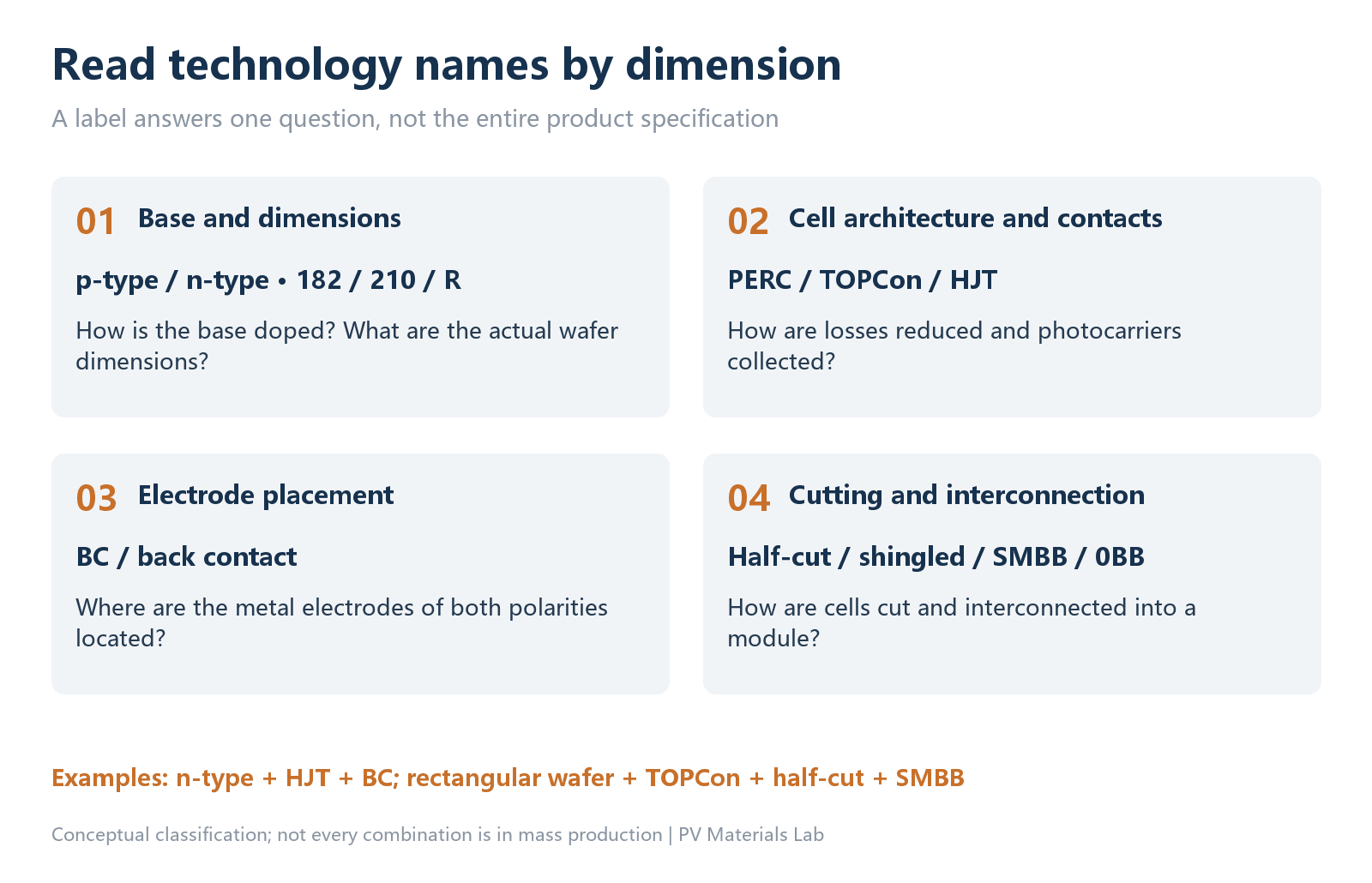
Figure 1 Technology terms belong to different dimensions and can be combined. This schematic does not imply that every combination is in mass production.
These labels do not all occupy the same classification level. BC describes electrode placement and can be combined with different passivating-contact approaches; combining HJT and BC is one example.[2] Names such as HPBC and ABC also carry proprietary meanings, so readers should identify the actual structure and product model.
MBB and SMBB commonly mean multi-busbar and super multi-busbar interconnection. 0BB means a zero-busbar approach, typically eliminating conventional printed cell busbars; it does not mean no fingers, metal or interconnection wires. Half-cut and third-cut describe cell cutting and interconnection designs. Shingling overlaps cell strips like roof tiles; it is different from a tandem cell.
03 Performance claims require a denominator
Bao wa, loosely translated as a wattage breakthrough, is informal Chinese shorthand for measured module power exceeding an expectation or benchmark. Ask what benchmark is used, then check area, cell count, measurement conditions and uncertainty. A larger module can deliver more watts without having higher conversion efficiency.
STC means standard test conditions: typically irradiance of 1,000 W/m², cell temperature of 25°C and an AM1.5 reference spectrum. The 25°C value is not ambient air temperature. A 600 W rating is power under specified conditions; a kilowatt-hour is energy. One Chinese du of electricity equals 1 kWh. A 600 W module cannot be described as generating 600 kWh per day simply from its rating.
An efficiency improvement of one point also needs clarification. Moving from 25% to 26% is a gain of one percentage point and a relative increase of approximately 4%. Identify cell versus module efficiency, a champion sample versus a production average, and the area basis used.
Glass-glass describes the front and rear cover construction; bifacial describes electricity generation from both faces. They are not synonyms. For a maximum-power-based definition, bifaciality is rear-side maximum power divided by front-side maximum power under the same specified conditions. An 80% bifaciality factor does not mean 80% more outdoor energy. If rear irradiance is only 10% of front irradiance, a simplified linear estimate gives a contribution of roughly 8% of front-side power. Actual gain also depends on mounting, reflection, shading and mismatch.[10]
A lower temperature coefficient is ambiguous. For a negative maximum-power temperature coefficient, a smaller absolute value is generally preferred. With a coefficient of −0.30%/°C and cell temperature rising from 25°C to 65°C, a linear estimate gives about 12% lower power with other conditions unchanged. This is not an annual energy-loss estimate.
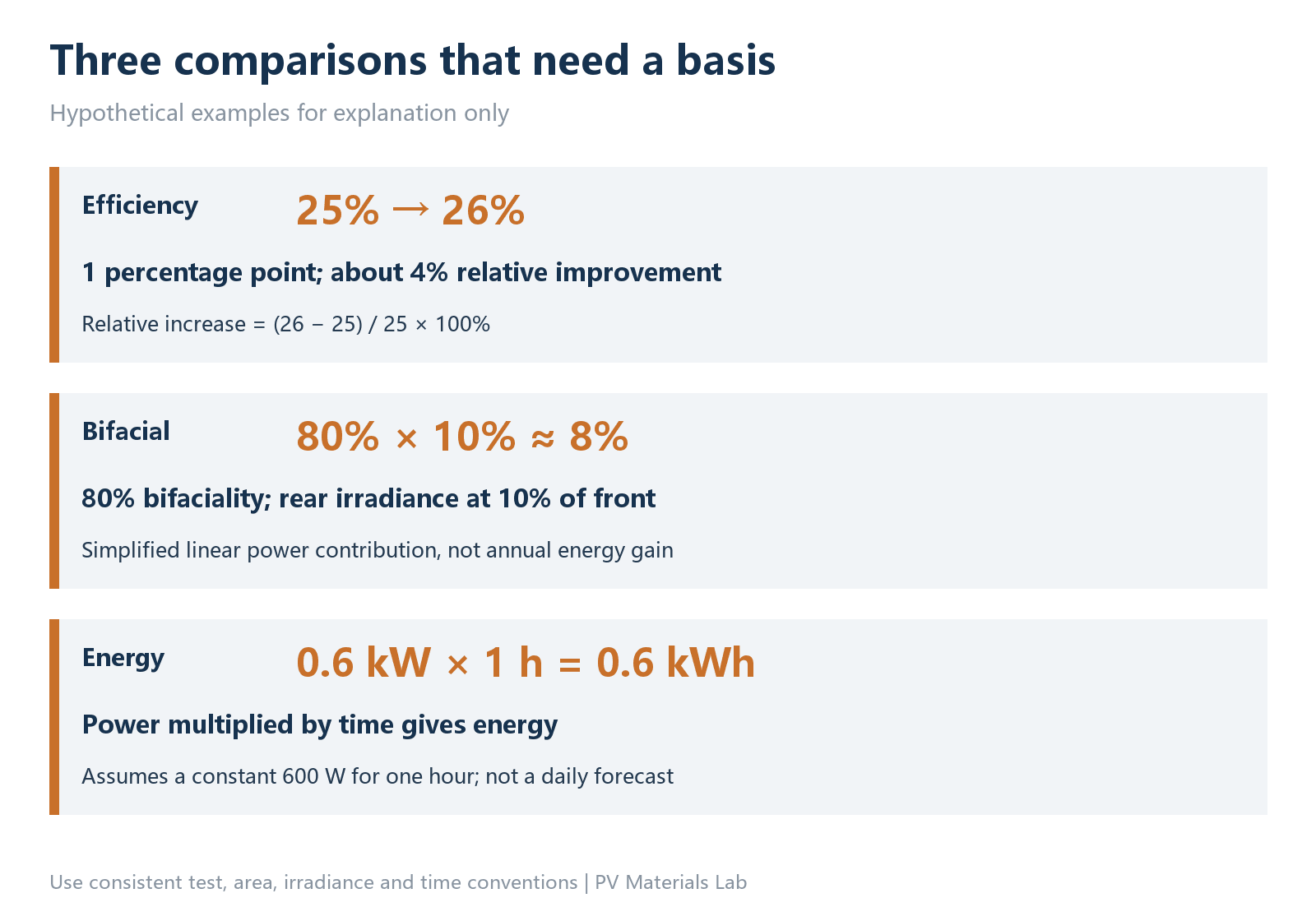
Figure 2 Three easily confused numerical comparisons. All values are hypothetical teaching examples and do not represent a particular product.
04 Manufacturing and quality depend on the process
CTM means cell-to-module. The power CTM ratio commonly discussed in factories equals module maximum power divided by the sum of the powers of the cells used. It captures combined integration gains and losses. Comparisons require consistent cell measurement, cutting and counting conventions. Optical coupling and other gains can produce a CTM ratio above 100% without violating energy conservation. CTM is not module conversion efficiency.[3]
Binning groups products by power, current, color or other properties. Mismatch describes losses caused by electrical differences among interconnected units. Yield could mean cell yield, module first-pass yield or acceptance after rework. Grade A, Grade B and downgraded products should not be treated as universal quality guarantees. Contracts must specify defects, inspection rules and warranties.
EVA, POE and EPE are common encapsulant terms. EVA is ethylene-vinyl acetate copolymer; POE means polyolefin elastomer. In PV encapsulation, EPE commonly describes an EVA/POE/EVA coextruded structure, rather than the expanded-polyethylene foam used in packaging. The material family alone is insufficient: formulation, thickness and layer proportions also affect performance. Selection still requires validation with the cell, module format and process.[11]
Lamination encapsulates a module using heating, vacuum and pressure, among other process steps. Crosslinking degree evaluates crosslinking in certain encapsulant systems; higher is not automatically better, and it cannot replace adhesion, insulation or aging assessment. Xu han refers to an inadequate solder connection; microcracks are cell cracks that may be difficult to see. Both require inspection and electrical assessment rather than diagnosis from a single appearance photograph.
05 Testing and certification do not guarantee thirty years
EL means electroluminescence imaging, which reveals electrical nonuniformities inside cells and modules. IV testing measures the current-voltage characteristic and parameters such as power. Dark EL regions may indicate cracks, contact problems or other issues. Images provide diagnostic clues rather than a complete failure-mechanism analysis.
DH1000 and TC200 commonly mean 1,000 hours of damp heat and 200 thermal cycles. The former typically uses 85°C and 85% relative humidity; the latter typically cycles between −40°C and +85°C. Complete procedures also specify dwell times, current injection, characterization and acceptance criteria. Execution requires the applicable standard and edition.[4][5]
PID, LID and LeTID mean potential-induced degradation, light-induced degradation and light- and elevated-temperature-induced degradation. They have different triggers and mechanisms, so not every power loss is PID. A hot spot is abnormal localized heating, not a problem exclusive to one cell technology.
First-year degradation, linear degradation and power warranties must also be distinguished from measured results. A warranty curve defines obligations under agreed conditions; it is not a year-by-year forecast for each module. Zero degradation is difficult to compare without test duration, stress conditions, measurement uncertainty and sample size. It cannot be extrapolated to permanent stability in every climate.
Passed certification needs a standard, edition, certificate scope, product construction and BOM. IEC 61215 addresses design qualification and type approval; IEC 61730 focuses on safety qualification. Actual service life also depends on design, environment and operation. IEC explicitly states that design-qualification test results are not a quantitative prediction of module lifetime.[6][9]
06 Projects and commercial language lead to energy and cash flow
The DC/AC ratio commonly divides module-side rated DC capacity by inverter-side rated AC capacity. A 120 kWp array paired with 100 kW AC capacity has a ratio of 1.2. It is not efficiency, and increasing it alone does not establish a better project. Clipping here means available power is not converted after inverter output reaches its limit. Curtailment may arise from external constraints such as grid dispatch; the two should be recorded separately.
PR, or performance ratio, normalizes energy output by installed capacity and plane-of-array irradiation to help assess system losses. It is not cell conversion efficiency.[7] Equivalent full-load hours usually divide energy over a period by rated capacity, using a consistent DC or AC basis. They do not measure the number of hours the sun actually shone.
| Term | Meaning to confirm in practice |
|---|---|
| EPC | Engineering procurement and construction contracting; responsibilities depend on the contract |
| BOS | Balance of system beyond modules; cost boundaries must be consistent |
| LCOE | Levelized cost of electricity, typically discounted lifetime costs divided by discounted electricity generation[8] |
| Price per watt | Confirm module versus system scope, taxes, freight, payment terms and delivery conditions |
| Locked order Locked price Long-term agreement | Quantities, pricing mechanisms, performance obligations and exit terms govern; the label does not guarantee returns |
Cost reduction and efficiency improvement require looking beyond the initial purchase price to lifetime generation and maintenance costs. Bankability concerns whether lenders or investors accept technology, supplier and project risks; a certificate alone does not automatically establish it. Expressions such as involution, industry shakeout and capacity exit are market narratives that need evidence from prices, inventories, cash flow and actual closures.
07 Conclusion
The practical way to decode jargon is to complete the sentence: what object does it describe, on what comparison basis, and under which conditions? For newcomers, this is more useful than memorizing abbreviations. For experienced practitioners, stating the conditions reduces misunderstandings across departments and in technical marketing.
When a claim promises high efficiency, a wattage breakthrough, low degradation or certification, look for verifiable specifications, test reports and contract terms. Terminology can compress a conversation; engineering judgment still requires complete evidence.
Verified on 17 November 2026. Scope: crystalline-silicon PV manufacturing and common project settings. Informal expressions have no single standardized definition. All numerical examples illustrate concepts; they are not market quotations, production specifications or project forecasts. Standard references explain scope; execution requires the applicable edition and full text.
References
[1] Trinasolar — Initiative on Standardization of Rectangular Silicon Wafer Module Dimensions (2023-07-07). https://www.trinasolar.com/en-mea/resources/newsroom/fri-07072023-1906/
[2] LONGi — EcoLife HJT plus BC product announcement (2025-05-08). https://www.longi.com/cn/news/hbc-module-and-ecolife-launch/
[3] Fraunhofer ISE — CTM 100+. https://www.ise.fraunhofer.de/en/research-projects/ctm-100plus.html
[4] Kiwa PVEL — Damp Heat. https://careers.kiwa.com/us/en-us/about-kiwa/entities/pvel/pqp/dh/
[5] Kiwa PVEL — Thermal Cycling. https://www.kiwa.com/us/en-us/about-kiwa/entities/pvel/pqp/tc/
[6] IEC — IEC 61215-1:2021 scope and lifetime limitation (2021-02-23). https://webstore.iec.ch/en/publication/61345
[7] Sandia PVPMC — Performance Ratio and STC. https://pvpmc.sandia.gov/modeling-guide/5-ac-system-output/pv-performance-metrics/performance-ratio/
[8] IRENA — REsource Data Methodology LCOE. https://dashboard.irena.org/download/Methodology.pdf
[9] IEC — IEC 61730-1:2023 safety qualification scope (2023-09-13). https://webstore.iec.ch/en/publication/59803
[10] IEC — IEC TS 60904-1-2:2024+AMD1:2026 bifacial IV measurement (2026-03-16). https://webstore.iec.ch/en/publication/112783
[11] Primary patent disclosure — CN117801691A coextruded EPE encapsulation film. https://patents.google.com/patent/CN117801691A/zh
PV Materials Lab
A team with over a decade of PV R&D and technical experience
Materials · Reliability · Failure analysis · Certification · Products · Processes
AI and PV exploration and collaboration
Disclaimer:
- Original content expresses the author’s views for reference and is not investment advice.
- Reproduced and cited content is attributed to its sources.
- Some content uses AI assistance for charts, research and explanations; the core framework and key content are written by the technical team and reviewed by humans.
- Contact us about factual errors or intellectual-property concerns.