
The Bulldozers Came First: Site Work Begins at Tesla's $10.1B 'Project Crystal Sun' Solar Factory
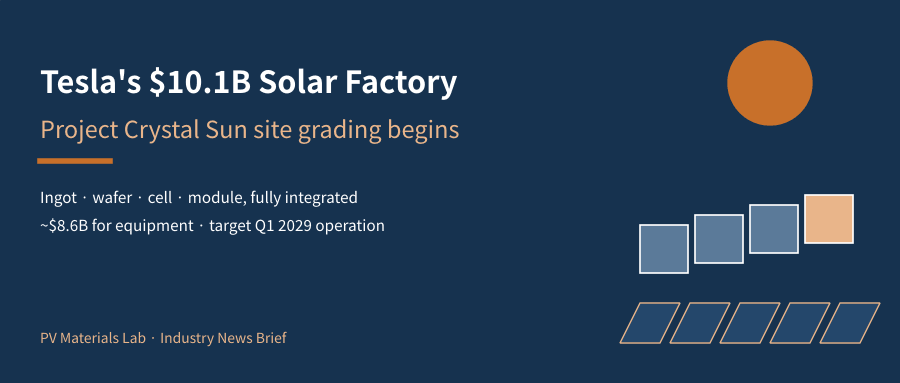
Drone footage dated November 8 shows clearing and grading on the roughly 3,000-acre proposed site in Fort Bend County, Texas, and Elon Musk replied "Project Crystal Sun" on X. The project is a ~$10.1 billion application for vertically integrated PV manufacturing from ingot to module, with about $8.6 billion for equipment. We sort out what has actually happened, the key numbers in the filing, incentives and timeline, and where it sits in the U.S. solar supply chain.
On November 8, drone footage showed large-scale clearing and grading on roughly 3,000 acres of land in Fort Bend County, Texas. The next day, Elon Musk shared a related post on X with just three words: "Project Crystal Sun." This is the ~$10.1 billion vertically integrated solar manufacturing application from Tesla that surfaced in August. Does a bulldozer on site mean the factory has "broken ground"? What does the filing say, and what does it leave out? Let's sort it out.
01 What happened: bulldozers first, a name from Musk
There were two steps. First, videographer S.E. Robinson Jr. released a roughly 12-minute drone video dated November 8. According to Teslarati, it shows large clearings, equipment staging areas, use of an existing homestead, and active grading across a substantial portion of the property. The site lies southwest of Houston, near FM 762 and FM 1994, south of the Brazos River close to Needville.
Second, on November 9 (23:21 Beijing time), Musk quoted a post saying construction had officially begun and wrote only the project name, "Project Crystal Sun." When we captured it, the post had about 1.6 million impressions and about 28,000 likes. TeslaNorth noted that Musk's comment gave no construction schedule, production target or other details.
To be clear: as of publication, Tesla has not issued a formal groundbreaking announcement. The "construction has started" narrative currently rests on aerial footage and social media, i.e. media reporting.
Takeaway: What can be confirmed is that earthworks are under way on the site; an official construction start has not been confirmed by Tesla.
02 What the filing says
Most of what we know comes from a tax-incentive application filed this July. Prepared by consulting firm Kroll and signed on July 22, it was made public by the Texas Comptroller in early August. It seeks a 10-year limitation on appraised property value from Lamar Consolidated ISD under Texas's Jobs, Energy, Technology and Innovation Act (JETI), a state program that trades lower property taxes for investment and job commitments. The key figures are below.
| Item | As stated in the application |
|---|---|
| Site | ~3,050 acres (~1,234 ha) |
| Total investment | ~$10.1 billion |
| of which equipment & personal property | ~$8.6 billion |
| of which real property | ~$1.5 billion |
| Product scope | Ingots, wafers, cells, modules |
| Construction | 2026–2028 |
| Commercial operation | Q1 2029 |
| Permanent jobs | ~1,900 in year one; ~9,712 by 2033 |
| Peak construction jobs | ~1,147 |
| Annual capacity | Not disclosed |
The equipment list covers ingot pulling, wafer slicing, chemical coating, metallization and printing, cell testing and quality control, plus automated material handling and cleanroom systems. In other words, ingot through module is all in scope, but upstream polysilicon is not.
Two points are often misread. First, the application does not state an annual capacity. The widely quoted "100 GW" is Musk's goal for Tesla and SpaceX overall, not a figure filed for this plant. Second, the school district's summary says Tesla was still evaluating alternative locations and had not made a final site decision.
03 Where the money goes: 85% equipment
Of the ~$10.1 billion, about $8.6 billion is equipment and other personal property and about $1.5 billion is real property (land, buildings, utilities, etc.), so equipment is about 85%. Figure 1 shows the split and the three-year spending profile.
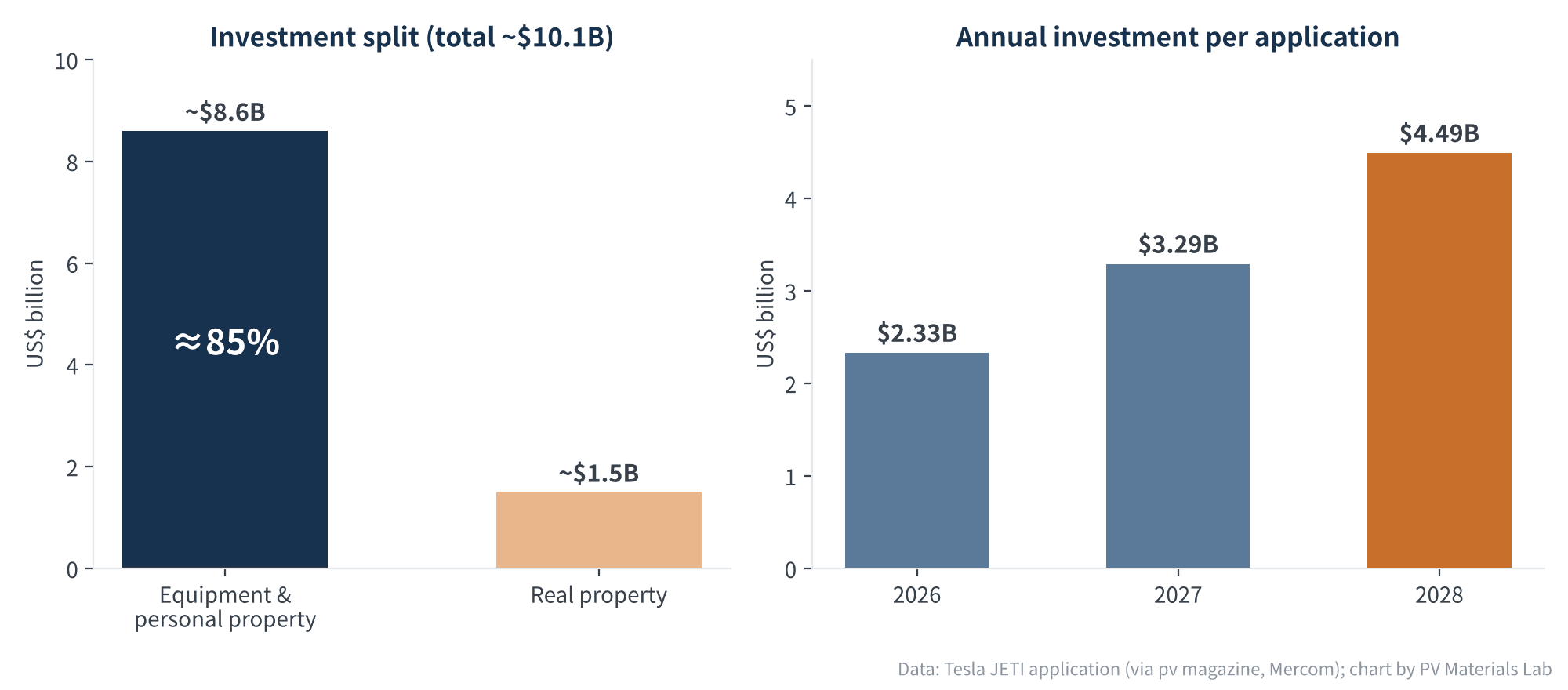
Figure 1 Investment structure and annual spending of Project Crystal Sun (as stated in the application)
That ratio says a lot about the project. A module-assembly-only plant would spend a larger share on buildings and civil works; with equipment above 80%, the money is going mainly into capital-intensive front-end lines such as ingot pullers, wire saws, cell coating and metallization. pv magazine reached the same conclusion.
By year, the application lists about $2.33 billion in 2026, $3.29 billion in 2027 and $4.49 billion in 2028, so spending is back-loaded. Land and buildings come first and equipment later, the usual pattern for a new plant.
So how much capacity does this buy? The filing does not say. PV Tech offered a reference point: Qcells' integrated plant in Cartersville, Georgia cost around $2.5 billion for 3.3 GW of PERC capacity, suggesting this facility could exceed 10 GW. Using the same unit cost, our rough estimate puts $10.1 billion at the order of 13 GW. This is only an order-of-magnitude reference: technology route (PERC, TOPCon, BC, etc.), equipment sourcing and U.S. construction costs can move the real number a long way.
Bottom line: 85% of the investment is equipment, pointing to a plant centered on front-end steps (ingot, wafer, cell); capacity is undisclosed, so any GW figure is an estimate.
04 From filing to bulldozers: timeline and incentives
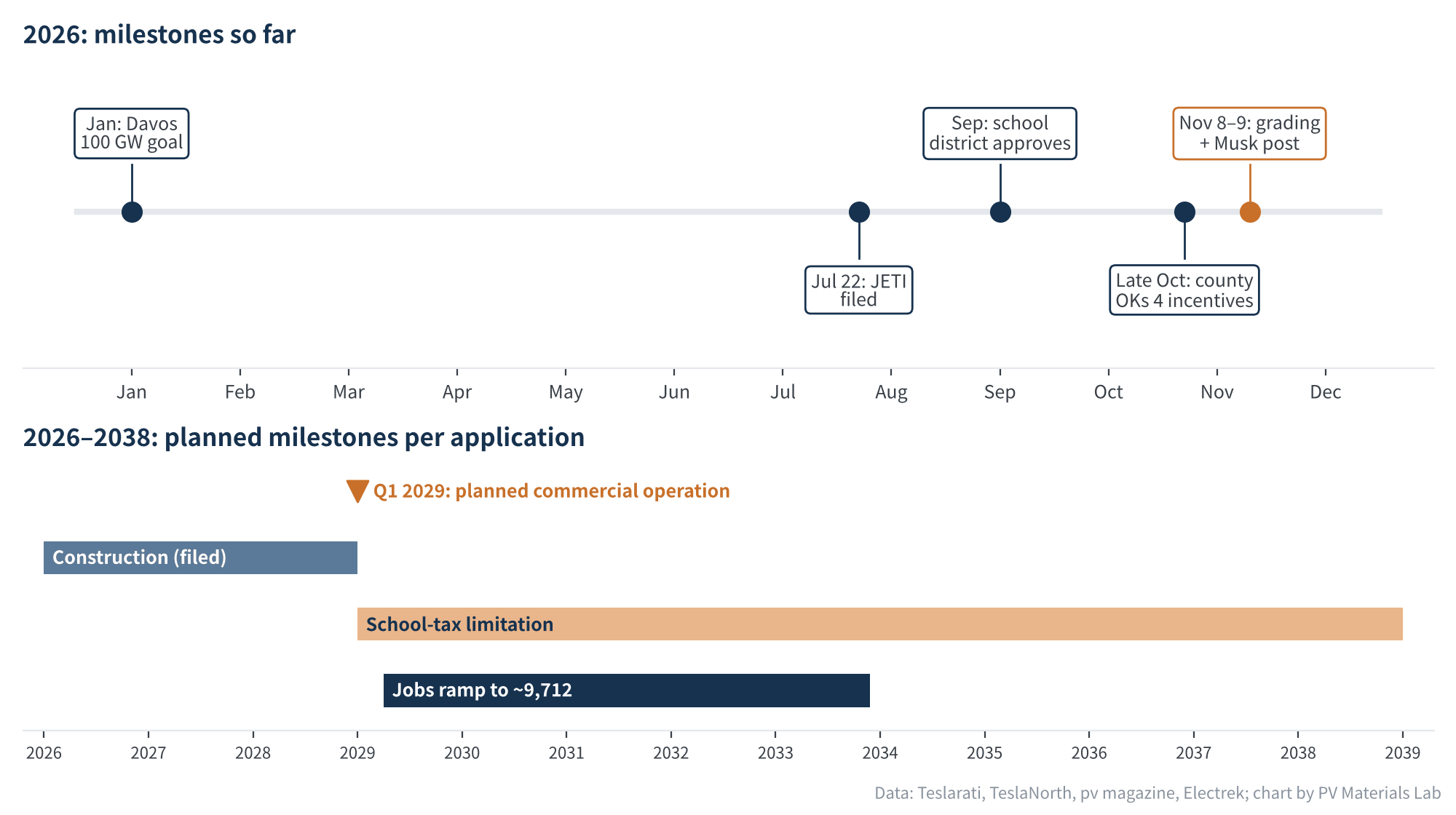
Figure 2 Milestones so far and planned milestones of Project Crystal Sun
- January: At Davos, Musk said the Tesla and SpaceX teams were working toward manufacturing 100 GW of solar per year in the U.S., which would probably take about three years.
- July–August: The JETI application was signed and published, revealing the code name Project Crystal Sun.
- September: Lamar CISD unanimously approved the school-tax limitation agreement, covering 2029–2038.
- Late October: Fort Bend County approved four incentive agreements. Teslarati reports equipment-related tax breaks could run as long as 35 years.
- November 8–9: Aerial footage showed grading; Musk shared it and named the project.
Electrek also reported that the application references the federal Section 45X advanced manufacturing production credit and Section 48D. Stacking local property-tax relief with federal manufacturing credits is key to making the economics of U.S. domestic manufacturing work.
Between incentives being in place, equipment moving in and commercial operation in Q1 2029, there is still building construction, tool installation and commissioning, and a production ramp. Integrated projects usually proceed in phases, and grading is only one of the earliest milestones, a long way from the first cell coming off the line.
05 Placing it in the U.S. solar supply chain
The update drew attention because it targets the weakest link in U.S. solar manufacturing. According to figures cited by pv magazine, U.S. module capacity stood at roughly 60 GW in early 2026, while cell capacity was under 15 GW. Most recent U.S. manufacturing additions have been module assembly using imported cells, and wafer and ingot capacity is even scarcer.
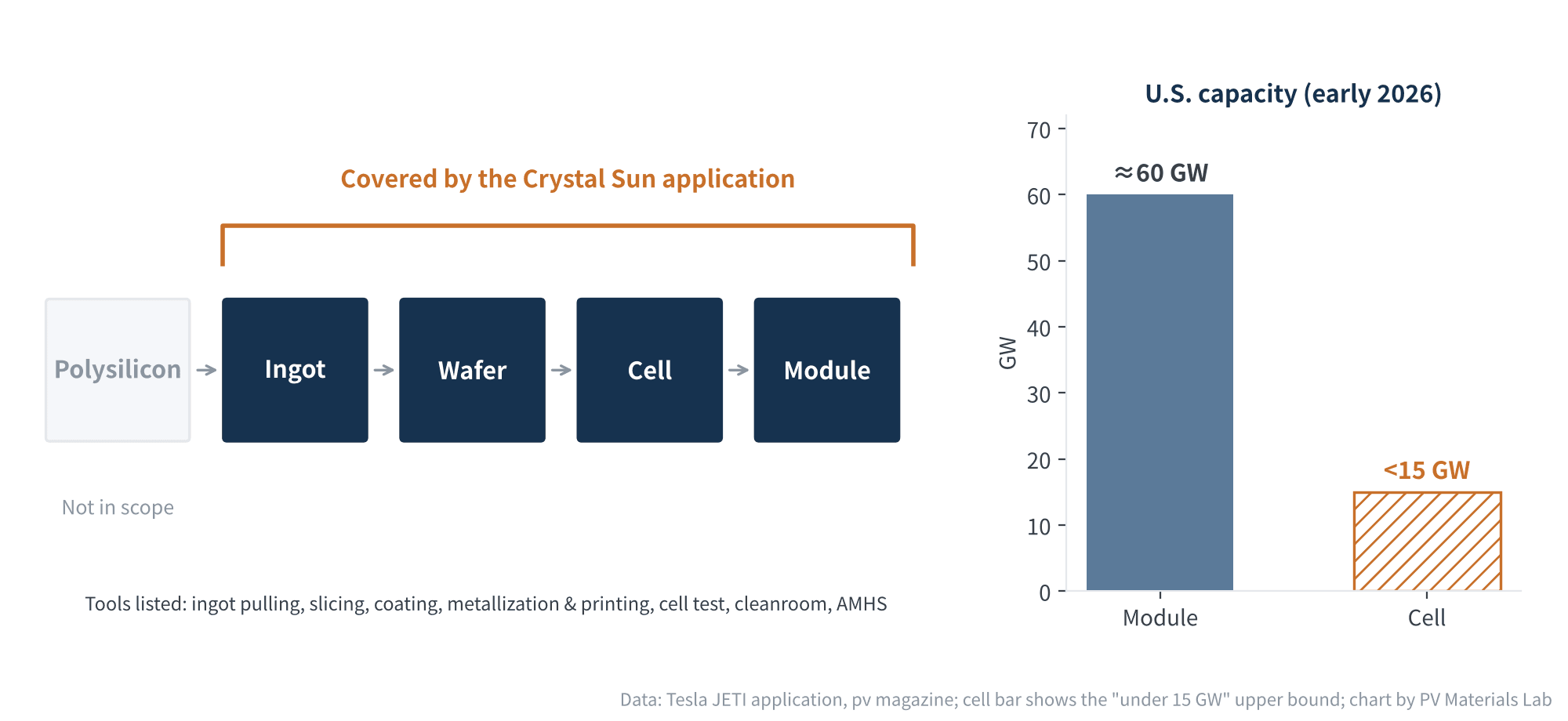
Figure 3 Value-chain steps covered by the Crystal Sun application, and U.S. module vs. cell capacity
Against that backdrop, a plant that goes from ingot to module fills exactly the missing "core." pv magazine USA commented that a single facility of this capital scale would represent a multiple of current domestic cell output, provided, of course, that it is actually built and ramped as planned.
Where the equipment comes from is another question to watch. Carbon Credits, citing a Reuters report from March, said Tesla had held talks with Chinese companies over about $2.9 billion of solar manufacturing equipment. Much of the world's supply capability for ingot, wafer and cell tools is in China, which means potential opportunity for Chinese equipment and materials suppliers, along with uncertainty from trade policy.
06 Our view
We sort the information in this story into four buckets, to avoid treating an application as an accomplishment.
- Has happened: Site grading is under way; the school district and county incentive agreements have been approved; Musk publicly claimed the project name.
- Still application figures: The $10.1 billion investment, 9,712 jobs, ~$107 billion Texas GDP contribution and Q1 2029 start are forecasts or commitments in the filing, not realized numbers.
- Not yet disclosed: Annual capacity, cell technology, equipment suppliers, module product specs.
- Reasons for caution: Tesla's earlier solar manufacturing in Buffalo, New York fell well short of initial expectations, and Electrek cautioned that the filed figures should be read as a negotiating position rather than a commitment. This year Tesla announced a Buffalo expansion with an initial module capacity of 300 MW per year.
For practitioners in China, the story has three implications. First, U.S. localization is moving upstream, which could create new demand for cell, wafer and ingot equipment and for consumables such as paste, chemicals, quartz crucibles and diamond wire. Second, U.S. labor, energy and construction costs are far higher than in China, so automation level and yield ramp speed will decide the plant's economics; those are the indicators we most want to see. Third, the technology route is unknown; choosing TOPCon, HJT or BC will raise a chain of questions about patent licensing, tool selection and materials systems.
Takeaway: Grading is a beginning, not proof of construction, let alone production. The real milestones are an official groundbreaking, building topping-out, the first ingot puller moving in, and the first cell off the line.
07 Final thoughts
That three words from Musk can make a 3,000-acre grading job go viral is a measure of his reach. For technical practitioners, the plainer numbers in the filing matter more: 85% of the money for equipment, spending spread over three years, production in Q1 2029. Together they describe a genuine push into ingots, wafers and cells, exactly the parts U.S. solar manufacturing lacks most.
We will keep tracking Project Crystal Sun: whether Tesla announces a formal groundbreaking, when capacity and technology are disclosed, and where the equipment orders go. When there is news, we will break it down again.
Calculation notes / data basis
- Equipment share: ~$8.6B ÷ ~$10.1B ≈ 85%; real property ≈ 15%.
- Annual investment (application figures as reported by Mercom): ~$2.33B in 2026, ~$3.29B in 2027, ~$4.49B in 2028, about 23%, 33% and 44% respectively.
- Order-of-magnitude capacity estimate: using the Qcells Cartersville reference cited by PV Tech (~$2.5B / 3.3 GW, ~$0.76/W, integrated PERC), $10.1B ÷ $0.76/W ≈ 13 GW. For scale only; it ignores differences in technology, equipment sourcing and construction cost, and is not a Tesla-filed figure.
- Area: 1 acre ≈ 0.4047 ha; 3,050 acres ≈ 1,234 ha ≈ 12 km². Media reports mostly say "about 3,000 acres."
- Social media metrics are public figures captured at 05:05 Beijing time on 2026-11-10 and will keep changing.
- "Equipment tax breaks of up to 35 years" is from Teslarati; we have not seen the county agreements. The ~$2.9B Chinese equipment talks are Carbon Credits' account of a Reuters report; the original was not retrieved.
References
- Joey Klender. Tesla begins groundworks on $10B 'Project Crystal Sun' in Texas. Teslarati, 2026-11-09. https://www.teslarati.com/tesla-begins-10b-project-solar-panel-manufacturing-project/
- Alex Diaz. Tesla's Massive Texas Solar Factory Site Is Starting to Take Shape. TeslaNorth, 2026-11-09. https://teslanorth.com/2026/11/09/tesla-crystal-sun-solar-factory-site-work-drone-video/
- Elon Musk. "Project Crystal Sun". X, 2026-11-09. https://x.com/i/status/2119812607117062451
- pv magazine. Tesla's $10.1 billion Texas solar gigafactory clears key tax hurdle. 2026-09-19. https://www.pv-magazine.com/2026/09/19/teslas-10-1-billion-texas-solar-gigafactory-clears-key-tax-hurdle/
- pv magazine USA. Tesla files tax incentive application for $10.1 billion Texas solar cell plant. 2026-08-11. https://pv-magazine-usa.com/2026/08/11/tesla-files-tax-incentive-application-for-10-1-billion-texas-solar-cell-plant/
- PV Tech. Tesla plans US$10.1 billion vertically integrated solar cell plant in Texas. 2026. https://www.pv-tech.org/tesla-plans-us10-1-billion-vertically-integrated-solar-cell-plant-in-texas/
- Mercom India. Tesla Proposes $10.1 Billion Solar Cell Manufacturing Facility in Texas. 2026. https://mercomindia.com/tesla-proposes-10-1-billion-solar-cell-manufacturing-facility-in-texas
- Electrek. Tesla files for $10.1 billion solar cell factory in Texas (Project Crystal Sun). 2026-08-11. https://electrek.co/2026/08/11/tesla-solar-cell-factory-texas-project-crystal-sun/
- Carbon Credits. Tesla's $10.1 Billion Solar Factory in Texas Signals a New U.S. Manufacturing Push. 2026. https://carboncredits.com/tesla-10-1-billion-solar-factory-us-manufacturing/
- Lamar CISD. Tesla JETI application summary. https://www.lcisd.org/teslajeti26
PV Materials Lab
https://pvmaterialslab.com
PV Materials Lab
A PV R&D and technical team with 10+ years of experience | In-depth technical knowledge sharing
Materials · Reliability · Failure Analysis · Standards & Certification · Products · Processes
Exploring AI + PV — collaboration welcome
Disclaimer:
- Original content reflects the authors' personal views only, is for reference, and does not constitute investment advice.
- Reposted and cited content is credited to its source, with respect for original work.
- Some content is AI-assisted (chart generation, data retrieval, concept explanations, etc.); the core framework and key content are written by our technical team and reviewed by humans.
- For any inaccuracy or infringement, please leave a message or contact us.