
Same BOM, Two Outcomes: Kiwa Audits 60+ Factories and Finds New Plants Have ~10× More Critical Issues
Kiwa PI Berlin's new white paper compares new factories (under 24 months of operation) with mature ones. In audits of more than 60 facilities, about 20% of new factories were rated Poor versus about 1% of mature ones, and new factories had roughly 10 times more critical findings. Modules with the same brand and BOM from two factories diverged after 1,000 hours of damp heat, and UVID loss was about 1.5% for qualification samples but 0.81%–2.90% across five production batches. We discuss what this means for procurement and incoming inspection.
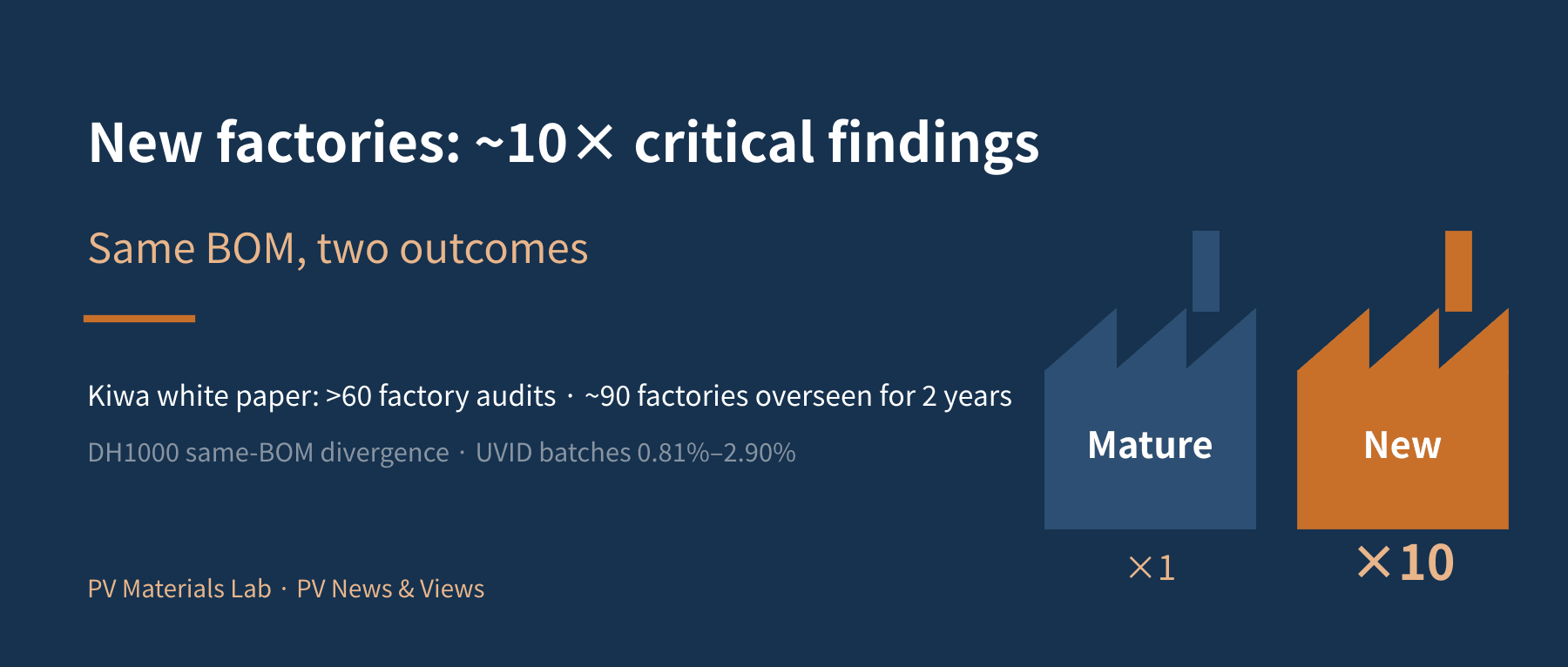
When choosing modules, many buyers look at two things: certificates and the bill of materials (BOM). Kiwa PI Berlin's latest white paper on new factories is a reminder that the same BOM can deliver very different results in a different factory or batch. New factories with less than two years of operation carry clearly higher quality risks.
01 How big is the gap between new and mature factories?
The white paper, "From Startup to Stable: Guidance for Buying From New PV Factories", defines a new factory as one operating for less than 24 months and compares it with mature factories. The data come from two sources: audits of more than 60 manufacturing facilities, and two years of on-site production oversight at about 90 factories.
| Metric | Data source | New vs. mature |
|---|---|---|
| Share rated Poor | Factory audits (>60) | ~20% vs ~1% |
| Critical findings | Factory audits | ~10× |
| Major findings | Factory audits | Nearly 2× |
| Quality findings per shift | 2-year oversight (~90) | ~+21% |
| Critical findings | 2-year oversight | ~12× |
Kiwa defines a critical finding as one that may create a safety hazard, early-life failure or significant power loss; major findings are less severe. New factories had only about twice as many major findings, but about ten times as many critical ones. In other words, new factories don't just have more problems, they have more serious ones.
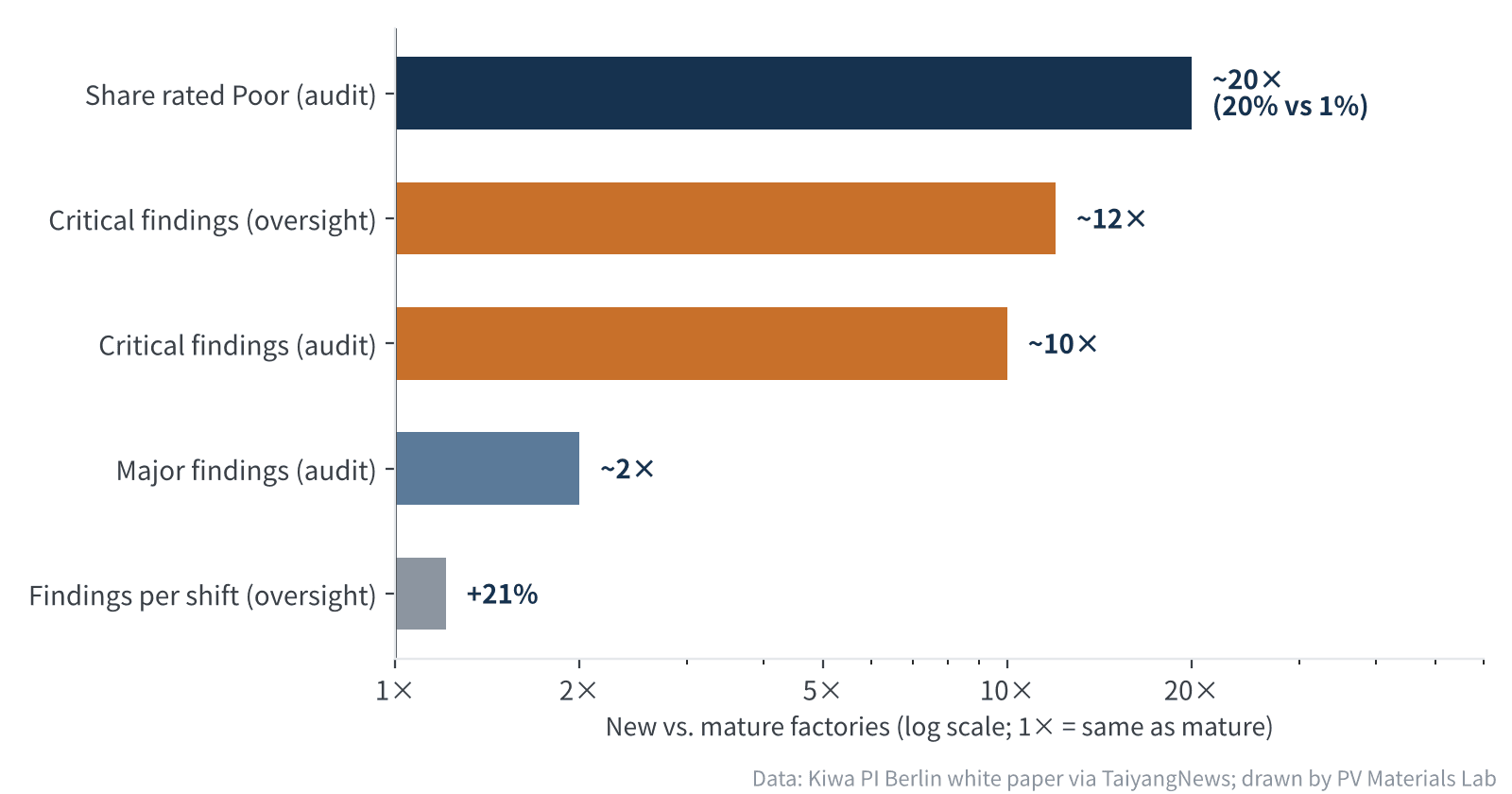
Figure 1 Quality-risk multiples of new vs. mature factories
Takeaway: Two independent data sets, factory audits and production oversight, agree: critical issues at new factories are an order of magnitude higher.
02 Same BOM, two outcomes
The most convincing case in the white paper compares modules of the same brand and the same BOM made at two factories. After 1,000 hours of damp heat (DH), samples from one factory showed no defects, while those from the other developed bubbles and delamination. The two factories used different lamination equipment and processes.
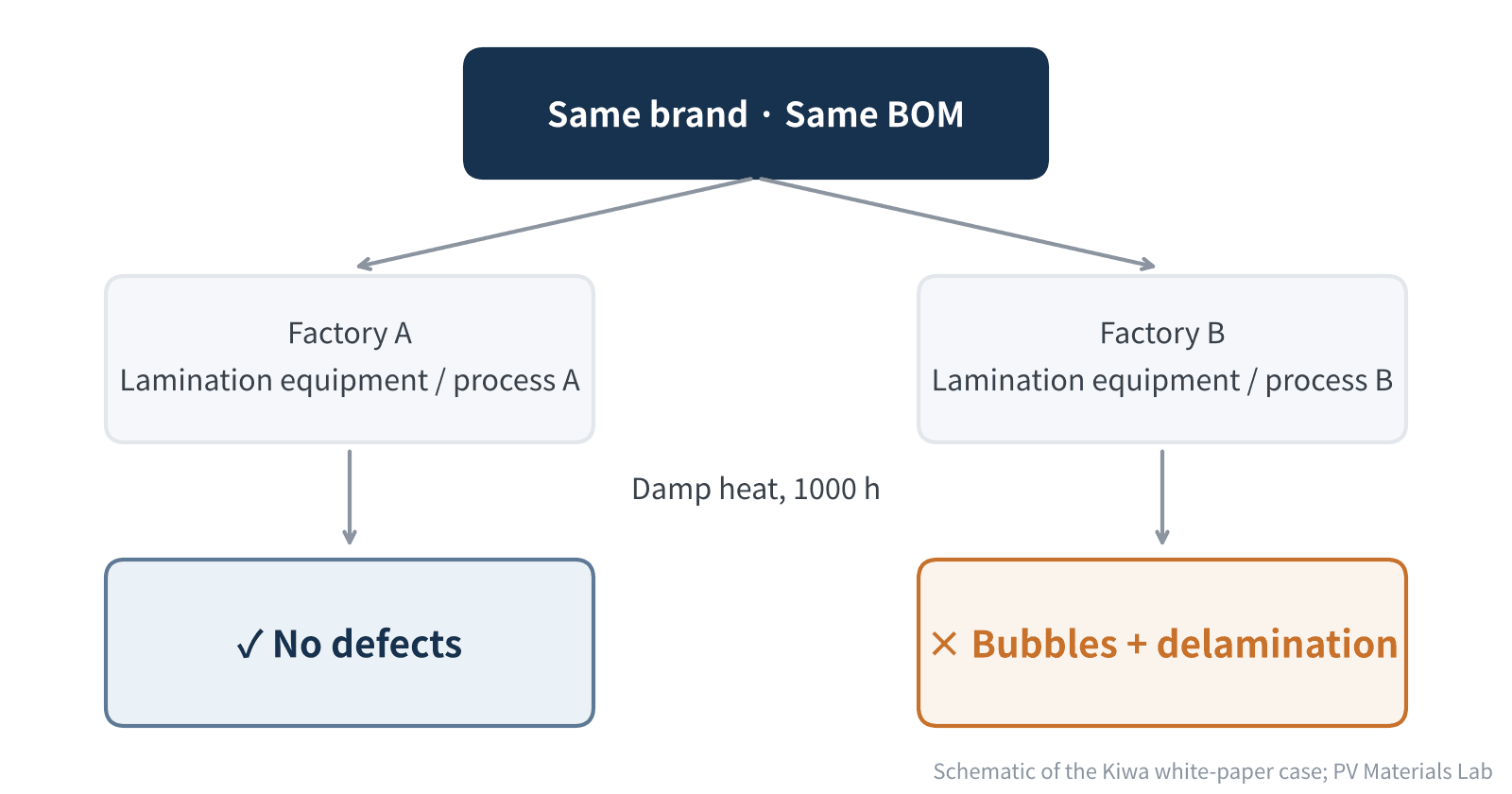
Figure 2 Damp-heat results for the same BOM from two factories (schematic)
Anyone with module process experience will not be surprised. Lamination is the most critical encapsulation step: the encapsulant must melt, degas and crosslink under set temperature, vacuum and pressure. Heating uniformity, vacuum capability, process windows, and how encapsulant is stored and protected from moisture after opening all matter. A weak link can leave bubbles, under-crosslinking or weak interfacial adhesion that is invisible at shipment and only appears after damp heat or thermal cycling.
Kiwa's 2026 PV Module Manufacturing Quality Report reached the same conclusion: lamination issues (bubbles, edge delamination) are the most common production defects, mainly caused by improper encapsulant storage and inadequate lamination process control.
Bottom line: The BOM decides which materials are used; the factory decides how well they are used. Same BOM does not mean same quality.
03 Qualification samples pass; production batches may not
The second signal comes from UVID (UV-induced degradation, a hot issue for TOPCon modules in recent years). One module type lost about 1.5% power in UVID testing of its qualification samples (those sent for certification or testing), while five production batches lost between 0.81% and 2.90%.
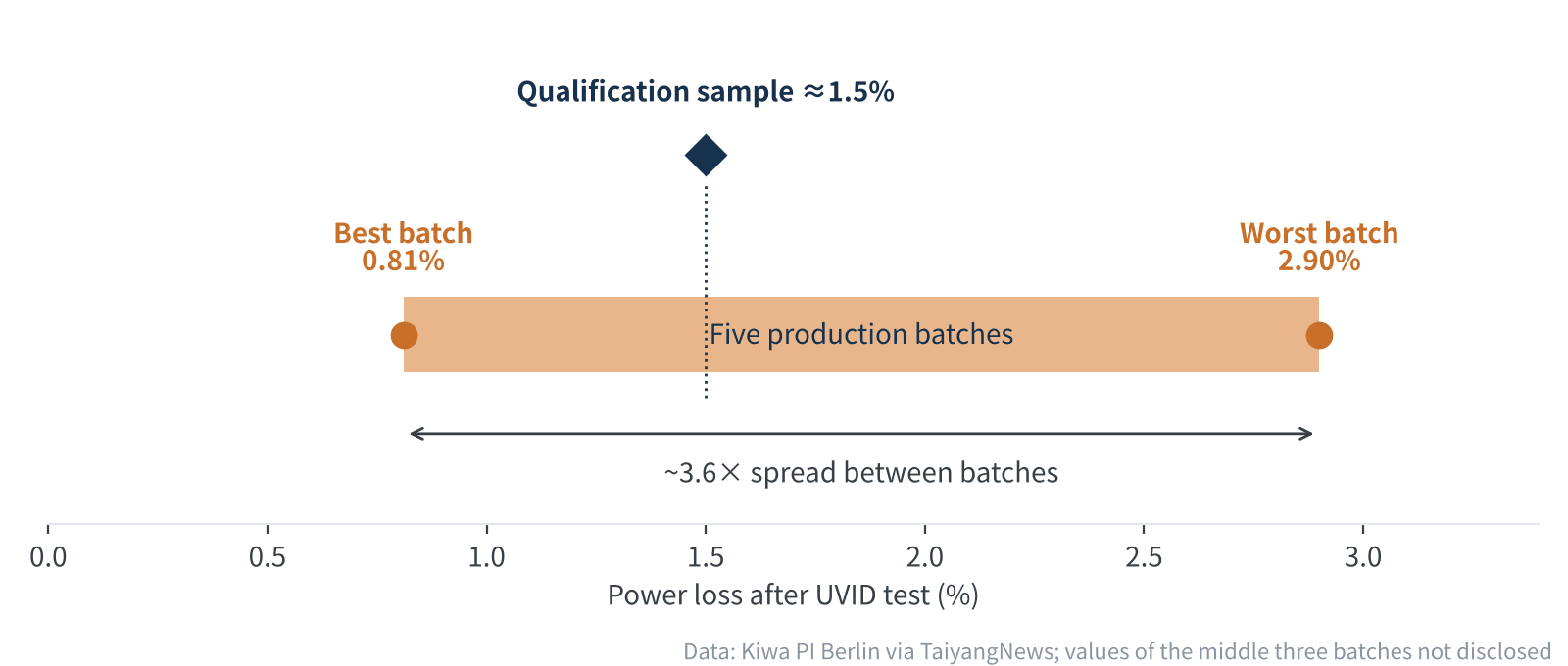
Figure 3 UVID: qualification sample vs. five production batches
This has two implications. First, batches differ by a factor of about 3.6: the best batch beat the qualification sample, while the worst lost nearly twice as much. Second, relying on the 1.5% qualification value overestimates some batches and underestimates others. UVID is sensitive to cell surface passivation, anti-reflection coatings and process conditions, so results drift when cell sources or line conditions change.
The report does not disclose the UVID dose, sample size, or whether the product came from a new factory, so we cannot judge whether 0.81%–2.90% is good or bad by industry standards. But the conclusion that qualification samples do not represent production batches is clear.
04 Why new factories are more prone to problems
From our production experience, new-factory risk comes mainly from four areas:
- Process windows not yet stable: Equipment has just been commissioned and key lamination and soldering parameters are still being tuned, so batch-to-batch variation is large.
- Limited staff experience: New operators and process and quality staff are less practiced at spotting and handling anomalies, leading to more rework and missed defects.
- Supply chain still settling: New factories often onboard new encapsulant, glass and cell suppliers at the same time; incoming consistency and storage practices take time to establish.
- Quality system still being built: Incoming, in-process and outgoing inspection frequencies and criteria are incomplete, so problems are found later.
None of this means new factories are bad by default; it is the normal ramp-up process. The value of the white paper is turning that experience into data.
05 Lessons for procurement and quality teams
Kiwa offers buyers three recommendations: consider factory age, require factory-level certification, and evaluate actual production samples rather than only qualification samples. We turn them into clauses that can go into purchase and quality agreements:
| Stage | Recommended practice | Purpose |
|---|---|---|
| Supplier approval | Name the production factory and its age in the contract; audit factories under 24 months more often | Identify ramp-up risk |
| BOM and process lock | Lock the production factory along with the BOM; require advance notice of key lamination parameter changes | Prevent "same BOM, different factory" |
| Production oversight | Station inspectors for a new factory's first batches, focusing on lamination, soldering and encapsulant storage | Catch problems before shipment |
| Incoming inspection | Randomly sample shipped batches for DH, UVID and other reliability tests; do not substitute qualification samples | Verify batch consistency |
| Acceptance rules | Agree batch-level limits for UVID and DH degradation; out-of-limit batches are traceable and rejectable | Give test results contractual weight |
06 Our view
- Value: The white paper quantifies new-factory risk with two data sets, audits and oversight, and explains why with the same-BOM and qualification-vs-batch cases. It is highly relevant for an industry in rapid expansion.
- Limitations: So far we have only a trade-media report. Sample structure, regional and technology mix, DH conditions and UVID dose are undisclosed; whether "~20% rated Poor" applies to new bases of leading Chinese manufacturers needs the original paper.
- China context: China has added large TOPCon and BC capacity in the past two years, much of it new bases of established companies. By the white paper's definition these are also new factories: systems can be copied, but equipment, staff and incoming materials must settle in again.
- Implications for certification: IEC 61215 type approval is a one-time design assessment and does not guarantee production consistency. The data again show that ongoing oversight, such as factory inspections and batch sampling, matters more.
07 Final thoughts
Certificates and BOMs tell you how good a module can be; the factory and batch decide how good it actually is. For buyers, asking "which factory, which line, and how long has it been running?" before ordering, and testing a few modules from actual batches after delivery, costs little but blocks most of the risk.
We will keep following the details of the original white paper, and welcome peers to share experience with new-factory audits and incoming inspection.
Calculation notes / data basis
- "About 3.6× between batches" is our calculation of 2.90% ÷ 0.81%; "nearly twice the qualification sample" is 2.90% ÷ 1.5% ≈ 1.9.
- "~20× gap in Poor ratings" is ~20% ÷ ~1%; other multiples in Figure 1 are taken from the news report.
- Data in this article are from TaiyangNews' report on the white paper; we have not yet obtained the original white paper, which governs.
References
- TaiyangNews. Kiwa Finds Greater Quality Risks At New PV Factories, 2026-11-05. https://taiyangnews.info/technology/kiwa-finds-greater-quality-risks-at-new-pv-factories
- Kiwa PI Berlin. From Startup to Stable: Guidance for Buying From New PV Factories (white paper), 2026
- Kiwa PI Berlin & Kiwa PVEL. The 2026 PV Module Manufacturing Quality Report. https://www.kiwa.com/globalassets/china/pdf-documents/2026en.pdf
- IEC 61215-2:2021 Terrestrial photovoltaic (PV) modules – Design qualification and type approval – Part 2: Test procedures
PV Materials Lab
https://pvmaterialslab.com
PV Materials Lab
A PV R&D and technical team with 10+ years of experience | In-depth technical knowledge sharing
Materials · Reliability · Failure Analysis · Standards & Certification · Products · Processes
Exploring AI + PV — collaboration welcome
Disclaimer:
- Original content reflects the authors' personal views only, is for reference, and does not constitute investment advice.
- Reposted and cited content is credited to its source, with respect for original work.
- Some content is AI-assisted (chart generation, data retrieval, concept explanations, etc.); the core framework and key content are written by our technical team and reviewed by humans.
- For any inaccuracy or infringement, please leave a message or contact us.