
Save a Yuan or Gain a Watt? The Cost-Efficiency Math of PV Glass
In brief
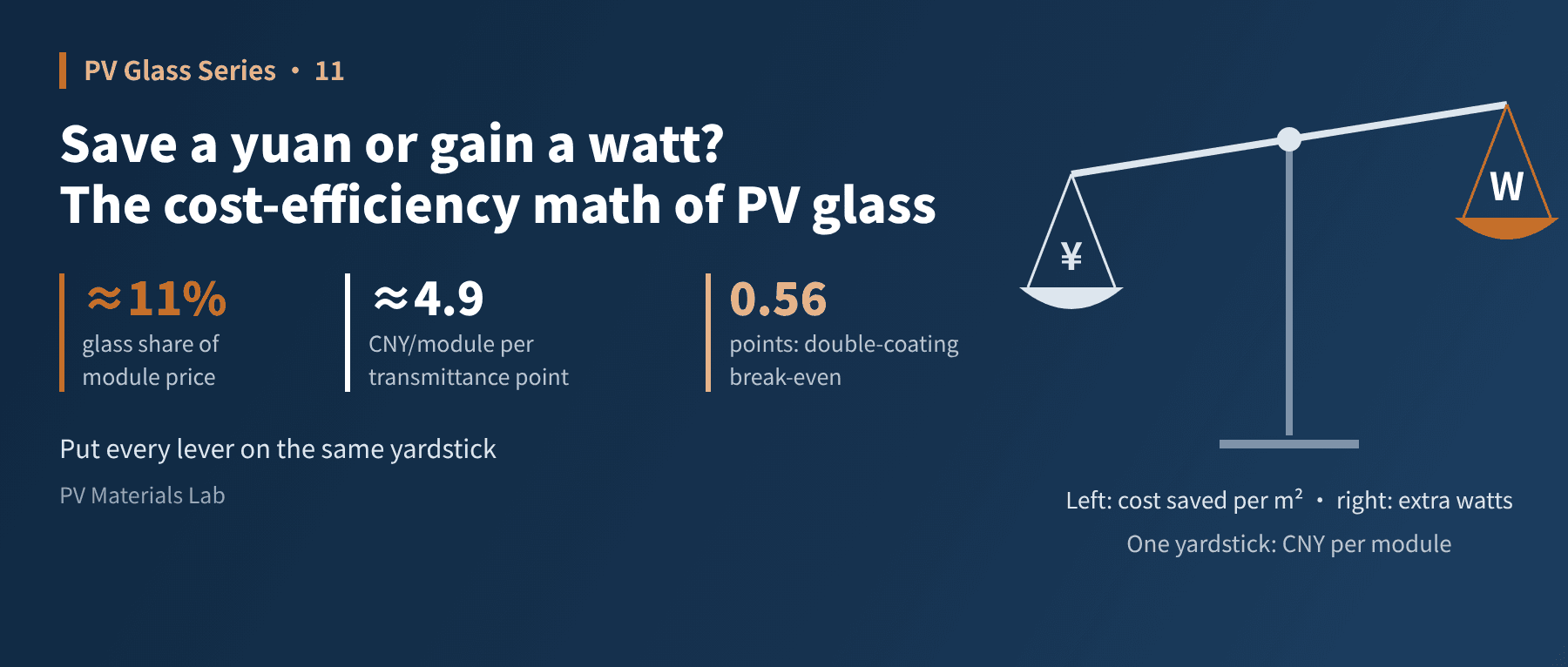
Cutting cost and raising efficiency in PV glass comes down to two things: making each square metre of glass cheaper, and getting a few more watts out of each module. Using one 650 W module as the unit of account, we convert transmittance, thinning, yield and double-layer coating into "CNY per module", and arrive at an interesting result: at the standard thresholds, the extra transmittance of a double-layer coating may not pay for the extra glass cost. Our calculations use August 2026 prices as the baseline, with an update on price moves since October.
In the previous article we argued that competition in PV glass ultimately comes down to cost. For a module maker, though, glass is not only a cost: it also determines how much power the module produces. So cost reduction and efficiency gains in glass require two sets of accounts at once: how much is saved per square metre, and how many more watts each module delivers. In this article we put both on the same unit.
01Several yardsticks for cost and efficiency
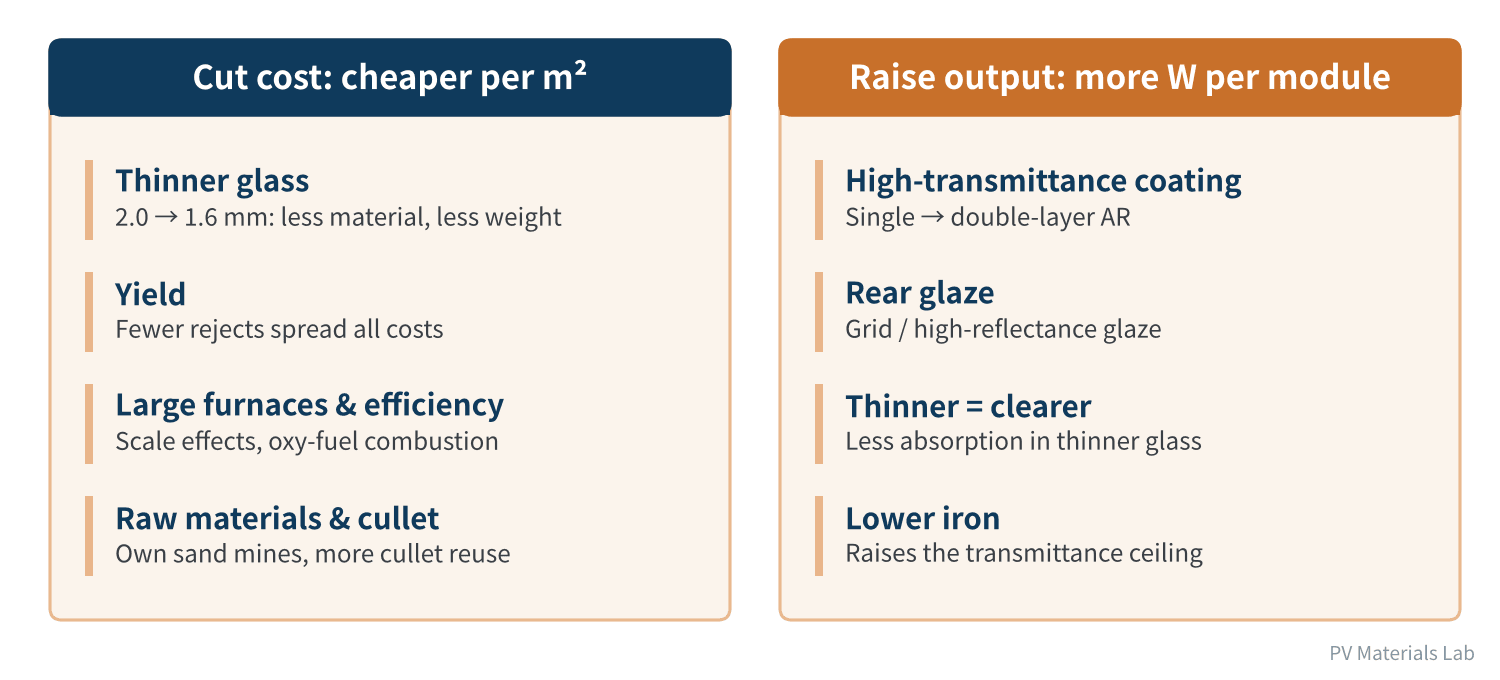
Figure 1 Main levers for cutting cost and raising efficiency in PV glass
The cost levers sit mainly with the glass maker: thinner glass saves material; higher yield spreads costs over more good glass; large furnaces and efficiency upgrades cut fuel and power use; own sand mines and cullet recycling lower raw material costs. The efficiency levers show up directly in module power: high-transmittance coatings, rear glazes, thinner glass and lower iron content all let more light reach the cells.
First, how much does glass weigh in module cost? At about CNY 9.5/m² for 2.0 mm single-layer coated glass in August 2026, a 2382 × 1134 mm dual-glass module uses about 5.4 m² of glass across its two sheets, costing about CNY 51. Spread over 650 W, that is about CNY 0.079/W, or about 11% of a CNY 0.7/W module price, consistent with the "roughly one tenth" estimate in Article 1.
That share is not fixed. Since August, glass prices have rebounded clearly as cold repairs cut supply. According to SMM, 2.0 mm double-layer coated glass rose from about CNY 10.15/m² in early August to about CNY 11.4 in mid-October, with the market expecting CNY 11.5–12 in November. Module prices were broadly flat over the same period: OPIS put TOPCon modules at about USD 0.107/W in late October, roughly CNY 0.72/W. At CNY 11.4, two sheets of glass cost about CNY 62, or about 13% of the module price. When glass prices rise and module prices do not, glass becomes a bigger part of module cost.
02A conversion first: what is one point of transmittance worth?
To compare cost cuts with efficiency gains, we first need to turn "how much more transmittance" into money. We make a simplifying assumption: module power is roughly proportional to front glass transmittance.
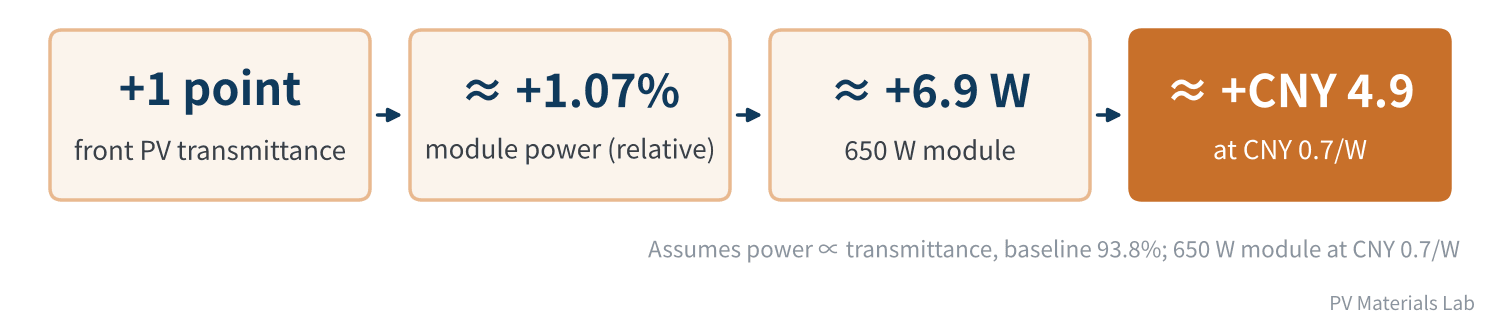
Figure 2 The value of transmittance (per module)
From a 93.8% baseline, each extra percentage point of transmittance raises module power by about 1.07% in relative terms. For a 650 W module that is about 6.9 W more, which at CNY 0.7/W is worth about CNY 4.9 per module; at October's roughly CNY 0.72/W it is about CNY 5.0. Put the other way, every 0.1 point of transmittance lost costs about CNY 0.5 of value per module.
Remember this yardstick: one percentage point of front glass transmittance is worth roughly CNY 5 per 650 W module. Every efficiency measure that follows can be measured against it.
03Does double-layer coating always pay?
This is an interesting question. Under T/CPIA 0028.1—2024, the transmittance threshold is 93.8% for single-layer coated glass and 94.1% for double-layer, a gap of 0.3 percentage points. SMM's early-August quotes put 2.0 mm single-layer coated glass at about CNY 9–10/m² and double-layer at about CNY 10–11, so double-layer cost about CNY 1/m² more.
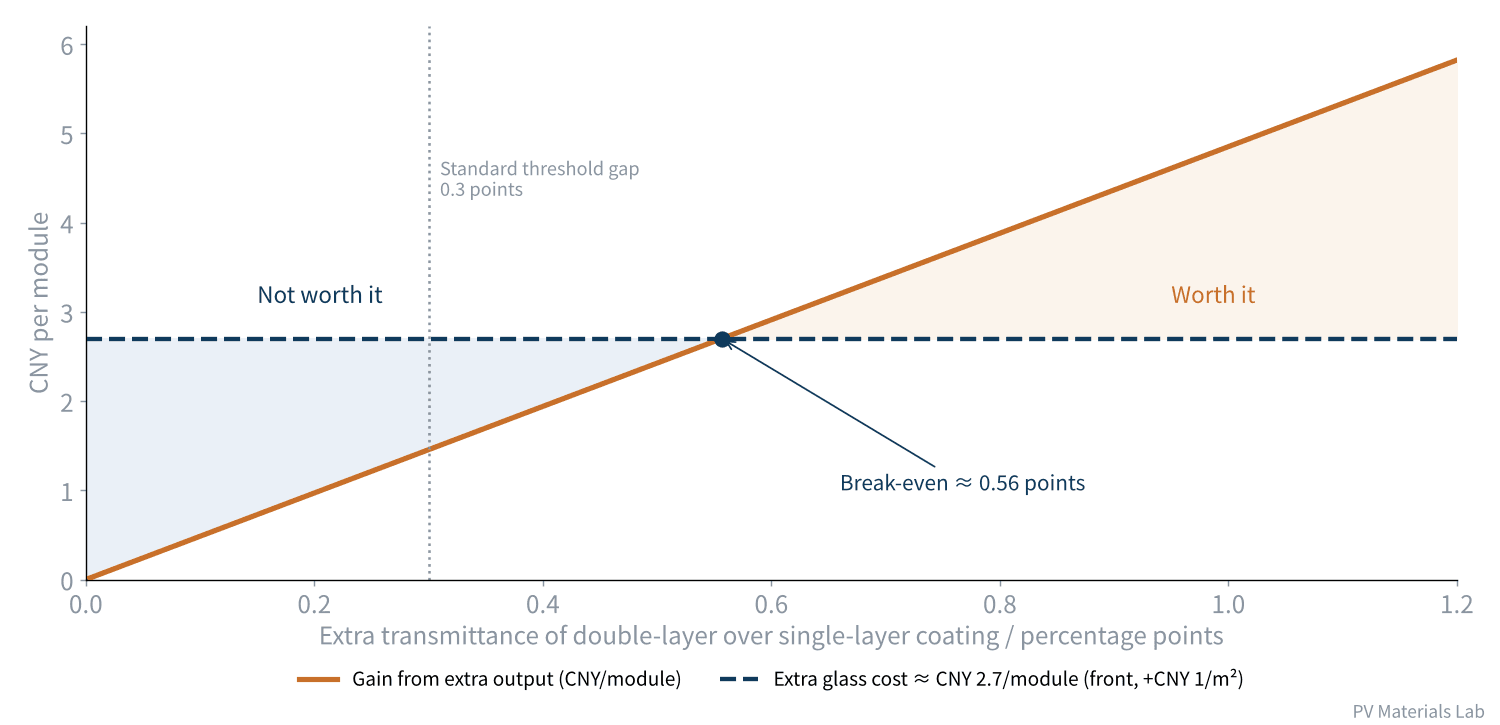
Figure 3 Break-even for double-layer coating (front sheet, per module)
Run the numbers: a double-layer coated front sheet costs about CNY 2.7 more per module. If transmittance improves only by the 0.3-point threshold gap, the efficiency gain is worth about CNY 1.5, so the module loses about CNY 1.2. Break-even is about 0.56 percentage points: only when the real transmittance advantage of the double-layer coating exceeds about 0.56 points is the extra spend worthwhile. With a measured advantage of 0.8 points, each module nets about CNY 1.2.
This break-even point is very sensitive to the price gap between single- and double-layer glass:
| Scenario | Module price (CNY/W) | Value of 1 point (CNY/module) | Extra front glass cost (CNY/module) | Break-even (points) |
|---|---|---|---|---|
| August baseline: gap CNY 1/m² | 0.70 | 4.9 | 2.7 | ≈0.56 |
| October module price, gap still CNY 1/m² | 0.72 | 5.0 | 2.7 | ≈0.54 |
| Gap widens to CNY 1.5/m² | 0.72 | 5.0 | 4.0 | ≈0.81 |
| Gap narrows to CNY 0.5/m² | 0.72 | 5.0 | 1.35 | ≈0.27 |
Table 1 Sensitivity of the double-layer break-even point to the price gap (estimate)
Small moves in module price make little difference. What decides the answer is the single-to-double price gap and the measured transmittance difference. If the gap narrows to CNY 0.5/m², even the 0.3-point threshold gap pays back.
There are still three caveats. First, real products usually exceed the standard thresholds, so the true gap must come from measurements. Second, modules are sold in power bins, and a few watts that push a module over a bin boundary are worth more. Third, plant owners care about energy per unit area, and higher-power modules also spread racking, land and installation costs. So there is no single answer, but it must be worked out with measured data and current price gaps, rather than assuming "more transparent is always better".
04Thinning and yield: the main cost battleground for glass makers
- Thinning: Going from 2.0 mm to 1.6 mm on both sheets cuts material by 20% and module weight by about 5.4 kg. If glass cost fell fully in line with weight, each module would save about CNY 10 in theory. In practice the saving is smaller: tempering and coating costs are charged by area and do not fall with thickness, and thin glass has lower yield and is harder to temper, as Article 5 explained.
- Yield: Yield is an underrated cost lever. Article 4 put the yield of 2 mm rolled glass at about 78%. Raising it to 82%, with raw materials, fuel and power at about 86% of cost, would cut cost per square metre by about 4%, or about CNY 2 per module across two sheets. Better still, higher yield sacrifices no performance at all.
- Large furnaces and energy efficiency: As the previous article showed, leading producers have cash costs of about CNY 8.5–9/m² for 2.0 mm glass, while third-tier producers are above CNY 12. Much of that gap of more than CNY 3 comes from furnace scale, energy use and yield.
- Raw materials: Owning low-iron quartz sand, recycling more cullet and optimising the fuel mix all cut cost at the source, as Article 3 discussed in detail.
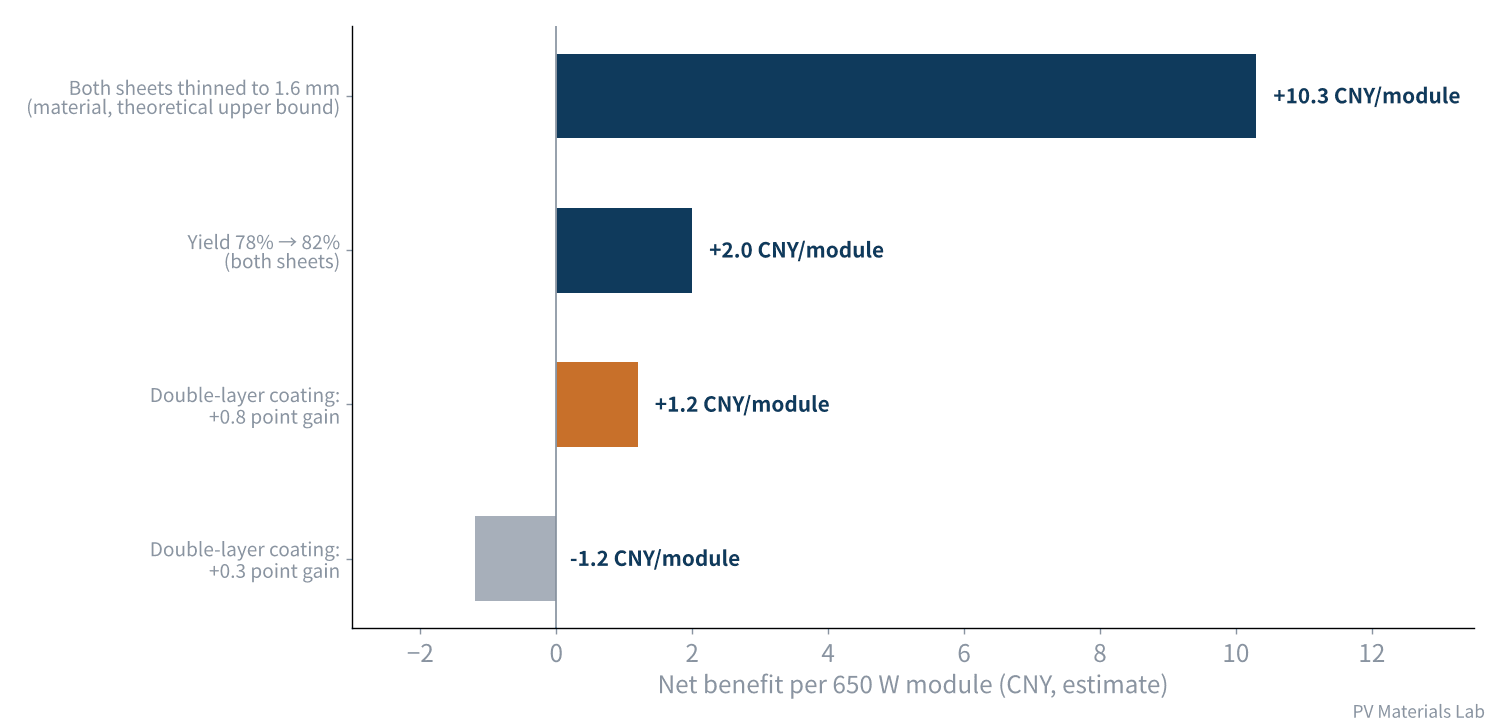
Figure 4 Net benefit per module of several measures (estimate)
Side by side, thinning has the greatest potential but faces the tightest reliability limits; better yield brings a certain gain with no side effects; and the benefit of double-layer coating depends heavily on the measured transmittance difference and the current price gap.
05Rear glazes and thinner, clearer glass: easily overlooked gains
Grid glazes and high-reflectance glazes on the rear glass are an efficiency lever unique to dual-glass modules. They reflect light that falls through the gaps between cells back onto the cells, raising front-side power, at the cost of less transparent rear area and lower bifaciality. Using our yardstick, each extra watt on the front is worth about CNY 0.7 per module, while the rear-side energy lost to lower bifaciality depends on the ground reflectance at the site. That is why Article 2 said that high-reflectance glazes suit distributed rooftops better, and call for caution at high-albedo ground-mounted sites.
Thinner glass is also clearer. Light absorption in the glass body depends on thickness. When PPG launched its 2 mm solar glass in 2012, it said the solar transmittance of its 2 mm glass was about 0.3% higher than that of 3.2 mm glass. So thinning brings a small efficiency gain on top of the material saving, though that gain is rarely enough to decide the choice on its own.
06The limits: do not lose reliability in the accounts
Every cost and efficiency measure has to be tested against the reliability framework from Articles 7 and 9. Apply the yardstick once more: if thinner glass means one more breakage per thousand modules, the loss is not just the price of one module but also replacement labour, lost generation and warranty disputes. Every yuan saved has to be weighed against the extra risk.
- Thinning: Assess load, hail and field breakage risk at the same time, and adjust frames and mounting to match. In Kiwa PVEL's 2026 scorecard, 61% of breakages in 45 mm hail tests were 2+2 dual-glass modules, and frames under 35 mm doubled the breakage rate.
- High-transmittance coatings: Watch coating durability. A coating with high initial transmittance that degrades quickly may not pay off over the module's life.
- High-reflectance glazes: Watch glaze adhesion and how well reflectance holds up after long-term ageing.
07Final thoughts
Cost reduction and efficiency gains in PV glass can look like a pile of scattered process improvements. Measured with the "CNY per module" yardstick, the priorities become clear: yield is a certain gain, thinning is the biggest opportunity, high-transmittance coatings depend on measured data and price gaps, and reliability is the floor for every measure.
For module makers, the most practical approach is to build their own conversion table: transmittance, power bins, glass price and breakage rate, all converted into value per module and per watt, updated regularly with market prices, before making decisions.
Cost reduction and efficiency gains are not about thinner or clearer at any cost: put every measure on the same balance sheet, then weigh it against reliability risk.
The next article is the last in this series: what kind of glass do perovskites need? Will lightweight flexible modules move away from glass? Where is PV glass heading? Stay tuned. We would be glad to hear from you.
References
- China Photovoltaic Industry Association: T/CPIA 0028.1—2024 Glass for PV modules, Part 1: Front-sheet anti-reflection coated glass
- SMM: Glass Price Raised, Cell Producer Offers Rise, 2026-08-06, https://news.metal.com/newscontent/104044440
- SMM: PV glass October price analysis and November outlook, 2026-10, https://news.metal.com/newscontent/104173618
- pv magazine: China solar module prices steady as proposed price floors meet skepticism, 2026-10-23 (OPIS Chinese Module Marker data), https://pv-magazine-usa.com/2026/10/23/china-solar-module-prices-steady-as-proposed-price-floors-meet-skepticism/
- pv magazine: Chinese TOPCon module prices fall as high efficiency supply adds pressure, 2026-07-31
- Glassonweb: PPG makes heat-strengthened 2-millimeter glass for solar applications, 2012-11-27, https://www.glassonweb.com/news/ppg-makes-heat-strengthened-2-millimeter-glass-solar-applications
- Sinolink Securities power equipment team: PV glass: supply clearing accelerates (citing Zhuochuang Information data as of 2026-09-10), 2026-09-15, https://news.qq.com/rain/a/20260915A0C0P100
- pv magazine: Kiwa PVEL's 2026 solar module reliability scorecard reveals high failure rates, 2026-05-28
https://pvmaterialslab.com
A PV R&D and technical team with 10+ years of experience | In-depth technical knowledge sharing
Materials · Reliability · Failure Analysis · Standards & Certification · Products · Processes
Exploring AI + PV — collaboration welcome
Disclaimer:
1. Original content reflects the authors' personal views only, is for reference, and does not constitute investment advice.
2. Reposted and cited content is credited to its source, with respect for original work.
3. Some content is AI-assisted (chart generation, data retrieval, concept explanations, etc.); the core framework and key content are written by our technical team and reviewed by humans.
4. For any inaccuracy or infringement, please leave a message or contact us.