
"Darkness Before Dawn" vs. "300 GW in Six Months": Unpacking the Grid and Market Logic Behind Liu Hanyuan’s Remarks
Series: Industry News & Perspectives
Key Takeaways
- Core Remarks & Incremental Details: In an interview during a Chengdu industry conference on November 18, 2026, Tongwei Group Chairman Liu Hanyuan described the solar sector as being in "another darkness before dawn," while stating that if PV-plus-storage integration works and receives policy support, China’s annual newly installed PV capacity could return to 300 GW or higher "in as fast as about half a year"—and reaching 500 GW+ would largely resolve involution and temporary overcapacity.
- Three Stark Operating Metrics: Reports by The Paper paraphrased Jan–Sep 2026 domestic figures showing PV spot settlement prices as low as RMB 0.1–0.2/kWh, curtailment exceeding 30% in some regions (earlier reports cited 20%–30%; both are preserved side by side), and newly grid-connected PV capacity plunging nearly 54% YoY.
- Engineering & Market Takeaway: "Installed capacity" must be strictly separated from "reliable, grid-recognized output." The 300 GW figure is a conditional personal scenario, not an official target or a confirmed recovery timetable, and should not be treated as a standalone demand forecast.
In the same interview, one of China’s most prominent solar executives characterized the industry as having entered "another darkness before dawn," yet floated the possibility that domestic annual installations could return to 300 GW or higher in as little as six months.
Published on the evening of November 19 by The Paper and China News Service, the remarks from Tongwei Chairman Liu Hanyuan immediately drew attention for their stark contrast. For PV engineers, manufacturers, and project developers, however, the real value lies not in reacting to the headline number, but in separating the operating data, underlying market mechanisms, and strict preconditions embedded in his statement.
Summary of Key Claims & Metrics
| Dimension | Publicly Reported Remarks & Data | Engineering & Market Framing |
|---|---|---|
| Industry Diagnosis | "Another darkness before dawn"; "China’s polysilicon industry is the master valve of global PV capacity utilization" | A leading manufacturer’s assessment of current cyclical and supply-demand pressure |
| Jan–Sep Operating Data | Spot settlement prices down to RMB 0.1–0.2/kWh; curtailment >30% in some areas (20%–30% in earlier reports); new grid connections down ~54% YoY | Media paraphrases reflecting real-world pressure from power-market trading and grid absorption |
| Strategic Direction | Turning "low-utilization, weather-dependent intermittent power into stable, reliable power" | System-level transition from pure generation to dispatchable power |
| Capacity Scenario | Return to 300 GW+ in "as fast as about half a year" if PV+storage works with policy support; 500 GW+ would largely resolve overcapacity | Conditional personal scenario, not an official target, restart timetable, or investment advice |
01 Three Stark Metrics, Three Distinct Mechanisms
The Jan–Sep operating figures paraphrased in The Paper offer a clear lens into the current downturn. While often lumped together as general "industry headwinds," each metric reflects a different physical or market mechanism:
- Spot Settlement Prices Down to RMB 0.1–0.2/kWh: Midday Cannibalization in Power Markets As more renewables enter marketized trading, solar’s synchronized midday generation profile is amplified. When every plant in a region pushes power onto the grid during the same hours, marginal clearing prices collapse. Lowering module prices and LCOE alone can no longer guarantee healthy project returns in spot markets.
- Curtailment Exceeding 30% (or 20%–30%) in Some Regions: Hard Physical Grid Constraints If low spot prices are an economic signal, high curtailment is a physical red line. When local grid flexibility, inertia support, and inter-regional transmission corridors lag behind capacity additions, grid operators must curtail solar output to maintain frequency and voltage stability.
- New Grid-Connected Capacity Dropping ~54% YoY: Capital Responding to Price & Absorption Signals When developers face both depressed capture prices and high curtailment, project IRR models break down. The sharp drop in new grid connections is the direct investment-side consequence of market signals forcing deployment back in line with grid hosting capacity.
02 Separating "Installed Capacity" from "Reliable Output"
With that causal chain in mind, Liu Hanyuan’s 300 GW and 500 GW+ scenarios become much easier to evaluate.
As quoted by China News Service, the core task is turning "weather-dependent intermittent power into stable, reliable power." For the past decade, the solar industry measured progress in gigawatts of peak capacity. Under high renewable penetration, however, what the grid actually needs is predictable, dispatchable output that can support peak demand.
Accordingly, "returning to 300 GW in as fast as half a year" is not a standalone forecast. It rests on two hard preconditions:
- Precondition 1: Technical and economic viability of PV-plus-storage. Storage must not only be co-located, but also deliver competitive system costs, cycle life, round-trip efficiency, and grid-forming control performance.
- Precondition 2: Supportive policy and market design. Capacity payments, ancillary service compensation, workable peak-valley price spreads, and clear dispatch rules are required so that reliable, dispatchable solar-plus-storage assets are financially rewarded.
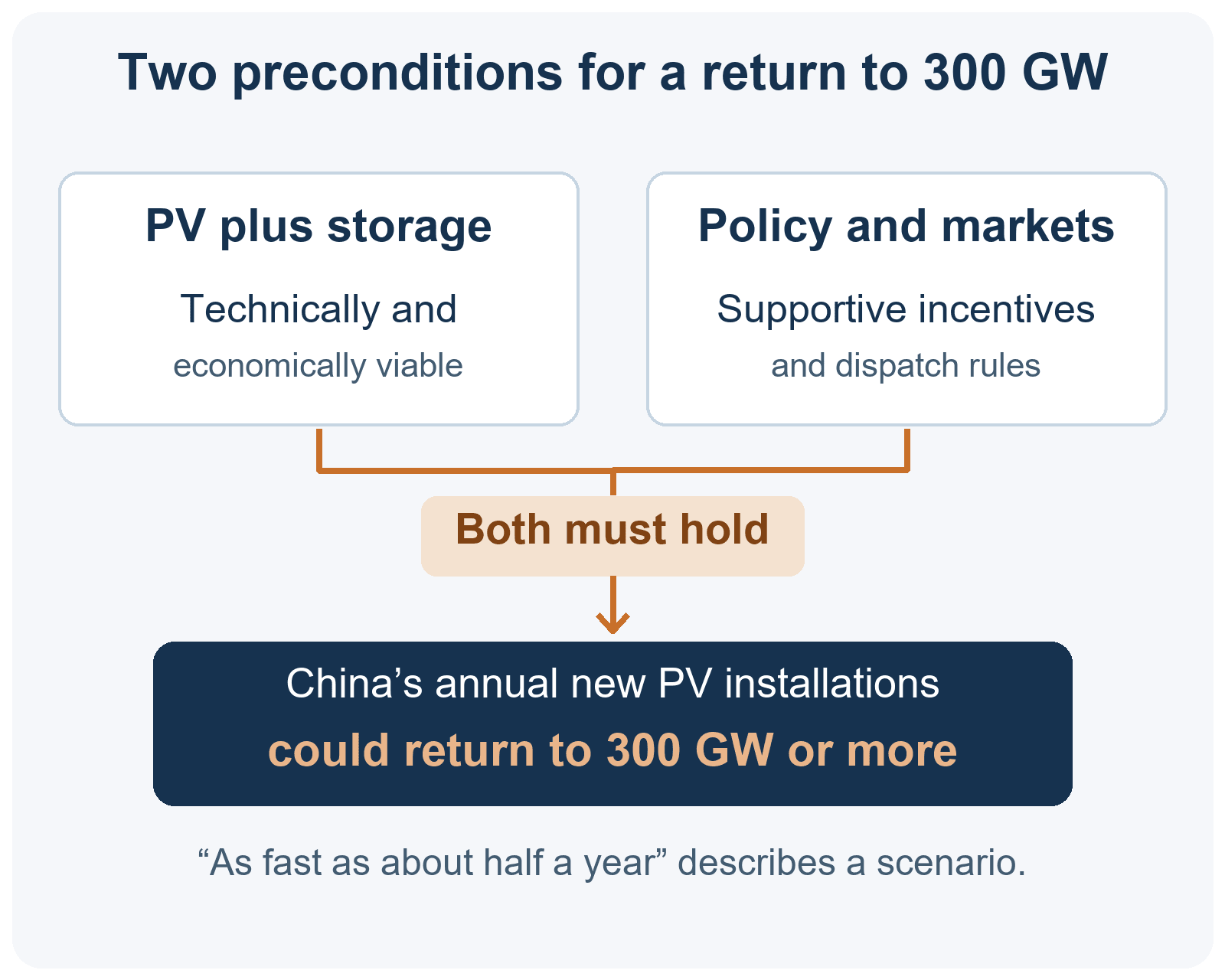
Figure 1. Two preconditions for a return to 300 GW. Based on Section 02 and The Paper’s interview coverage.
Only when both conditions are met can grid bottlenecks genuinely open up. Treating a conditional statement as a confirmed six-month restart schedule misreads the engineering premise.03 Three Grounded Takeaways for PV Practitioners
For R&D, manufacturing, and project teams, these signals point to three practical priorities:
- For R&D & System Engineers: Evaluating new materials and cell/module technologies solely on lab efficiency or cost-per-watt is no longer enough. Technical premiums will increasingly favor effective lifetime yield and system reliability under real-world grid stress—such as lower temperature coefficients, stronger low-irradiance performance, and durability under high-frequency PV-storage cycling.
- For Manufacturing & Supply Chain Teams: Referring to China’s polysilicon sector as the "master valve" of global utilization underscores that upstream capacity discipline remains central to finding a cyclical bottom. Until PV-plus-storage unlocks sustainable grid absorption, betting on a rapid demand rebound carries high risk; cash flow and quality discipline matter more than market-share expansion.
- For Project Developers & Decision-Makers: New project feasibility models must anchor on local spot-price curves, historical curtailment bands, and storage-inclusive full-investment IRR, rather than relying on legacy benchmark-tariff assumptions or macro industry visions.
One-Sentence Conclusion
Depressed spot prices, high curtailment, and plunging grid connections show the grid forcing solar from pure scale toward reliable output; "300 GW in six months" is a conditional scenario contingent on PV-plus-storage breakthroughs and policy support, not a confirmed recovery timetable.
Methodology & Data Notes
- Source Attribution: Jan–Sep 2026 domestic PV spot settlement prices (RMB 0.1–0.2/kWh), regional curtailment (>30%), and YoY grid-connection decline (~54%) are cited from public interview paraphrases published by The Paper on November 19, 2026.
- Curtailment Figure Variance: Earlier reports from November 18–19 covering the same conference cited regional curtailment at "20%–30%," whereas The Paper cited "over 30%." Both are interview paraphrases and are presented side by side without overwriting either source.
- Scope Note: Technical details of the "firm/credible PV" (置信光伏) concept covered in prior daily briefings are not repeated here; this article focuses specifically on the incremental 300 GW / 500 GW conditional remarks and Jan–Sep operating data disclosed on November 19.
References
- The Paper (澎湃新闻), Tongwei’s Liu Hanyuan: If PV+Storage Integration Breaks Bottlenecks, Domestic PV Installations Could Return to 300 GW in as Fast as Half a Year, Nov 19, 2026, 22:50 CST. https://www.thepaper.cn/newsDetail_forward_34514228
- China News Service (中国新闻网), Liu Hanyuan: Turning Solar Power from Weather-Dependent to Dispatchable, Nov 19, 2026, 21:31 CST. https://www.chinanews.com.cn/cj/2026/11-19/10734846.shtml
光伏新材料研究所
https://pvmaterialslab.com
光伏新材料研究所
十余年光伏研发与技术团队|硬核专业知识分享
材料 · 可靠性 · 失效分析 · 标准认证 · 产品 · 工艺
AI+光伏探索交流,欢迎合作
声明:
1. 原创内容仅代表作者个人观点,仅供参考,不构成投资建议。
2. 转载及引用内容均注明出处,尊重原创。
3. 部分内容含AI辅助(图表生成、数据检索、概念说明等),核心框架与重点内容由本技术团队撰写,并经人工审核。
4. 如有不实或侵权,请留言或联系我们处理