
The Road to Lower Cost: Lighter Frames and Moving Beyond Aluminum
PV Module Frame Series · 09
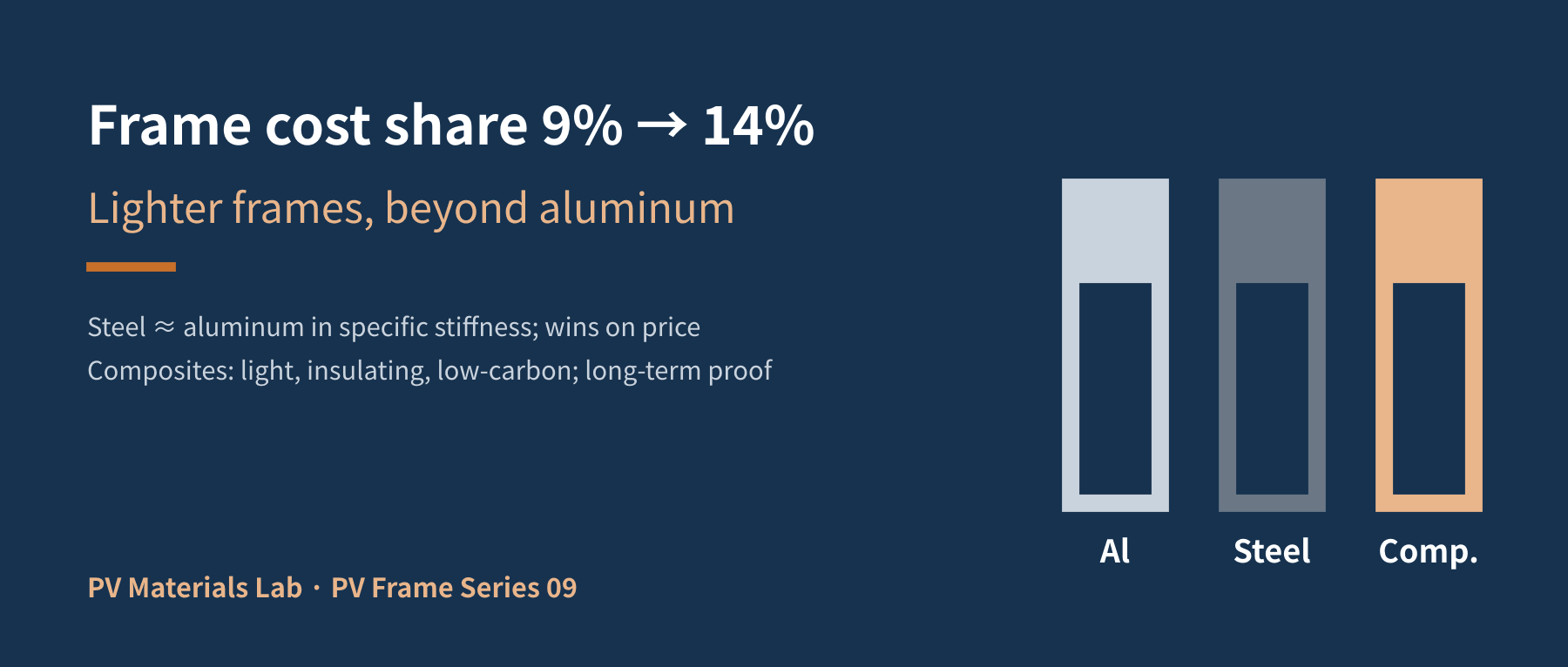
The frame's share of module cost has risen from about 9% to about 14%, and the twin pressures of aluminum prices and carbon footprint have made “less aluminum” and “no aluminum” hot topics. In the ninth article of our frame series, we first look at how much lighter aluminum frames can get, then use materials physics to compare the strengths and hidden risks of steel frames, composite frames and frameless glass-glass modules, ending with a selection table.
As we noted in Article 01, the frame is one of the most expensive auxiliary materials in a module. After polysilicon and cell prices fell, the frame's weight in the cost structure kept growing, and every swing in aluminum prices shakes module cost. The industry has taken two roads: keep lightening aluminum frames, or replace aluminum altogether. In this article we run the numbers on both.
01 Why move beyond aluminum
Start with three sets of figures:
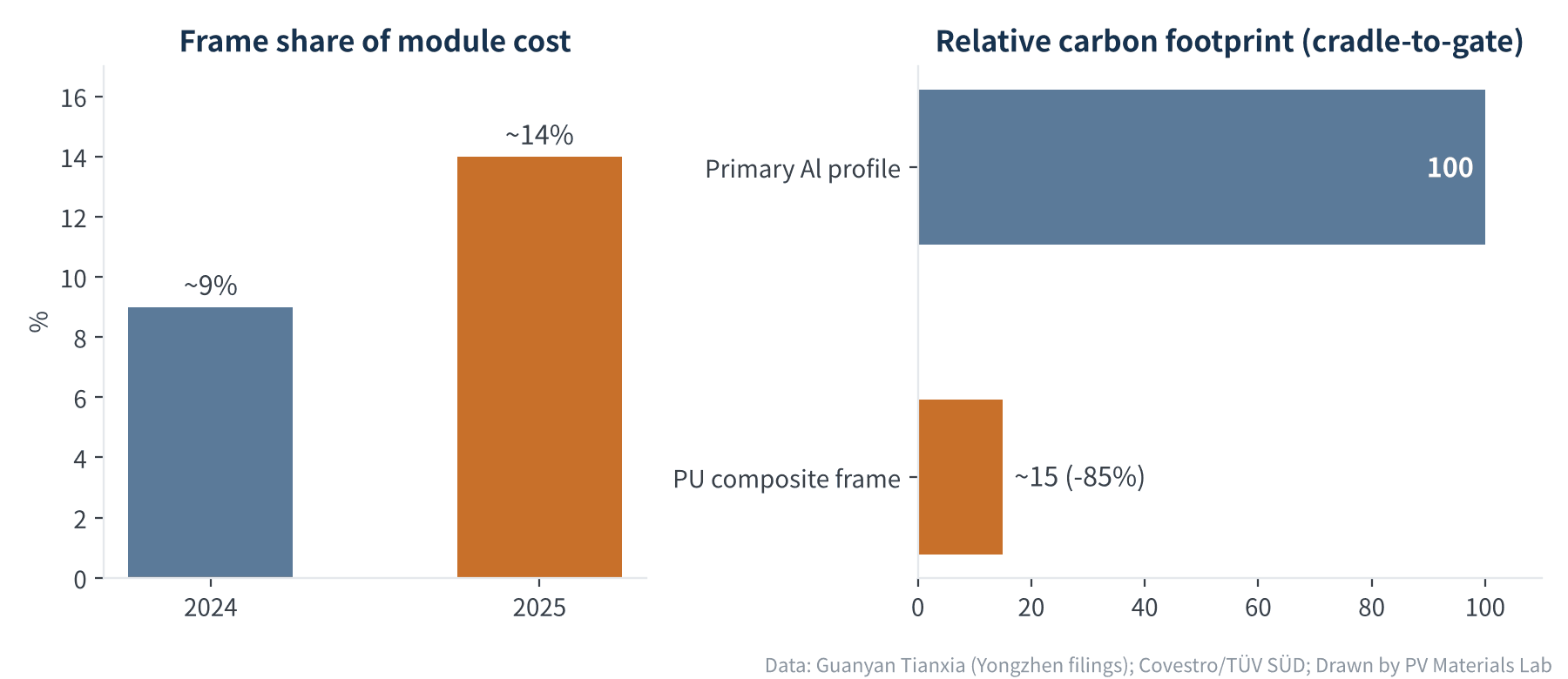
Figure 1 Frame share of module cost, and the carbon footprint of a polyurethane composite frame
- Rising cost share: according to Yongzhen's prospectus and annual report as compiled by Guanyan Tianxia, the frame accounted for about 9% of module cost in 2024 and about 14% in 2025;
- Aluminum still dominates: according to the 2025–2026 China PV Industry Roadmap, aluminum frames held about 93% of the market in 2025;
- Carbon pressure: TÜV SÜD data show about 24.2 kg of CO₂ per kilogram of 100% primary aluminum profile, while export markets keep tightening carbon-footprint requirements for modules.
Cost, price volatility and carbon emissions stacking up are the root reasons “less aluminum” and “no aluminum” have taken off. But whichever road is taken, it must return to the five jobs from Article 01: structure, sealing, mounting, grounding and transport protection, and none can be dropped.
02 How much lighter can aluminum frames get?
Cost reduction within aluminum frames relies on several levers, all touched on in earlier articles:
- Section optimization: a taller Face B with thinner walls raises stiffness with roughly the same aluminum (Article 04);
- Different long and short sides: put aluminum on the more heavily loaded long sides and lighten the short sides (Article 04);
- Stronger alloys: use stronger alloys such as 6005 for thinner walls, while respecting the limits of stiffness and crimp cracking (Article 02);
- Recycled and low-carbon aluminum: cut the carbon footprint, but control impurities and batch consistency (Article 02).
These levers share a common limit: as walls get thinner, local instability becomes the new problem. Thin walls crush more easily under concentrated clamp pressure, deform during crimping and punching, and may buckle locally first under mechanical load. Aluminum frames still have room to lose weight, but every gram gets harder to save.
Takeaway: Aluminum frame lightweighting is now in deep water: overall stiffness can be won back through section design, but local instability, crushing and crimp cracking of thin walls are limits there is no way around.
03 Steel frames: stiff enough, but corrosion and weight are the hard part
Steel frames generally use zinc-aluminum-magnesium or similar coated steel sheet, roll-formed rather than extruded like aluminum. To understand their strengths and risks, start with the materials themselves:
| Property | Aluminum alloy | Steel | Glass (reference) |
|---|---|---|---|
| Density (g/cm³) | ~2.7 | ~7.85 | ~2.5 |
| Elastic modulus (GPa) | ~69 | ~200 | ~70 |
| Specific stiffness E/ρ | ~25.6 | ~25.5 | ~28 |
| Thermal expansion (10⁻⁶/K) | ~23 | ~12 | ~9 |
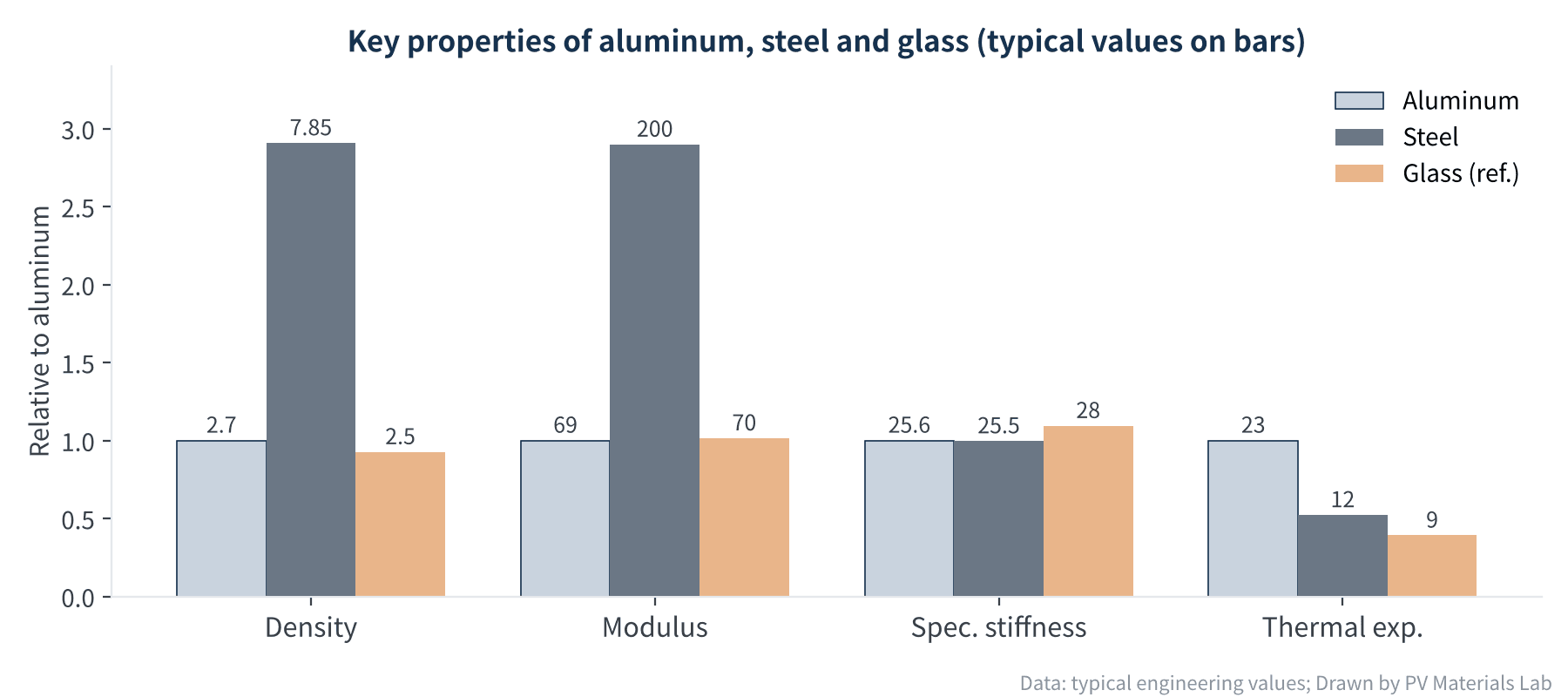
Figure 2 Key properties of aluminum, steel and glass
This table hides an interesting conclusion: steel and aluminum have almost the same specific stiffness. With the same outer shape and the same weight, a steel frame's walls are only about 1/2.9 as thick as aluminum's, but its elastic modulus is about 2.9 times higher, so their bending stiffness is almost equal. In other words, steel's advantage is not being stiffer at the same weight, but that steel costs far less per tonne than aluminum, delivering the same stiffness at lower material cost.
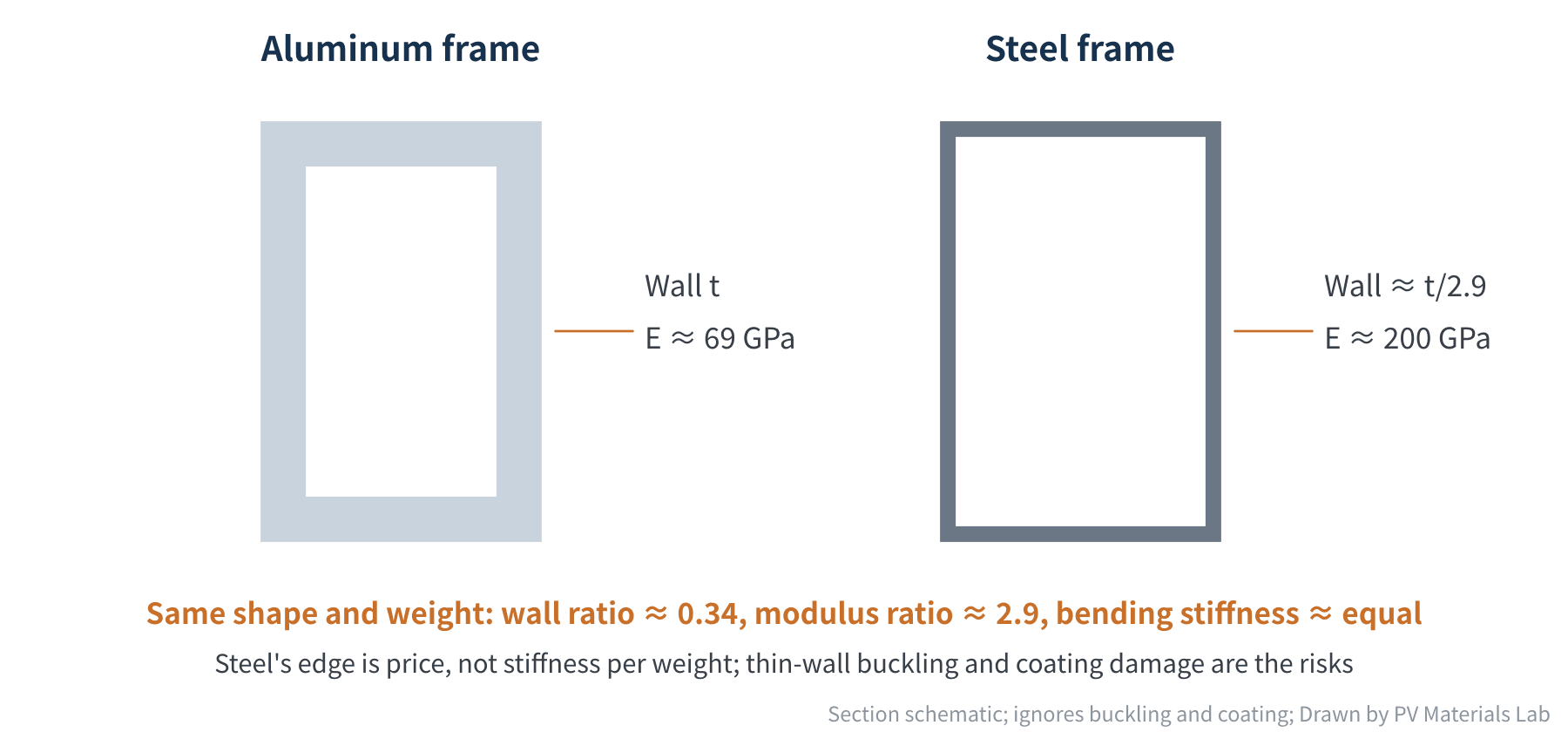
Figure 3 Wall thickness and bending stiffness of steel and aluminum frames at the same shape and weight
Steel's thermal expansion is closer to glass, so it matches the glass better during thermal cycling, another advantage. But steel frames also carry clear risks:
- Corrosion: once the coating is broken at cut ends, punched holes or scratches, the steel substrate rusts, especially around grounding holes;
- Weight: if walls cannot be made very thin for fear of local instability, the module gets heavier. According to Guanyan Tianxia, steel-framed modules weigh about 2–2.5 kg more than aluminum-framed ones, which limits rooftop load capacity and installation in distributed projects;
- Recycling: steel's recycling economics are far worse than aluminum's, lowering the frame's residual value at module recycling.
04 Composite frames: light and insulating, but long-term validation is the hard part
Composite frames mainly follow routes such as glass-fiber-reinforced polyurethane or other glass-fiber-reinforced resins, usually made by pultrusion: continuous glass fibers are impregnated with resin and pulled through a heated die where they cure into shape. The industry already has a group standard, T/CPIA 0081—2024, for glass-fiber-reinforced composite frames for PV modules.
Take Covestro's polyurethane composite frame as an example. According to Solarbe, cumulative shipments of modules using this technology passed 3 GW by June 2025, with certifications from TÜV Rheinland and TÜV SÜD; by Covestro's calculation based on TÜV SÜD data, its cradle-to-gate carbon footprint is 85% lower than that of a primary aluminum profile.
The strengths of composite frames include low density, no electrical conductivity, corrosion resistance and thermal expansion closer to glass. Being non-conductive brings a knock-on change: the frame is no longer an exposed conductive part requiring grounding, so grounding design changes accordingly, and its effect on PID differs from that of aluminum frames.
But the difficulties also come down to one word: long term.
- Creep: polymers deform slowly under sustained load, so persistent loads such as snow test them harder than metals;
- Temperature sensitivity: stiffness and strength change noticeably with temperature, so load capacity at high temperature must be verified separately;
- Aging: the long-term effect of UV and damp heat on the resin matrix needs longer outdoor data to prove;
- Corner joints: they cannot be crimped like aluminum, so corners rely on dedicated corner keys and bonding;
- Recycling: thermoset-resin composites are relatively hard to recycle.
05 Frameless glass-glass modules: for specific scenarios
The most thorough way to move beyond aluminum is to drop the frame entirely. Frameless glass-glass modules are mounted directly by clamps on the two glass panes, saving the frame's cost and carbon emissions, and their surface does not trap dirt or snow.
But the five jobs from Article 01 do not disappear along with the frame: mechanical support must come from the glass itself and the clamps, the glass edges are exposed directly, knocks during transport and installation are riskier, and mounting is strictly constrained by the clamps. Frameless modules therefore suit scenarios with controlled installation conditions and clear load requirements, such as specific tracker designs, floating and agrivoltaic projects, and building-integrated applications.
06 How to choose among the four routes
The four routes compare as follows:
| Item | Lighter aluminum | Steel | Composite | Frameless glass-glass |
|---|---|---|---|---|
| Material cost | Medium | Low | Medium | Lowest |
| Weight | Light | Heavier | Lightest | Depends on glass |
| Corrosion | Good | Coating-dependent | Good | No frame issue |
| Grounding | Required | Required | Usually not | No frame |
| Recycling | Good | Fair | Harder | Depends on glass |
| Maturity | Highest | Scaling up | Scaling up | Niche |
No option wins on every dimension. When choosing, the key is what the project cares about most: cost, weight, corrosion resistance, carbon footprint or maturity, and then proving the choice through the full qualification flow described in Article 07.
Bottom line: Moving beyond aluminum is not a simple material swap but a reallocation of the frame's five jobs. Whichever route answers all five questions well will go the farthest.
07 Final thoughts
To wrap up this article:
- Drivers: a rising frame cost share, aluminum price swings and carbon-footprint pressure are pushing less and no aluminum;
- Lighter aluminum frames: now in deep water, with local instability and crimp cracking as the main limits;
- Steel frames: specific stiffness on par with aluminum; the advantage is material price, the risks are corrosion, weight and recycling;
- Composite frames: light, insulating and low-carbon; the difficulties are creep, aging and long-term validation;
- Frameless glass-glass: the most thorough way to drop aluminum, suited to specific scenarios with controlled installation.
The contest of material routes will ultimately show up in supply chains and market structure. In the next article we look at the frame supply chain and market: the business performance of leading suppliers, how aluminum prices pass through to module cost, the make-or-buy debate, and overseas capacity and trade barriers. Stay tuned.
Calculation notes / data basis
- Densities, elastic moduli and thermal expansion coefficients in the property table are typical values for common engineering materials (aluminum as 6063, steel as carbon steel, glass as soda-lime glass, rounded); specific grades differ. Specific stiffness is elastic modulus divided by density.
- Derivation of “nearly equal bending stiffness at the same weight and shape”: a thin-walled section's moment of inertia is roughly proportional to wall thickness; at equal weight, steel's wall is about 2.7 ÷ 7.85 ≈ 0.34 times aluminum's, while its elastic modulus is about 200 ÷ 69 ≈ 2.9 times, and the product is about 1.0. This ignores local instability and coating thickness.
- That steel-framed modules weigh about 2–2.5 kg more than aluminum-framed ones comes from Guanyan Tianxia's comparison table, stated “per unit area” without specifying module size.
- The 85% lower carbon footprint of the polyurethane composite frame is Covestro's calculation based on TÜV SÜD data, compared with a 100% primary aluminum profile.
References
- Guanyan Tianxia. PV frame industry analysis (citing the 2025–2026 China PV Industry Roadmap and Yongzhen's prospectus and annual report), 2026-04 (in Chinese). https://www.chinabaogao.com/market/202604/792097.html
- Solarbe. Covestro: modules with Baydur® polyurethane composite frames pass 3 GW cumulative shipments, 2025-06-23 (in Chinese). https://cn.solarbe.com/news/20250623/50003282.html
- T/CPIA 0081—2024 Glass-fiber-reinforced composite frames for PV modules (CPIA group standard, in Chinese)
- IEC 61215-2:2021 Terrestrial photovoltaic (PV) modules – Design qualification and type approval – Part 2: Test procedures
- IEC 61730-2 Photovoltaic (PV) module safety qualification – Part 2: Requirements for testing
PV Materials Lab
https://pvmaterialslab.com
PV Materials Lab
A PV R&D and technical team with 10+ years of experience | In-depth technical knowledge sharing
Materials · Reliability · Failure Analysis · Standards & Certification · Products · Processes
Exploring AI + PV — collaboration welcome
Disclaimer:
- Original content reflects the authors' personal views only, is for reference, and does not constitute investment advice.
- Reposted and cited content is credited to its source, with respect for original work.
- Some content is AI-assisted (chart generation, data retrieval, concept explanations, etc.); the core framework and key content are written by our technical team and reviewed by humans.
- For any inaccuracy or infringement, please leave a message or contact us.