
120 modules an hour: how to read the data from an end-of-life PV recycling line that has run for over a year
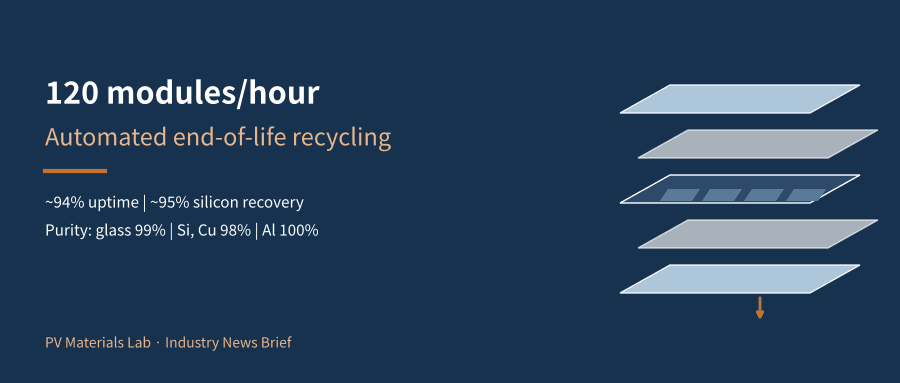
The fully automated end-of-life module recycling line that Italian equipment maker Ecoprogetti delivered to circular-economy group Haiki+ has been running in Sale, Italy, since early 2025. The company reports up to about 120 modules per hour, about 94% uptime, 100% recovery of aluminium and junction boxes, and about 95% silicon recovery at 98% purity. We walk through the process (air-based glass removal plus electromechanical separation), flag the questionable '700,000 tonnes a year' figure, the grade of the recovered silicon and the unknown fate of the silver, and draw lessons for module designers and recyclers.
PV module recycling has been discussed for years, yet it has long been stuck at 'works in the lab, struggles in the factory'. On 9 November, pv magazine published operating data from a fully automated end-of-life module recycling line that Italian equipment maker Ecoprogetti delivered to circular-economy group Haiki+: up to about 120 modules per hour, about 94% uptime and about 95% silicon recovery. The line has been running in Sale, north-western Italy, since early 2025. In this issue we summarise the news, the process route, and the parts of the data that deserve a closer look.
01 What the news says
Ecoprogetti is an Italian maker of PV module production equipment. Over the past two years it has built module lines in South Africa, Iraq, Oman and elsewhere, while also promoting its own recycling equipment. Haiki+ is an environmental and circular-economy group listed on Euronext Growth Milan, active in industrial waste, battery recycling and waste electrical and electronic equipment (WEEE).
The line is installed at Haiki+'s waste treatment plant in Sale, on the same site as its battery recycling lines. According to the report it has operated since early 2025, and the pv magazine article made its operating data public.
Ecoprogetti's managing director Marco Manfron said, in essence, that the line shows PV recycling can follow industrial principles of high capacity, automation, continuous operation and output quality, and that compared with earlier solutions it handles large volumes with less downtime and better-quality recovered fractions.
02 Key data: capacity, recovery and purity
- Capacity: Up to about 120 modules per hour, roughly 4 tonnes per hour; the article cites a nominal potential of about 700,000 tonnes a year in continuous operation (we discuss this figure separately below).
- Uptime: Currently about 94%, which Ecoprogetti describes as among the highest in the industry. Uptime is the share of planned time the equipment is actually available to run.
- Module types: Mono- and polycrystalline, double-glass and bifacial modules, plus glass-backsheet modules; modules with broken glass, missing parts, hail or fire damage, corrosion or delamination can also be processed.
| Material | Recovery | Purity |
|---|---|---|
| Aluminium (frame) | 100% | 100% |
| Junction box | 100% | 100% |
| Copper | 99% | 98% |
| Glass | 99% | 99% |
| Plastics (polymers) | 99% | 88% |
| Silicon | 95% | 98% |
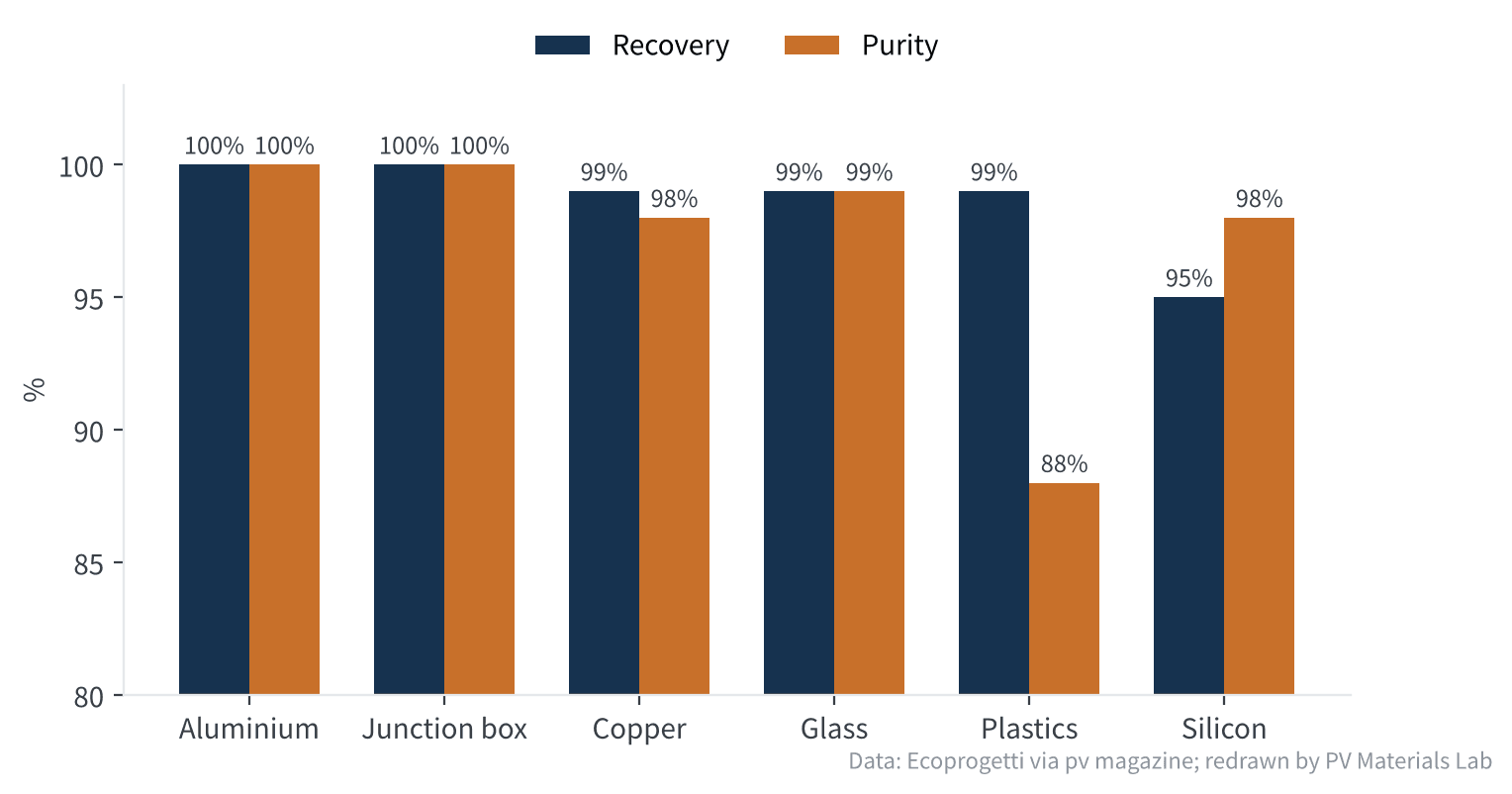
Figure 1 Recovery and purity by material (company data)
Two concepts need to be kept apart. Recovery is how much of a given material entering the line ends up in its designated output bin; purity is what share of that bin is actually the target material. The two often trade off: a wider cut raises recovery but lets in more impurities. Plastics show 99% recovery but only 88% purity, which means the polymer fraction still contains a fair amount of other material; the article does not say what.
For comparison with earlier figures: in May 2025 pv magazine reported a 60-modules-per-hour version made up of seven machines; at Intersolar 2026 Ecoprogetti showed two lines, 1.5 t/h (60 modules) and 3 t/h (120 modules). The Haiki+ line belongs to the higher-capacity class.
03 Process: one component per station
According to the company, the sequence is: automatic module recognition → junction box and frame removal → module flipping → glass removal → shredding → separation and collection. The core is a patented air-based glass removal system combined with staged electromechanical processing, designed so that each station handles one component and cross-contamination is minimised.
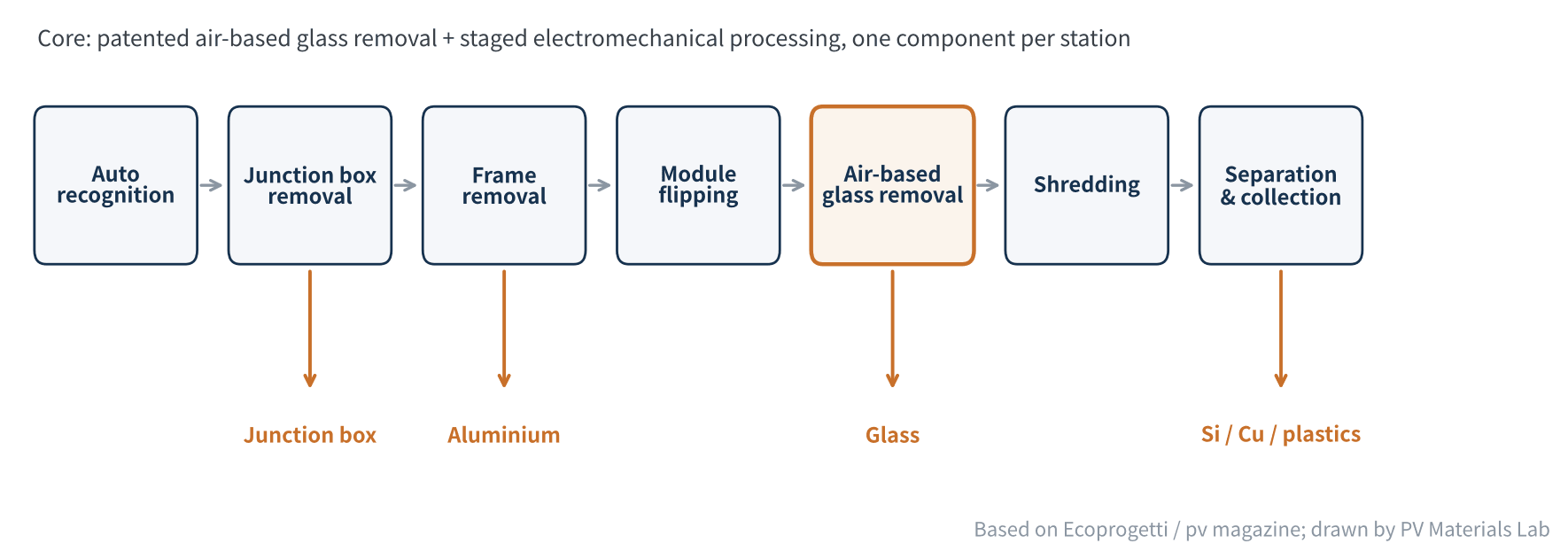
Figure 2 Ecoprogetti recycling line process (redrawn from the company's description)
- Easy parts first: Frames and junction boxes come off whole at the start, hence 100% recovery and purity. This part is not hard; nearly every recycling line can do it.
- Glass decides the outcome: Glass is roughly 70% of a crystalline-silicon module's weight. How cleanly it can be stripped in one piece determines the concentration of the downstream silicon, copper and polymer fractions. The company has not disclosed how its air-based glass removal works.
- Physical separation downstream: The remaining 'cell + ribbon + encapsulant' sandwich is shredded and sorted into silicon, copper and plastic fractions. The route is mechanical/physical; the article mentions no pyrolysis or chemical dissolution.
Takeaway: What this line has industrialised is front-end dismantling: splitting a module efficiently into a few fairly clean fractions. Whether those fractions can return to the PV supply chain, and what they are worth, is a question for downstream refining.
04 Reading the data: three question marks
People who work in materials and failure analysis tend to redo the arithmetic before trusting numbers like these.
First, the '700,000 tonnes a year' figure does not add up. 4 t/h × 8,760 h ≈ 35,000 t; at 94% uptime about 33,000 t, roughly a twentieth of 700,000 t. By contrast, 120 modules/h × 16 h × 365 days ≈ 700,000 modules. We suspect the '700,000' more likely refers to modules, or that there is a unit mix-up; this needs clarification from the company. We advise against quoting '700,000 tonnes a year' as is.
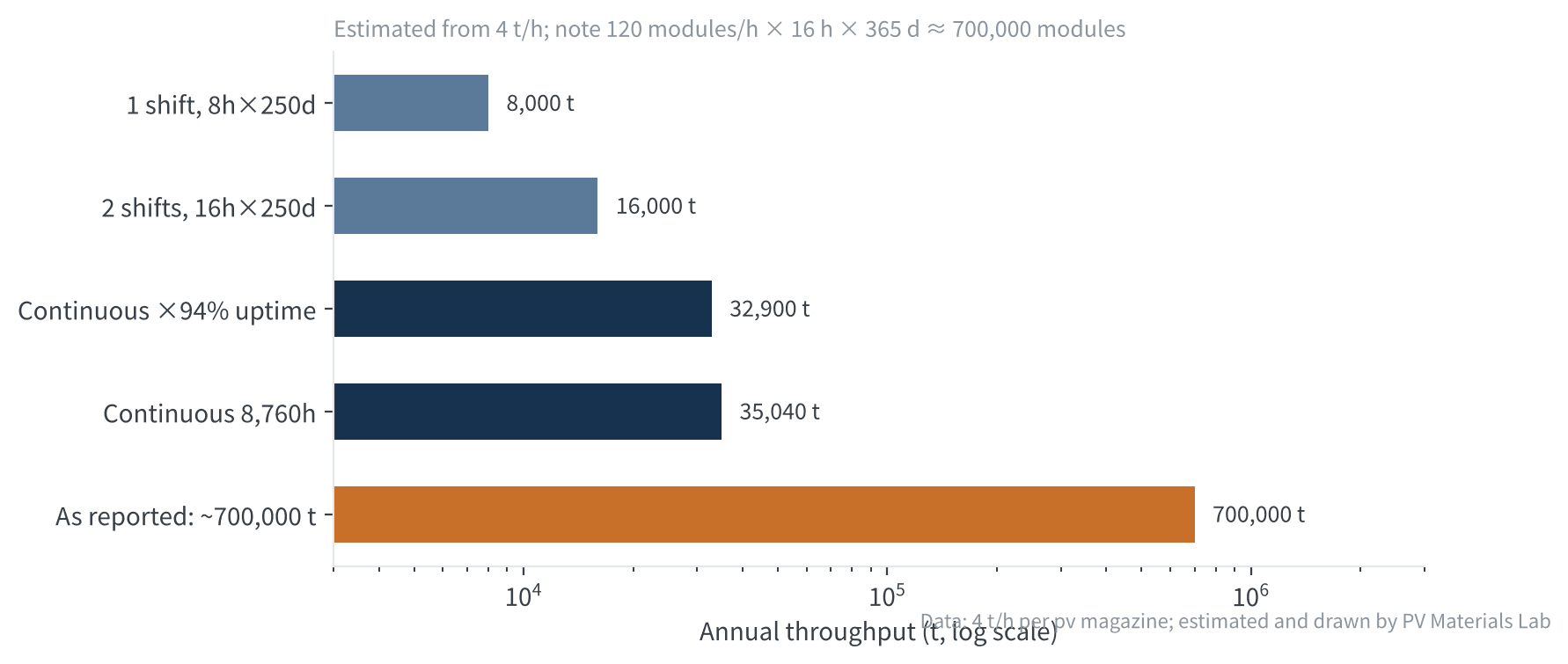
Figure 3 Annual throughput estimated from 4 t/h vs the figure as reported (log scale)
Second, how heavy is a module? 120 modules ≈ 4 t implies about 33 kg each, close to today's large-format double-glass modules, whereas TaiyangNews's '3 t/h = 120 modules/h' implies about 25 kg each. The early wave of retirements will be dominated by smaller glass-backsheet modules installed over a decade ago, which are lighter. Whether the bottleneck is module count or tonnage directly affects the real cost per tonne.
Third, what kind of silicon is '98% pure'? 98% is around metallurgical grade, far from PV-grade polysilicon (6N and above). This fraction comes from cell fragments that still carry silver fingers, aluminium paste residue and encapsulant debris. The article does not say where the silver, the most valuable material in the cell, ends up. According to Italian media, Haiki+ is working with the University of L'Aquila at another plant on recovering silver from silicon dust, with plans to bring the system to Sale once it is ready.
In addition, all recovery and purity figures were supplied by the company to the media; we have not seen a third-party audit. Haiki+'s actual annual throughput, energy consumption and cost per unit processed have not been disclosed either.
05 Lessons for practitioners
- Module design: Design for recycling is now getting feedback from real lines. Frame and junction box removal is no longer the problem; pressure shifts to encapsulants, fluorinated backsheets and glass composition. For example, some patterned PV glass uses antimony-containing fining agents, which affects where recycled glass can go; this is worth considering at material selection.
- Double-glass vs backsheet: The company says the same equipment handles both conventional and double-glass modules without extra machinery or investment (a company claim). Double-glass modules have glass on both sides and no backsheet, so glass removal and material flows differ from backsheet modules; real-world compatibility is worth tracking.
- Dismantling vs refining: Mechanical routes offer high capacity and continuous operation; routes such as laser EVA delamination, pyrolysis and hydrometallurgical silver recovery focus on recovering high-value materials at high purity. They look more like relay partners along the chain than substitutes.
- Damaged modules: Modules with broken glass, fire, hail or delamination damage can go straight into the line, good news for handling scrapped modules from O&M and insurance claims.
06 Our view
Value: the significance is not how impressive the recovery figures look, but that this is a continuous line that has run in a real plant for over a year at about 94% uptime. For end-of-life recycling, stable continuous operation often matters more than one-off lab results.
Limitations: all data come from the company; the annual capacity figure is questionable; the fate of silver and high-purity silicon is unclear; economics such as gate fees and the sale price of recovered material are not disclosed. The EU WEEE Directive brings PV modules under extended producer responsibility, and the economics of lines like this depend heavily on that framework.
China context: modules from China's early installations will gradually reach end of life. For Chinese companies, mechanical dismantling equipment may not be the biggest gap; the harder parts are a stable outlet and value for recovered materials, and a mechanism for who pays for recycling. The data from this Italian line can serve as a reference when assessing domestic recycling lines, especially on capacity and uptime.
Bottom line: Front-end dismantling can now run continuously at industrial scale; the next hurdle is getting recovered silicon, silver and glass back into the supply chain and making the numbers work.
07 Final thoughts
End-of-life module recycling is moving from 'can we take it apart?' to 'who buys what comes out?'. We will keep watching whether Ecoprogetti and Haiki+ publish third-party audit data and actual annual throughput. Colleagues in recycling and materials are welcome to share: where does the silicon fraction from your lines end up?
Calculation notes / data basis
- Annual throughput is our estimate from the reported ~4 t/h, not company data: continuous 8,760 h ≈ 35,040 t; × 94% uptime ≈ 32,900 t; one shift (8 h × 250 days) ≈ 8,000 t; two shifts (16 h × 250 days) ≈ 16,000 t.
- Module count: 120 modules/h × 16 h × 365 days ≈ 701,000 modules. That '700,000' may refer to modules is our inference.
- Module weight: 4,000 kg ÷ 120 ≈ 33 kg (pv magazine basis); 3,000 kg ÷ 120 = 25 kg (TaiyangNews basis).
- 'Glass is about 70% of module weight' is a commonly cited literature value (IRENA & IEA-PVPS, 2016) and varies with module construction.
- Recovery and purity figures were supplied by the company to pv magazine and have not been third-party audited; information on Haiki+'s silver recovery research comes from Il Sole 24 Ore and its progress is unverified.
References
- Patrick Jowett. Ecoprogetti presents automated line for recycling end-of-life PV modules. pv magazine Global, 2026-11-09. https://www.pv-magazine.com/2026/11/09/ecoprogetti-presents-automated-line-for-recycling-end-of-life-pv-modules/
- pv magazine. Ecoprogetti releases fully automated solar panel recycling line. pv magazine Global, 2025-05-20. https://www.pv-magazine.com/2025/05/20/ecoprogetti-releases-fully-automated-solar-panel-recycling-line/
- TaiyangNews. Ecoprogetti Presents Turnkey Module Lines And Recycling Equipment. 2026. https://taiyangnews.info/technology/ecoprogetti-presents-turnkey-module-lines-and-recycling-equipment
- Il Sole 24 Ore. Solar panels: Haiki+ aims to increase recycling capacity. https://en.ilsole24ore.com/art/haiki-solar-panels-aims-to-increase-its-recycling-capacity-AJgwMYz
- IRENA & IEA-PVPS. End-of-Life Management: Solar Photovoltaic Panels. 2016.
PV Materials Lab
https://pvmaterialslab.com
PV Materials Lab
A PV R&D and technical team with 10+ years of experience | In-depth technical knowledge sharing
Materials · Reliability · Failure Analysis · Standards & Certification · Products · Processes
Exploring AI + PV — collaboration welcome
Disclaimer:
- Original content reflects the authors' personal views only, is for reference, and does not constitute investment advice.
- Reposted and cited content is credited to its source, with respect for original work.
- Some content is AI-assisted (chart generation, data retrieval, concept explanations, etc.); the core framework and key content are written by our technical team and reviewed by humans.
- For any inaccuracy or infringement, please leave a message or contact us.