
Frame Test Methods and Standards: From Profile to Module
PV Module Frame Series · 07
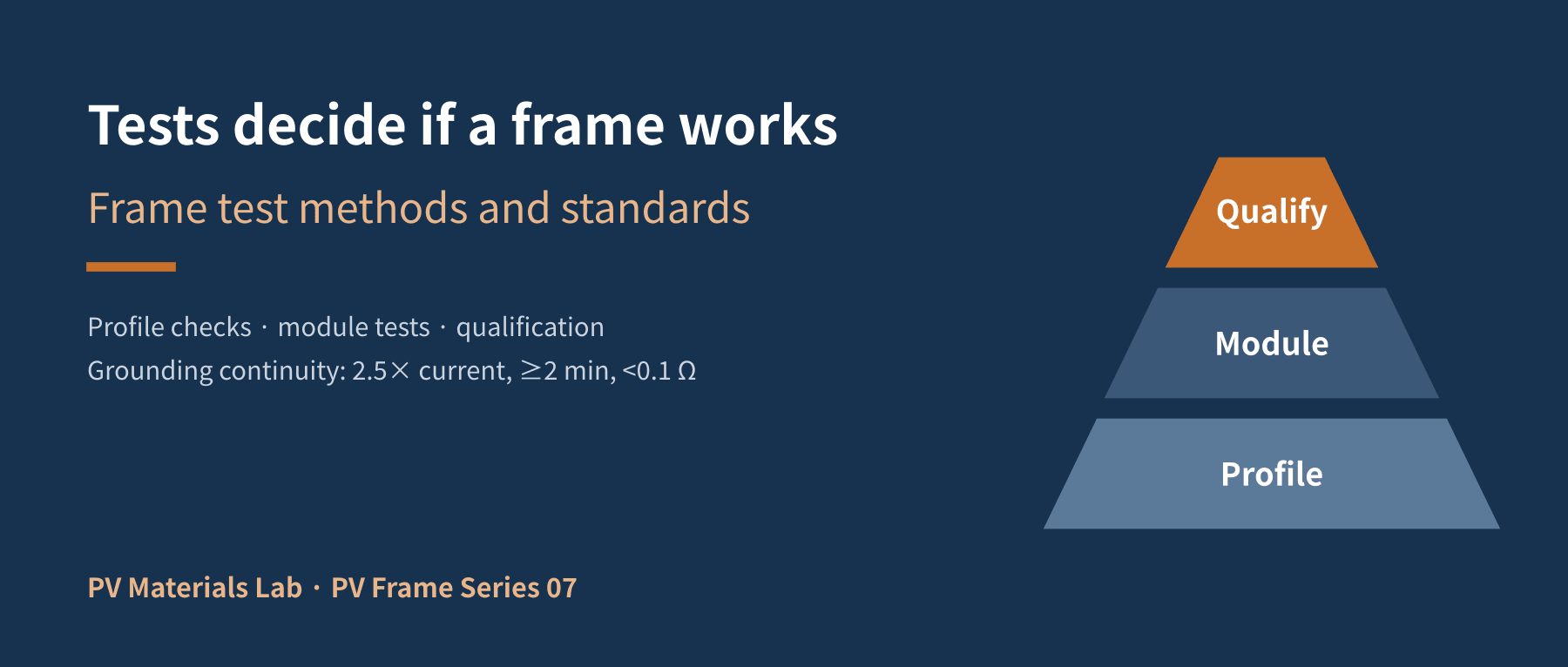
Whether a frame is good is ultimately decided by tests. In the seventh article of our frame series, we split frame testing into three levels: at profile level, composition, dimensions, hardness, film thickness and corrosion resistance; at module level, static and cyclic mechanical load, grounding continuity, and damp-heat, salt-mist and ammonia tests; and finally the validation flow for qualifying a new frame and the key levers for routine incoming inspection.
The first six articles went from function to framing, each describing what a frame should be. But whether a given frame actually works is ultimately decided by test data. In this article we walk through frame-related testing: what to check at profile level, how modules are tested, and how to validate a new frame before qualifying it.
01 Three levels of testing: profile, module, qualification
Frame testing can be split into three levels by test object:
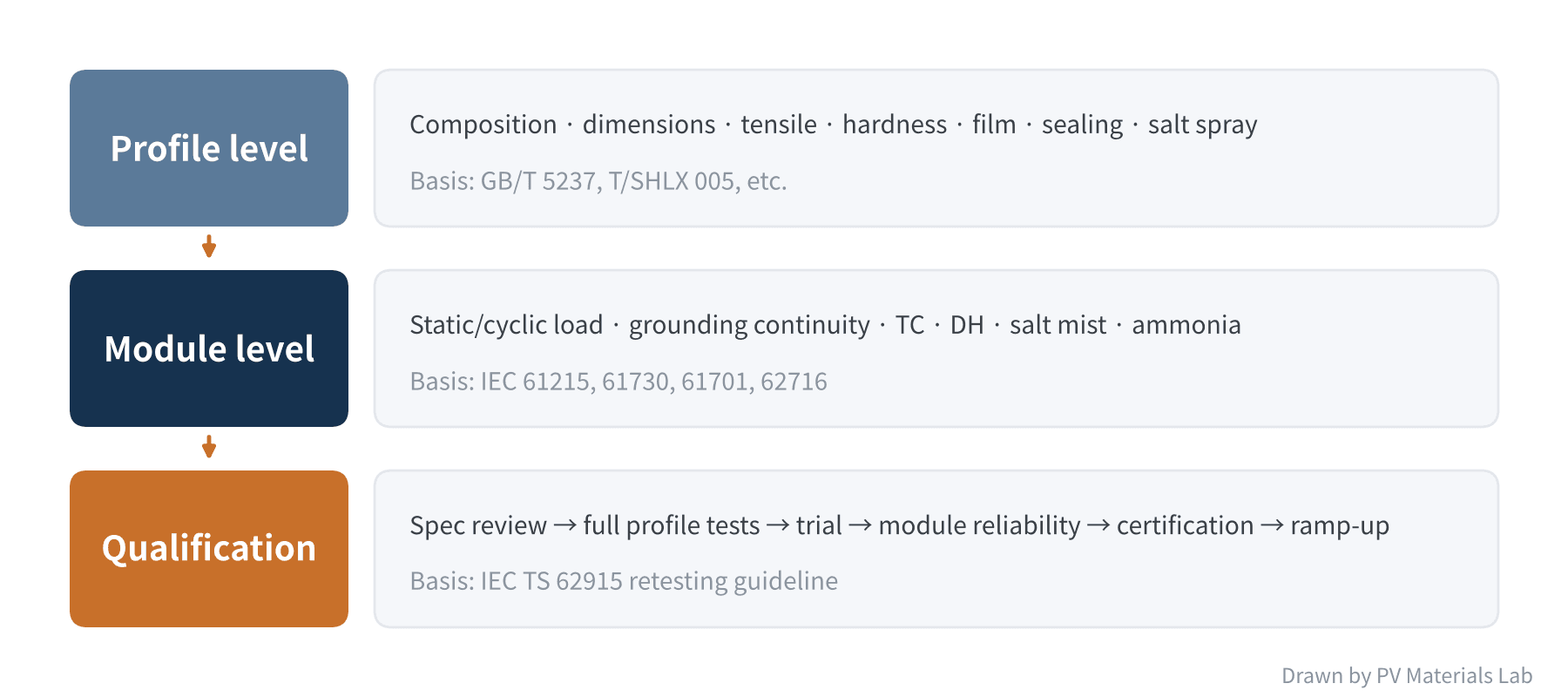
Figure 1 The three levels of frame testing
- Profile level: tests the frame itself: composition, dimensions, mechanical properties, coatings and corrosion resistance, mainly under profile standards, mostly done at the frame maker and in the module maker's incoming inspection;
- Module level: tests the whole module with its frame fitted: mechanical load, grounding continuity and various weathering tests, mainly under module certification standards such as IEC 61215 and IEC 61730;
- Qualification: ties the first two together: before a new frame or supplier enters mass production, profile tests, trial runs and module reliability tests are completed to plan, and the impact on certification is assessed.
The three levels build on each other: a compliant profile is the precondition, a passing module is the result, and qualification is the process that connects them. The earlier a profile-level problem is found, the cheaper it is.
02 Profile level: composition, dimensions, properties and coatings
In China, profile-level testing mainly refers to the GB/T 5237 series for architectural aluminum profiles, the basic test-method standards, and the group standard written specifically for PV frames, T/SHLX 005—2024. Common items are as follows:
| Test item | Common method or standard | What to watch |
|---|---|---|
| Chemical composition | Spectroscopy, judged to GB/T 3190 | Mg, Si, Fe, Cu within grade limits |
| Dimensional deviation | GB/T 14846, drawing tolerances | Section, wall, length, miter, holes |
| Tensile properties | GB/T 228.1 | Tensile and yield strength, elongation |
| Webster hardness | YS/T 420 | Compliance, batch and position consistency |
| Film thickness | Eddy current, GB/T 4957 | Average and local thickness |
| Sealing quality | GB/T 8753.1 | Acid dissolution mass loss within limit |
| Salt spray | GB/T 10125 | Corrosion rating, blistering, pitting |
| Appearance | Visual, colorimeter | Scratches, color, weld seams, blisters |
Among these, Webster hardness and film thickness are quick and cheap, suiting batch sampling; composition, tensile and salt-spray tests take longer and cost more, so they suit periodic testing or the qualification stage.
03 Module level: mechanical load is the frame's main exam
The frame's main job is carrying load, so mechanical load is the core module-level test. Two tests in IEC 61215-2:2021 matter most for frames:
- Static mechanical load (MQT 16): uniform pressure is applied alternately to the front and back of the module and held for a period; the test load equals the design load times a safety factor of at least 1.5, simulating extreme wind and snow;
- Cyclic mechanical load (MQT 20): lower loads are applied repeatedly front and back to simulate long-term wind-induced vibration, following IEC TS 62782. It examines cumulative damage from repeated flexing, such as growth of cell microcracks and loosening corners.
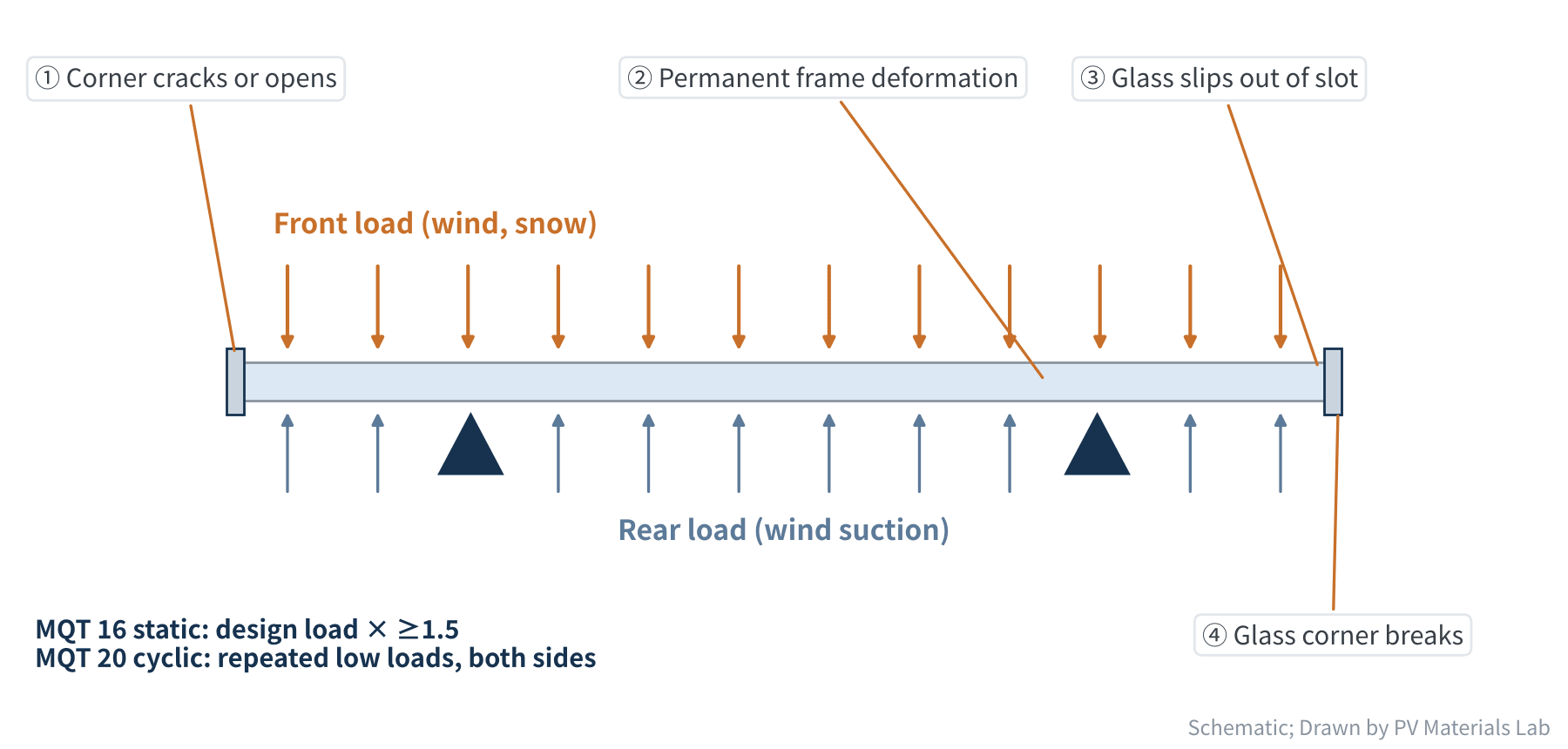
Figure 2 Mechanical load testing and frame-related observation points
A module passes based mainly on the absence of major visual defects, acceptable wet leakage current and power loss within limits. But for frame engineers, a few things deserve close attention during the test: permanent frame deformation, cracked or opened corners, glass slipping out of the slot, and broken glass corners. Even when they do not cause a failure, these are often signs of insufficient design margin.
One more point: mechanical load tests are run with the mounting method the manufacturer specifies. As Article 04 explained, changing the mounting position or method can completely change load capacity, so the load ratings in the certificate may no longer apply.
04 Module level: electrical safety and weathering
Besides mechanical load, several module tests relate directly to the frame:
| Test | Standard | Relevance to the frame |
|---|---|---|
| Grounding continuity | IEC 61730-2 | Continuity from grounding point to farthest conductive part |
| Thermal cycling | IEC 61215-2 | Expansion match of frame, silicone and glass |
| Damp heat | IEC 61215-2 | Durability of sealing and bonding at heat and humidity |
| Salt mist corrosion | IEC 61701 | Salt resistance of coating, cut ends and holes |
| Ammonia corrosion | IEC 62716 | Ammonia resistance in agrivoltaic and livestock settings |
The grounding continuity test deserves a closer look. IEC 61730-2 requires that, between the manufacturer's designated grounding point and the exposed conductive part farthest from it, a current of 2.5 times the module's maximum overcurrent protection rating is applied for at least 2 minutes, and the calculated resistance must be less than 0.1 Ω. As Article 05 explained, if only one side has a grounding hole, the other three sides depend on the corner joints for conduction, so corner crimping quality directly affects this result.
Takeaway: A compliant profile does not guarantee a passing module. Mechanical load and grounding continuity are the two module-level exams where frame weaknesses most often show.
05 Qualifying a new frame: a complete validation flow
Changing frame supplier, adjusting the section, or switching to a new material or surface treatment all count as frame changes. A fairly complete qualification flow looks like this:
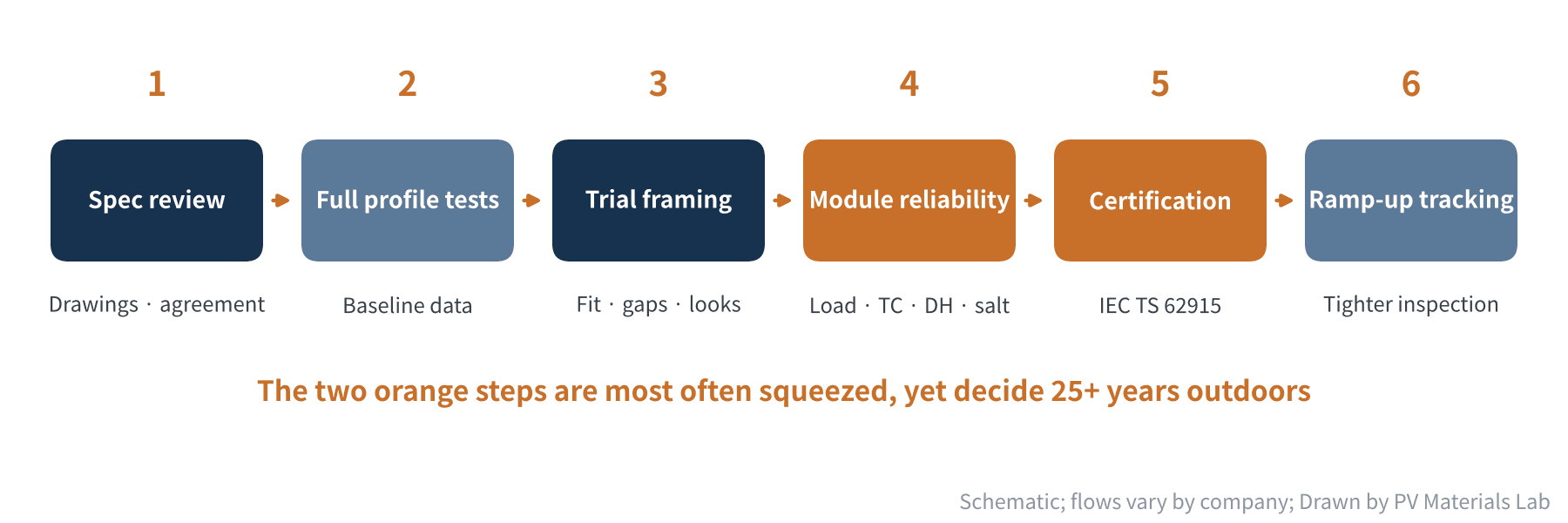
Figure 3 Typical validation flow for qualifying a new frame
- Specification review: check section, alloy and temper, film class, holes and tolerances against drawings and the technical agreement;
- Full profile testing: run full tests on the first delivery (composition, dimensions, mechanical properties, hardness, coating and corrosion) to establish baseline data;
- Trial framing: frame a small batch on the line to verify fit with the laminate, silicone or tape and the framing machine, watching corner gaps and appearance;
- Module reliability: run module-level mechanical load, thermal cycling and damp heat, adding salt mist and ammonia for coastal or agrivoltaic projects;
- Certification assessment: use the retesting guideline IEC TS 62915 to decide which certification tests the change requires;
- Ramp-up tracking: tighten incoming inspection in early mass production and track the quality of the first batches.
The steps most often squeezed in this flow are module reliability and certification assessment. Yet these two steps decide whether a new frame will hold up outdoors for two to three decades.
06 Routine incoming inspection: focus on a few key items
After qualification, routine incoming inspection cannot run full tests on every batch, so trade-offs are needed. A practical approach is tiered control:
- Every batch: dimensions, Webster hardness, film thickness and appearance: quick to test and able to catch most common problems;
- Periodic tests: composition, tensile properties, sealing quality and salt spray, sampled monthly or quarterly to watch for drift in the supplier's process;
- Supplier data: require composition, aging records and outgoing inspection reports for each batch, traceable by cast and batch number;
- Triggered by anomalies: when hardness swings, corners crack or appearance changes, tighten testing immediately and trace back to the process step.
Bottom line: The goal of incoming inspection is not to test as much as possible, but to detect supplier process drift as early as possible with as few tests as possible.
07 Final thoughts
To wrap up this article:
- Three levels: the profile is the precondition, the module is the result, and qualification connects them;
- Profile level: composition, dimensions, hardness, film, sealing and corrosion; quick tests per batch, slow tests periodically;
- Module level: mechanical load and grounding continuity are the frame's main exams, while thermal cycling, damp heat, salt mist and ammonia test long-term durability;
- Qualification: specification review, full profile testing, trial framing, module reliability, certification assessment and ramp-up tracking; skip none of them;
- Incoming inspection: tiered control that watches for process drift.
Tests help us find problems early, but outdoor conditions are always more complex than the lab. In the next article we look at frames and module reliability: how common failures such as frame deformation, corner cracking, broken glass corners, corrosion and galvanic corrosion actually happen. Stay tuned.
Calculation notes / data basis
- The grounding continuity test conditions are taken from a test-instrument description citing IEC 61730-2:2016: test current 2.5 times (±10%) the module's maximum overcurrent protection rating, for at least 2 minutes, with resistance below 0.1 Ω; follow the current edition of the standard.
- The load amplitude, frequency and number of cycles for the MQT 20 cyclic mechanical load are not given here; refer to IEC 61215-2:2021 and IEC TS 62782.
- The tiered incoming inspection frequencies are our suggestions based on industry experience; actual practice should reflect supplier quality and the company's quality system.
References
- IEC 61215-2:2021 Terrestrial photovoltaic (PV) modules – Design qualification and type approval – Part 2: Test procedures (MQT 16, MQT 20)
- IEC 61730-2 Photovoltaic (PV) module safety qualification – Part 2: Requirements for testing (continuity test of equipotential bonding)
- Instrument.com.cn. Product description of an IEC 61730-2:2016 continuity tester (in Chinese). https://m.instrument.com.cn/show/C16741.html
- Sinovoltaics. Dynamic Mechanical Load Testing (IEC 61215 MQT 20) for Solar Modules. https://sinovoltaics.com/learning-center/testing/dynamic-mechanical-load-testing-iec-61215-mqt-20-for-solar-modules/
- IEC TS 62782 Photovoltaic (PV) modules – Cyclic (dynamic) mechanical load testing
- IEC 61701 Photovoltaic (PV) modules – Salt mist corrosion testing
- IEC 62716 Photovoltaic (PV) modules – Ammonia corrosion testing
- IEC TS 62915 Photovoltaic (PV) modules – Type approval, design and safety qualification – Retesting
- T/SHLX 005—2024 Aluminum alloy extruded profiles for solar cell frames (in Chinese)
- GB/T 5237 series; GB/T 14846 dimensional deviations of aluminium extruded profiles; GB/T 228.1 tensile testing; YS/T 420 Webster hardness test; GB/T 4957 eddy-current coating thickness; GB/T 8753.1 sealing quality; GB/T 10125 salt spray tests (all Chinese standards)
PV Materials Lab
https://pvmaterialslab.com
PV Materials Lab
A PV R&D and technical team with 10+ years of experience | In-depth technical knowledge sharing
Materials · Reliability · Failure Analysis · Standards & Certification · Products · Processes
Exploring AI + PV — collaboration welcome
Disclaimer:
- Original content reflects the authors' personal views only, is for reference, and does not constitute investment advice.
- Reposted and cited content is credited to its source, with respect for original work.
- Some content is AI-assisted (chart generation, data retrieval, concept explanations, etc.); the core framework and key content are written by our technical team and reviewed by humans.
- For any inaccuracy or infringement, please leave a message or contact us.