
First Certificates Issued Under China's Mandatory PV Module Standards: 11 Manufacturers Certified
According to TaiyangNews (Nov 3), China's National Technical Committee on Solar PV Systems (SAC/TC90) presented the first certificates under the country's mandatory PV module standards to 11 companies, including GCL Perovskite, JA Solar, JinkoSolar, LONGi and Trinasolar, at a conference in Yancheng, Jiangsu. The certificates cover GB 47739-2026 (Safety Requirements for PV Modules) and GB 47740-2026 (Nameplate Labeling Requirements for PV Modules), published on May 25, 2026 and taking effect on June 1, 2027. This article covers the update and recaps the standards' key requirements and the official implementation guidance.
In May this year, China published two mandatory national standards — Safety Requirements for PV Modules and Nameplate Labeling Requirements for PV Modules — which drew wide attention across the industry. Six months on, there is an update: the first certificates are now in manufacturers' hands. This piece focuses on the news, with a quick recap of the standards and the official implementation guidance for reference.
01 The update: first certificates presented in Yancheng
According to TaiyangNews on November 3, China's National Technical Committee on Solar Photovoltaic Systems (SAC/TC90) held a conference in Yancheng, Jiangsu province, where the country's first certificates under its mandatory PV module standards were presented to 11 companies.
The certificates cover two standards: GB 47739-2026, Safety Requirements for Photovoltaic Modules, which addresses electrical safety, mechanical strength, fire protection, harmful-substance control and hot-spot endurance; and GB 47740-2026, Requirements for Nameplate Labeling of Photovoltaic Modules, which covers nameplate information, data retention and measurement traceability.
The first certified companies (in the order reported):
| No. | Company | Chinese name |
|---|---|---|
| 1 | GCL Perovskite | 协鑫光电 |
| 2 | JA Solar | 晶澳科技 |
| 3 | JinkoSolar | 晶科能源 |
| 4 | Jolywood | 中来股份 |
| 5 | TCL Zhonghuan | TCL中环 |
| 6 | Astronergy | 正泰新能 |
| 7 | Trinasolar | 天合光能 |
| 8 | AIKO | 爱旭股份 |
| 9 | LONGi | 隆基绿能 |
| 10 | Tongwei | 通威股份 |
| 11 | Ronma Solar | 润马光能 |
The list includes most leading module makers and spans the mainstream TOPCon, BC and HJT routes; perovskite company GCL Perovskite is also among the first batch. With about seven months to go before mandatory enforcement on June 1, 2027, the first certificates mark the standards' move from text to practice.
Takeaway: The first certificates are the first concrete milestone in moving the two module standards from publication to enforcement. Public information so far comes from media coverage of the conference; certificate numbers, issuing bodies and covered product models have yet to be officially published.
02 Recap: what the two standards cover
Both standards were drafted under the Ministry of Industry and Information Technology (MIIT), published on May 25, 2026 with a 12-month transition period, and take effect on June 1, 2027. They are China's first mandatory national standards dedicated to PV modules.
| Item | GB 47739-2026 Safety | GB 47740-2026 Nameplate |
|---|---|---|
| Scope | Crystalline silicon and thin-film modules with max. system voltage ≤1500 V (excl. concentrator and consumer-product modules) | PV module nameplates |
| Core content | Electrical, mechanical and fire safety; restriction of harmful substances | Basic nameplate requirements, marking content, electrical parameter labeling |
| Key metrics | Hot-spot endurance; fire class and combustion performance; component flame retardancy; arsenic in glass ≤50 ppm | Tolerances and verification for rated Pmax, Isc, Voc; measured deviation within tolerance limits or ±2% |
| Targets | Fire, electric shock, structural failure; arsenic-containing glass | Inflated power ratings |
- Electrical safety: Electrical and insulation protection requirements, plus requirements on the raw materials and components used in modules.
- Fire safety: Hot-spot endurance, fire class and combustion performance, plus hard limits on flame retardancy of component materials.
- Mechanical safety: Load and impact resistance requirements with corresponding test methods.
- Harmful substances: Modules must not leak harmful substances; arsenic in glass components may not exceed 50 ppm, targeting arsenic-based fining processes.
- Nameplate labeling: Maximum permissible tolerances and verification criteria for electrical parameters, plus requirements on measurement uncertainty and traceability.
On cost, a standards-committee expert said at publication that the higher fire and mechanical requirements may push some companies to buy higher-grade materials and parts, so costs may rise slightly in the short term, though earlier surveys suggest the increase is limited.
03 Further detail: the official Q&A
In early September, MIIT released its first official FAQ on the mandatory standards (17 questions), summarised by PV Tech. Points most relevant to module and materials suppliers:
- Exports: May follow contractually agreed specifications and are exempt from domestic mandatory standards; export products resold domestically must fully comply.
- Inventory: After enforcement, all products sold must comply regardless of production date; Grade B modules sold domestically are also covered.
- Out of scope: R&D test samples, non-commercial exhibition pieces and spare parts for plant maintenance are not marketable products.
- Nameplate QR code: The QR-code link on the nameplate must stay accessible for the product's entire service life; a dead link makes the product non-compliant.
- Spot checks: Run by market regulators at national, provincial, municipal and county levels; routine checks for the module safety and nameplate standards start on June 1, 2027.
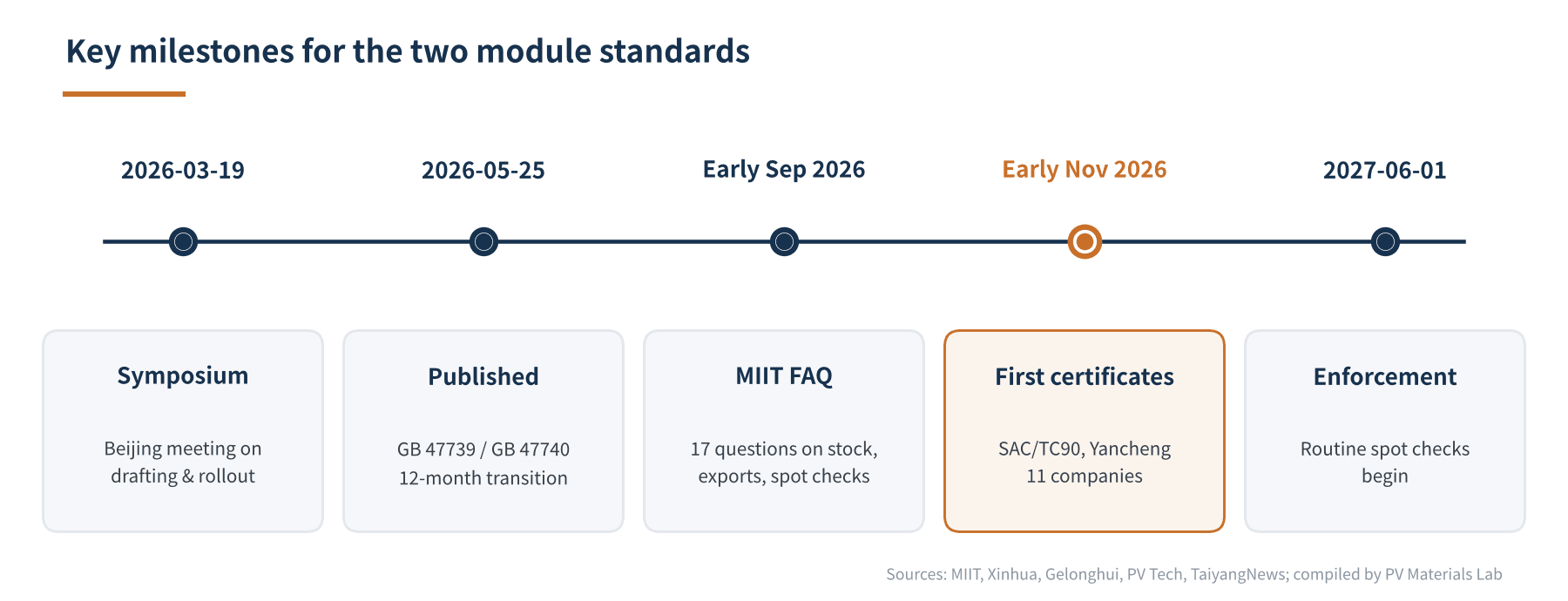
Figure 1 Key milestones for the two module standards
04 Final thoughts
The first certificates carry more practical weight than the publication of the text — they show the testing and certification path is now actually running. For module and materials suppliers, the priority for the remaining seven months is to benchmark the BOM items tied to flame retardancy, glass and nameplate traceability. We will keep following where the certificates are published and how GB 47739 differs from IEC 61730.
References
- TaiyangNews. China Solar PV News Snippets: 11 PV Companies Receive First Certificates Under China’s Mandatory Module Standards & More. 2026-11-03. https://taiyangnews.info/markets/china-solar-pv-news-snippets-november-3-2026
- China News Service (via MIIT WeChat). Two mandatory national standards for PV modules officially published. 2026-05-26. https://www.chinanews.com.cn/cj/2026/05-26/10628806.shtml
- Sina Finance. Two mandatory national standards for PV modules officially published. 2026-05-26. https://finance.sina.com.cn/wm/2026-05-26/doc-inhzffsk2904847.shtml
- Guangming Online (via Economic Information Daily). Two mandatory national standards released. 2026-05-26. https://m.gmw.cn/2026-05/26/content_1304471560.htm
- STCN. Two mandatory national standards for PV modules released. 2026-05-26. https://www.stcn.com/article/detail/3928936.html
- National Public Service Platform for Standards Information. Safety Requirements for PV Modules. https://std.samr.gov.cn/gb/search/gbDetailed?id=30AA4038065185EDE06397BE0A0A19A4
- PV Tech. Official Q&A clarifies rules of China’s mandatory PV standards. 2026-09-15. https://www.pv-tech.org/official-qa-clarifies-rules-of-chinas-mandatory-pv-standards/
- Gelonghui. Symposium on the two mandatory national standards held in Beijing. 2026-03-20. https://m.gelonghui.com/live/2358262
PV Materials Lab
PV Materials Lab
A PV R&D and technology team with 10+ years of experience | In-depth technical knowledge
Materials · Reliability · Failure Analysis · Standards & Certification · Products · Processes
Exploring AI + PV — collaboration welcome
Disclaimer:
- Original content reflects the author's personal views only, is for reference only, and does not constitute investment advice.
- Reposted and cited content is attributed to its source; we respect original work.
- Some content is AI-assisted (chart generation, data retrieval, concept explanations, etc.); the core framework and key content are written by our technical team and reviewed by hand.
- If anything is inaccurate or infringing, please leave a comment or contact us.