
183N wafer and cell prices fell again. Why did TOPCon modules stay at RMB 0.715/W?
Industry News and Analysis · PV Materials Lab
On November 18, InfoLink published its PV spot prices for November 12–18. The average price for 183N monocrystalline n-type wafers fell 3.2% week on week to RMB 0.920 per wafer. The corresponding TOPCon cell averaged RMB 0.285/W, down another 1.7%. The Chinese average for bifacial, dual-glass TOPCon modules stayed at RMB 0.715/W. The table covers contracts in force or newly signed in the period. The module average is based primarily on ex-works deliveries that week. [1]
Wafer and cell prices moved down in the same week that the module average held steady. A breakdown by format shows that the cuts were concentrated in 183N and 210RN, while 210N wafer and cell averages held. Two questions help explain what the table shows. How did the price gaps between formats widen, and when might newly signed upstream prices show up in module delivery prices?
1. Prices fell for 183N and 210RN while 210N held steady
Compared with the November 5–11 table, 183N wafers fell from RMB 0.950 to 0.920 per wafer and 210RN wafers from RMB 1.010 to 0.980. Both lost RMB 0.030 per wafer. At the cell stage, both 183N and 210RN lost RMB 0.005/W. Their percentage declines differ slightly because they started from different price levels. The 210N wafer and cell averages held at RMB 1.100 per wafer and RMB 0.310/W respectively. [1, 2]
Average RMB prices for November 12–18
| Stage | Format | Unit | Current average | Week on week |
|---|---|---|---|---|
| Polysilicon | Dense | RMB/kg | 40.0 | -- |
| Polysilicon | Granular | RMB/kg | 40.0 | -- |
| N-type wafer | 183N | RMB/wafer | 0.920 | −3.2% |
| N-type wafer | 210RN | RMB/wafer | 0.980 | −3.0% |
| N-type wafer | 210N | RMB/wafer | 1.100 | Flat |
| TOPCon cell | 183N | RMB/W | 0.285 | −1.7% |
| TOPCon cell | 210RN | RMB/W | 0.305 | −1.6% |
| TOPCon cell | 210N | RMB/W | 0.310 | Flat |
| TOPCon module | Bifacial dual-glass, overall | RMB/W | 0.715 | Flat |
Source: InfoLink’s November 18 Chinese spot price table. Both polysilicon entries show “--” for the change.
In the table, 183N refers to the 182–183.75 mm class, 210RN to 182 × 210 mm, and 210N to 210 × 210 mm. All three wafer prices are for 130 μm material. All three TOPCon cell prices are for cells at 25.4% efficiency or higher. The table prices wafers per piece and cells per watt. Even at equal thickness, the formats differ in area and power per cell. Converting wafer prices to wafer cost per watt of cell output also requires actual cell power and production yield. [1]
The averages also hide a change in the published ranges. The lows for the two cell formats stayed at RMB 0.285/W and RMB 0.305/W respectively. Both highs fell by RMB 0.005/W, and both averages landed at their previous week’s lows. For a cell buyer, the next question is whether it can secure a quote near that price at the required efficiency grade, order volume and delivery date. The table shows the range. The volume available depends on what individual suppliers will commit to. [1, 2]
2. How much did the 210N cell price gaps widen?
Using the same RMB-denominated cell price table, the gap between 210N and 183N widened from RMB 0.020/W to RMB 0.025/W. The gap between 210N and 210RN went from zero to RMB 0.005/W. The gap between 210RN and 183N remained RMB 0.020/W. Both gaps widened because the comparison formats fell in price. The published 210N average stayed at RMB 0.310/W. [1, 2]
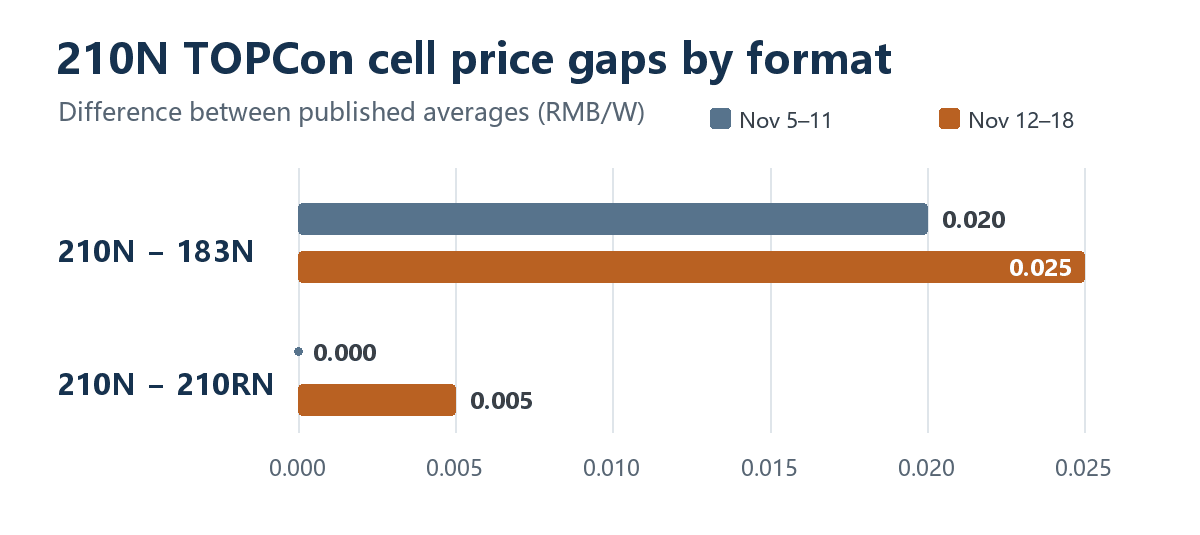
Figure 1. Average price gaps between 210N and the other TOPCon cell formats, based on published RMB prices. [1, 2]
In its previous commentary, InfoLink said deliveries to Chinese utility-scale projects were still supporting 210N wafers, while demand for 183N cells was sluggish. That helps explain why the formats are worth tracking separately, and it describes the prior reporting period. At the time of checking, the November 18 commentary page showed an update notice. To assess whether this week’s wider gaps reflect shifts in module formats or overseas demand, we would need new order volumes by format, main delivery markets and changes in production schedules. [3, 4]
For a module maker with established designs, the price differences affect what it pays for cells in each format. Changing cell size may require adjustments to cutting, layout and stringing. The finished module dimensions, power and operating current also need to meet the order requirements. A product already in production has defined specifications. Whether a one-week price difference turns into savings depends on whether the order permits a format change.
3. Why module delivery prices can hold for now
The RMB 0.715/W figure is the overall Chinese average for bifacial, dual-glass TOPCon modules across multiple formats. The average primarily reflects ex-works deliveries for the week and excludes inland freight. InfoLink’s published range was RMB 0.650–0.760/W. Utility-scale and distributed project averages held at RMB 0.705/W and RMB 0.730/W respectively. The RMB 0.025/W gap between project categories shows how much these segments can differ within a single overall average. [1, 2]
Cell inventory, production schedules and order fulfilment sit between a module maker’s cell purchase and its module deliveries. Suppose a module maker signs a lower-priced 183N cell order this week. Modules it ships in the same week may still use an earlier cell shipment and sell at prices agreed earlier. The lower purchase price is reflected in the material cost of the relevant module batch once the new cells arrive and are issued to production. The timing of any change in module selling prices also depends on when new orders are priced and when delivery is scheduled.
Consider the RMB 0.005/W cell price decline from a buyer’s perspective. For an order settled on a combined 1 MW of rated cell power, the purchase price would fall by RMB 5,000 if efficiency grade, acceptance criteria and payment terms were identical. That calculation applies to the cell order. Estimating the savings per watt on a new module batch requires the actual amount of cells consumed, production yield, finished module power and other costs such as glass, encapsulant and frames. The module and cell averages share a unit, and those inputs are still needed to estimate the change in module cost.
A module buyer should also specify the same delivery point in each request for a quote. Freight separates the ex-works price from the price delivered to site, and split shipments and delivery schedules affect that expense. A comparison between the last order’s delivered price and this week’s ex-works average therefore includes a difference in logistics terms. Matching the project type, delivery point, shipment schedule and module power class makes it possible to see whether the supplier actually changed its quote on comparable terms.
4. Summary
In this table, 183N cell prices continued to fall, 210RN moved lower after holding steady a week earlier, and 210N held its price. We would watch whether newly signed orders for the two cheaper formats lead to sustained deliveries at those prices. If buyers secure lower prices on small spot volumes, the effect is primarily on those purchases. If like-for-like order volumes rise and lower prices carry through to subsequent deliveries, look for a corresponding move in newly signed module orders and then in delivered prices. For module buyers, quotes matched for format, power class, project type and delivery date give a better indication of negotiating room than the RMB 0.715/W overall average alone.
Data notes
The current and previous periods are November 12–18 and November 5–11, 2026. Each price gap is calculated from published cell averages for the same period, efficiency bracket and currency. Domestic RMB and overseas USD module pricing cover different markets. All price comparisons here use RMB data. Sources checked on November 19, 2026.