
Will PV Flux Become Obsolete? Four Trends and a Series Wrap-up
In brief
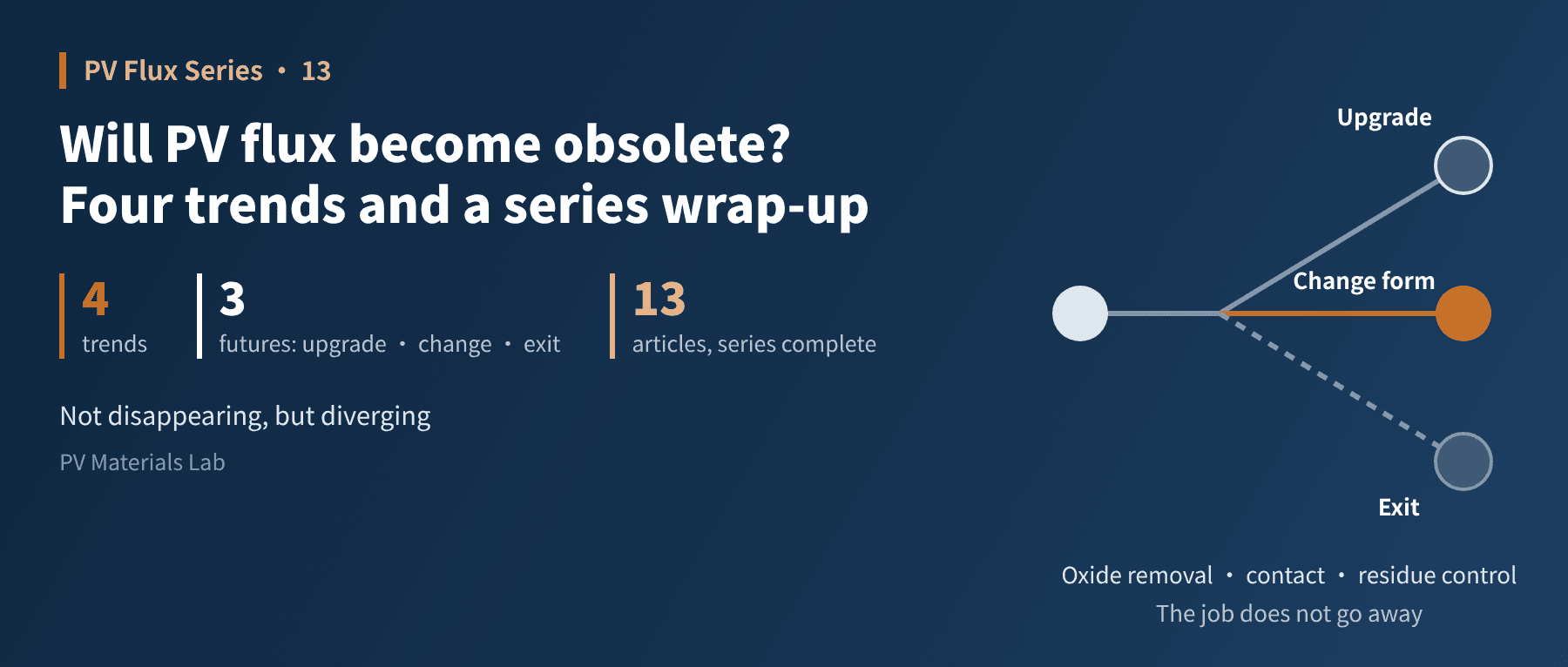
As the final article in our PV flux series, this piece first reviews the previous twelve articles in one overview figure, then sets out four trends for flux: cleaner (halogen-free, low acid, low residue), greener (water-based, low VOC, evaporation control), cooler and more precise (low-temperature activation, precise application, prefluxed ribbon), and a partial exit in routes such as 0BB with film, tape interconnection and conductive adhesive. Our view: flux will not disappear altogether, but will diverge into three futures: "stay and upgrade", "change form" and "exit the stage". The job of "removing oxide and ensuring reliable contact" remains in every case.
This is the last article in the PV flux series. In article 06 we raised a question: with 0BB arriving, will flux become obsolete? Here we answer it directly, taking a longer view. First, a figure to look back over the whole series.
01Looking back: what the twelve articles covered
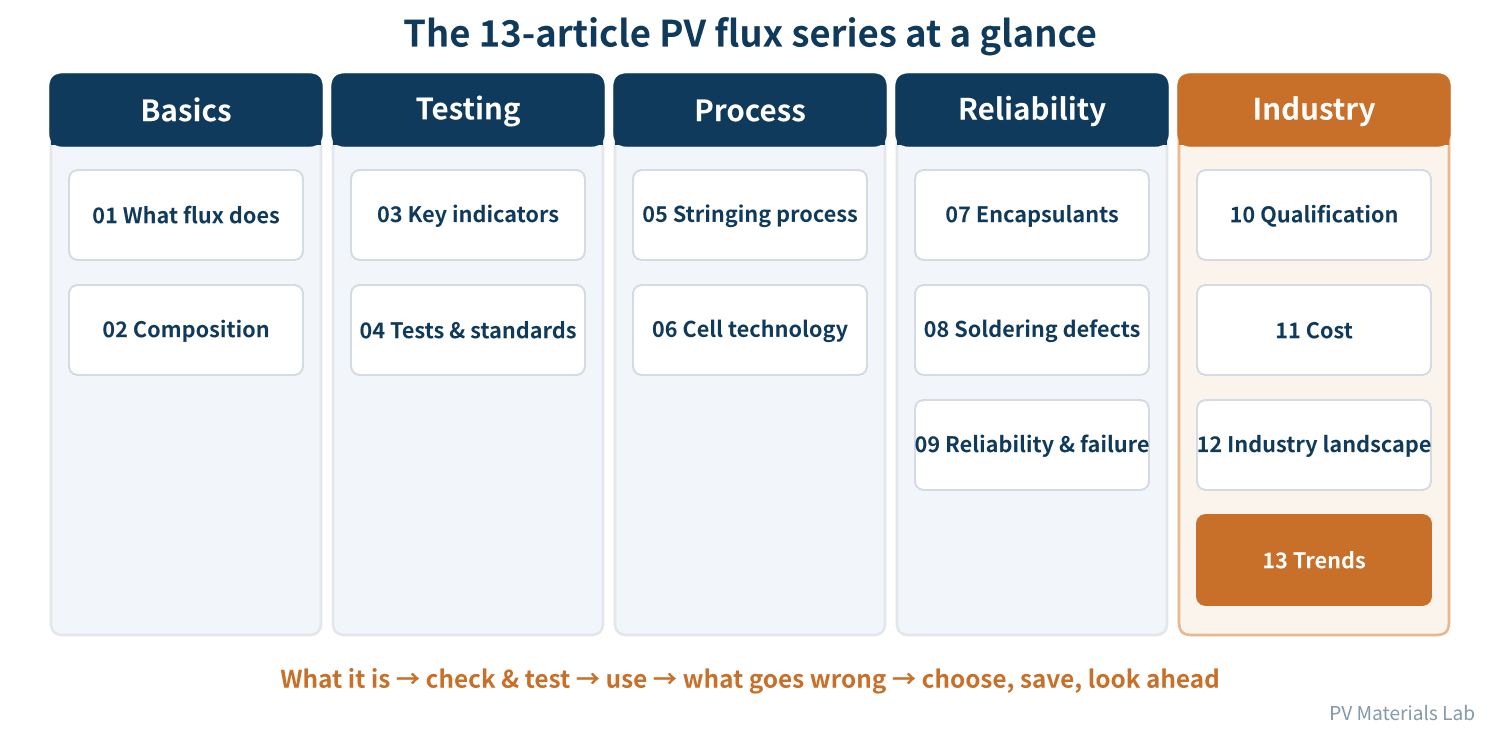
Figure 1. The 13-article PV flux series at a glance
The series ran in the order "what it is, what to check, how to test, how to use, what can go wrong, how to choose, how to save, where it is heading", in five parts:
- Basics (01–02): the four things flux does: removing oxide, promoting wetting, shielding from air and aiding heat transfer; plus its components such as solvents, activators and film formers, and four ways to classify it.
- Testing (03–04): how to read a TDS and COA, why low-solids flux should be monitored by acid value rather than specific gravity, and the standards landscape with three levels of testing.
- Process (05–06): application, dosage, bath and temperature management on the stringer; and the new demands TOPCon, HJT, BC and 0BB place on flux.
- Reliability (07–09): compatibility of residue with encapsulants, how to troubleshoot soldering defects, and the mechanisms and analysis workflow for flux-related corrosion failures.
- Industry (10–13): selection and qualification, the cost picture, the industry landscape, and the trends in this article.
If the whole series had to be summed up in one sentence, it would be: flux is one of the smallest materials by volume in a module, yet it decides both "whether the joint is made" and "whether it lasts twenty or thirty years".
02Trend one: cleaner
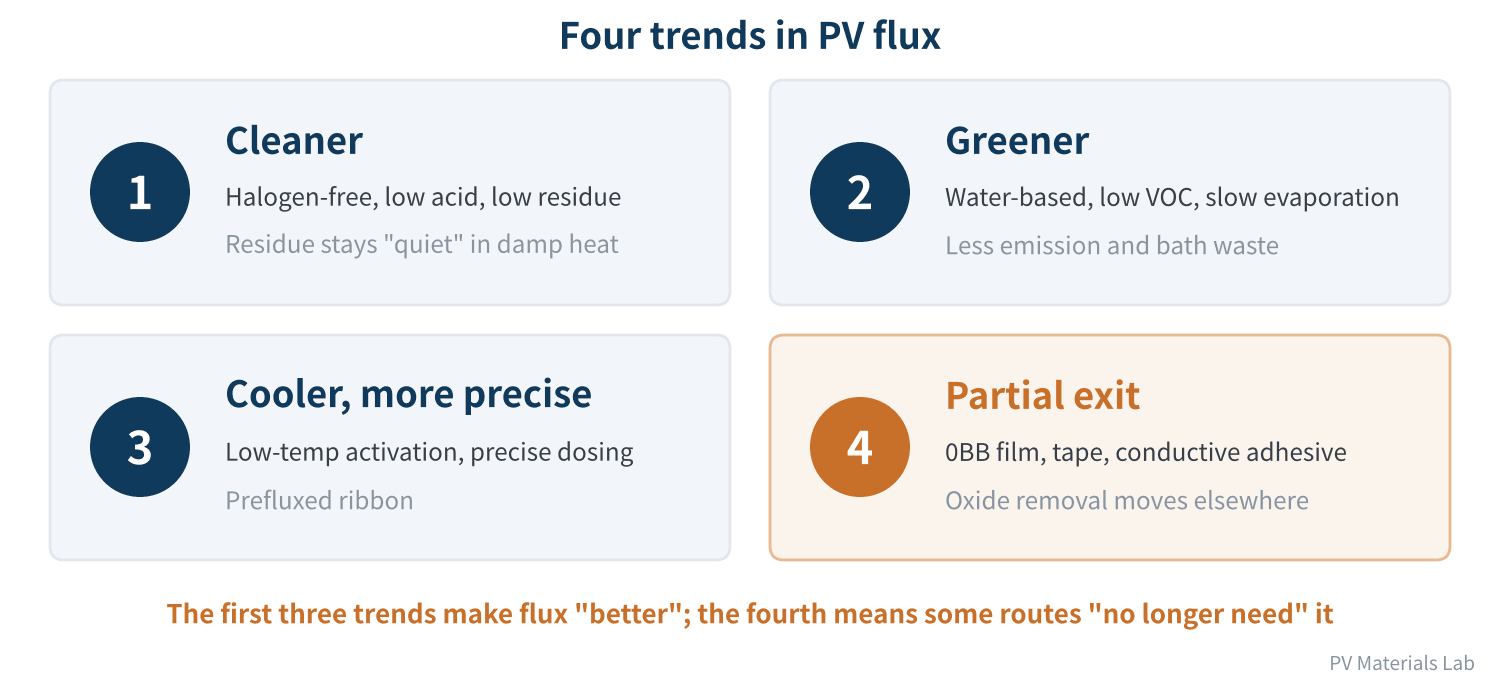
Figure 2. Four trends in PV flux
As TOPCon, HJT and other cells become more sensitive to residue, the most certain trend for flux is to become "cleaner":
- Halogen-free is now the consensus: under J-STD-004B and later editions (the current edition is D, published at the end of 2023), halides must be below 0.05% for a "0" rating. Mainstream PV fluxes have essentially all gone halogen-free.
- More than halogen-free: UNSW's TOPCon research showed that halogen-free flux can also cause clear degradation, and the team recommended optimising acid content as well. Formulation competition will shift from "is there halogen?" to "how quiet is the residue?"
- More careful choice of activator: as article 07 noted, organic acids absorb water and dissolve at very different humidities. Activators with higher deliquescence points that are more easily consumed or evaporated during soldering will become a focus of formulation.
03Trend two: greener
PV flux today is mostly alcohol-based, and alcohol solvents are volatile organic compounds (VOCs). China's control of VOCs is getting stricter: standards such as GB 37822-2019, the standard for fugitive emission control of VOCs, require VOC-containing materials to be kept as enclosed as possible during storage, transfer and use. This points flux in several directions:
- Water-based routes: water as the main solvent means non-flammable and low VOC emissions. International suppliers have mature water-based PV fluxes, and a Chinese soldering-material company launched a water-based PV flux in 2026 (see article 12). As article 02 noted, though, water-based systems are more demanding on preheat and drying.
- Low-VOC and VOC-free formulas: ribbon and solder companies introduced low-VOC and VOC-free PV fluxes as early as around 2010.
- Evaporation control: formulas that slow evaporation and reduce crystallisation cut emissions and also reduce the bath concentration drift and bath-change waste discussed in article 05.
Here, environmental goals and cost reduction point the same way: less evaporation means fewer emissions, less waste and a more stable bath.
04Trend three: cooler and more precise
- Low-temperature activation: HJT, BC and other cells are pushing soldering temperatures down (see articles 05 and 06), so the flux activation window must move down with them, a new challenge for activator systems.
- Precise application: fine round-wire ribbon and multi-busbar designs leave less and less tolerance on dosage, so more precise metered application and drying and blow-off before soldering will be the direction of process upgrades.
- Prefluxed ribbon: flux is pre-coated onto the ribbon, so no separate liquid flux is needed during stringing. The idea is not new: prefluxed PV ribbon was launched as early as 2010, and at SNEC 2021 MacDermid Alpha gave a dedicated presentation on the advantages of prefluxed ribbon-wire in multi-busbar interconnection.
Prefluxed ribbon deserves a few more words. It turns flux from "a bath on the line" into "a coating on the ribbon": module makers no longer have to manage bath concentration, evaporation and changes, and usage is easier to standardise. In return, ribbon shelf life, coating uniformity and oxidation resistance become new key indicators, and cooperation between ribbon makers and flux makers becomes more important. This is also where our ribbon series and flux series "meet".
05Trend four: a partial exit, and three futures for flux
As article 06 explained, the 0BB film route needs no flux, and the adhesive-dot route has no separate soldering step. In BC, approaches have appeared that fix the wires with tape and complete interconnection during lamination, and for HJT there is equipment that interconnects with conductive adhesive. These routes bypass conventional soldering, so flux naturally "exits".
Recent developments show this trend still moving: according to trade media, almost every leading module maker introduced a 0BB module in 2025, and 0BB has spread from its origins in HJT into BC designs. At SNEC 2026, encapsulant suppliers were already showing dedicated films for routes such as conductive-adhesive 0BB, SWCT and film-based interconnection. There are, however, no reliable public statistics yet on the share of each route.
Putting the four trends together, we see three futures for PV flux:
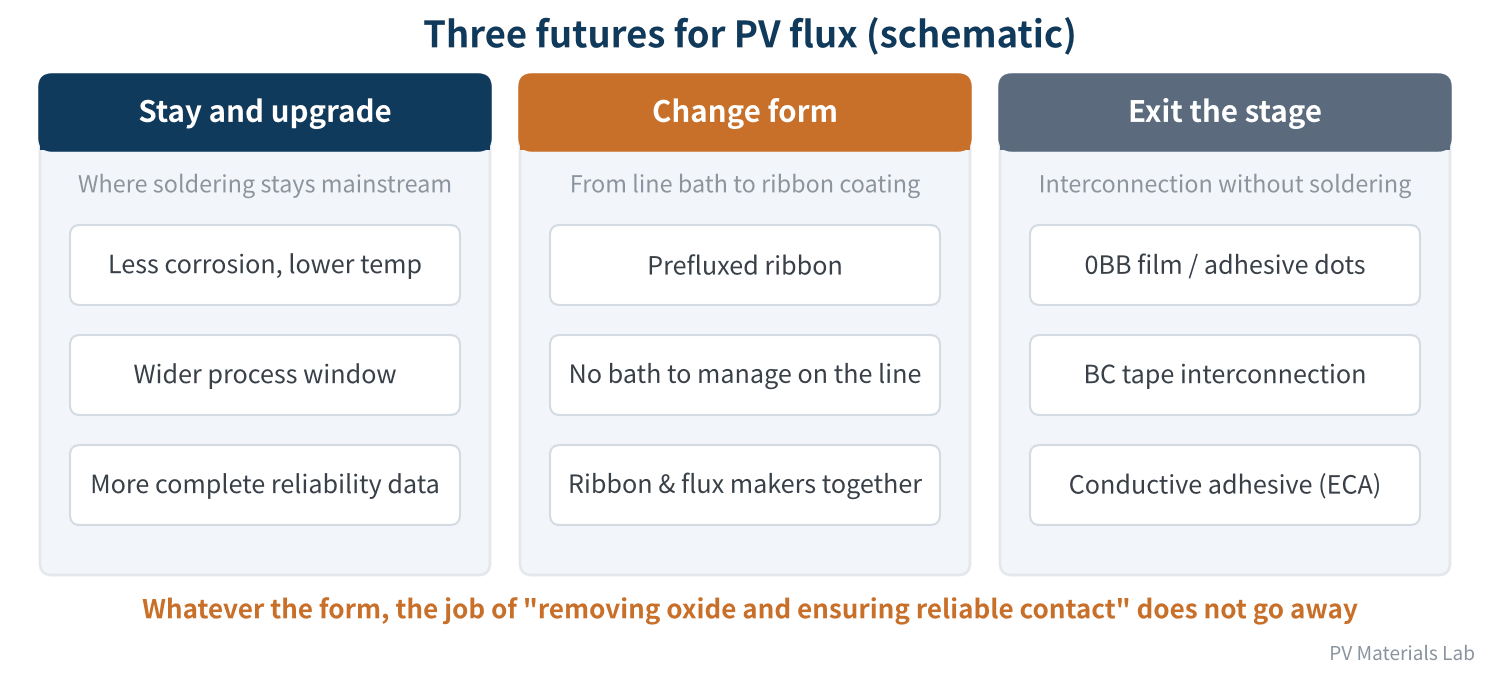
Figure 3. Three futures for PV flux (schematic)
- Stay and upgrade: where soldering remains the mainstream interconnection, flux stays, but with higher demands: lower corrosion, lower temperature, a wider window and more complete reliability data.
- Change form: with prefluxed ribbon as the example, flux moves from a line bath to a ribbon coating, and the supply-chain division of labour changes with it.
- Exit the stage: in routes that no longer solder, such as 0BB with film, tape interconnection and conductive adhesive, flux is no longer needed, and cost and risk shift to encapsulant, conductive adhesive and the lamination process.
So, to answer the question from the start of the series: flux will not be made obsolete as a whole, but it will diverge. Which form dominates depends on how each interconnection route industrialises. Whatever the form, the job of "removing oxide and ensuring reliable contact" does not go away; it simply shifts from flux to ribbon coatings, encapsulants or the lamination process. With that in mind, any new interconnection scheme can be evaluated the same way: what removes the oxide? Where does the residue end up? What guarantees long-term reliability?
The future of flux is not "present or absent" but a three-way divergence: stay and upgrade, change form, or partly exit. The job it does will not disappear when it does.
06Final thoughts
With thirteen articles done, we would like to close the series with three thoughts:
- Don't underestimate it because there is so little of it: the direct cost of flux is only a few tenths of a percent, yet it decides both soldering quality and long-term reliability;
- See it as part of a system: flux has to be evaluated together with ribbon, cells, encapsulant and equipment, and a change in any of them should trigger re-validation;
- See it as something that evolves: cell and interconnection technologies are still changing fast, and the form and role of flux will change with them, but the underlying logic of "remove oxide, ensure contact, control residue" stays the same.
Thank you to everyone who has read this far. Flux is a topic that is rarely discussed systematically. We have tried to combine published research with engineering experience, but there will inevitably be omissions and mistakes. Corrections are welcome, as are real cases from your lines and labs. We would be glad to hear from you.
Next, we will continue with new series on PV materials, reliability and failure analysis. Stay tuned.
References
- IPC J-STD-004D, Requirements for Soldering Fluxes, IPC, 2023
- pv magazine Australia: UNSW study shows impact of soldering flux on TOPCon solar cell degradation, 2025
- GB 37822-2019, Standard for fugitive emission control of volatile organic compounds; Ministry of Ecology and Environment, Comprehensive VOC control plan for key industries, 2019
- Indium Corporation: Solar Tabbing Fluxes product page (water-based and evaporation-control products), https://www.indium.com/products/fluxes/solar-tabbing-fluxes/
- Renewable Energy World: Solar cell tabbing interconnect, flux from Balver Zinn Group at EU PVSEC, 2010 (prefluxed ribbon, low-VOC/VOC-free flux)
- MacDermid Alpha: Technical Presentation on "Advantages of Prefluxed Ribbon-wire in Multi-busbar Interconnection" at SNEC 2021, https://www.macdermidalpha.com/news/technical-presentation-advantages-prefluxed-ribbon-wire-multi-busbar-interconnection-snec-2021
- TaiyangNews: Gapless, Full-Screen, And 0BB Redefine Module Assembly, 2026-07-03, https://taiyangnews.info/technology/gapless-full-screen-and-0bb-redefine-module-assembly
- TaiyangNews: Hangzhou First's BC & TOPCon PV Material Range At SNEC, 2026-07-20, https://taiyangnews.info/technology/hangzhou-first-bc-topcon-snec-2026
- SMM: [SMM Analysis] 0BB Technology and Cost of Encapsulation Film for Different Routes (Part 1), 2025
- TaiyangNews: Tape-Based Interconnection Approach for BC Modules; A New ECA-Based Stringer for HJT from Teamtechnik
- Articles 01–12 of this series
A PV R&D and technology team with 10+ years of experience | In-depth technical knowledge sharing
Materials · Reliability · Failure Analysis · Standards & Certification · Products · Processes
Exploring AI + PV; collaboration welcome
Disclaimer:
1. Original content reflects the authors' personal views only, is for reference only and does not constitute investment advice.
2. Reposted and cited content is credited to its source, out of respect for original work.
3. Some content was produced with AI assistance (chart generation, data retrieval, concept explanations, etc.); the core framework and key content were written by our technical team and reviewed by people.
4. If anything is inaccurate or infringes your rights, please leave a message or contact us and we will deal with it.