
Google's Project Suncatcher Heads for Orbit: What PV Engineers Should Read Into the Q1 2029 New Glenn Launch
Section: Industry News & Perspectives
Key Takeaways
- Core Fact: On November 19, 2026, Google and Blue Origin announced a launch services agreement targeting Q1 2029 for Project Suncatcher's first dedicated heavy-lift launch aboard Blue Origin's New Glenn rocket into sun-synchronous orbit.
- Architecture Clarification: This is not a space-based solar power (SBSP) plant beaming electricity back to Earth; it is in-orbit solar-powered AI compute, with each satellite carrying Google TPUs at roughly the capacity of a data center rack.
- First-Principles Math: Orbital irradiance and near-continuous illumination in sun-synchronous orbit can multiply annual solar yield compared to terrestrial sites, but vacuum thermal management, inter-satellite links, and space-grade reliability remain major engineering hurdles.
- Industry Signal: No immediate volume impact on terrestrial PV manufacturing, yet a clear long-term demand signal for high specific-power (W/kg) cells, flexible arrays, and radiation-tolerant encapsulation materials.
When headlines about Google launching "Suncatcher" satellites in 2029 began trending, the immediate public assumption was familiar: is a tech giant finally building a solar power plant in space to beam electricity down to Earth?
From a PV and energy engineering standpoint, the actual architecture flips that premise. Google is not bringing orbital solar electricity down to the grid; it is moving power-hungry AI compute up to where sunlight is abundant and nearly continuous.
On November 19, 2026, Google and Blue Origin jointly announced a launch services agreement for Project Suncatcher. Below, we separate the confirmed commercial milestone from earlier research projections and break down the underlying PV engineering math.
01 Separating Confirmed Agreements from Earlier Research
In industry news coverage, commercial launch contracts are frequently conflated with earlier research roadmaps. Here is how the November 19, 2026 launch agreement compares against Google's earlier November 4, 2025 research blog:
| Dimension | Nov 19, 2026 Launch Agreement (Commercial) | Nov 4, 2025 Google Research Blog (Prior Research) |
|---|---|---|
| Partners | Google & Blue Origin | Google Research (previously noted collaboration with Planet) |
| Mission Scope | First dedicated heavy-lift launch for Project Suncatcher | System design study for scalable space-based AI infrastructure |
| Target Timeline | Q1 2029 (target launch window) | Aimed to launch two prototype satellites in early 2027 |
| Launch Vehicle | Blue Origin New Glenn heavy-lift rocket | Not specified in the 2025 blog |
| Payload Profile | Solar-powered satellites with Google TPUs; each roughly one data center rack in compute capacity | Concept of an interconnected network of solar-powered AI satellites |
| Target Orbit | Sun-synchronous orbit (SSO) | Specific orbits (e.g., dawn-dusk SSO) for near-continuous sunlight |
| PV & Engineering Notes | Tapping abundant orbital solar power to scale AI infrastructure in space | Solar panels can be up to 8x more productive than on Earth, reducing battery mass; thermal, inter-satellite links, and reliability remain challenges |
Table 1: Comparison of Project Suncatcher's 2026 launch agreement vs. 2025 research baseline (Compiled by PV Materials Lab).
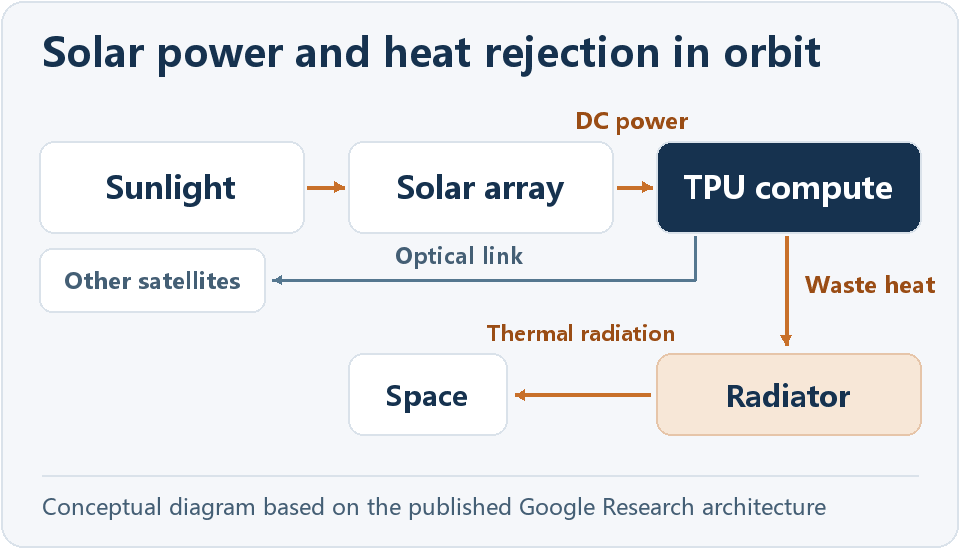
Figure 1. Orbital power, heat rejection, and inter-satellite communication. Based on the published Google Research architecture.
Two boundaries should be kept clear:
- Q1 2029 is a target launch date, not a completed orbital data center.
- There is no wireless power transmission to Earth—generation and compute consumption happen locally on the spacecraft.
02 First-Principles Math: Why Catch Sunlight in Orbit?
Terrestrial AI data centers face grid interconnection bottlenecks, diurnal/weather intermittency, and heavy energy storage costs. In orbit, the solar resource behaves very differently.
In its November 2025 research post, Google noted that in the right orbit, a solar panel can be up to 8 times more productive than on Earth and generate power nearly continuously, reducing battery requirements. A quick first-principles check illustrates the physics behind this order of magnitude:
- Irradiance Baseline: Extra-terrestrial solar irradiance (AM0) is approximately 1361 W/m2, compared to the terrestrial STC benchmark (AM1.5G) of 1000 W/m2. Once atmospheric attenuation, cloud cover, and incidence angles are factored in, terrestrial PV sites typically average only 3.5 to 5.5 peak sun hours per day.
- Illumination Continuity: In a dawn-dusk sun-synchronous orbit, satellites remain in sunlight for roughly 90%–100% of the year, drastically shrinking the eclipse-period battery mass.
- Array Area Sizing: Assuming a typical data center rack consumes 20--50 kW, and an orbital PV array achieves an effective end-to-end conversion efficiency of 25%–30% under AM0 irradiance, output density sits around 340--408 W/m2. Supporting a single rack-equivalent satellite therefore requires roughly 50--150 m2 of deployable, lightweight solar wings.
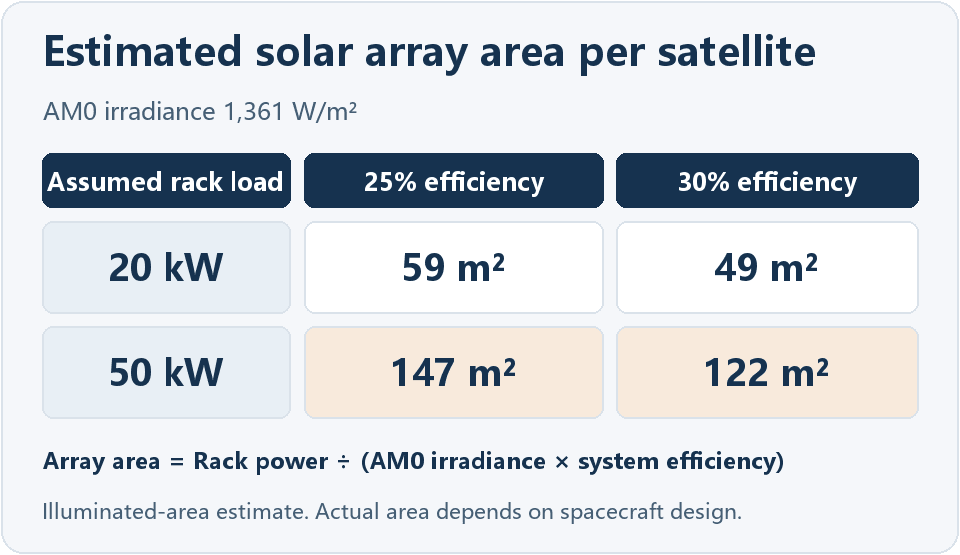
Figure 2. Solar array area across assumed rack loads and system efficiencies. Calculated from the assumptions in the text.
This sizing explains why a heavy-lift vehicle like New Glenn is necessary: fairing volume and mass budgets quickly become binding constraints when pairing rack-class compute with large solar wings and thermal hardware.
03 The Real Engineering Bottlenecks
Leaving the atmosphere lifts the solar yield ceiling, but it also raises the engineering floor. Based on Google's disclosed challenges and space PV fundamentals, three hurdles stand out:
- Vacuum Thermal Management: On Earth, air or liquid cooling rejects tens of kilowatts of rack heat. In vacuum, radiation is the only heat-rejection mechanism. Dissipating high heat flux from densely packed TPUs requires large radiator surfaces that compete directly with solar wings for mass and deployment geometry.
- Harsh Orbital Material Stress: Without atmospheric shielding, solar arrays endure energetic particle radiation (protons/electrons), intense UV, atomic oxygen (in LEO), and extreme thermal cycling (from below $-100^\circ\text{C}$ to above $+100^\circ\text{C}$). Standard terrestrial BOMs (EVA/POE encapsulants, soda-lime glass, polymer backsheets) cannot survive; space arrays require radiation-hardened coverglass or specialized polymer films, low-outgassing adhesives, and fatigue-resistant interconnects.
- Inter-Satellite Links & Long-Term Reliability: Scaling beyond a single rack requires high-bandwidth optical inter-satellite links. Because on-orbit hardware servicing is impractical, both TPU single-event upset (SEU) tolerance and PV beginning-of-life (BOL) to end-of-life (EOL) degradation rates govern commercial viability.
04 Tiered Takeaways for PV Practitioners
A single targeted heavy-lift launch in 2029 will not shift terrestrial gigawatt-scale PV supply and demand. Still, it provides actionable technical signals across three functions:
- Cell & Module Design: In orbit, specific power (W/kg) and stowed power density (W/m3) outweigh $/W. Alongside established multi-junction III-V (GaAs) cells, ultra-thin silicon and flexible perovskite/tandem architectures are gaining attention for radiation tolerance and mass reduction.
- Encapsulation & BOM Materials: Large flexible or roll-out arrays demand materials that simultaneously pass low-outgassing requirements (e.g., ASTM E595 criteria), resist UV yellowing, and survive severe thermal cycling without delamination—creating a long-term pull for specialty space-grade silicones, polyimide (PI) substrates, and radiation-resistant frontsheets.
- Reliability & Qualification: While terrestrial PV revolves around IEC 61215 and IEC 61730, orbital PV prioritizes particle irradiation testing (BOL/EOL retention), thermal vacuum cycling (TVAC), and high-voltage plasma arcing mitigation. Labs and material suppliers bridging these qualification regimes will hold a differentiated position in commercial space supply chains.
05 Balanced Assessment
Where the value lies: Signing a dedicated heavy-lift launch services agreement with Blue Origin moves Project Suncatcher from a conceptual research paper onto a concrete launch manifest timeline.
Where the limits remain: Q1 2029 is a target window, early-2027 prototype validation has not yet occurred, and the unit economics of orbital thermal rejection, compute density, and launch costs remain unproven at scale. Until on-orbit telemetry is demonstrated, the industry should treat this as a credible long-term R&D vector rather than an immediate commercial disruption.
One-Sentence Conclusion
Project Suncatcher is not beaming orbital solar power to Earth—it is testing whether heavy-lift rockets can pair abundant orbital sunlight directly with AI compute, offering no near-term volume for terrestrial PV but a clear long-term pull for high specific-power, space-qualified PV materials.
Methodology & Data Notes
- Solar Irradiance: AM0 solar constant is taken as 1361 W/m2; terrestrial STC (AM1.5G) is 1000 W/m2.
- Array Area Estimation: A=Prack / (IAM0×ηsys). Assuming a rack power range Prack=20--50 kW and an effective orbital PV system efficiency $\eta_{\text{sys}} = 25%\text{--}30%$, output density is ≈340--408 W/m2, yielding an array area of ≈50--150 m2. These are first-principles order-of-magnitude estimates, not official Google specifications.
- Source Separation: The Q1 2029 target and New Glenn agreement are sourced strictly from the Nov 19, 2026 press releases; the "up to 8x productivity," early-2027 prototype plan, and engineering challenges are sourced from Google's Nov 4, 2025 research blog.
References
- Google Official Blog (Travis Beals), Blue Origin & Project Suncatcher Partnership, Nov 19, 2026. (https://blog.google/innovation-and-ai/models-and-research/google-research/blue-origin-project-suncatcher-partnership/)
- Blue Origin Newsroom, Google Selects New Glenn for Project Suncatcher, Nov 19, 2026. (https://www.blueorigin.com/news/google-selects-new-glenn-for-project-suncatcher)
- Google Research Blog, Exploring a space-based, scalable AI infrastructure system design, Nov 4, 2025. (https://research.google/blog/exploring-a-space-based-scalable-ai-infrastructure-system-design/)
PV Materials Lab
https://pvmaterialslab.com
PV Materials Lab
A team with over a decade of PV R&D and technical experience | In-depth technical knowledge sharing
Materials · Reliability · Failure analysis · Standards and certification · Products · Processes
AI+PV exploration and exchange; collaboration welcome
Disclaimer:
1. Original content expresses the author's views only, is for reference only, and does not constitute investment advice.
2. Reproduced and cited content is attributed to its sources, with respect for original work.
3. Some content includes AI assistance (chart generation, data retrieval, conceptual explanations, etc.); the core framework and key content are written by this technical team and reviewed by humans.
4. If you find any inaccuracy or infringement, please leave a comment or contact us so we can address it.