
210N Cells Up Nearly 7% in a Month While Modules Stand Still: PV Price Review (Oct 2026)
We stitched together our weekly price reports for weeks 42–45 of 2026. Over the past month, spot prices across the chain moved within a narrow band. TOPCon 210N cells rose from 0.29 to 0.31 RMB/W (+~7%), drawing level with 210RN; 183N cells eased slightly and the 210RN wafer range shifted down. Domestic modules rose then flattened, with the high end narrowing, and silver futures fell about 14%.
This is the monthly review in our "PV Price Trends" column. We connect our four weekly price reports for weeks 42–45 of 2026 (9 Oct to 5 Nov): spot prices come from InfoLink's Wednesday postings, and futures from closing prices on the Shanghai Futures Exchange (SHFE) and Guangzhou Futures Exchange (GFEX). In one sentence: the chain as a whole moved within a narrow range, but 210N cells charted their own course, and silver fell noticeably.
01 The month at a glance: most segments barely moved
InfoLink published five spot postings over this period (30 Sep, 14 Oct, 21 Oct, 28 Oct and 4 Nov). Each posting covers "the previous Thursday to the current Wednesday" and reflects contract prices still being executed or newly signed as of that Wednesday.
| Product | Unit | 09-30 | 10-14 | 10-21 | 10-28 | 11-04 | Monthly change |
|---|---|---|---|---|---|---|---|
| n-type wafer 183N | RMB/pc | 1.00 | 1.00 | 1.00 | 1.00 | 0.95–1.00* | Range unchanged |
| n-type wafer 210N | RMB/pc | 1.125 | 1.15 | 1.15 | 1.15 | 1.13–1.15* | +2.2% |
| n-type wafer 210RN | RMB/pc | 1.05 | 1.05 | 1.05 | 1.05 | 1.01–1.03* | Range lower |
| TOPCon cell 183N | RMB/W | 0.300 | 0.300 | 0.300 | 0.300 | 0.295 | −1.7% |
| TOPCon cell 210N | RMB/W | 0.290 | 0.295 | 0.295 | 0.305 | 0.310 | +6.9% |
| TOPCon cell 210RN | RMB/W | 0.310 | 0.310 | 0.310 | 0.310 | 0.310 | Flat |
| TOPCon module (utility) | RMB/W | 0.690 | 0.705 | 0.705 | 0.705 | 0.65–0.71* | +2.2%→range |
| TOPCon module (DG) | RMB/W | 0.720 | 0.740 | 0.740 | 0.735 | 0.730 | +1.4% |
| BC module (utility) | RMB/W | 0.760 | 0.773 | 0.773 | 0.773 | 0.75–0.77* | High end lower |
| BC module (DG) | RMB/W | 0.795 | 0.810 | 0.810 | 0.810 | 0.78–0.81* | High end lower |
| Overseas TOPCon module | USD/W | 0.114 | 0.114 | 0.114 | 0.114 | 0.114 | Flat |
Note: items marked * had only a transaction range, with no separate average, in the public 4 Nov weekly article. We report the range and do not estimate an average. "Monthly change" is from 30 Sep to the latest comparable average; range-only items are described in words. DG = distributed generation.
Of the eleven spot products, four had an unchanged average all month, and most of the rest moved within ±2%. The only clear directional moves were the steady rise in 210N cells and the downward drift at the top of the wafer and module ranges at month-end.
02 Cells: 210N leads, size spreads all but disappear
The clearest trend this month was in TOPCon 210N cells (210N refers to 210mm×210mm square n-type cells, mainly used in large-format modules for utility-scale plants). The average climbed from 0.29 RMB/W on 30 Sep to 0.31 RMB/W on 4 Nov, about +6.9% in total. Across the four changes between postings it rose three times, held once and never fell.
InfoLink's column headlines tell the same story: "Utility-scale demand lifts 210N cells" (14 Oct), "Module makers speed up shipments, 210N cell prices edge up" (28 Oct), and "Demand for 210N products improves, sizes diverge" (4 Nov).
- 210N: 0.29→0.31 RMB/W, about +6.9%, rising through the month;
- 210RN: steady at 0.31 RMB/W all month (210RN is a rectangular wafer 210mm wide, commonly used in rectangular formats such as 66-cell modules);
- 183N: steady at 0.30 RMB/W for the first four postings, then down to 0.295 RMB/W on 4 Nov, about −1.7%.
The result: at the start of the month 210N was 0.02 RMB/W cheaper than 210RN; by the end both stood at 0.31 RMB/W, and 183N had become the cheapest of the three. The price spread between sizes was largely erased within a month, which is exactly what "sizes diverge" looks like in practice.
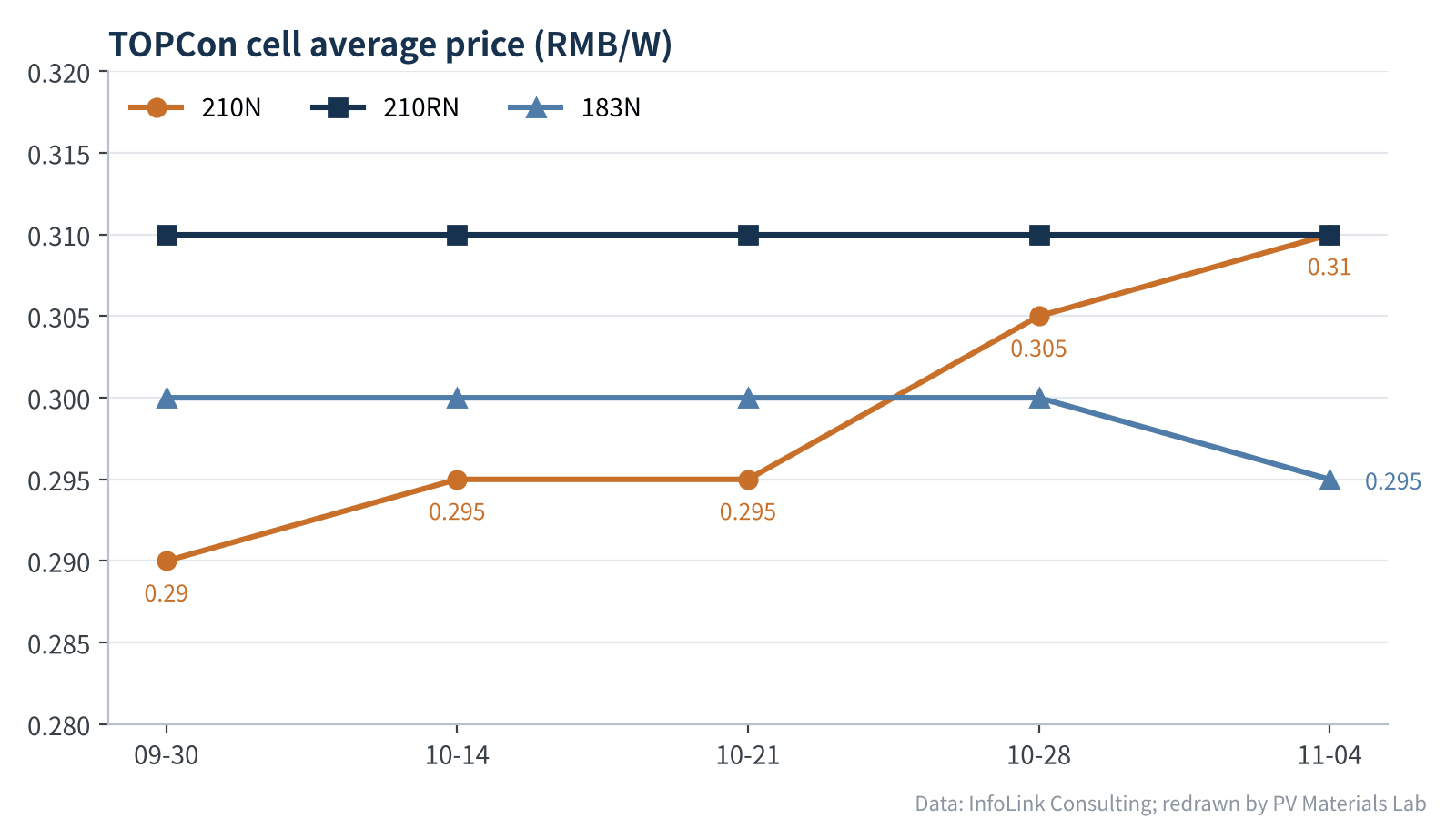
Fig. 1 Average prices of three TOPCon cell sizes (30 Sep – 4 Nov 2026)
Summary: The divergence in cells is not a broad price rise but a structural shift as demand concentrates on 210N: 210N up, 210RN steady, 183N slightly down.
03 Wafers: 210N holds high, 210RN range shifts down
Wafers were calmer than cells. The 183N wafer averaged 1.00 RMB/pc for the first four postings. The 210N wafer was raised from 1.125 to 1.15 RMB/pc on 14 Oct and has held there since; on 28 Oct its low end rose from 1.10 to 1.13 RMB/pc, showing transactions clustering at the higher end.
The change came at month-end. The public 4 Nov article gave no wafer averages, only ranges: 183N at 0.95–1.00 RMB/pc and 210N at 1.13–1.15 RMB/pc, both unchanged from the prior posting. The mainstream 210RN range was 1.01–1.03 RMB/pc, a full 0.02 RMB/pc below the previous 1.03–1.05.
Compared with cells, there is an interesting mismatch: 210RN cell prices did not move all month while the 210RN wafer range moved down at month-end; 210N cells rose nearly 7% while the 210N wafer average has not moved since mid-October. Price transmission between upstream and downstream is out of sync, and this is worth tracking over the coming weeks.
04 Modules: a small rise, then a pause, with the high end narrowing
Domestic modules this month can be summed up as "one small step up, then standing still". In the 14 Oct posting, all four domestic module categories were raised together: TOPCon utility 0.69→0.705 RMB/W, TOPCon DG 0.72→0.74 RMB/W, BC utility 0.76→0.773 RMB/W and BC DG 0.795→0.81 RMB/W, increases of 1.7%–2.8%.
Prices were then largely flat for two weeks, except TOPCon DG, which slipped 0.005 RMB/W on both 28 Oct and 4 Nov to 0.73 RMB/W. On 4 Nov the other three categories were given only as ranges: TOPCon utility 0.65–0.71, BC utility 0.75–0.77 and BC DG 0.78–0.81 RMB/W. Compared with mid-October ranges, the low end did not move while the high end fell by 0.01–0.03 RMB/W, so room for high-priced orders is narrowing.
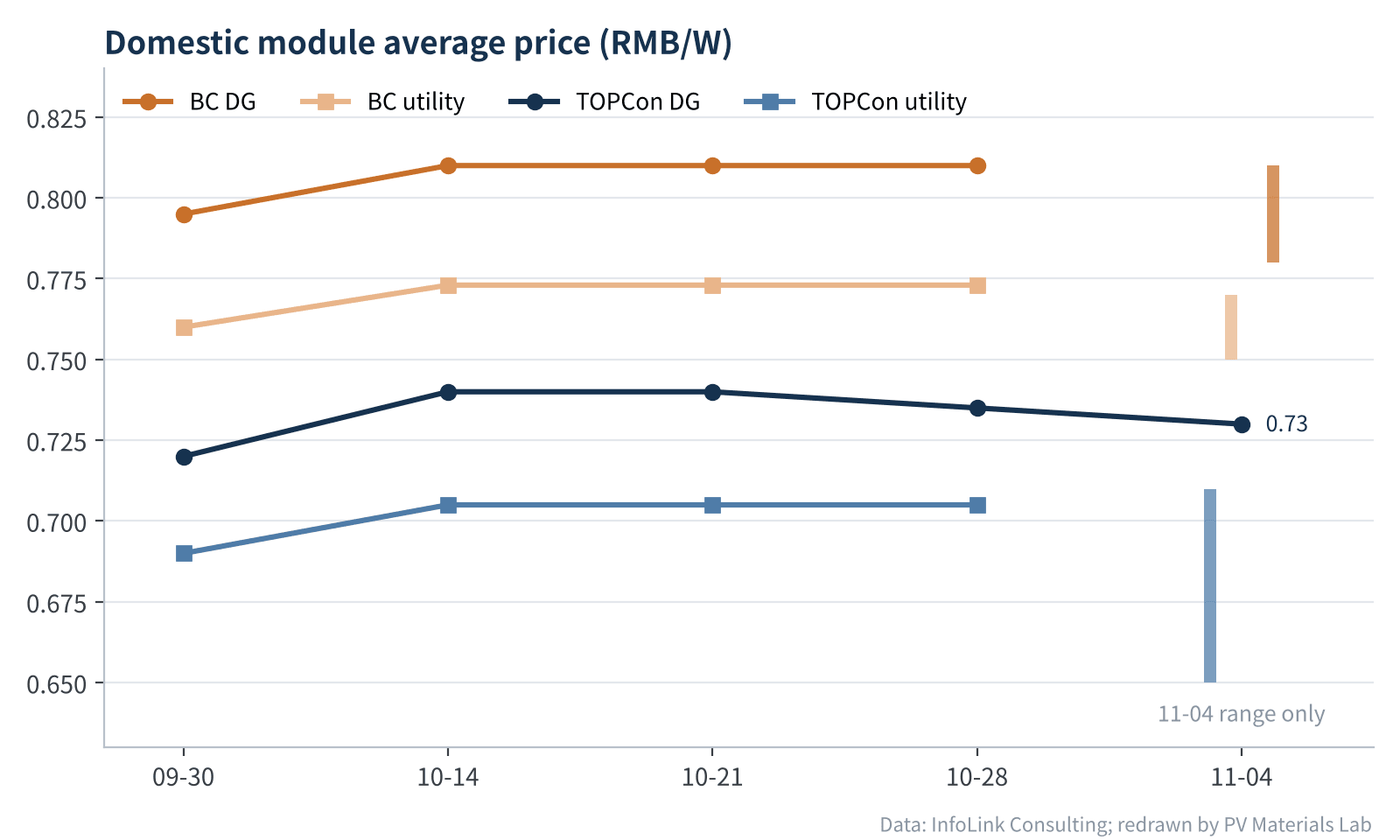
Fig. 2 Domestic module average prices (on 4 Nov, three categories given as ranges, shown as vertical bars)
Overseas TOPCon modules held at 0.114 USD/W throughout the month. The premium of BC (back-contact, no front-side busbars) modules over TOPCon stayed stable: about 0.07 RMB/W for utility and about 0.07–0.08 RMB/W for DG.
05 Futures and raw materials: silver down ~14%, polysilicon data gap
Futures were far more volatile than spot prices. To compare them, we indexed each of the four contracts to 100 at its first available close in the month (Fig. 3).
- Silver (AG2612): 14,816 RMB/kg on 12 Oct, a low of 11,655 on 3 Nov and a close of 12,708 on 5 Nov; about −14.2% over the month, with a maximum drawdown of about 21% and a rebound over the last two days;
- Aluminium (front month): a narrow range of 23,000–23,540 RMB/t, from 23,465 on 12 Oct to 23,180 on 5 Nov, about −1.2% (the front month rolled from AL2611 to AL2612 on 20 Oct);
- Polysilicon (PS2611): 36,120 RMB/t on 9 Oct, a low of 33,255 on 15 Oct and a close of 34,285 on 16 Oct, about −5.1%;
- Industrial silicon (SI2611): 8,645→8,720 RMB/t, about +0.9%, essentially flat.
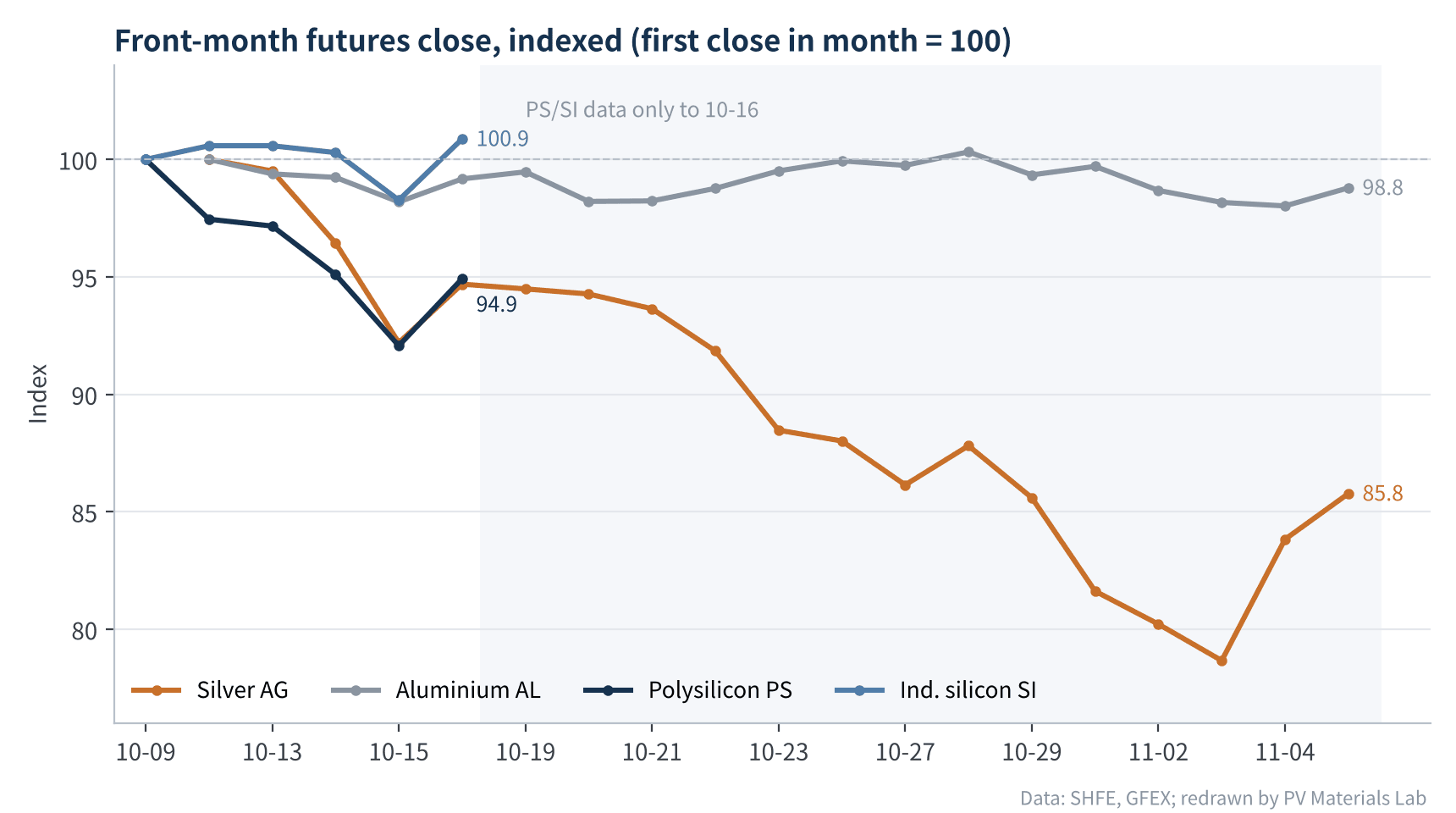
Fig. 3 Indexed closing prices of front-month futures (first close in the month = 100)
Silver is the largest single item in a cell's non-silicon cost, so lower silver prices ease costs for cell makers. But spot cell prices are set by supply and demand, and 210N cells still rose this month. Please note: polysilicon and industrial silicon futures data are currently only updated to 16 Oct; we have not yet obtained verifiable closing prices for later trading days, so these two contracts reflect only the first week of the month.
Bottom line: Spot prices across the chain moved within a narrow band this month; 210N cells were the only product with a clear direction; room at the high end of module prices is narrowing; and silver was the most volatile raw material.
Final thoughts
Looking back at the month, we draw three observations:
- For cell makers: 210N and 210RN are now priced the same and 183N is the cheapest, so the logic of size premiums is shifting. Production planning and quoting are best viewed size by size rather than across the board;
- For module makers: with 210N cells rising and the high end of module prices narrowing, margins on large-format utility modules are squeezed from both sides. Cost relief from lower silver should be passed into procurement and process as soon as possible;
- For buyers: module prices are in a narrow band and the high end loosened at month-end, so when signing contracts the range is more informative than a single average; overseas TOPCon module prices did not change all month.
Our weekly reports only compile verifiable data. This month we still lacked verifiable primary data for polysilicon, PV glass and encapsulant resin, so they are not covered here; we will review them separately once the data are filled in. This article is a compilation of price data only and does not constitute investment advice.
Calculation notes / data basis
- Monthly change = (latest comparable average ÷ average on 30 Sep 2026 − 1) × 100%, calculated by us from the weekly report data and rounded to one decimal place.
- For the 4 Nov posting, InfoLink's public article gave only transaction ranges, with no separate averages, for the three wafers, TOPCon utility, and BC utility and DG modules. We do not estimate averages and compare ranges only.
- Fig. 3 indexing: silver and aluminium use the 12 Oct 2026 close as 100; polysilicon and industrial silicon use the 9 Oct 2026 close as 100. Aluminium rolled on 20 Oct (AL2611→AL2612); the series is the front-month close on each day and includes a contract switch.
- Polysilicon PS2611 and industrial silicon SI2611 closes are only updated to 16 Oct 2026. Silver drawdown of 21% = 11,655 ÷ 14,816 − 1.
- BC premium over TOPCon = BC average − TOPCon average in the same segment (postings from 14 Oct to 28 Oct); 4 Nov is compared by range.
References
- InfoLink Consulting, "Mid- and upstream prices hold steady; European module prices weaken", 30 Sep 2026, https://www.infolink-group.com/energy-article/cn/pv-spot-price-20260930
- InfoLink Consulting, "Utility-scale demand lifts 210N cells", 14 Oct 2026, https://www.infolink-group.com/energy-article/cn/pv-spot-price-20261014
- InfoLink Consulting, "Limited moves up and downstream; prices stabilise for now", 21 Oct 2026, https://www.infolink-group.com/energy-article/cn/pv-spot-price-20261021
- InfoLink Consulting, "Module makers speed up shipments; 210N cell prices edge up", 28 Oct 2026, https://www.infolink-group.com/energy-article/cn/pv-spot-price-20261028
- InfoLink Consulting, "Demand for 210N products improves; sizes diverge", 4 Nov 2026, https://www.infolink-group.com/energy-article/cn/pv-spot-price-20261104
- Shanghai Futures Exchange, daily trading data (silver AG2612, aluminium AL2611/AL2612), 12 Oct – 5 Nov 2026
- Guangzhou Futures Exchange, historical market data (polysilicon PS2611, industrial silicon SI2611), 9 Oct – 16 Oct 2026
- PV Materials Lab, PV Weekly Price Report, weeks 42–45 of 2026
PV Materials Lab
https://pvmaterialslab.com
PV Materials Lab
A PV R&D and technical team with 10+ years of experience | In-depth technical knowledge sharing
Materials · Reliability · Failure Analysis · Standards & Certification · Products · Processes
Exploring AI + PV — collaboration welcome
Disclaimer:
- Original content reflects the authors' personal views only, is for reference, and does not constitute investment advice.
- Reposted and cited content is credited to its source, with respect for original work.
- Some content is AI-assisted (chart generation, data retrieval, concept explanations, etc.); the core framework and key content are written by our technical team and reviewed by humans.
- For any inaccuracy or infringement, please leave a message or contact us.