
Tongwei's TNC 3.0 Update: Butyl Rubber Encapsulation for ~3% More Cell Area, 90% Bifaciality Targeted for Mass Production
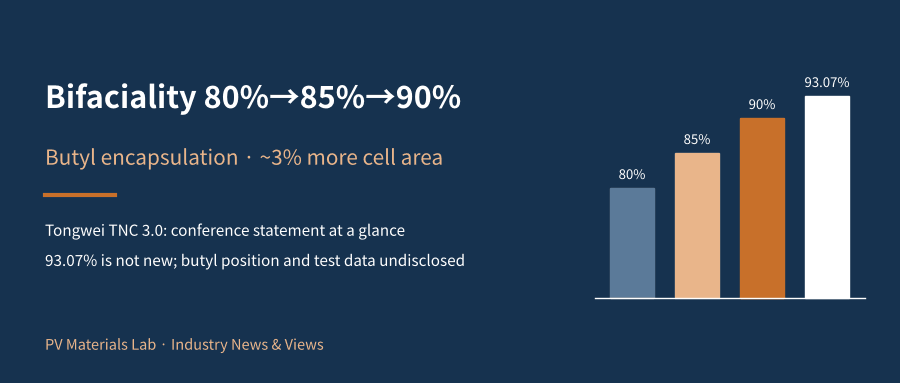
At TaiyangNews' online conference on 11 November, Tongwei presented TNC 3.0: selective rear-side polysilicon removal and a three-layer reflection structure lift bifaciality from the conventional ~80% to 85%, with 90% targeted for mass production. The company also introduced butyl rubber as an encapsulation material, claiming about 3% larger cell area. We sort out what was and was not said: 93.07% is a certified maximum already published mid-year, not a new record, and the position, type and insulation test data of the butyl were not disclosed.
On 11 November, at TaiyangNews' online conference on high-efficiency solar technologies, Tongwei shared two updates on its TNC 3.0 platform: bifaciality has moved from the conventional ~80% to 85%, with 90% targeted for mass production; and butyl rubber has been introduced as an encapsulation material, said to enable about 3% larger cell area. This short piece walks through what was said, what was not, and how we read it.
01 What was said
According to the TaiyangNews live blog, Tongwei's Ranson Tian presented TNC 3.0, the company's latest TOPCon platform. On the optical side, the approach is selective rear-side polysilicon removal and a three-layer reflection structure, combined with rear-side texturing. On the encapsulation side, butyl rubber was introduced. We put the numbers from the live blog, and the nature of each, into one table:
| Item | Conference statement | Our note |
|---|---|---|
| Bifaciality (conventional) | ~80% | Baseline given in the talk |
| Bifaciality (now) | 85% | Test standard and sample not disclosed |
| Bifaciality (MP target) | 90% | A target, not the current status |
| Bifaciality (certified max) | 93.07% | Published mid-year; not a new record |
| Encapsulation | Butyl rubber introduced | Position and type not disclosed |
| Cell area | ~3% larger | Company statement; baseline not disclosed |
Takeaway: There are two genuinely new pieces of information: bifaciality is now described in tiers (85% today, 90% targeted for mass production), and butyl rubber with a ~3% cell-area gain has entered the conference narrative of a mass-production platform.
02 Bifaciality: four numbers that should not be mixed
Bifaciality is the ratio of rear-side to front-side power of a module (or cell) under standard test conditions. The higher it is, the more electricity the same rear-side irradiance delivers. Four numbers appear in the live blog, and they do not carry the same weight:
- 80%: The 'conventional' level cited in the talk; the starting point of the comparison.
- 85%: The level Tongwei says it has reached, without stating whether it is a cell or module figure, and without a test standard or sample size.
- 90%: A mass-production target. It shows the direction, not the current line average.
- 93.07%: The certified maximum. Tongwei already released this number at Intersolar Europe mid-year; the press release then said it was certified by TÜV Rheinland, alongside power up to 770 W and efficiency up to 24.8%. The live blog does not name the certification body this time, so it should not be read as a new record from this conference.
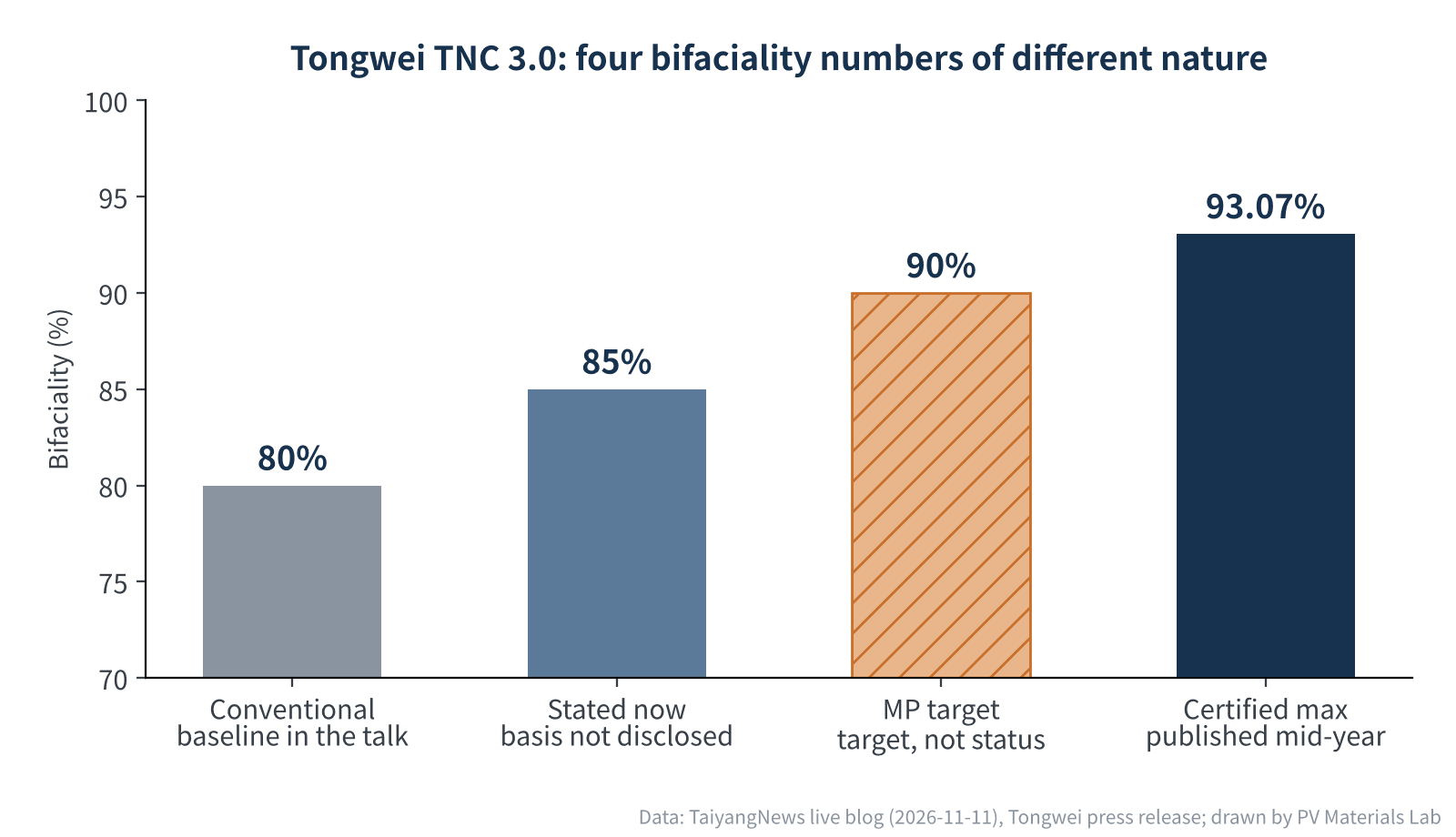
Fig. 1 Four bifaciality numbers for Tongwei TNC 3.0 and what each one is
The technical route is easy to follow. The doped polysilicon layer on the rear of a TOPCon cell absorbs light parasitically, and light entering from the rear has to pass through it first. Selectively removing the polysilicon in the non-metallised areas, and optimising the rear texture and film stack, lets more rear-side light reach the wafer. The live blog does not elaborate on the 'three-layer reflection structure'; read literally, it is an optical design of the rear film stack, and we will not over-interpret it.
How much energy are five points of bifaciality worth? We use the simplest possible estimate: rear-side gain ≈ bifaciality × rear irradiance ratio. If rear irradiance equals 10% of front irradiance, raising bifaciality from 80% to 85% adds roughly 0.5 percentage points of energy yield; reaching 90% adds about 1 point. The higher the ground albedo and the mounting height, the larger this number.
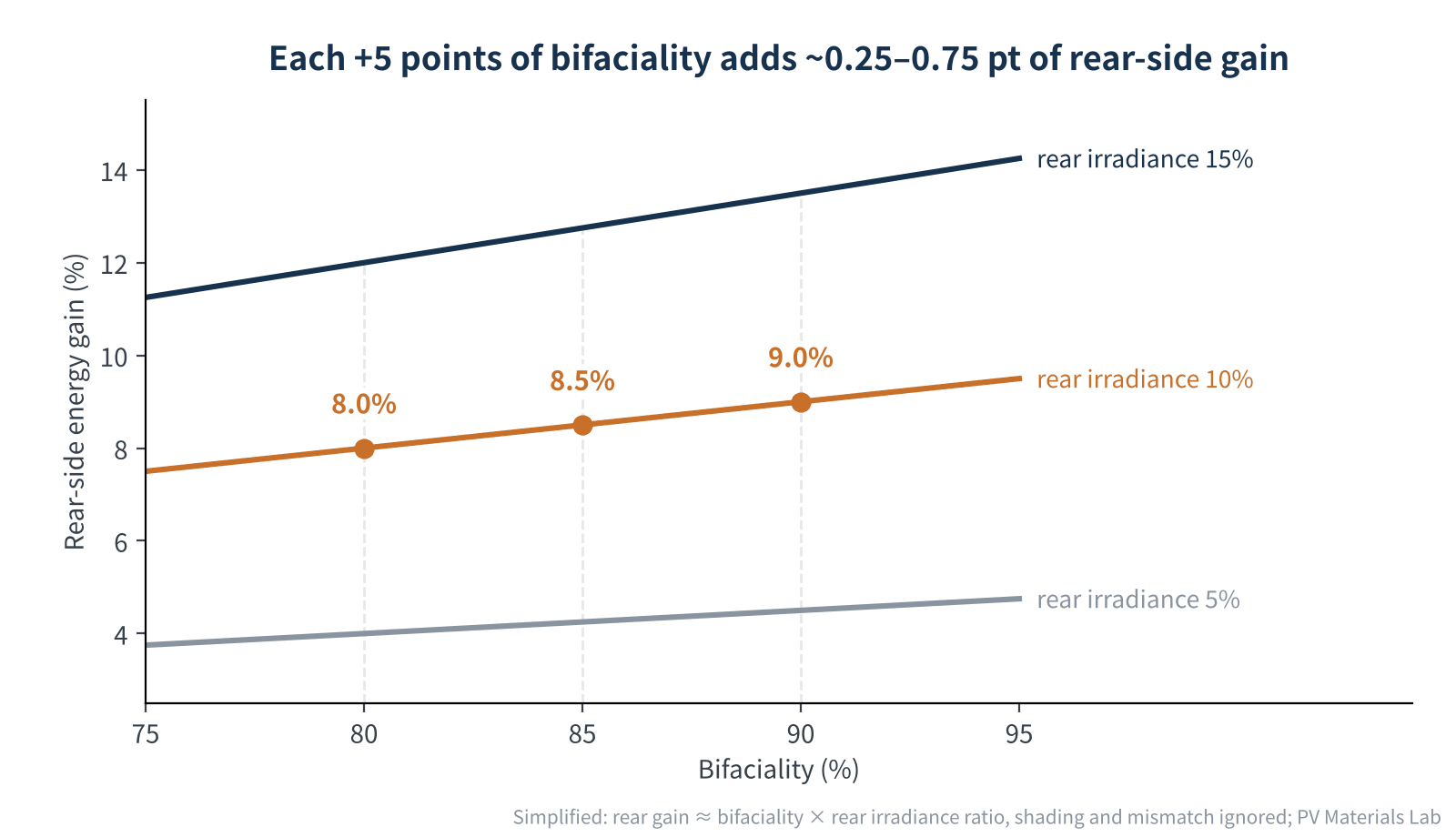
Fig. 2 Simplified relation between bifaciality and rear-side energy gain (our estimate)
03 Butyl rubber: where does ~3% of area come from?
Butyl rubber is no stranger to PV. Its water vapour transmission rate is far lower than that of common EVA and POE encapsulants, and its volume resistivity is high. It has long been used as an edge seal in thin-film modules and, in recent years, in moisture-sensitive glass-glass modules. But writing it into the narrative of a TOPCon mass-production platform, and linking it to '~3% larger cell area', deserves a closer look.
The live blog does not say where in the module the butyl is used. What follows is our inference: if it serves as an edge seal, the insulation distance from cells and busbars to the glass edge could be shortened. In the logic of IEC 61730, live parts need sufficient creepage distance to the module edge, while a verified, durable bonded interface (a 'cemented joint' in the standard) can be assessed under more favourable conditions. With a smaller edge margin, larger cells fit into the same glass size.
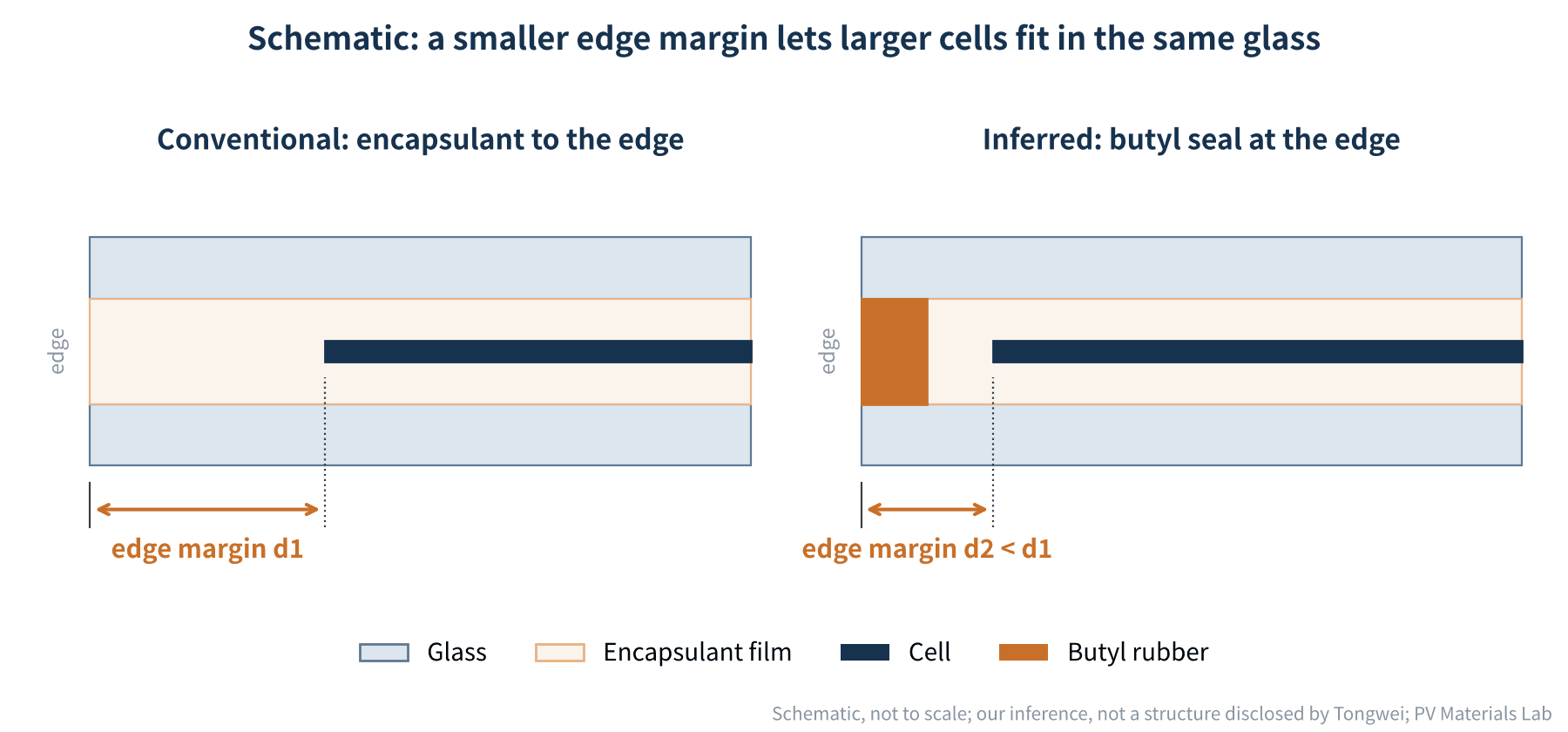
Fig. 3 Schematic of a butyl edge seal reducing the edge margin (our inference, not a structure disclosed by Tongwei)
A quick calculation. Working back from the 770 W and 24.8% in the mid-year press release, the module area is about 3.1 m², which matches a 2384×1303 mm format. If the entire 3% of cell area came from the four edge margins, each edge would have to shrink by about 12 mm. That is not small, so the question 'compared with which format and which edge design?' matters. With 3% more cell area in the same footprint, the power headroom is of the same order, provided the added area is as efficient as the rest.
04 Questions still open
The live blog only says butyl rubber 'maintains the required electrical insulation and reliability', with no data. Colleagues working on material introduction and certification will probably want to ask the same things we do:
- Position and type: Is the butyl a full perimeter seal, used locally, or something else? Is it hot-melt butyl, butyl tape, or another form?
- Insulation and reliability data: How does it perform after wet leakage, insulation, damp heat, humidity freeze, thermal cycling and PID tests? Was it evaluated as a cemented joint with peel, lap shear and creep tests?
- Bifaciality basis: Is 85% a cell or module figure, an average or a typical value, and measured to which standard?
- Process and cost: How the butyl is applied, how squeeze-out and bubbles are controlled in lamination, its compatibility with the encapsulant film, and whether the added material and process cost is covered by the power gain.
05 Our view
The value lies in a clear direction. As TOPCon efficiency gains get harder, looking for gains from both 'more active area in the same glass' and 'more power from the rear' is a pragmatic approach. In high-albedo sites such as desert projects in particular, every point of bifaciality maps to real energy yield.
The limits are equally clear. This is a conference statement, not a technical paper or a certification report: 85% has no test basis, 3% has no baseline, and the butyl has no structure or test data. Until that information is filled in, it is better treated as a direction worth tracking than as a conclusion to be quoted.
In the Chinese market context, butyl rubber means one more material, one more process step and one more set of incoming and in-process controls. Under today's cost pressure, whether it scales depends on the balance between gain per watt and added cost, and on the accumulation of long-term outdoor reliability data.
Bottom line: '85% today, 90% targeted' bifaciality and 'butyl rubber for ~3% more cell area' are two updates worth tracking; 93.07% is an older number, and the position and insulation test data of the butyl remain undisclosed.
06 Closing thoughts
Module technology has reached a stage where big structural innovations are rare and gains hide in details such as edges, gaps and film stacks. Butyl rubber entering the discussion for mainstream crystalline silicon modules is itself a signal: the role of encapsulation materials is extending from 'protecting the cells' to 'taking part in module layout design'. If Tongwei or third parties disclose more structural and test information, we will follow up.
Calculation notes / data basis
- Original not retrieved: the TaiyangNews live blog page could not be opened directly this time; the conference statements follow the verified excerpt of the live blog.
- Rear-side gain estimate: rear-side gain ≈ bifaciality × rear irradiance ratio. At a 10% ratio, bifaciality of 80%, 85% and 90% gives rear-side gains of 8.0%, 8.5% and 9.0%. Structure shading, rear irradiance non-uniformity and mismatch are ignored; the figures only indicate the order of magnitude.
- Module area: 770 W ÷ 24.8% ÷ 1000 W/m² ≈ 3.105 m², matching 2384×1303 mm (3.106 m²). This format is our inference, not disclosed at the conference.
- Edge margin estimate: assuming cell area is about 93% of module area (~2.89 m²), 3% more is ~0.087 m²; with a perimeter of ~7.37 m, 0.087 ÷ 7.37 ≈ 0.012 m, i.e. about 12 mm per edge. Part of the gain may also come from cell and string gaps; this was not disclosed.
- 'Butyl used as an edge seal that shortens the insulation distance' is our inference based on common industry practice and the logic of IEC 61730; Tongwei did not disclose where the butyl is used.
References
- TaiyangNews. Live Blog: High-Efficiency Solar Technologies 2026 (Online), entry 10:46 am, 11 Nov 2026. https://taiyangnews.info/technology/live-blog-nov-11-20-25-high-efficiency-solar-technologies-2026-online-2
- Tongwei. 93.07% Bifaciality Module! Tongwei Leads Intersolar Europe 2026 with Global Launch of TNC 3.0 BIFIMAX Module. PR Newswire, 2026-07-17. https://en.prnasia.com/releases/apac/93-07-bifaciality-module-tongwei-leads-intersolar-europe-2026-with-global-launch-of-tnc-3-0-bifimax-module-541064.shtml
- pv magazine. Tongwei claims record-breaking 93.07% bifaciality factor for 770 W solar module. 2026. https://www.pv-magazine-australia.com/?p=16779
- IEC 61730-1:2016 / IEC 61730-2:2016. Photovoltaic (PV) module safety qualification.
PV Materials Lab
https://pvmaterialslab.com
PV Materials Lab
A PV R&D and technical team with 10+ years of experience | In-depth technical knowledge sharing
Materials · Reliability · Failure Analysis · Standards & Certification · Products · Processes
Exploring AI + PV — collaboration welcome
Disclaimer:
- Original content reflects the authors' personal views only, is for reference, and does not constitute investment advice.
- Reposted and cited content is credited to its source, with respect for original work.
- Some content is AI-assisted (chart generation, data retrieval, concept explanations, etc.); the core framework and key content are written by our technical team and reviewed by humans.
- For any inaccuracy or infringement, please leave a message or contact us.