
Module Framing: Silicone or Tape?
PV Module Frame Series · 06
Once the frame is made, it has to be joined to the laminate through a layer of silicone or double-sided tape. In the sixth article of our frame series, we explain the three jobs framing must do (bonding, sealing and cushioning), compare the silicone and tape routes in process, cycle time, sealing and cost, describe how framing machines work and why pressure control matters, list common defects such as squeeze-out, missing adhesive and corner gaps, and discuss silicone curing and when modules can ship.
The first five articles were about the frame itself. But a frame only does its job once it is reliably joined to the laminate, and that depends on the layer of silicone or tape in the slot, only a millimeter or two thick. In this article we cover module framing: how to choose between silicone and tape, how a framing machine works, where common defects come from, and how long silicone must cure before modules can ship.
01 Three jobs framing must do
The material between frame and laminate looks like just “glue”, but it does three jobs at once:
- Bonding: holds the laminate firmly in the slot so it does not loosen or pull out under wind, snow or handling;
- Sealing: closes the laminate edge, blocking moisture from entering through the edge interfaces of glass, encapsulant and backsheet, which matters most for glass-backsheet modules;
- Cushioning: absorbs relative movement between frame and glass caused by thermal expansion and load deformation, so the glass edge never meets hard contact.
It must also make up for tolerances in laminate thickness and slot dimensions. The industry has two main routes today: liquid silicone and double-sided foam tape.
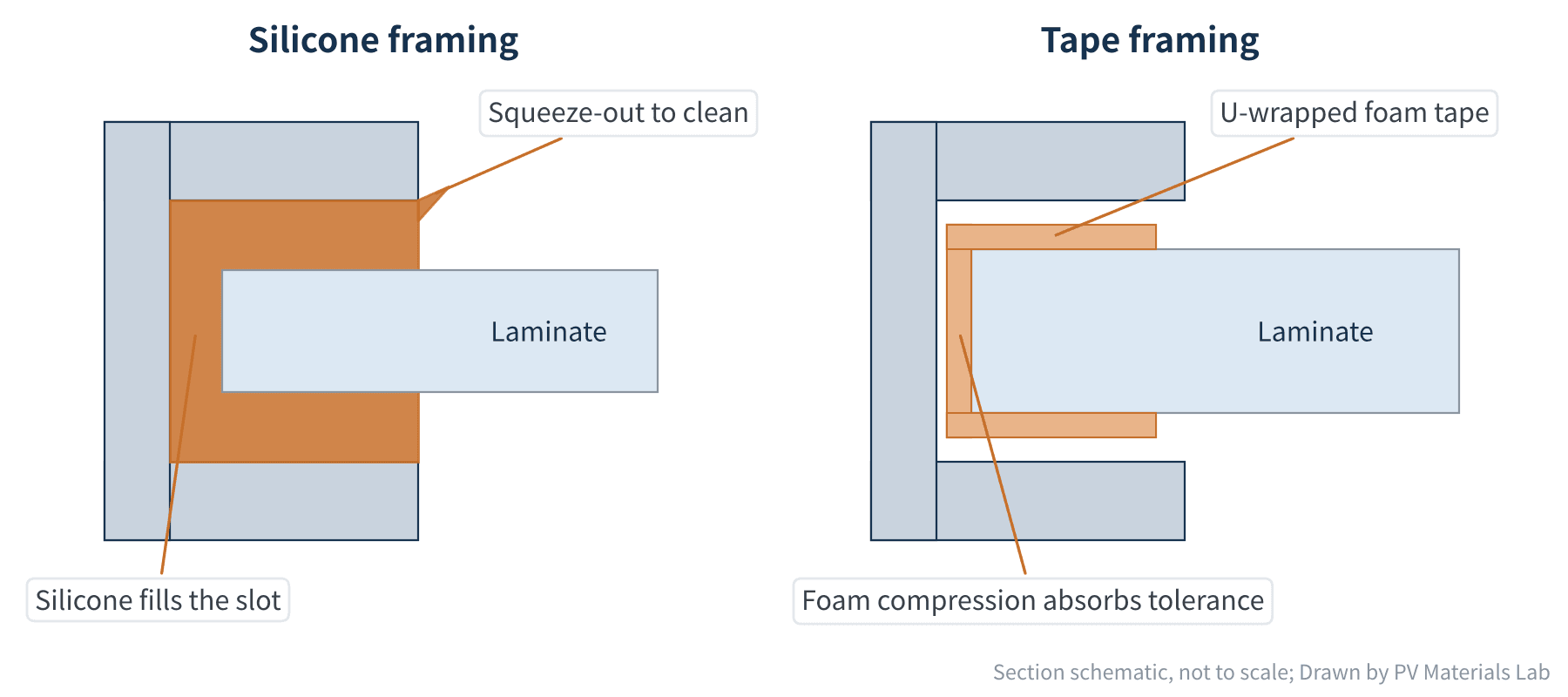
Figure 1 Cross-sections of silicone framing and tape framing
02 Silicone framing: the classic “wet” route
Silicone framing roughly works like this: a metered amount of silicone is dispensed into the frame slot, the laminate is inserted, the framing machine presses it into place while assembling the corners, the squeezed-out excess is cleaned off, and the module rests while the silicone cures.
PV framing usually uses neutral-cure silicone sealants, most commonly one-component alkoxy (alcohol-releasing) types. Acetoxy silicones are avoided because they release acetic acid while curing, which can corrode the frame and metal parts inside the module.
By number of components there are two types:
- One-component silicone: used straight from the container, it cures by absorbing moisture from the air, progressing from the surface inward. Equipment is simple, but the silicone in the slot has very little contact with air, so deep curing is slow and a long resting time is needed;
- Two-component silicone: parts A and B are mixed in ratio and cure throughout at once, so deep curing is fast, resting time shorter and turnover quicker. The price is mixing equipment, plus control of mix ratio and pot life to avoid poor mixing or premature curing in the hoses.
Silicone's strength is tolerance: it flows to fill gaps in the slot, copes well with variation in laminate thickness and slot dimensions, seals well, and has a long outdoor track record. Its weaknesses are in the process: dispensing volume must be controlled, squeeze-out cleaned up and curing waited for, and the shop is harder to keep clean.
03 Tape framing: the clean, fast “dry” route
In tape framing, double-sided foam tape is first wrapped around the laminate perimeter, usually in a U-shape over the edge. The taped laminate is then inserted into the frame and pressed by the framing machine. The industry already has a dedicated specification, SEMI PV61, for frame sealing tapes of PV modules.
Such tapes usually use polyethylene or acrylic foam as the carrier, coated on both sides with pressure-sensitive adhesive. The foam provides cushioning and gap filling, and the adhesive bonds to glass, backsheet and frame under pressure. Its biggest advantage is that no curing is needed: initial bond strength is there as soon as it is pressed, the module moves straight to the next step, there is no squeeze-out, and the shop stays cleaner.
But tape is stricter on upstream and downstream processes:
- Thickness match: foam compression is limited, so variation in laminate thickness and slot dimensions must stay within what the tape can absorb: too loose and it will not hold, too tight and it will not insert or the tape gets scraped;
- Application quality: pressure-sensitive bonding depends on application pressure and contact area; wrinkles, bubbles or lifting during wrapping weaken both bonding and sealing;
- Surface condition: cleanliness and residues on the laminate edge and slot walls affect adhesion;
- Corners: where the tape breaks or overlaps at the four corners is the weakest point of the seal.
04 How to choose between the two
The two routes compare as follows:
| Item | Silicone framing | Tape framing |
|---|---|---|
| Bonding | Chemical cure | Pressure-sensitive |
| Cure wait | Yes; longer for 1K, shorter for 2K | None |
| Cycle time | Limited by curing and cleaning | Fast; flows on after pressing |
| Tolerance | High; flows to fill gaps | Lower; relies on foam compression |
| Sealing | Good; continuous fill | Depends on application and corners |
| Shop cleanliness | Squeeze-out needs cleaning | Clean |
| Equipment & control | Dispensing; volume and cure control | Wrapping; incoming thickness control |
There is no absolute answer. Lines with consistent laminate thickness that want high throughput and a tidy shop will find tape more attractive; where tolerance, sealing margin and material cost matter more, silicone remains the safe choice. Whichever route is chosen, it must be validated through module-level mechanical load, damp-heat and thermal-cycling tests.
Takeaway: Silicone wins on forgiveness: it fills gaps and seals. Tape wins on being clean and fast, but needs tight dimensional control upstream and downstream. Choosing a route really means choosing which end you are more confident of controlling.
05 The framing machine: balancing pressure and accuracy
A framing machine basically positions the laminate and the four frame sides, pushes the frames in from the long-side and short-side directions so the laminate enters the slots, and crimps the corner keys at the four corners to join the sides into a rigid frame.
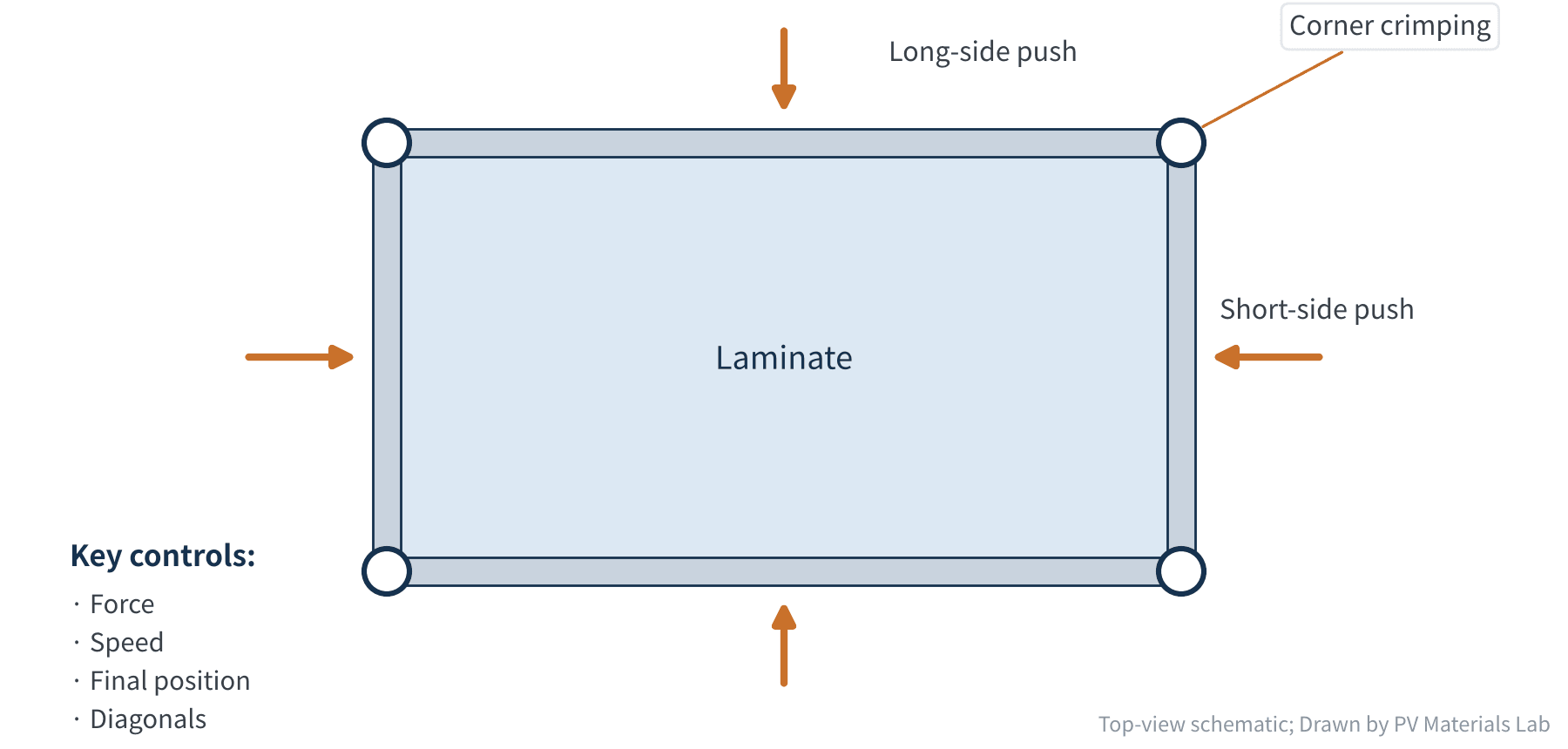
Figure 2 How a framing machine works
The key here is pressing force and final-position accuracy. Too little force and the laminate does not seat fully, the bond area is insufficient and corners tend to leave gaps; too much force overloads the glass edge, risking edge chipping or microcracks, and the laminate may shift in the slot. So a framing machine must control pressing force, pressing speed and final position together, with parameters adjusted to laminate thickness and frame type.
Common framing defects and their sources are as follows:
| Defect | Common causes | Potential impact |
|---|---|---|
| Squeeze-out | Too much silicone, pressing too fast | Poor appearance; residue affects later steps |
| Missing or broken bead | Too little or discontinuous silicone | Weaker bond, failed seal |
| Corner gaps | Length or miter errors, incomplete pressing | Water and salt traps, crevice corrosion |
| Misalignment, step | Positioning error, laminate size variation | Appearance and installation issues |
| Glass edge chipping | Excessive force, laminate offset | Microcracks, breakage risk |
| Tape lifting, wrinkles | Low wrapping pressure, contamination | Poor bonding and sealing |
06 Curing time and when to ship
Silicone framing has another easily underestimated issue: assembled does not mean bonded. One-component silicone cures from the surface, so it may look skinned over while still soft deep in the slot. If modules are stacked, packed and shipped at this point, the laminate may shift in the slot, or the not-yet-cured layer may be strained, leaving a hidden bonding defect.
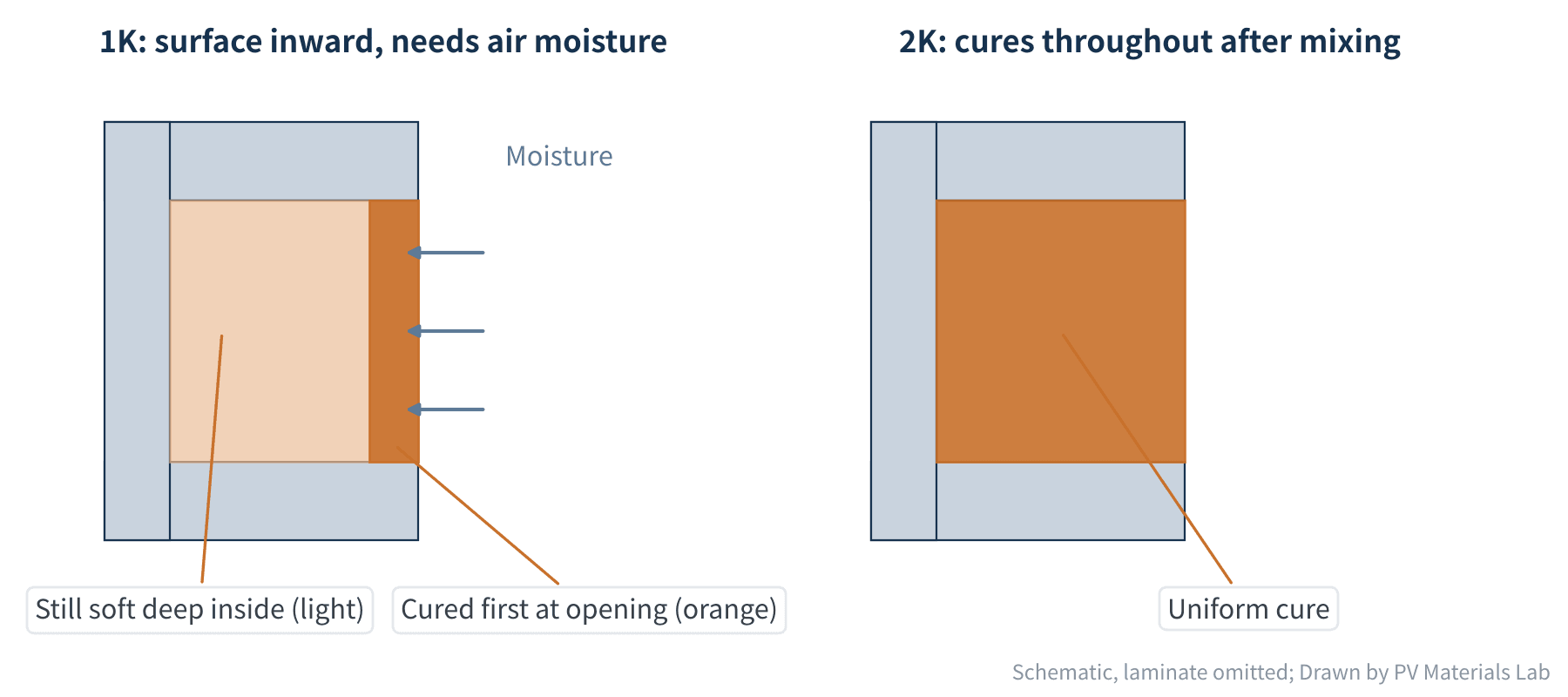
Figure 3 How one- and two-component silicones cure in the slot
So silicone-framed modules usually rest in the factory for a while before packing and shipping. Curing speed depends strongly on ambient temperature and humidity: one-component silicone cures more slowly when it is cold and dry, so factories in winter or in dry regions need extra care. The actual resting time should follow the silicone supplier's technical data and be verified with tests such as frame pull-off force.
Bottom line: A skinned surface does not mean a bonded joint. Adjust resting time to the season, temperature and humidity, and let test data decide rather than rushing to meet schedules.
07 Final thoughts
To wrap up this article:
- Three jobs: the framing material bonds, seals and cushions, and also makes up for dimensional tolerances;
- Silicone: forgiving and well sealing, but dispensing volume, squeeze-out and curing must be controlled;
- Tape: no curing, fast cycles and a clean shop, but stricter on thickness consistency and application quality;
- Framing machine: balance pressing force and position accuracy: too little leaves gaps, too much damages glass;
- Shipping time: silicone must cure fully, and resting time should follow temperature and humidity.
From material and design to manufacturing and framing, we have now covered how a frame comes into being. In the next article we turn to frame test methods and standards: what to check at profile level, how modules are tested, and how to validate a new frame when qualifying it. Stay tuned.
Calculation notes / data basis
- This article gives no specific values for silicone curing time or tape thickness: we could not obtain publicly citable supplier technical data, and products vary widely. Follow the technical data sheets of silicone and tape suppliers and confirm through your own validation tests.
- The comparison of the two routes is our qualitative summary of common industry practice and does not represent the performance of any specific product.
References
- SEMI PV61 光伏组件用封框胶带技术规范 / Specification for frame sealing tapes of PV modules. https://store-us.semi.org
- tesa. Solar Frame Bonding (tesa® FrameSelect). https://tesa.com/en-au/industry/renewable-energies/solar-industry/solar-frame-bonding
- IEC 61215-2:2021 Terrestrial photovoltaic (PV) modules – Design qualification and type approval – Part 2: Test procedures
- IEC 61730-2 Photovoltaic (PV) module safety qualification – Part 2: Requirements for testing
PV Materials Lab
https://pvmaterialslab.com
PV Materials Lab
A PV R&D and technical team with 10+ years of experience | In-depth technical knowledge sharing
Materials · Reliability · Failure Analysis · Standards & Certification · Products · Processes
Exploring AI + PV — collaboration welcome
Disclaimer:
- Original content reflects the authors' personal views only, is for reference, and does not constitute investment advice.
- Reposted and cited content is credited to its source, with respect for original work.
- Some content is AI-assisted (chart generation, data retrieval, concept explanations, etc.); the core framework and key content are written by our technical team and reviewed by humans.
- For any inaccuracy or infringement, please leave a message or contact us.