
Inverter Prices Up 5%–15%: It's the Chips Rising, Not Demand Heating Up
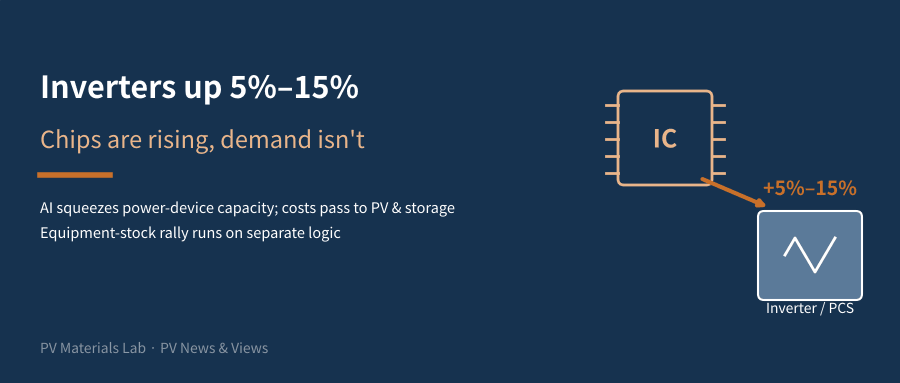
Since late October, Huawei Digital Power, Kehua Data and others have raised inverter and energy-storage prices by about 5%–15%, and Sungrow, Inovance and Growatt have also sent price-adjustment notices. In the same week, PV equipment stocks saw a wave of limit-up moves. We trace this round of price increases: the main driver is cost push, as AI demand squeezes the supply of chips and electronic components, not a surge in end-market orders. The equipment-stock rally and the inverter price hikes rest on different verification chains and should not be used to confirm each other. We close with an illustrative estimate of the system-level impact and suggestions for practitioners.
Over the past two weeks the PV industry has shown an awkward picture: module prices are still being fought over, yet inverter and storage makers have been sending out one notice after another — prices up 5%–15%. In the same week, PV equipment stocks posted a wave of limit-up moves. Many people's first reaction was "PV is recovering." Our view: not so fast — this is a cost signal, not a demand signal.
01 What happened: a concentrated round of price increases
According to a 10jqka review published on 8 November, this round involves several leading companies and covers residential, C&I and utility-scale applications:
- Huawei Digital Power: Residential PV+storage, C&I PV+storage, and utility inverter products and solutions, with increases set at 5%–15%.
- Kehua Data (Kehua Digital Energy): Prices across the full product range raised by 5%–15% from 1 November 2026.
- Sungrow, Inovance, Growatt and others: Had already issued price-adjustment notices earlier (public reports gave no uniform range).
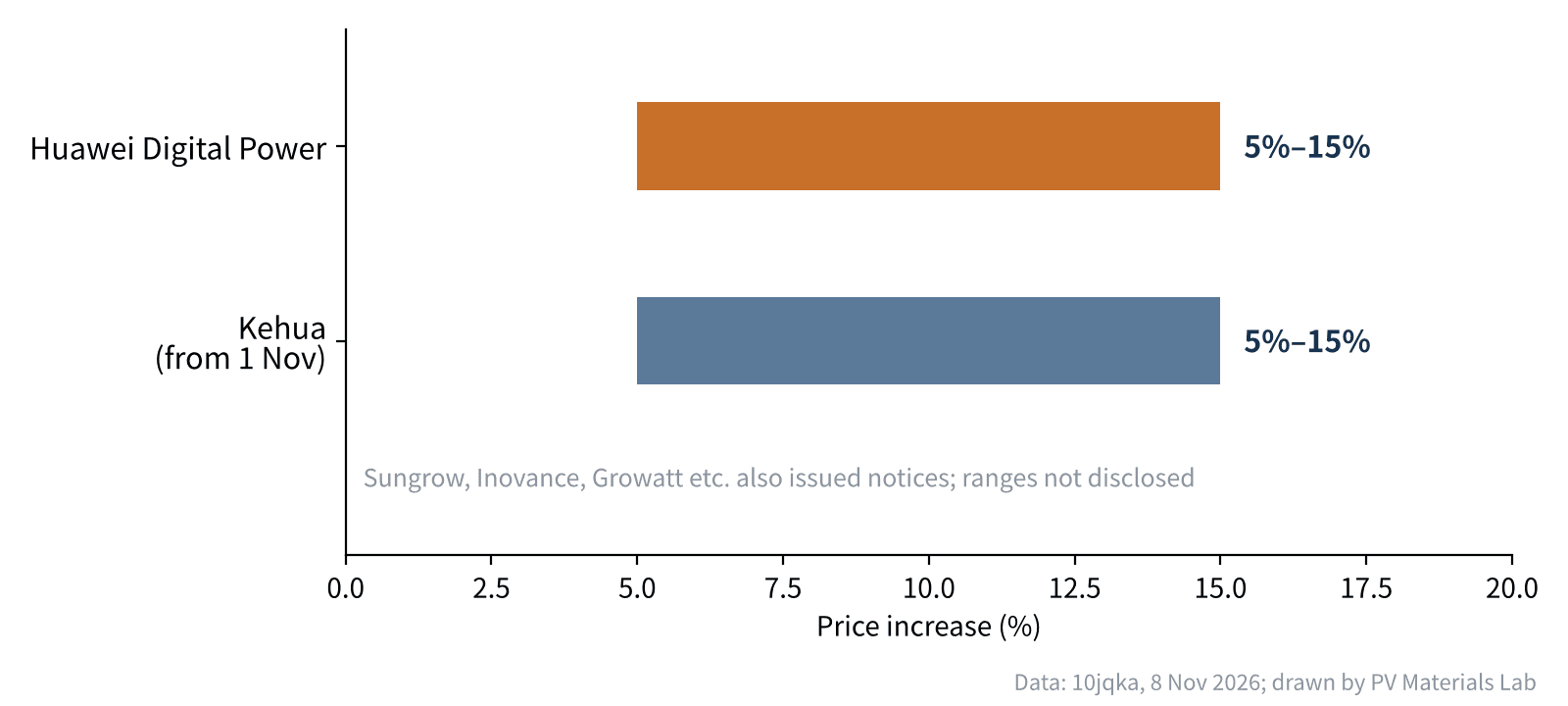
Fig. 1 Disclosed price increases for inverter/storage products in this round
Note that these are the ranges stated in the notices. Actual transaction prices depend on existing contract terms, customer bargaining power and project size, and may differ from the notices.
02 Why prices are rising: AI is competing with PV for chips
The report cites industry experts saying that the collective price rise in inverters, storage power conversion systems (PCS — the equipment that converts between AC and DC in a storage system) and EV chargers is driven mainly by higher costs for related chips and electronic components: rapidly expanding AI demand has tightened supply of these parts and pushed their prices up.
This did not come out of nowhere. Back in February 2026, power-semiconductor leader Infineon told customers that the rapid build-out of AI data centers had made some power switches and related ICs scarce, and that, together with higher raw-material and infrastructure costs, prices on certain products would rise from 1 April 2026. AI server power supplies, data-center power distribution and PV inverters use the same family of power devices; when AI claims the capacity first, the PV and storage industry has to accept higher prices.
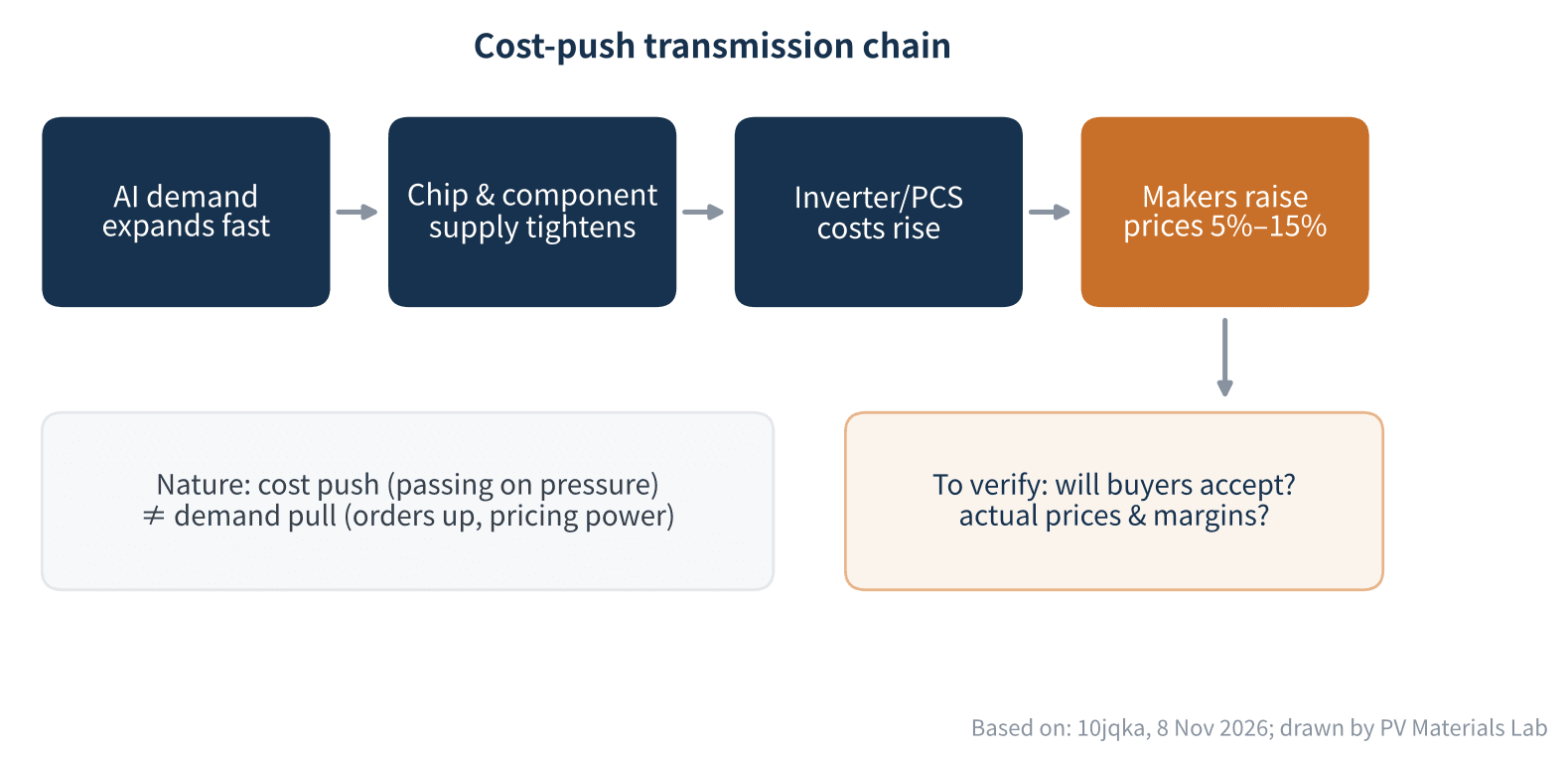
Fig. 2 How a cost-push price increase is transmitted
For anyone who has worked on an inverter BOM (bill of materials), the chain is easy to follow: power devices (IGBTs, SiC MOSFETs, etc.), control chips, capacitors and magnetics are the most "electronic" part of an inverter's cost. When upstream supply tightens and the manufacturer cannot absorb it, the cost is passed downstream.
Takeaway: This is a classic cost-push price increase: manufacturers are passively passing on upstream pressure, not exercising pricing power because they are flooded with orders.
03 The same-week limit-ups are a different story
On 5 November, 21 constituent stocks of the PV equipment sector hit limit-up or rose at least 10%. Put next to the inverter price hikes, it is easy to conclude that "PV is recovering across the board." But the two are driven by completely different logic.
| Inverter/storage price hikes | PV equipment stock rally | |
|---|---|---|
| Nature | Product price change | Share price change |
| Main driver | Rising chip/component costs | Overseas policy expectations; rebound after oversold |
| Source of demand | Utility, C&I and residential end users | Expansion/upgrades at wafer, cell and module makers |
| What to watch | Actual transaction prices, gross margin | Order announcements, contract liabilities, downstream capex |
PV equipment makers sell crystal pullers, wire saws, coating tools and the like to manufacturers. Their orders depend on whether downstream makers are willing and able to expand or upgrade, and bear no direct relation to what inverters sell for. Using one to "confirm" the other mixes up two separate lines of logic.
Industry views are cautious as well. The report notes that some experts see the rally mainly as a rebound after an oversold period, and a company executive said a single quarter's results are not enough to show that the industry has turned the corner.
04 How big is the system-level impact? An illustrative estimate
The effect of an inverter price increase on total plant investment depends on the inverter's share of system cost, which varies widely by application (central vs string, residential, with or without storage). We show a parametric illustration only, not any specific project:
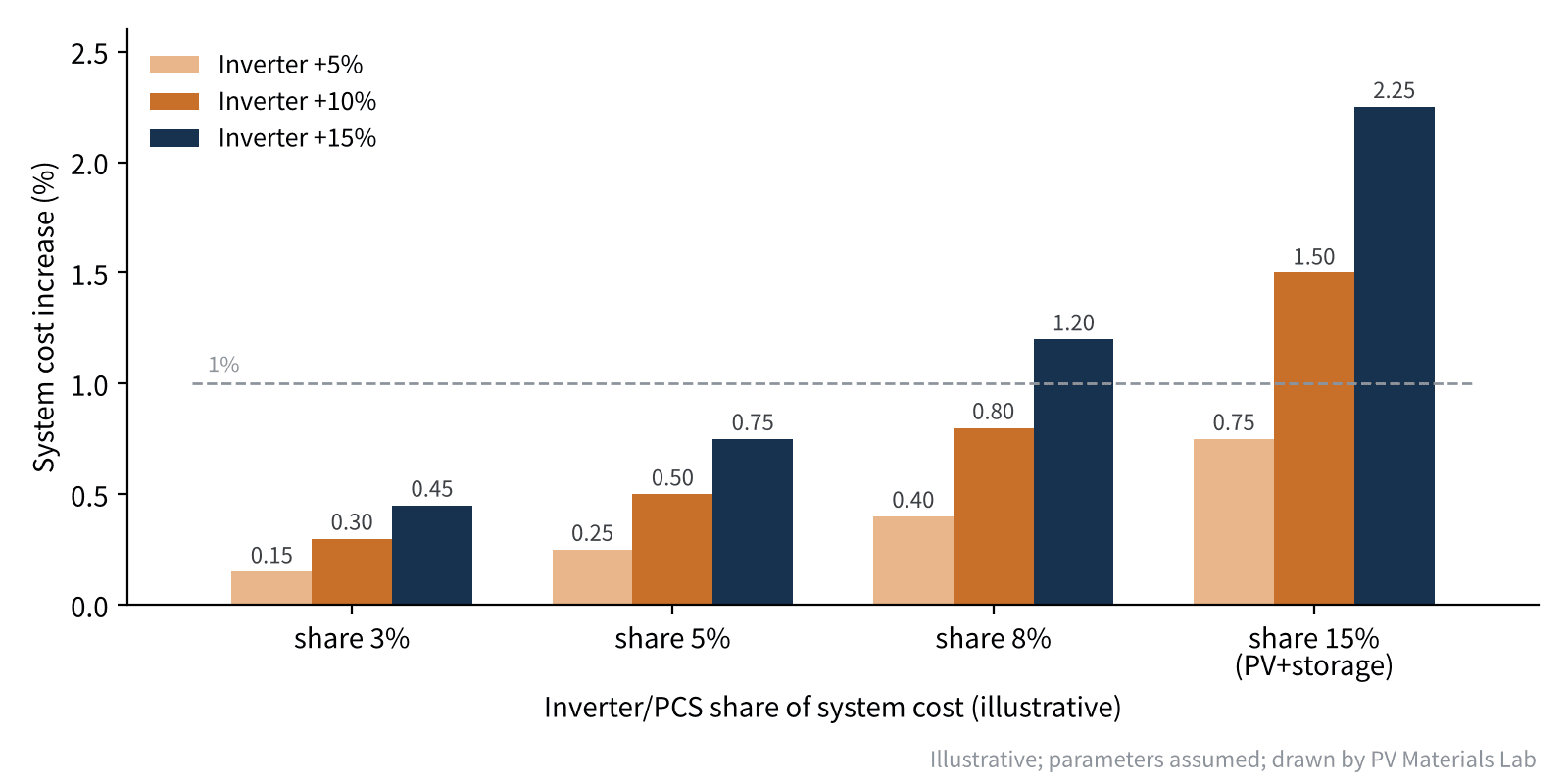
Fig. 3 Impact of inverter price increases on total system cost (illustrative)
For ground-mounted plants, even a 15% inverter increase usually adds less than 1% to system cost if the inverter's share is in the mid single digits. For PV+storage projects with a large storage share, however, PCS and battery-management electronics weigh more, and the impact is amplified. Residential and C&I markets are also more price-transparent and more competitive, so whether end customers accept the increase is harder to say than for large plants.
Bottom line: For most ground-mounted plants this round is a drizzle; the projects that need careful arithmetic are integrated PV+storage and small-to-mid distributed systems.
05 What it means for practitioners
- Project developers and procurement: Check price-adjustment clauses and delivery terms in contracts — whether locked prices in signed contracts hold, and whether new bids leave enough margin.
- Inverter/PCS R&D: During component shortages, multi-sourcing qualification, adopting domestic devices and sensible derating become more valuable — but any device change needs proper reliability validation, not just a price check.
- Module and materials companies: This round has no direct link to the module segment and should not be taken as evidence of a chain-wide price recovery.
- Market watchers: Watch orders and contract liabilities for equipment makers, and actual transaction prices and gross margins for inverters — each has its own indicators.
06 Our view
The signal from this round is real: PV's cost structure is increasingly exposed to the semiconductor cycle. When we talked about cost reduction in the past, we mostly focused on PV's "own" materials such as polysilicon, silver paste and glass. In power electronics, however, the PV and storage industry shares the same device capacity with AI data centers and electric vehicles. As long as AI computing build-out stays intense, this "capacity squeeze" pressure may keep coming back.
Its limits are just as clear: a price notice is not a transaction price, and cost push is not a recovery in demand. Until actual transaction data and company results give an answer, we prefer to classify this round as a cost pass-through event, not an industry turning point.
07 Final thoughts
On the same industry chain, one end is fighting over price cuts while the other is raising prices — which shows that PV's ups and downs are no longer set by its own supply and demand alone. For technical practitioners, understanding who is behind each price signal matters more than chasing the market of the moment. We will keep tracking actual transaction prices after the adjustments and share updates as they come.
Calculation notes / data basis
- Fig. 3 is a parametric illustration: system cost increase ≈ inverter (or PCS) share of system cost × inverter price increase. The shares of 3%, 5%, 8% and 15% are illustrative parameters we chose, not figures from the report or any specific project; use the project BOM for actual shares.
- Example: with a 5% inverter share and a 10% price increase, system cost rises by about 0.5%; with a 15% share (e.g., a PV+storage project with a high share of storage electronics) and a 15% increase, it rises by about 2.25%.
- Price-increase ranges are as stated in manufacturer notices reported by the media; specific ranges for Sungrow, Inovance and Growatt were not disclosed and are not plotted in Fig. 1.
References
- 10jqka iNews. Inverter & storage prices up 5%–15% while PV equipment stocks hit limit-up: why the PV sector ran hot and cold on the same day (in Chinese). 2026-11-08. https://news.10jqka.com.cn/20261108/c681580020.shtml
- TrendForce News. Infineon to Lift Prices Starting April 2026 Amid AI-Driven Power IC Tightness. 2026-02-05. https://www.trendforce.com/news/2026/02/05/news-infineon-to-lift-prices-starting-april-2026-amid-ai-driven-power-ic-tightness/
PV Materials Lab
https://pvmaterialslab.com
PV Materials Lab
A PV R&D and technical team with 10+ years of experience | In-depth technical knowledge sharing
Materials · Reliability · Failure Analysis · Standards & Certification · Products · Processes
Exploring AI + PV — collaboration welcome
Disclaimer:
- Original content reflects the authors' personal views only, is for reference, and does not constitute investment advice.
- Reposted and cited content is credited to its source, with respect for original work.
- Some content is AI-assisted (chart generation, data retrieval, concept explanations, etc.); the core framework and key content are written by our technical team and reviewed by humans.
- For any inaccuracy or infringement, please leave a message or contact us.