
The Ceiling Set by a Grain of Sand: Raw Materials for PV Glass
In brief
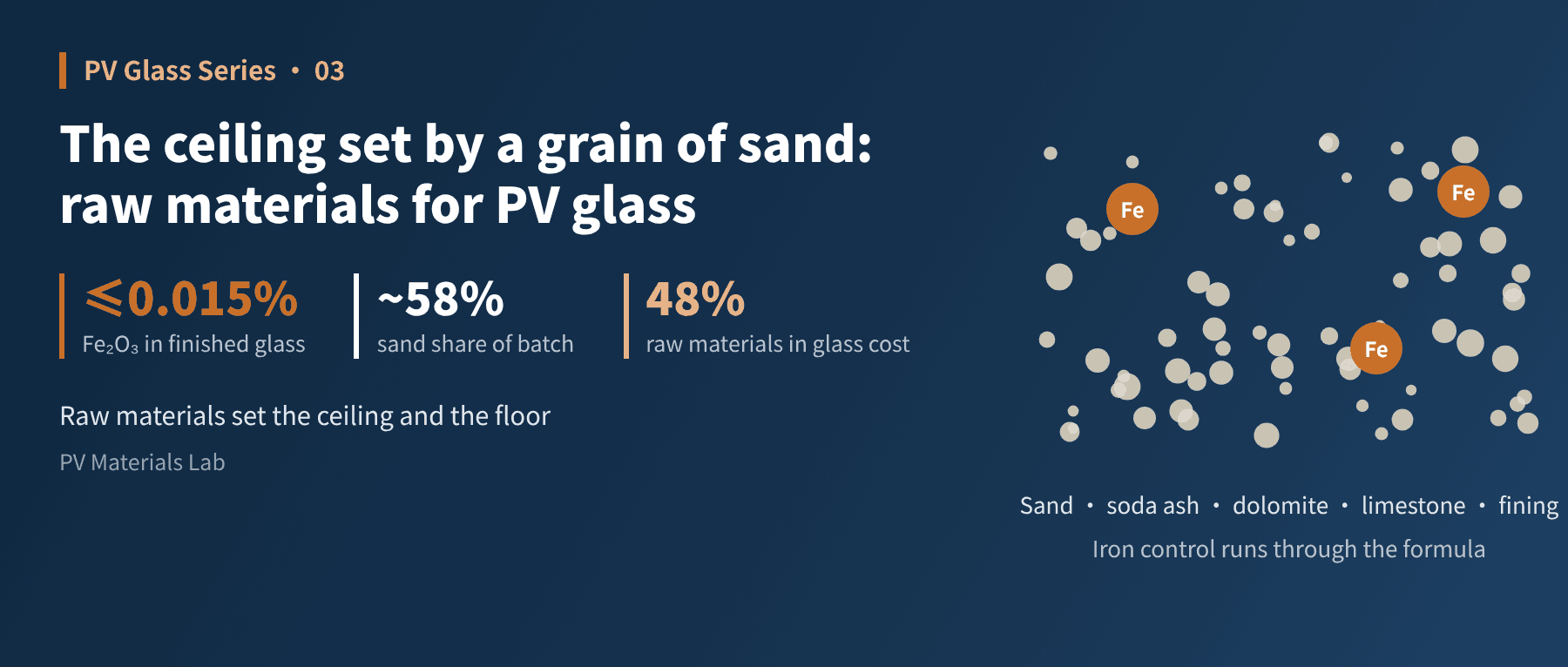
The recipe for PV glass is not complicated: quartz sand, soda ash, dolomite and limestone, plus a small amount of fining agent. But every one of these raw materials must be guarded strictly against iron, because iron content directly sets the ceiling for transmittance. This article breaks down the PV glass batch: what each raw material does, where iron comes from and how it is "kept in check", why antimony-based fining agents are both indispensable and controversial, and how much raw materials weigh in cost.
The previous two articles covered what PV glass does and how it is classified. From this article on, we move upstream along the production chain, starting with raw materials. The raw material list for PV glass is surprisingly short: little more than sand, soda and stone. Yet these most ordinary of materials set the upper limit of a sheet's transmittance and the lower limit of its cost.
01What a sheet of PV glass is made of
PV glass is a soda-lime-silica glass, part of the same family as window glass. About 70% of the finished glass is silica, and most of the rest is sodium oxide, calcium oxide and magnesium oxide. On the batch side, that means the main raw materials quartz sand, soda ash, dolomite and limestone, plus small amounts of salt cake and fining agent.
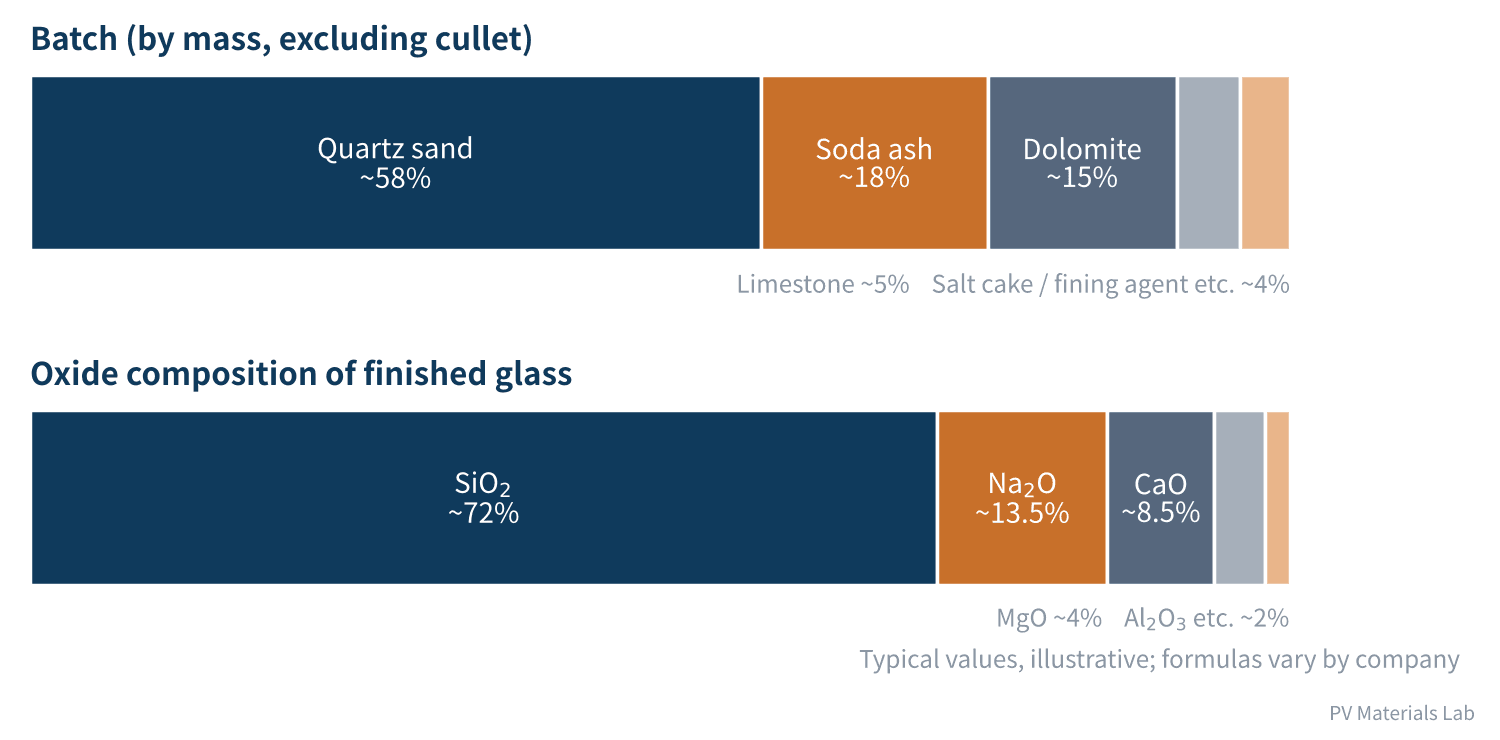
Figure 1. Typical batch and oxide composition of PV glass (illustrative)
| Raw material | Component introduced | Main function | Key control points |
|---|---|---|---|
| Quartz sand | SiO₂ | Forms the glass network | Iron content, particle size, impurity minerals |
| Soda ash | Na₂O | Flux; lowers melting temperature | Price volatility, impurities |
| Dolomite | CaO, MgO | Stabiliser; improves chemical durability | Iron content |
| Limestone | CaO | Stabiliser; adjusts working properties | Iron content |
| Salt cake (sodium sulphate) | Na₂O, SO₃ | Aids fining; removes surface scum | Dosage control |
| Fining agent | Mainly sodium pyroantimonate | Removes bubbles; also helps transmittance | Environmental concerns and substitution |
Table 1. Main raw materials for PV glass and their roles
In addition, offcuts and rejects from the production line are crushed into cullet and returned to the furnace. Cullet melts faster and saves energy, an "invisible raw material" used on every line.
02Quartz sand: the ingredient that sets the ceiling
Quartz sand makes up more than half the batch, and the "ultra-clear" quality of PV glass depends mainly on it. As we noted in article 01, front glass for modules must contain no more than 0.015% Fe₂O₃. For the sand itself, the industry usually requires Fe₂O₃ of around 0.010% or even lower, because the other raw materials, refractories and equipment wear add some extra iron.
Few natural sand sources meet this requirement. Low-iron quartz sand usually goes through a full purification process: crushing and classification, magnetic separation to remove iron-bearing minerals, flotation to separate impurities such as feldspar and mica, and, where needed, acid leaching to "wash off" iron on the grain surfaces. Research has shown that quartz from kaolin tailings, after magnetic separation, flotation and acid leaching, can reach Fe₂O₃ below 0.01%, meeting PV glass requirements.
This explains why leading PV glass makers place so much weight on sand resources: whoever has a stable source of low-iron sand has the edge on both transmittance and cost. As PV glass output grew rapidly, supply of low-iron quartz sand at one point became quite tight.
Quartz sand makes up more than half the batch and is also the main source of iron. The "ultra-clear" quality of PV glass starts at the sand mine.
03Where iron comes from, and how to keep it in check
Why is PV glass so sensitive to iron? The key is that iron exists in glass in two oxidation states, and they "eat" completely different parts of the spectrum:
- Fe²⁺ (ferrous): has a very broad absorption band in the near infrared, centred around 1000 nm, right on the peak of crystalline silicon cells' spectral response. It does the most damage to energy yield and is mainly responsible for glass looking green.
- Fe³⁺ (ferric): absorbs mainly in the near ultraviolet and has a much smaller effect on crystalline silicon cells.
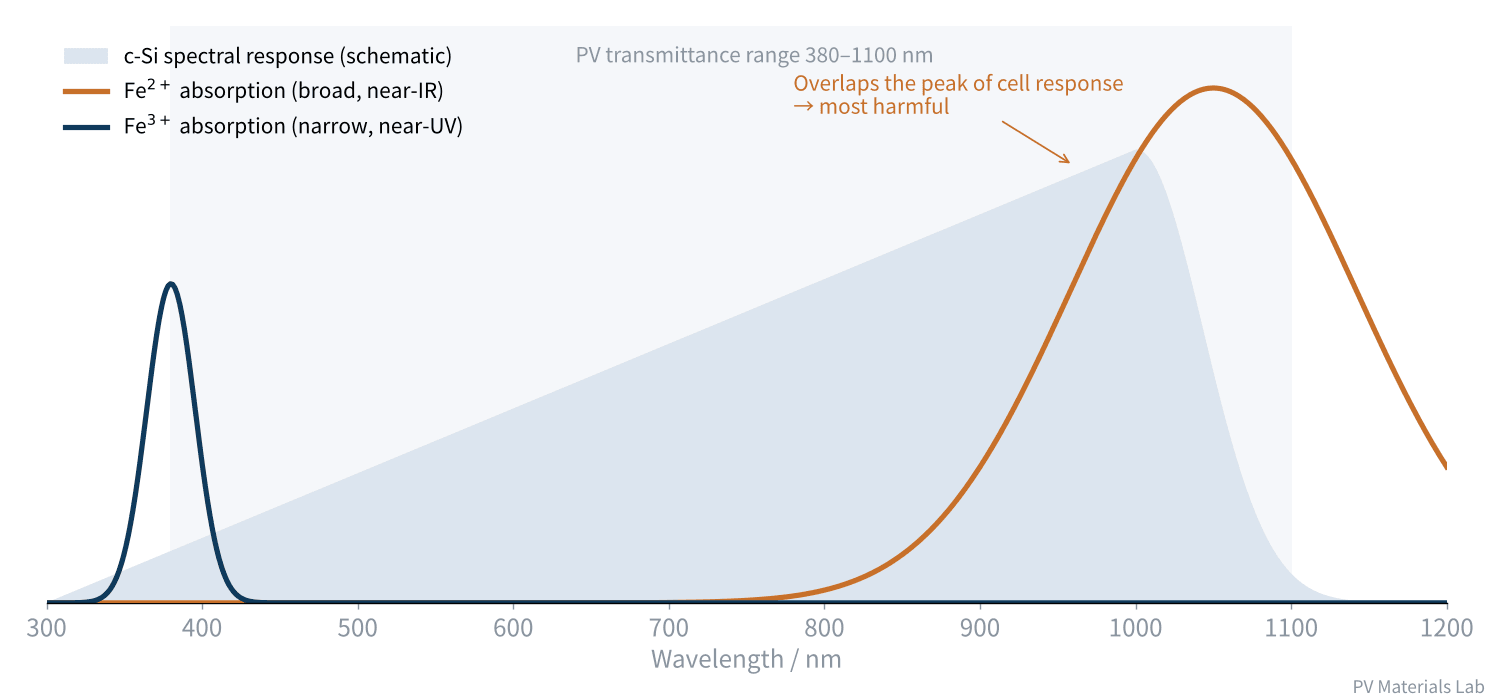
Figure 2. Absorption by the two iron oxidation states versus c-Si spectral response (schematic)
So there are two ways to "keep iron in check". The first is let less in: not only the sand but also dolomite, limestone and soda ash have iron limits, and batching and conveying must prevent iron filings from equipment wear. The second is turn it into the better iron: by controlling the furnace atmosphere and adding oxidising materials, more of the iron is kept as Fe³⁺, pushing down the share of the most harmful Fe²⁺. The fining agent discussed below also helps here.
04Soda ash, dolomite and limestone: fluxing and stabilising
Pure quartz melts above 1700 °C, which would waste energy and be hard to handle. Soda ash acts as a flux: the sodium oxide it introduces breaks up the silicon–oxygen network, so the batch melts fully at around 1500 °C.
But glass made with alkali alone would dissolve in water and have poor chemical durability. Dolomite and limestone therefore add calcium oxide and magnesium oxide as stabilisers, making the glass both easy to melt and resistant to water and weathering. The ratio of these raw materials determines the melt's viscosity, forming temperature and tendency to crystallise, and is a core process parameter for every company.
On cost, soda ash is the most important raw material after sand, and its price is volatile. A round of soda ash price rises often feeds straight into the cost line of PV glass.
05Fining agents: the smallest dose, but indispensable
Raw materials decompose at high temperature, releasing large amounts of carbon dioxide and other gases. If these bubbles stay in the glass, the product will have bubble defects that affect appearance, light transmission and strength. The fining agent's job is to "drive out" these bubbles.
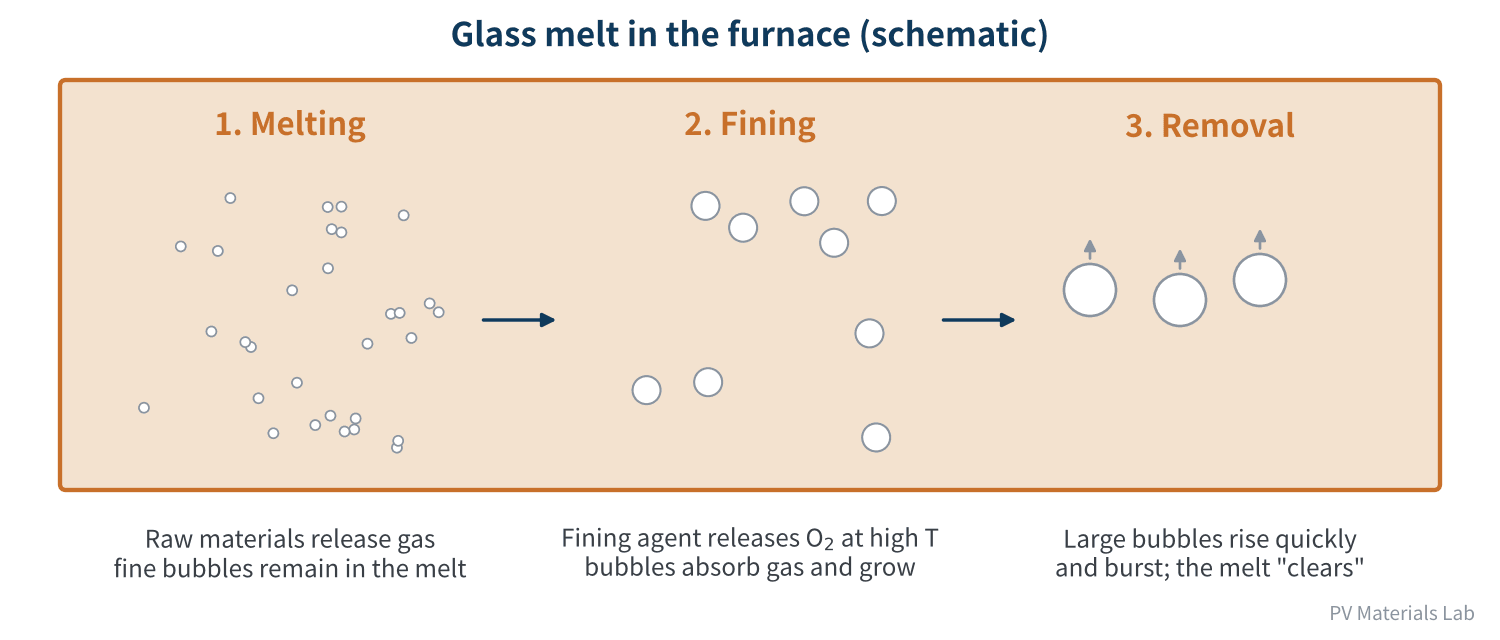
Figure 3. How a fining agent removes bubbles (schematic)
The principle is simple: at high temperature the fining agent decomposes and releases oxygen; small bubbles absorb the gas and grow, gaining buoyancy, so they rise quickly, burst and escape. Ultra-clear rolled PV glass currently mainly uses compound fining agents based on sodium pyroantimonate, added at about 0.2–0.4% by mass according to brokerage research assumptions. Antimony also brings a side benefit in glass: during cooling it oxidises part of the Fe²⁺ to Fe³⁺, helping to raise transmittance.
The problem is that antimony carries environmental risk and is also a strategic metal in tight supply. PV glass is produced in huge volumes, so its demand for antimony has grown rapidly, and once modules are retired, recycling and disposal of antimony-containing glass is an unavoidable issue. The antimony supply picture has changed sharply over the past two years: China imposed export controls on some antimony products from 15 September 2024, and according to Fastmarkets, international antimony prices hit a record USD 59,750 per tonne in early July 2025 before easing. Other countries began studying rules for the use and disposal of antimony-containing PV glass years ago, and Chinese companies are exploring low-antimony and antimony-free fining formulas. However, according to a Fastmarkets industry analysis in early 2026, sodium pyroantimonate still has no mature, cost-effective substitute. How to cut antimony without sacrificing fining performance or transmittance remains a problem for the industry to solve.
The fining agent is the smallest ingredient in the formula, yet it governs both bubbles and transmittance; the environmental and supply pressures of antimony are pushing the industry to look for alternatives.
06Raw materials and cost: half the money goes on "sand and soda"
Putting raw materials back into the cost structure makes their weight clearer. According to public industry information, raw materials account for about 48% of PV glass cost and fuel and power for about 38%, together close to 90%.
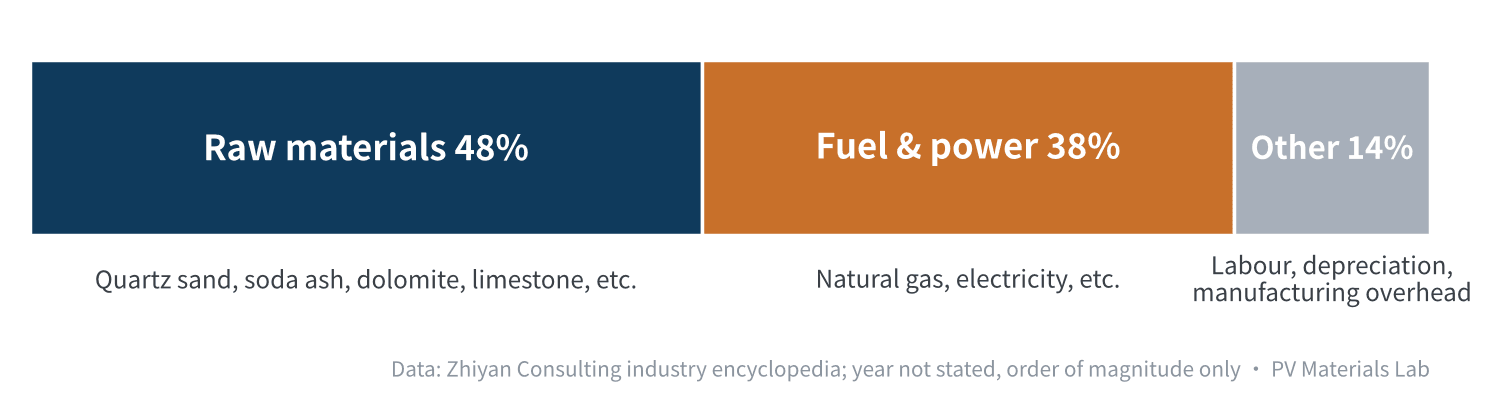
Figure 4. Cost structure of PV glass
Within raw materials, quartz sand and soda ash are the largest items; within fuel and power, natural gas and electricity. This means a PV glass maker's cost competitiveness depends largely on three things: sand resources, soda ash purchasing and energy prices. That is also why leading companies often integrate upstream into sand mines and locate capacity in regions with cheaper energy.
07Final thoughts
The PV glass recipe is short, but every line matters: quartz sand sets the starting point for iron content, soda ash and the calcium and magnesium raw materials decide how easily the glass melts and how stable it is, and the fining agent decides whether bubbles remain, while also helping to adjust the oxidation state of iron.
Seen this way, competition in the PV glass industry starts the moment raw materials enter the plant.
Raw materials set the ceiling for PV glass transmittance and the floor for its cost, and "iron control" runs through the entire formula.
In the next article we step into the furnace: from batch to a raw sheet, which steps are involved — melting, fining, rolling and annealing? And what do daily melting capacity, yield and cold repair mean? Stay tuned. We would be glad to hear from you.
References
- China Photovoltaic Industry Association: T/CPIA 0028.1—2024 Glass for photovoltaic modules — Part 1: Front plate anti-reflective coated glass, 2024
- Study on purification of quartz from kaolin tailings to produce low-iron quartz sand, Multipurpose Utilization of Mineral Resources, 2023(6), DOI: 10.3969/j.issn.1000-6532.2023.06.002
- Zhiyan Consulting: PV glass industry encyclopedia: value chain and cost structure, 2024-03
- Jiemian News: Report on PV glass driving demand for sodium pyroantimonate, 2024-01-23, https://www.jiemian.com/article/10716474.html
- Mercom India: MNRE to frame rules on antimony-containing solar glass, 2019-03-05
- Fastmarkets: Antimony 2026: Ample supply, strategic demand to guide geopolitical oversight, 2026-01-07, https://www.fastmarkets.com/insights/antimony-2026-ample-supply-strategic-demand-to-guide-geopolitical-oversight/
- ThePrint: Explainer: What is antimony and why is China curbing its exports, 2024-08-16, https://theprint.in/tech/explainer-what-is-antimony-and-why-is-china-curbing-its-exports/2226090
https://pvmaterialslab.com
A PV R&D and technical team with 10+ years of experience | In-depth technical knowledge sharing
Materials · Reliability · Failure Analysis · Standards & Certification · Products · Processes
Exploring AI + PV — collaboration welcome
Disclaimer:
1. Original content reflects the authors' personal views only, is for reference, and does not constitute investment advice.
2. Reposted and cited content is credited to its source, with respect for original work.
3. Some content is AI-assisted (chart generation, data retrieval, concept explanations, etc.); the core framework and key content are written by our technical team and reviewed by humans.
4. For any inaccuracy or infringement, please leave a message or contact us.